
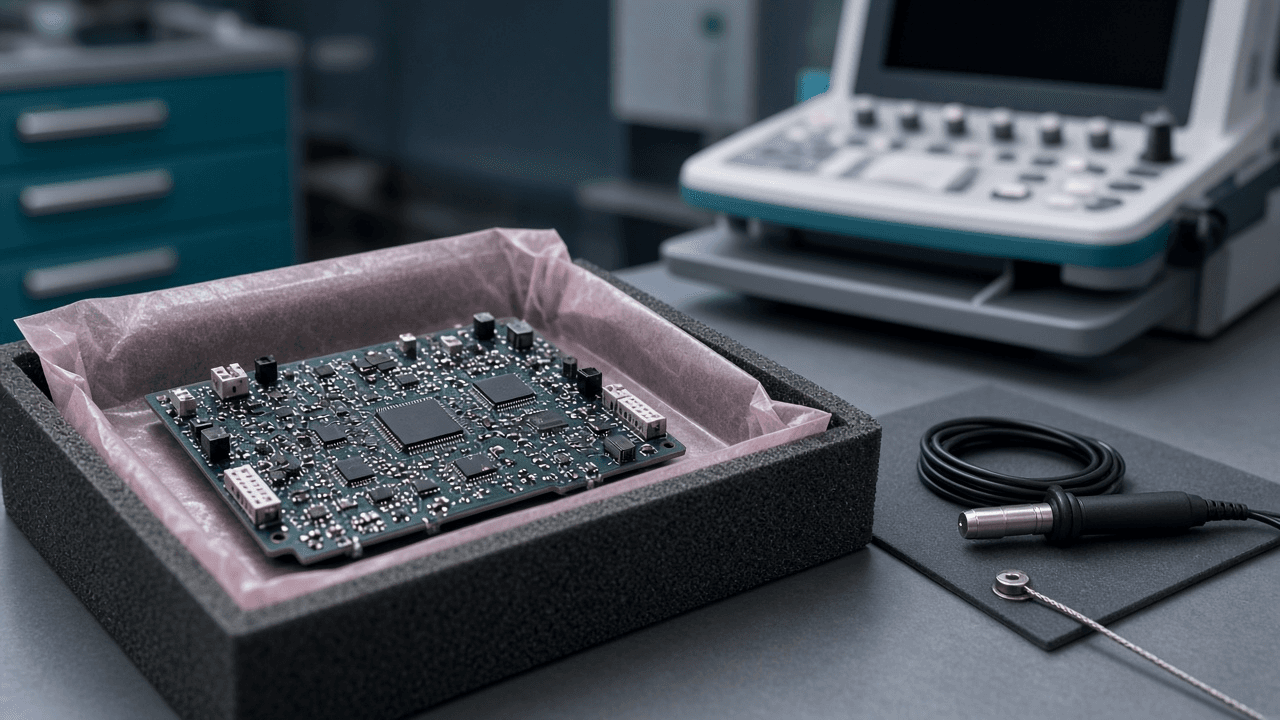
1. Define the fault and affected host before shipping
In a hypothetical case, Meridian Clinical Engineering is servicing a six-year-old ultrasound console used for outpatient imaging. The operator reports recurring sector dropout and reboots following longer periods of scanning. Clinical staff isolate the unit under their facility procedure. A qualified engineer retains settings, relevant authorized logs, hardware and software identifiers, and observed circumstances for follow-up. The engineer considers two suspect assemblies: a front-end board and a compatible abdominal transducer. These symptoms leave unresolved whether the board, host, probe, connections or measured operating conditions are responsible. A qualified diagnostic plan should distinguish the two before shipping parts unless the depot has agreed to evaluate the complete pair.
The depot may fail to reproduce an intermittent symptom under routine bench conditions. It may also be unable to verify what happens in the customer's host configuration. A replacement board or a different software or firmware revision can change the evidence needed. The local site still needs a distinct installation and release decision. Use a written test plan and scope negotiated with the depot to make uncertainty visible. In this example, timing, approved mode and probe/port combination affect the proposed non-clinical reproduction plan. A field symptom observed after forty to sixty minutes is context for negotiating an authorized interval, and permissible operating limits still govern the test.
Specific regulator notices show why to identify affected performance separately. One FDA transducer record describes calibration concerns affecting acoustic output and temperature, and a separate ultrasound system recall relates to the reported circumference produced by a measurement tool. Those are examples of affected features for the listed products. They neither show that the same uncertainties apply to all repairs nor estimate the rate of these problems among repaired devices. For the actual system, use service documentation, approved configuration and appropriate test procedures 2 10 11 12.
| Record | Affected feature in the record | Repair-specific question |
|---|---|---|
| FDA record 44908, diagnostic transducer | Calibration issue associated with acoustic output and surface temperature | Did the work change an affected characteristic requiring approved verification? |
| FDA record 190620, ACUSON Sequoia | Manual trace circumference calculation | Does the approved return configuration require verifying measurement and software changes? |
The specific records illustrate distinct checks without estimating the frequency or cause of servicing failures.
Source: FDA recall records https://www.accessdata.fda.gov/scripts/cdrh/cfdocs/cfres/res.cfm?id=44908 and https://www.accessdata.fda.gov/scripts/cdrh/cfdocs/cfres/res.cfm?id=190620.
2. Record fault evidence and qualify transport
Pre-shipment diagnostic packet
Record fields that support a defined decision. Site diagnostics should follow applicable safety, competence and service procedures. Use only the authorized evidence needed for the depot and the local records that confirm what was sent.
| Evidence | Content and owner | Decision it supports |
|---|---|---|
| Exact host and authorized configuration | Local engineering records model, chassis identifier, part number, software or firmware and relevant approved options | Determine any equivalent depot host, test limits and approved return configuration |
| Visible and original fault evidence | Local service captures symptom, timing, applicable modes and positions, report and relevant logs from an agreed window | Scope diagnostics to reproduce or isolate the symptom |
| Component and transport identity | Site checks serial, labels, part, revision, photographs and assets; broker confirms required departure evidence by route | Match physical inventory, U.S. outbound identity or EU authorization and export movement |
| Condition, prior work and possible interactions | Site records approved tests, probe ports, visible damage, earlier work and outstanding equipment issues | Establish permitted work and what remains to be investigated |
| Data and reprocessing state | Site data and clinical leads review all shipped hardware, attachments, labels and probe condition | Confirm which evidence can leave the site and which handling is authorized |
| Expected depot and local tests | Depot and facility agree method, approved conditions, documentation, limits and response to nonreproduction | Decide continued diagnostics, return or approved exchange and local acceptance |
For the hypothetical console, photograph the board's own labels and physical attachment points without exposing local records. Include the source of the software and module revision. Request permission to share fault evidence, not an entire system database. Supplement a short error excerpt with the event sequence and stage where needed. The authorized local data owner should examine drives and memory in the assembly, evidence copied to the shipment, paperwork and all screenshots, photographs or video. Keep any necessary authorized backup, redaction or synthetic recreation under the site's controls. Escalate any necessary shipment material that still contains patient data. A proposed patient-data-free repair transfer can be an internal policy. For covered U.S. entities, the HIPAA Security Rule’s device and media controls apply according to the rule's scope. The site should determine additional applicable privacy conditions for the actual activity and jurisdiction 13.
Check before shipment whether a retained probe is needed to distinguish a host fault from a transducer fault. In the example, the site has observed that the symptom is intermittent but is still determining how it relates to an approved probe/port combination. A safely verified comparison with an approved reference probe under the facility's procedure might narrow the scope. If no suitable reference is available, invite the depot and local engineer to agree what can be investigated with the measurements and configuration on hand. State what's missing and keep the console's clinical status separate from the parts' shipment decisions. Use a separate record for any software or access constraints. Do not send a proprietary key or warranty documentation without authorization.
| State of evidence | What can be established | Next authorized action |
|---|---|---|
| Fault reproducible on exact approved host and probe | Documented result under the applicable method | Authorize quotation for the specified investigation or repair |
| Problem appears only on the facility’s configuration | Generic bench success has limited coverage | Include the approved configuration in the qualified testing plan or arrange facility verification |
| Fault not reproduced and expected checks incomplete | Observation time or configuration may explain discrepancy | Keep the case open for an authorized test or referral |
| Evidence suggests an unapproved material change | The proposed work may affect safety, performance or intended use | Hold scope and obtain regulatory and competent technical review |
A diagnostic result changes the permitted next action depending on test coverage and proposed work.
Source: Proposed workpaper. FDA Remanufacturing of Medical Devices, https://www.fda.gov/regulatory-information/search-fda-guidance-documents/remanufacturing-medical-devices; IEC 62353:2014, https://webstore.iec.ch/en/publication/6913.
Pack for the assembly and route
For an electrostatic-discharge-sensitive assembly, identify the control programme and the qualified protective materials. ANSI/ESD S20.20 addresses the ESD control programme, including handling and packaging controls in the selected version. ANSI/ESD S541 addresses protective packaging properties, including the intended use in and out of an electrostatic protected area. A company can specify approved shielding, immobilization, connector protection, condition records and a receiving alert for a sensitive assembly. Choose the material and cushioning that were qualified for the actual component and shipment. Avoid asserting that one bag, foam or label meets all needs. Add moisture protection only where supported by sensitivity, assembly documentation, duration and planned processing. Have the depot repair lead identify controls needed before rework if its assessment depends on the component's handling history 14 15.
Give packing and receiving teams a shared check. Record visible condition and connector state before closing a qualified package, then verify outer condition, tamper evidence and identifiers at depot intake. If photographs show crushed outer material or an unexpected opening, have the depot hold the assembly and document the damaged state and contents under its protected handling procedure. The local service lead chooses whether the depot can examine it safely under its order or whether the custodian should quarantine it. Distinguish the shipped symptom from potential new damage. If a probe is used in care, send documentation of the necessary processing and intended condition under the manufacturer and facility instructions 9.
3. Select the customs route before authorizing movement
The owner and broker must establish why the item is leaving, which unit is expected to return and who can complete the records under that route. Resolve trade, taxes, logistics and product admissibility for every actual movement. If it is unclear which article will be returned, agree an exception path in advance so the depot does not substitute an item using paperwork for a same-article return.
United States: establish the exported item and the return entry
Ask the broker to determine the commodity classification and any additional duties or controls before departure. Chapter 90 Note 2 is relevant to parts and accessories, but the exact article, alternative headings, origin and date matter 4. The commercial record should distinguish the pre-export item, the value of the repair and the item's post-repair value. Keep the work order, export reference, asset record and part and serial photos. These records let the importer match the return to the correct departure.
For an eligible U.S. export and return of the repaired article, 19 CFR § 10.8(a) describes the usual declarations from the person who performed the repairs and from the owner, importer, consignee or agent who knows the facts. The latter should have sufficient evidence that the returning article is the article exported. Paragraph (c) permits a waiver where the port director is satisfied by other evidence. A serial number, labelled board photo or uniquely recorded component identifier helps link the records. A genuinely substituted unit requires advance discussion of the proper entry instead of signing the same-article declaration 4 7.
For Meridian, the broker receives a PDF with the part and chassis positions, paired photographs, and the depot's quotation before export. If shipment comes back with a different identifier, the broker and service lead compare the item, work record and explanation before making the declaration. If the depot supplied another board, price and document the appropriate ordinary or separately eligible entry. Assess FDA admissibility and any affirmation of compliance requirements independently of the customs treatment 16.
European Union: outward processing, warranty repair and exchange
For Union goods, Articles 211 and 259 of the Union Customs Code cover authorization and outward processing. Article 86(5) addresses duty calculation based on processing costs in the applicable cases. Article 260 provides total import-duty relief for a free repair where the authority is satisfied the repair was made because of a contractual or statutory guarantee obligation or a manufacturing or material defect. The relief does not apply if the defective state was taken into account at first release for free circulation. Verify VAT separately in the relevant Member State 5 17 18.
For authorized standard exchange under Article 261, the replacement needs the same eight-digit Combined Nomenclature code, commercial quality and technical characteristics the defective item would have after repair. An item that was already used must normally be replaced by a used one. The authority waives the prior-use requirement when the replacement is supplied free because of a contractual or statutory guarantee obligation or a material or manufacturing defect. The matching conditions still apply. Ask the depot to submit the exact substitute specification and evidence for the claim, and have the broker document the relevant customs authorization 5.
Article 262 allows prior import under an authorization sought from customs and the conditions it sets. It requires a guarantee covering the duty that would become payable if the defective item is not exported as required. The two-month export period runs from customs acceptance of the declaration releasing the replacement for free circulation. Customs may grant a reasonable extension in exceptional circumstances on a justified application by the holder. Plan who tracks acceptance, export and discharge, and whether the authorization requires INF. The guarantee and any authorized extension apply to the customs movement. The hospital still owns verification of the actual substitute on its approved system 5 19.
| Movement | Before shipping | Return or entry evidence | Hold condition |
|---|---|---|---|
| United States | Broker confirms classification and expected entry; retain outbound evidence and item identity | Applicable foreign repairer and owner/importer declarations; verify same article and repair value | Substitution, unsupported entry code or inadequate documentation |
| European Union | Confirm applicable customs authorization, conditions and expected discharge period | Match movement and completed work; document INF where applicable; verify VAT separately | Unapproved exchange or missed discharge deadline |
| China bonded zone | Confirm exact product and condition, competent receiving operator, applicable catalogue and remarks or other documented authority | Keep the approved admission, repair records and disposition or re-export evidence | Depot cannot document the specific authorization or plan for unrepaired return |
Match identity, authorization and return evidence to the relevant movement. Each row describes its own route.
Source: 19 CFR 10.8; HTSUS Chapter 98; Union Customs Code Articles 86(5), 211 and 259–262 and EC INF SP guide; MOFCOM 2025 No.82.
China: qualify the actual bonded-zone movement before dispatch
The depot and broker should identify the board or probe, its tariff code, whether it is a used part of a specified system, and the receiving entity's approved activity. Where a catalogue applies, record the annex line, category, remarks and limits with the acceptance decision. Announcement No. 45 of 2021 describes limits for listed B-mode and colour ultrasound systems. Announcement No. 82 of 2025 adds a separate catalogue and a route with particular conditions for domestically produced export products. The 2026 measures discuss repairs for domestically processed export products and their parts under stated conditions. None gives a blanket basis to send all imported used ultrasound assemblies to any depot 6 20 21.
Before permitting pickup, the shipper needs confirmation of the regulatory basis for this part and its condition, the declaration data and the route for re-export or remaining parts if the depot determines the unit is unrepaired. Identify which party records the inbound item, internal movement and discharge. Without a reproducible shipment-specific approval decision, use a permitted alternative depot or halt the shipment. Confirm duties and taxes on the actual approved route and discharge, especially if a plan changes to exchange, scrap or retention.
Compare a same-article repair with a substitute before routing either
Consider a depot proposal with two outcomes. In the first, it repairs the original front-end board and returns that board to the facility. In the second, it supplies an equivalent-looking spare before the depot can test the original. The first may qualify for a repair-and-return treatment where the conditions are met. The second changes the article being received. For the U.S. example, the broker traces the original outbound record and tests ordinary re-entry under its specific conditions. For a substitute, ask how the spare will be entered and valued, which additional duties may apply and what FDA information the receiving importer needs for that particular article. Document why the spare's accurate condition and origin matter to the entry. Maintain separate paperwork for any return of the original, if it is shipped or disposed of lawfully elsewhere 4 7 16.
For an EU comparison, assume the depot proposes an unused board as a paid replacement for a used board, and the invoice gives no basis for an Article 261 waiver. A matched tariff heading and host connector would be insufficient. The broker removes standard exchange from the proposed treatment for that substitute and assesses the proper separate import route if the facility wants it. The owner has evidence of the original board’s identity and can ask about authorized outward processing and its return, with any INF under that authorization. Where a serial label is missing, compare the depot’s intake photographs, board ID and release record before deciding whether the item is the one exported. A legal entry provides no measurement of installed performance 5 17 18 19.
For a China bonded-zone repair case, ask the receiving depot to assess the package under the approved activity and product scope using the article, condition and customer work order. Ask whether the depot can accept and return the exact assembly on the confirmed terms if additional service is needed. Have the sending broker confirm any export and re-entry obligations in the originating country. A customs hold can involve an actual description or a condition problem. Record who is permitted to handle or inspect the package while the issue is evaluated. If no approved route can be documented for the component, evaluate a different repair facility or another supported disposition. Do not use a generic authorization for a superficially similar ultrasound item 6 20 21.
A worksheet can compare transit, time until authorized service, price of repeat diagnostics, import and transport charges and cost of retaining a temporary replacement. Suppose one route has two additional days of rental for a compatible loaner and carries a lower total repair quote. Put both costs in the planned service comparison. If the clinical team lacks a qualified loaner, the true decision includes operational constraints, including rescheduling or shifting studies to another suitable system. Reserve a separate line for uncertainty about whether a fault can be reproduced. Build the plan from the agreed service scope, actual shipping quote and broker’s written entry assumptions. In the hypothetical case there is no quantified basis for saying that overseas repair always saves money.
4. Authorize what the depot is permitted to change
For a finished device in the U.S. regulatory context, apply the remanufacturer definition in 21 CFR 820.3(a). It addresses activities that significantly change the finished device’s performance or safety specifications or intended use. FDA’s May 2024 final guidance recommends assessing the proposal, intended use, body contact where relevant, individual and cumulative changes, and the evidence for significance. The guidance includes physical and software examples and documentation considerations. The exact activity and impact determine relevant obligations under current requirements. If a supplier proposes a change that could affect performance, intended use or safety, stop and assign competent regulatory and quality review before expanding the work order 2 22 23 24.
Restoring an approved OEM software configuration that returns a system to original specifications can be servicing under the guidance's stated circumstances. Rewriting a measurement algorithm, substituting a materially different component or applying an update outside the authorized configuration calls for its own assessment. Consider existing modifications, risk and relevant cumulative changes. Use the manufacturer's evidence for the intended host and device. If work amounts to remanufacturing, confirm the actor's manufacturer responsibilities and related submission or control requirements. A depot can adopt a stricter work-order restriction and seek prior written approval for substitutions under its service terms. A record of the authorized work, equivalence basis, remaining uncertainties and sign-off helps support that assessment 2 25 22 26 24 27.
For the example, the depot identifies a candidate assembly of a newer revision. Before accepting it, ask whether it is the same article repaired, a substituted article, or a component intended for an approved physical intervention. The answers can change customs, host evaluation and regulatory classification independently. Preserve the original and approved configuration in the work order and require documented authority for work pending. A compatible-looking connector or board layer neither establishes performance equivalence nor answers whether the proposal is allowed under the filed movement 2 5 7.
Choose the standards and procedures by purpose
FDA recognition is a specific status for a standard under the recognized consensus standards program. IEC 60601-2-37 Edition 3.0 has complete recognition under 12-380. The earlier Edition 2.1 recognition 12-293 has a transition period through July 2, 2028 under the FDA listing. Recognition no. 19-36 for IEC 60601-1-2 Edition 4.1 is partial. Inspect the recognition entry and relevant exclusions in context. The applicable host procedures and a local repair or acceptance plan still determine the verification scope. IEC 62353:2014 addresses recurrent and after-repair electrical safety testing in its scope. Its use should follow the chosen procedure and facility responsibilities. A premarket standard and the local field check answer distinct questions 1 3 12 28.
Agree the actual depot test and nonreproduction route
A typical service decision compares as-received condition against the local records and verifies the expected repair work within competence. In this example the depot records its compatible host, software and probe revision, equivalent or different operating conditions, approved duty cycle, method and observations. Rongtao describes 48-hour real-machine testing as an offered service. The depot and customer should agree test interval and evidence for the symptom under the allowed usage conditions. A repeat soak chosen in this case is a contract and engineering decision; a duration outside the approved equipment behavior or tests performed without suitable measurement equipment supply no basis for release 8.
The depot's return packet documents six items:
- Identity and permitted movement. Compare component and host details with the original work order. For ordinary U.S. same-article relief, attach available identity evidence and applicable repairer declaration with repair work, costs and returning item. In the EU, reference the authorization and agreed movement, physical identity, processing, INF where applicable and planned discharge. A replacement is a separate broker determination 4 5 7 19.
- Reproduction conditions. Identify how the center tried to reproduce the fault, including approved timings, host, inputs, modes and measurement limitations. Record which symptom reappeared and when or state it was not reproduced.
- Work and regulatory record. Summarize authorized actions, part changes and test evidence. For the applicable U.S. servicing assessment document significant or cumulative impact and intended use under the relevant definition and guidance 2 22.
- Measured return evidence. Identify the approved conditions for any host test, the technique, limits, calibrated equipment and raw data or captures. Provide safe evidence of what the agreed acceptance results cover. Reviewable supporting records may include relevant approved images or logs.
- Scope-specific safety and performance evidence. For the exact host and affected probe, identify whether the work could affect acoustic output, surface temperature, measurement or calibration, reprocessing, mechanical integrity or electrical safety. Specify applicable test procedures, limits and results. Where suitable methods or equipment are unavailable, keep the issue open for qualified assessment 3 12.
- Written disposition and terms. Apply the agreed vendor scope, turnaround and warranty. Obtain the required country-specific documents for the selected route. Maintain clinical hold and set the next decision if unresolved 6 8.
If the reported symptom is not reproduced, the depot records which configurations and conditions it could test, where the test differs from original conditions, and whether any observations support a suspected source. The depot and a named customer owner then decide among further diagnostics with the correct context, a separately authorized exchange, or an unrepaired return that preserves the clinical hold. A result of no reproduction under defined conditions can be valid evidence with explicit boundaries. Treat it as such when requiring the vendor to close the work order. If the customer decides to evaluate an exchange, obtain the new identity, market and regulatory evidence and ask the broker which route applies before shipment.
5. Verify the repair where the equipment will be used
The depot can document the movement, its own conditions and authorized work. The facility assigns the installation, verification and clinical-release authority. Prepare a repair-specific local plan while the equipment is held. After return, check custody, physical identity, actual corrected configuration and whether the depot packet addresses each original uncertainty. For used patient-contact equipment, confirm processing and the condition of all applicable components at the depot and receiving site, using the manufacturer and facility procedure before clinical reuse 3 9.
| Question | Record | Hold or escalation condition |
|---|---|---|
| Correct assembly and approved host configuration? | Part, revision, configuration and scope comparison | Identifier, release build or compatible probe remains unresolved |
| Reported fault adequately assessed? | Approved test and operating conditions, symptom and results | Original conditions remain untested or symptom recurs |
| Did changes affect safety or performance? | Applicable acoustic, thermal, calibration, electrical or imaging evidence | Required limit, method or qualified result is unavailable |
| Can it return to care? | Required processing, measured outputs and accountable facility approval | Applicable clinical release or reprocessing sign-off missing |
The qualified local team uses repair-specific results and the approved configuration to determine acceptance.
Source: Proposed facility review, informed by IEC 62353:2014, IEC 60601-2-37:2024, manufacturer instructions and Sections 4 and 5.
Use the approved return configuration and proper test equipment
Check the repaired board or probe against the authorized part, host, software and intended configuration. The as-found build is important evidence about the original incident. It may differ from the approved return build because of an authorized correction or change. Document those differences and which results remain applicable. If firmware updates change a measurement or other performance characteristic, complete the approved applicable review before any clinical release. For the particular assembly, check the appropriate startup, fault reproduction and subsystem behavior, and assess individually whether output, thermal, electrical or measurement checks apply 2 3 11 12.
For example, the repaired scanner with its approved probe may run through a non-clinical, manufacturer-permitted check that includes the mode and conditions in which the original symptom appeared. Use the approved runtime, duty cycle and safety limits. If the original fault was late and the approved test conditions or tools are unavailable, record that unresolved difference and keep the equipment held for qualified evaluation. A non-clinical imaging or reference target test can be used when the facility's procedure covers the type of performance at issue. Confirm whether measurements involving acoustic output, recalibration or transducer temperature need specialist evaluation. A light, boot screen or qualitative image sample may not address those characteristics. Choose the corresponding qualified procedure, calibrated test instrument and criteria before evaluating results 3 10 12.
Electrical safety evaluation depends on what was affected and how the safely authorized procedure applies to the host and applied part. The exact method for a mains-connected chassis can differ from that for a probe or another part. Specify test purpose and permitted conditions, the relevant limits and measured values, and who can conduct and interpret it. Escalate beyond the local team's competence or available equipment. When sending a transducer back for work on its enclosure, lens, connector or cable, have the appropriate staff assess the mechanical, electrical, performance and reprocessing implications of that scope. Reprocessing evidence and applicable acceptance observations should support their respective decisions 3 9 12.
For a hospital subject to the relevant U.S. CMS conditions of participation, State Operations Manual Appendix A addresses equipment maintenance under the specified scope. In the 2026 Joint Commission hospital program, medical equipment inspection, testing and maintenance are addressed under PE.04.01.01 in the survey guide. Check what governs the facility. An independent outpatient clinic should identify its applicable requirements and policy separately. Use the engineering record to support verification and audit, and keep the facility's delegated clinical-release authority visible. Record what the reviewer can actually validate from local evidence and the accountable person's decision 29 30.
Work through a disposition with conflicting evidence
Suppose the depot certifies that a board ran normally on its matching reference console during the agreed test. On local installation, the system fails during clinical engineering verification using the approved console and probe. Preserve both result sets and mark the facility equipment as held. Confirm physical identity and approved configuration, with observed time and conditions. Then test how the cases differ, using approved evidence and test equipment. If the site can confirm the device scope, a competent engineer may distinguish an upstream installation problem from recurrence of the original fault. If the depot's host had a different firmware revision or probe, determine whether accepted further diagnostic testing can reproduce the site combination.
In another case, the customer identifies no repeated symptom but discovers a configuration and calibration gap after a substitute arrives. The owner must resolve the discrepancy before installation or clinical release as appropriate, and the broker should ensure the movement was recorded appropriately. Keep customs documents, project decisions and local clinical acceptance evidence accessible to their respective owners with controlled links. Where the wrong configuration was tested, ask whether the depot can collect approved new evidence or whether the facility should send the device for a higher-level review. Point to the applicable job acceptance plan. Confirm that the clinical team knows the unit remains on hold until its release is signed. A warranty notice or rework claim can proceed independently of that hold.
| Stage | Owner in the example | Record or decision |
|---|---|---|
| 1. Local custody and diagnosis | Local clinical engineer and data owner | Approved configuration, observed symptoms and allowed evidence |
| 2. Qualified packing and departure | Packing owner and broker | Qualified ESD transport; U.S. identity or EU authorization and applicable INF; China acceptance verified |
| 3. Depot intake | Depot receiver | Condition, identity, receipt and permitted use |
| 4. Authorized work and test | Depot and local customer lead | Work scope, disposition, approved test conditions and remaining uncertainties |
| 5. Return entry | Broker and importer | U.S. repairer and importer evidence or approved alternative; EU authorized discharge or permitted exchange; applicable China return records |
| 6. Facility acceptance | Engineering, infection prevention and designated clinical release owner | Local approved configuration, repair-specific evidence, any holds and signed decision |
These responsibilities follow the actual test and movement decisions. A depot report supports a separate facility decision.
Source: Proposed responsibilities from Sections 2–6; 19 CFR 10.8; EU UCC; China CBZ 2025 No. 82; FDA Remanufacturing guidance; IEC 62353.
Check a measured result before clearing an incomplete repair
Continue with a hypothetical acceptance record for the original board. Before dispatch, the local clinical engineering lead held the system after an intermittent image failure on one approved probe and host configuration. The facility approved examination and repair within the manufacturer’s intended configuration. Depot and broker records identify board M-014 in the outgoing case and the returning case. The depot installs an approved component, preserves the board identity, and returns a functional result from its reference host. Local engineering matches the installed board to the repair and finds that the depot used a different validated reference probe. The statement of depot success covers its test setup. The facility approves use of its own procedure on the exact affected configuration 2 3 10 27.
Receiving opens two outstanding lines in the work order: repetition of the original fault conditions with the job's approved local method, and thermal verification that the facility's approved acceptance plan calls for. On the first run, the local engineer uses the approved instrument and fixtures and records no failed observation under the specified test conditions. The returned board retains its affected configuration identifier and the engineer attaches the records to the original work order. A required thermal result is still absent, so the designated facility owner retains the equipment hold, signs the reason and assigns the qualified reference service to complete the evidence. The lead gives the clinical service a compatible backup under its own acceptance record. There is no automatic release when the test is completed or when the customs file closes.
For the actual closure in this example, suppose a competent reference service then tests the same installed configuration using the approved procedure and sends a signed record. In the hypothetical fixture, the raw readings, calibration identifiers, test conditions, method revision and allowed device-specific limits are recorded in the service attachment. The facility’s named release owner checks that the report matches M-014 and the affected host and probe, all recorded readings meet the documented criteria, and all other applicable checks have passed. The owner signs and timestamps the return to use for that specific configuration, closes the hold and informs clinical operations. The depot RMA is closed after the contracted deliverables and disposition are recorded. The importer already closed the appropriate movement after matching the serial and statutory documentation. Record all three decisions with separate evidence, because one could have remained open after the others 3 7 9 27 29 30.
Two facts could change that result. If part of a thermal report applied only to another model or calibration had expired, keep the hold and refer the remaining check to a qualified provider. If the board's identity changed after an unplanned substitution, stop the same-article closure and ask the broker and service scope owner to evaluate the actual movement and authorization. Then require an acceptance plan appropriate to the actual replacement in the intended device. The hospital could choose to continue using its separately approved backup while either issue remains open. Use commercial price and timing for procurement. Base release on the completed authorization and acceptance evidence 2 3 5 7 27.
Retain a defensible repair and logistics history
Try reconstructing the case with someone who has access to the service records but did not participate in the repair. Give them the received unit identifier, service ticket and dates. They should trace which item left the facility, how its condition and custody were recorded at the depot, what the depot and importer authorized and what was actually received. Ask a second reviewer to identify the approved clinical state, scope-specific tests and outcome. A legible record can show that a transit package appeared damaged and the depot elected a safe examination without treating that as evidence about the original failure. On the next shipment, use the result to change a packaging method, evidence request or approval route if it is applicable. Record the basis for such a change in the approved service or supplier process.
Include a documentation-only failure in the rehearsal. If the authorized party needs additional identity evidence to complete the re-entry declaration, the broker identifies what authority or evidence is relevant. If an assistant accidentally enters the wrong asset in a local record, apply the authorized correction with its original history preserved. Confirm that clinical use remains held where required even if re-entry succeeds. Give the equipment owner and clinical team the verified status and next decision time. Avoid committing the site to a release date around a vendor turnaround estimate if customs or local verification is still open. A formal handoff can mark which work is cleared and which remains conditional without losing the original fault information.
6. Close the case under the correct route and authority
Use the final packet to associate the exact service scope, customs movement and approved return configuration with two separate results. The depot records what it found, did and verified. The qualified facility decision owner records what was installed, which acceptances were required and what authority and evidence support release. If no test can reproduce the concern under the approved conditions, document the limitations and the action chosen by both service and clinical teams. Do not put a device into care on the strength of an unexpected or incomplete test result. For an ordinary U.S. same-article route use the applicable declarations or authority-accepted waiver evidence. For EU outward processing use the established authorization and discharge flow. Check the accepted route, duties and FDA requirements independently for an advance exchange or ordinary replacement entry 4 5 7 16.
Rongtao Medical describes ultrasound repair, test services and logistics support on its quality page. Where the service is relevant, request the supported host configuration, stated warranty and turnaround, example return record and receiving-site operating terms for the proposed order. The details should be confirmed in the service scope. Test and clinical authorities remain assigned as above 8.