
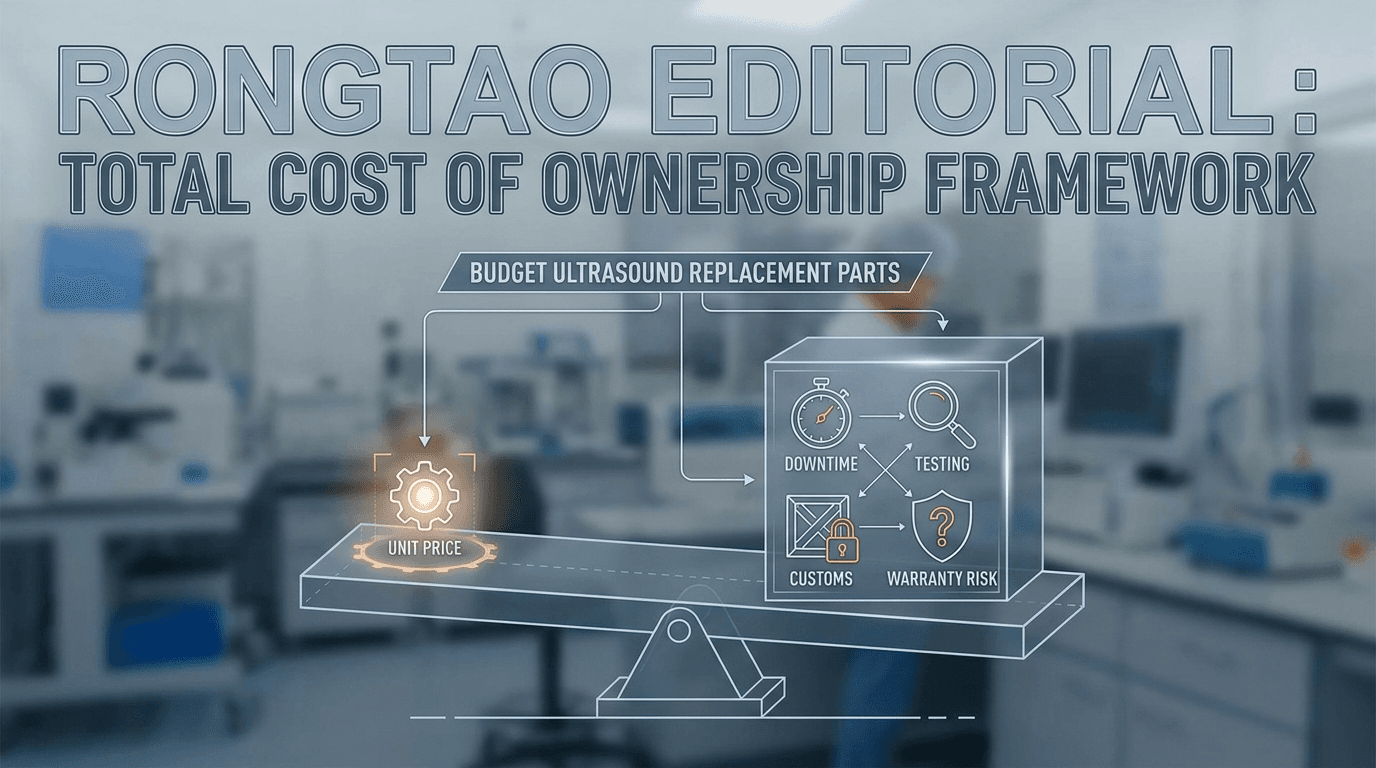
Why do lowest unit price and lowest total cost diverge for ultrasound parts?
In corporate healthcare procurement, line-item purchase order (PO) pricing is frequently used as the primary key performance indicator (KPI) for buyer performance. When sourcing an ultrasound beamformer board, high-voltage power supply, or 4D matrix transducer, selecting a seller quoting $500 less than competing vendors appears to generate immediate savings. However, in medical device maintenance, sticker price measures only the initial exchange fee—it completely ignores the financial risk shifted onto the operating environment.
Unlike commodity office supplies, ultrasound replacement components are complex, dynamic electro-acoustic sub-assemblies operating under high voltages, tight timing constraints, and continuous thermal loads. If a low-cost replacement board fails to initialize, exhibits Doppler noise artifacts, or breaks down after three weeks of clinical use, the initial purchase savings are instantly wiped out by secondary operational costs.
Buyers must align procurement strategies with broader maintenance planning. To understand how rapid sourcing interfaces with quality gates, consult our guide on [urgent ultrasound parts sourcing without skipping quality](/blog/reports/urgent-ultrasound-parts-sourcing) to evaluate time-boxed procurement models.
The financial divergence between line-item price and total cost stems from the asymmetric cost structure of clinical imaging operations. A replacement circuit board may represent a $1,500 transaction on a purchase order, but the ultrasound system housing that board generates thousands of dollars in diagnostic billings daily. If a low-cost part exhibits intermittent field failures due to poor solder quality or un-screened capacitors, the resulting downtime and clinical scheduling chaos cost orders of magnitude more than the part's initial purchase price.
To model this divergence mathematically, technology managers use the Total Sourcing Cost (TSC) equation: TSC = Purchase Price + Freight & Customs + Internal Testing Labor + (Probability of DOA × Cost of Re-work & Downtime) + (Unwarranted Failure Risk Adjustment). When a $1,200 unverified part carries a materially higher DOA risk — plug a 20% illustrative figure into the equation as a scenario — its expected TSC climbs well above that of a $1,500 pre-tested part once field labor and downtime are factored in, which is why a documented, pre-tested part is usually the lower-cost decision.
What are the seven TCO and risk levers that a sticker price hides?
To compare replacement part quotes objectively, procurement officers should evaluate candidate suppliers across seven financial and operational risk levers:
- 1. **Scanner Downtime & Lost Patient Revenue:** An inoperable ultrasound scanner in an emergency department, radiology suite, or vascular clinic blocks patient throughput. If a cheap part arrives DOA or requires four days of back-and-forth troubleshooting, lost exam revenue dwarfs any initial part discount.
- 2. **Engineering Labor & Re-Work Expenses:** Biomeds and field service engineers (FSEs) charge high hourly rates. Having an engineer install a part, discover it is defective, re-install the original board, re-package the shipment, and perform a second installation when a replacement arrives doubles or triples field labor costs.
- 3. **Freight, Tariff & Customs Uncertainty:** Low-cost international sellers often quote FOB (Free on Board) origin prices that exclude international air freight, import duties, customs broker fees, and VAT. Unpredicted customs delays can freeze critical parts in port for weeks.
- 4. **Return Rights & Reverse Logistics Fees:** Compare any restocking fee, return-shipping allocation, DOA window, and 'No Returns / All Sales Final' language in the actual quote; do not assume a market-standard percentage.
- 5. **In-House Testing & Validation Overhead:** If a part arrives without documented real-machine test records or electrical safety certificates, your clinical engineering department must absorb the labor and fixture costs to perform incoming acceptance testing.
- 6. **Warranty Duration & Scope Restrictions:** A lower-priced part with a short or narrow warranty may leave more post-installation risk with the buyer than a higher-priced part with clearer, longer coverage. Compare the written terms rather than treating duration alone as proof of quality.
- 7. **Repeat-Failure & Downstream Damage Probability:** Substandard power supplies or un-calibrated transmitter boards can deliver voltage spikes across the system backplane, destroying adjacent channel boards or damaging high-value connected transducers.
| TCO Risk Lever | Low-Price / High-Risk Supplier | Quality-Verified Sourcing Partner |
|---|---|---|
| Initial Part Sticker Price | Lower quoted unit price; enter the actual difference. | Quoted price includes the stated evidence and warranty terms. |
| Testing & Validation Evidence | None provided ('as-is' or unverified 'pulled'). | Item-appropriate functional record and, where applicable, post-repair equipment-safety evidence. |
| Shipping & Customs Duty | Buyer pays surprise customs, duty & clearance. | Quoted Incoterm, customs documents, and a written allocation of duties, taxes, freight, and insurance. |
| DOA / Misidentification Risk | Unquantified when identity and test evidence are absent. | Reduced by pre-shipment identity/revision matching and disclosed test results; never zero. |
| Warranty Governance | Short, narrow, or 'No Return / As-Is' terms; use the actual quote. | Written warranty and RMA terms, including exclusions, remedies, timing, and freight allocation. |
| Total Operational Outcome | Potentially higher TCO if one or more risks materialize. | Potentially lower TCO when the evidence and terms prevent or absorb those risks. |
How do downtime and misidentification dwarf the initial part price?
To quantify the impact of procurement decisions, healthcare managers must examine how scanner downtime and part misidentification compound financial losses.
Consider a busy hospital radiology department operating a premium cardiovascular ultrasound system. A diagnostic scanner performs multiple clinical studies daily—including echocardiograms, carotid Dopplers, and abdominal scans. When the system suffers a power supply failure, every hour of un-scheduled downtime results in canceled patient appointments, diverted emergency cases, and overtime pay for clinical staff.
Use a buyer-populated scenario: enter the quoted saving, the additional downtime if the wrong revision arrives, the facility's labor cost, return freight, and any rescheduling impact. The exercise shows when a lower price is outweighed by a preventable mismatch without pretending that every facility has the same costs. Buyers can review our [registration-led supplier qualification scorecard](/blog/reports/ultrasound-supplier-qualification-fda-registration-scorecard) to reduce misidentification risk.
Part misidentification is particularly rampant when buying multi-revision ultrasound boards. Manufacturers such as GE, Philips, and Siemens regularly update circuit board layouts, component revisions, and FPGA boot code across production runs without changing the top-level parent assembly part number. A low-cost broker listing a board under a generic part number may ship Revision A, whereas your scanner requires Revision D to communicate with the system's software version. The resulting incompatibility causes system boot errors (e.g., 'Front-End Acquisition Error 004') that take hours of engineer troubleshooting to diagnose.
In high-acuity clinical environments such as Emergency Departments (ED) or Intensive Care Units (ICU), point-of-care ultrasound (POCUS) scanners play a critical diagnostic role in FAST (Focused Assessment with Sonography in Trauma) exams. When a POCUS scanner fails due to an unverified replacement power board, emergency physicians are forced to transfer trauma patients to CT suites, delaying life-saving triage decisions. The clinical and liability risks of emergency scanner downtime extend far beyond simple billing losses.
To evaluate the true financial impact of misidentification, consider the multi-tier cost formula applied by hospital technology managers:
- **Unproductive Biomed Field Labor:** Your loaded FSE labor rate × the documented hours spent diagnosing, installing, removing, and reinstalling parts.
- **Emergency Freight:** Actual DOA return freight + replacement shipment + insurance and brokerage, using the quoted service level.
- **Restocking Fee:** The invoice value × the seller's stated percentage, applied only to the return scenarios covered by the policy.
- **Clinical Patient Rescheduling Overhead:** Administrative staff labor to call patients, re-book diagnostic appointments, and re-verify insurance authorizations when an emergency scanner is down.
How do freight, customs duties, and bonded-zone logistics impact TCO?
For international healthcare facilities, independent service organizations, and multi-national equipment distributors, cross-border logistics represents one of the largest hidden variables in total cost calculation.
When sourcing replacement circuit boards or returning high-value defective cores for repair across international borders, standard commercial shipments frequently incur heavy import tariffs, customs inspection holds, and administrative clearance fees. If a defective board sent overseas for component repair is misclassified by customs agents, the buyer may be forced to pay full import duties on the total equipment value rather than the repair labor value.
A bonded-zone repair workflow can simplify some inbound, repair, and re-export procedures when the shipment is eligible and correctly documented. It does not eliminate destination-country duties, taxes, classification questions, inspections, or delays. Ask the supplier and your customs broker for the transaction-specific treatment before calculating TCO.
Cross-border medical equipment logistics requires evaluating four customs variables:
- **1. Classification Integrity:** HS 9018.12 covers ultrasonic scanning apparatus, but a loose board, probe, or accessory may be classified differently depending on the tariff schedule and shipment facts. Confirm the code with a qualified broker rather than copying the whole-system code.
- **2. Bonded Repair Treatment:** A licensed bonded-zone process may allow conditional relief or suspension for eligible repair and re-export movements. Eligibility, valuation, deadlines, and destination-country treatment remain transaction-specific.
- **3. Incoterms:** DDP can make the seller responsible for many delivery-side costs, but it is not always practical or legally available to a foreign seller. Choose DDP, DAP, FCA, or another term deliberately and state who handles importer-of-record, taxes, brokerage, insurance, and exceptions.
- **4. Shipment Documents:** Commercial invoices, packing lists, serial/core references, repair declarations, and other origin or permit documents should match the destination and customs procedure. A certificate of origin is not universally required for every spare-part movement.
What are test evidence and warranty worth in dollars and risk terms?
Test evidence and warranty coverage are frequently treated by buyers as intangible 'nice-to-have' extras. In reality, they represent concrete financial risk transfer mechanisms.
A serial-linked real-machine test record for a replacement or repaired board can reduce, but not eliminate, installation uncertainty. IEC 62353 evidence should be requested only where applicable to the finished equipment or relevant part and test procedure; a board-level document does not guarantee immediate initialization in every system. For detailed guidance, see [which standards actually matter when buying ultrasound parts](/blog/reports/ultrasound-parts-standards-checklist).
A warranty transfers only the risks expressly covered by its written terms. Compare duration, start date, exclusions, diagnosis process, repair/replacement/refund remedy, advance-exchange availability, and freight allocation; a 90-day label alone does not promise an immediate replacement or prepaid shipping.
Evaluating warranty risk requires analyzing four commercial warranty terms that dictate seller accountability:
- **Advance Replacement Commitment:** A quality-oriented supplier ships a replacement part immediately upon receiving an RMA notification, prior to receiving the defective unit, minimizing scanner downtime.
- **Return Freight Coverage:** High-grade warranties specify that the vendor pays inbound and outbound express freight for confirmed DOA or warranty failures, rather than shifting shipping costs onto the buyer.
- **No-Fault Diagnostic Exclusions:** Beware of fine-print warranty exclusions stating that any board damaged by host system power surges is void. Reputable suppliers work with biomeds to diagnose host power stability before shipping replacements.
- **Labor Compensation Allowance:** Some premium service partners offer limited labor credit allowances if an advance replacement unit arrives non-functional, offsetting field service re-work costs.
Hospital and ISO buyers should preserve purchase specifications, identity checks, installation records, and the return-to-service evidence required by their own quality, accreditation, manufacturer-instruction, and local regulatory framework. ISO 13485 Clause 7.4.3 applies to organizations within an ISO 13485 QMS; it is not a universal hospital mandate, and IEC 62353 is not an automatic certificate requirement for every loose replacement board.
How do lifecycle depreciation and asset residual value factor into replacement parts TCO?
When making replacement part sourcing decisions, healthcare financial managers must align maintenance choices with the equipment's overall asset lifecycle depreciation curve and Remaining Useful Life (RUL).
For premium ultrasound systems in years 1 to 5 of clinical deployment, maintaining original factory performance specifications via quality-tested replacement parts preserves the system's high commercial trade-in value and operational utility. Using unverified, low-cost broker parts risks causing cascading hardware failures across system backplanes, accelerating equipment depreciation and forcing premature Capital Expenditure (CapEx) replacement.
For legacy systems in years 7 to 12 (past OEM End-of-Service declarations), purchasing tested aftermarket replacement parts or component-level board repairs provides an essential operational bridge. It extends system service life without requiring a $150,000+ new scanner capital purchase, optimizing Operational Expenditure (OpEx) maintenance budgets while maintaining full clinical scanning capacity.
How can multi-site health systems standardize replacement parts TCO scoring across regional biomeds?
Multi-hospital health networks and regional ISOs managing dozens of ultrasound systems across multiple clinical sites frequently struggle with inconsistent parts procurement practices. Biomeds at Hospital A may issue purchase orders based solely on local vendor relationships, while biomeds at Hospital B prioritize unit price.
To achieve organizational cost control, clinical engineering leaders should establish a centralized **Approved Vendor List (AVL)** and mandate standardized TCO scoring protocols across all regional biomedical engineering teams. Standardizing parts procurement involves four administrative controls:
- **1. Centralized Parts Requisition Portal:** Route all replacement part requests through a single CMMS (Computerized Maintenance Management System) portal enforcing vendor quality qualification gates.
- **2. Mandatory Vendor Scorecard Enforcement:** Require regional buyers to score suppliers against standardized criteria (ISO 13485 QMS, real-machine test evidence, DDP shipping terms, 90-day minimum warranty) before approving purchase orders.
- **3. Regional Core Exchange Pooling:** Establish a centralized core inventory depot within the health network to store harvested circuit boards and transducers, streamlining core returns and maximizing vendor exchange discounts.
- **4. Quarterly Vendor Performance Audits:** Review historical vendor DOA rates, RMA turnaround times, and shipping accuracy quarterly. Disqualify vendors that exceed a 3% first-pass DOA defect threshold.
How do you run a no-fabricated-prices TCO worksheet on any quote?
To prevent subjective purchasing decisions, procurement officers can apply the following qualitative **TCO Sourcing Worksheet** to evaluate candidate quotes. Insert your facility's specific hourly downtime and labor metrics to calculate the true cost of each option:
| Cost Calculation Line Item | Formula / Inputs Required | Quote A (Low-Price) | Quote B (Verified) |
|---|---|---|---|
| 1. Quoted Part Sticker Price | Direct PO purchase price from vendor quote. | [Enter Quoted Price] | [Enter Quoted Price] |
| 2. Shipping & Customs Fees | Air freight + estimated duties + broker fees. | [Enter Freight Cost] | [Enter Freight Cost] |
| 3. Expected In-House Testing | Biomed hourly rate × hours required to test. | [Enter Testing Cost] | $0 (Included) |
| 4. Misidentification Risk Buffer | Estimated DOA rate % × cost of 1 day downtime. | [High Buffer Value] | $0 (Verified Tag) |
| 5. Downtime Financial Exposure | Estimated shipping days × daily scanner revenue. | [Enter Downtime $] | [Enter Downtime $] |
| 6. Warranty Risk Adjustment | Value of un-warranted days 15-90. | [Enter Risk Value] | $0 (Fully Covered) |
| TOTAL ESTIMATED COST | Sum of Line Items 1 through 6 | [Calculated Total] | [Calculated Total] |
In the majority of commercial comparisons, Quote B—the quality-verified part with full testing, warranty, and customs clearance—delivers a significantly lower Total Estimated Cost than Quote A's lower sticker price.
What are the no-go gates where a cheap part is never worth it?
Healthcare technology managers should establish strict non-negotiable **No-Go Gates**. Regardless of how low a vendor's sticker price may be, reject any replacement part quotation immediately if:
- **Zero Provenance Disclosure:** The seller refuses to disclose the part's origin, serial number history, or removal source.
- **No Test Documentation:** The vendor acknowledges the part is untested, 'sold as-is,' or pulled from an unknown decommissioned unit without bench validation.
- **No RMA / Return Rights:** The invoice specifies 'No Returns,' 'All Sales Final,' or excludes DOA replacements.
- **Unresolved Customs Duty Liability:** For cross-border shipments, the seller refuses to provide clear customs documentation or DDP terms, leaving your organization vulnerable to impounded freight.
- **Absence of ESD Shielding:** The supplier confirms parts are shipped without ESD shielding bags or compliant protective packaging.
When evaluating transducer replacement decisions against repair economics, review our specialized analysis on [downtime is the other half of TCO](/blog/reports/ultrasound-probe-repair-vs-replace) to weigh probe repair versus replacement.
Where Rongtao Medical fits, and where it does not
Rongtao Medical helps clinical engineering teams, ISOs, and distributors optimize replacement parts procurement by delivering verified quality that minimizes total cost of ownership.
**Where Rongtao Medical Fits:**
- **Tested Parts and Repair Evidence:** Rongtao publishes real-machine verification for repaired boards and live-compatible-system verification for repaired probes; replacement-part test evidence depends on the item category and should be confirmed in the quote 5.
- **Bonded-Zone Workflow:** Rongtao operates a Guangzhou bonded-zone repair workflow with customs paperwork support. Eligibility, duties, taxes, importer-of-record responsibility, and destination-country clearance remain shipment-specific.
- **Typical Warranty:** Rongtao publishes a typical 90-day warranty, with final coverage, exclusions, remedies, and any extended option confirmed by product category and service type.
- **Board-Repair Turnaround:** Rongtao publishes a standard 5-to-8-business-day turnaround for board repair. Probe and other service timing is quoted case by case.
- **ISO 13485:2016 Certified Quality:** Full serial traceability, ESD-protected bench handling, and compliant quality management systems ensure seamless integration into hospital QMS workflows.
**Where Rongtao Medical Does Not Fit:**
- **Not a Salvage Broker for Untested Scrap:** We do not compete with low-end brokers selling unverified 'as-is' scrap parts without testing or warranty. If your sole purchasing criterion is the absolute lowest upfront dollar cost regardless of DOA risk, broker liquidators represent an alternative channel.
- **Independent Service Provider:** Rongtao is an independent multi-brand solutions provider. We do not claim official authorization or distribution rights from original equipment manufacturers such as GE, Philips, Siemens, or Canon.
To request a competitive quotation for verified multi-brand ultrasound replacement parts, evaluate bonded logistics options, or consult with our parts specialists, visit the [Rongtao Medical Parts Directory](https://rongtaomedical.com/parts) or email info@rongtaomedical.com.
Frequently Asked Questions
**Q: Are cheaper third-party ultrasound parts always lower total cost?** A: Not necessarily. A cheaper replacement part that lacks test evidence, arrives DOA, or fails after a few weeks of use incurs heavy secondary costs in scanner downtime, re-work engineering labor, re-shipping fees, and lost clinical revenue. Evaluating quotes through a Total Cost of Ownership (TCO) framework reveals that quality-tested, warranted parts are frequently the lower total cost option.
**Q: How does customs/duty affect parts TCO for international buyers?** A: Import duties, taxes, brokerage, classification, insurance, and clearance time can change TCO materially. A bonded-zone workflow may simplify an eligible repair/re-export movement, but it does not eliminate destination-country obligations; calculate the actual Incoterm and customs treatment with the supplier and broker.
**Q: What is downtime worth when comparing parts?** A: Downtime cost is often the single largest variable in parts TCO. In high-volume clinical departments, an unavailable ultrasound scanner blocks diagnostic imaging revenue and delays patient care. Saving a small amount on a part's purchase price is quickly negated if the part takes longer to arrive or requires multiple diagnostic attempts to install.
**Q: Why can skipping acceptance testing cost more?** A: Weak identity and functional checks can lead to repeat labor, downtime, and returns. Ask for supplier evidence, then complete the receiving and return-to-service steps applicable to the equipment; FDA QMSR purchasing controls should not be presented as a blanket hospital rule.
**Q: How can procurement officers evaluate restocking fees in TCO calculations?** A: Read the actual return terms and enter the quoted percentage or fixed fee into the worksheet. Confirm whether DOA, supplier misidentification, buyer ordering error, opened packaging, and international freight are treated differently.
**Q: What is the benefit of DDP shipping terms for cross-border replacement parts?** A: DDP can give the buyer a more inclusive delivered-price quote because the seller takes many destination-side obligations. It does not guarantee delay-free clearance, and it may be unsuitable where the seller cannot act as importer of record; compare the named place, exclusions, tax treatment, and alternative Incoterms.