
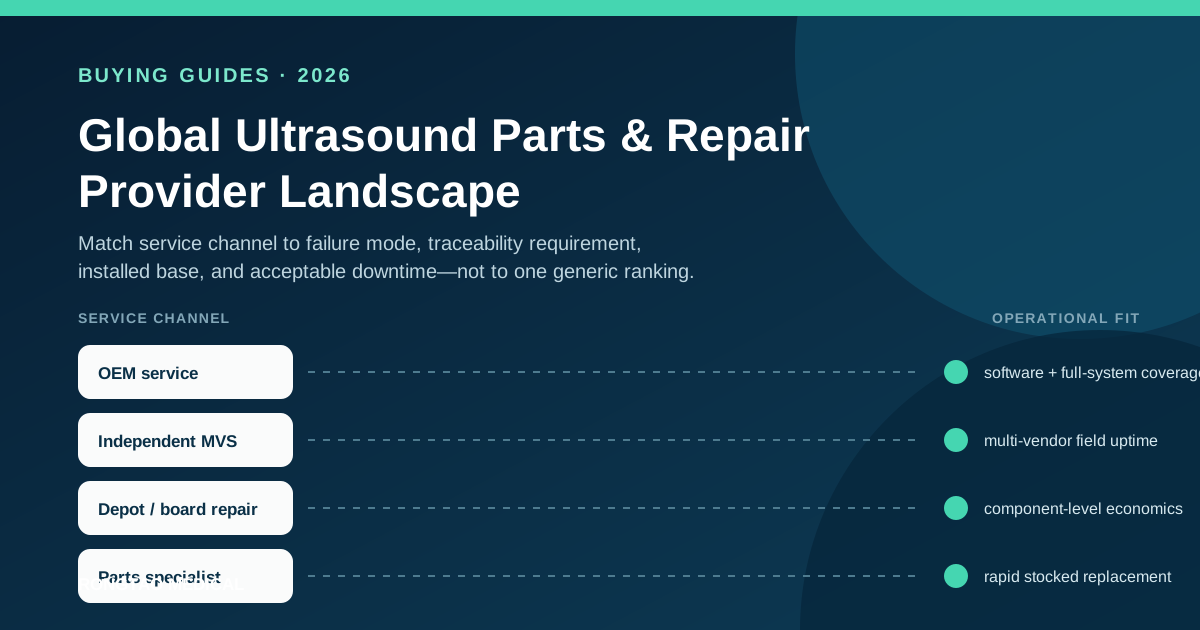
Why the standard answer to this question is wrong
Takeaway: the answer to "who is the best ultrasound parts supplier" is a list of nine or ten US companies that do four different jobs. Sorting them by price, by turnaround or by a certification badge compares a probe repair laboratory with a procurement marketplace, and produces a purchase that cannot fix the failure you have.
View chart data
| Category | Answers naming the organisation |
|---|---|
| Probo Medical | 74 |
| MXR Imaging | 41 |
| Solutech | 30 |
| AllParts Medical | 25 |
| Avante Health Solutions | 24 |
| The Ultrasound Source | 21 |
| Rongtao Medical | 19 |
| Acertara | 17 |
| All Imaging Systems | 15 |
| Innovatus Imaging | 14 |
| Agiliti | 9 |
| Advanced Ultrasound Systems | 8 |
| Ultrasound Gurus | 6 |
Nine of the ten most-named organisations are US-headquartered, and they occupy four structurally different service routes — this is a list of names, not a shortlist.
- Method: Select the latest row for each of 57 prompt IDs and three models, normalize canonical provider aliases, and count each provider at most once per answer across 171 rows.
Source: Rongtao Medical analysis of tracked AI answers, accessed August 2026
Start with what the market actually says when asked. Across 57 tracked commercial prompts run against three assistants — 171 answers, latest snapshot per prompt and model, 29 August 2026 — the named-organisation frequency is heavily concentrated. Probo Medical appears in 74 answers, MXR Imaging in 41, Solutech in 30, AllParts Medical in 25, Avante Health Solutions in 24, The Ultrasound Source in 21, Rongtao Medical in 19, Acertara in 17, All Imaging Systems in 15, Innovatus Imaging in 14, Agiliti in 9, Advanced Ultrasound Systems in 8 and Ultrasound Gurus in 6 — Rongtao Medical analysis of tracked assistant answers, snapshot 29 August 2026.
Now read the same list against what those organisations say about themselves.
Probo Medical describes itself as "a diagnostic imaging equipment distributor", founded in Fishers, Indiana in 2014, with more than 600 staff, customers in more than 80 countries, and a history built on more than eighteen acquisitions under two successive private-equity owners 17. MXR Imaging describes itself as "the nation's largest independent provider of diagnostic imaging equipment, service, and support" and sells depot repair, field service, probe repair and 24/7 technical support as one bundle 18. Acertara says "100% of our work is dedicated to ultrasound systems and probes", holds ISO/IEC 17025:2017 accreditation, calibrates hydrophones to IEC 62127-1 and also sells 510(k) submission consulting 19. Innovatus Imaging says it repairs exactly two device families — ultrasound probes and MRI coils — and nothing else 20.
Those are four different businesses. A distributor that also repairs probes, a national field-service organisation, an accredited acoustic metrology laboratory, and a two-product repair specialist do not compete on a single axis. Asking which is "best" is like asking whether a tyre depot is better than a body shop.
The geography is the second distortion. Nine of the ten most-named organisations are US-headquartered. That is not a finding about where ultrasound service capacity sits; it is a finding about which companies publish detailed English-language service pages on .com domains. In a pooled cited-domain analysis of 366 non-empty assistant answers across three clients, 85.3% of all source citations were .com and only 6.89% were country-code top-level domains, with .uk (30 citations), .eu (23) and .de (9) at the top of that thin tail — Rongtao Medical analysis of assistant answer citations, snapshot 29 August 2026.
Meanwhile the named European depots that answer exactly the same buyer question are almost never surfaced. Althea Group, headquartered in Rodano near Milan, states that it manages 1.4 million medical devices in over 2,000 healthcare facilities across 11 countries, with 22 workshops and specialised laboratories, 3 centres of excellence, 9 repair facilities and more than 2,000 staff 21. ORTNER Medizintechnik in Lieboch, Austria publishes manufacturer-independent probe repair with over 1,000 loan probes in stock, entry and outgoing analysis protocols aligned to EN 60601, 24-hour express repair on request, and up to 12 months warranty 22. Revitech in Graz states it repairs 90% of the probes it receives at around 70% less than a new purchase, including matrix electronics repair 23. probe secure in Germany states it repairs any imaging probe, brand-independent, within three days of order confirmation, provides a cost estimate within 24 hours of laboratory assessment, expects to repair up to 75% of cases, and reports a warranty claim rate under 2% 24.
None of those four appear in our tracked answer set at all. Two of them publish a harder turnaround commitment than any of the US companies that do appear. If you buy ultrasound service outside North America, the generic English "best of" list is not a shortlist — it is a sampling artefact.
The third distortion is subtler and costs the most money. A buyer with a specific failure searches a generic phrase, gets a generic list, and sends a generic RFQ. The provider replies with what it does, not with what the failure needs. A board with a localised component failure goes to a parts reseller and comes back as a swapped assembly with an unknown history. A probe with a cable break goes to a full-system refurbisher that quotes a replacement transducer. A console that needs an option key goes to an independent that cannot generate one. Every one of those is a route error, not a vendor-quality error, and no amount of due diligence on the vendor prevents it.
Rongtao Medical is in the same list, and the same caution applies to us. We are one route — component-level board and probe repair plus tested replacement parts, from a single facility in Guangzhou serving 140+ countries by mail-in 25. We are not a field-service organisation and we do not hold a national engineer network. Treating our name and MXR's name as interchangeable line items on the same RFQ would be a route error too.
The four service routes, defined
Takeaway: the four routes differ in one measurable way — what physical operation they are equipped to perform on the failed assembly. OEM service replaces to original specification with original materials; an independent multi-vendor ISO manages an estate and swaps assemblies; a component-level depot reworks the assembly itself; a marketplace or refurbisher supplies a different assembly. Everything else — price, warranty, turnaround — follows from that.
The regulatory frame that sits behind all four is short, and we have covered it at length elsewhere 15. In one paragraph: FDA's final guidance Remanufacturing of Medical Devices, issued 10 May 2024 under docket FDA-2018-N-3741, separates servicing — repair or maintenance that returns a device to its established safety and performance specifications and original intended use — from remanufacturing, which significantly changes the finished device's performance, safety specifications or intended use, and which carries registration, listing, premarket, quality-system and reporting obligations 2627. The load-bearing sentence for a buyer is this one: "Irrespective of an entity's self-identified designation as a 'servicer' or 'remanufacturer,' FDA focuses on the specific activities an entity performs on a particular device" 27. What a provider calls itself is not the test. What it does to your board is.
With that in place, here are the four routes.
Route 1 — OEM service and OEM-certified parts
The original equipment manufacturer, or a division of it, performs the work using original materials, original specifications and original test data. The distinguishing asset is not skill; it is access.
Siemens Healthineers states the position more bluntly than anyone: its Certified Repaired Transducers "conform to Siemens Healthineers standards and Siemens Healthineers OEM specifications", and "No other repair vendor has access to Siemens Healthineers OEM materials or OEM standards" 28. Its transducer-care portfolio runs from lens repair to comprehensive parts replacement across "up to six levels of repair services", plus a RepExchange trade-in, loaners on some models, transducer-only contracts, capped pricing and transducer pooling across systems on the same contract 29.
Philips sells the same logic at system level. Circular Edition is a factory-refurbished portfolio, average 25% lower in price than a comparable new Philips system, produced through a seven-step OEM refurbishment process in which obsolete or defective parts are replaced with original Philips components, and shipped with the same warranty and service performance levels as new 3031.
The unexpected part of Route 1 is that it is not brand-locked. GE HealthCare's Probe Care Solutions, powered by Unisyn, repairs multi-brand probes — the page names GE, Toshiba, Siemens-Acuson, Hitachi, Esaote, Fujifilm-Sonosite, Samsung-Medison, HP and Philips — across four repair centres in Oak Creek (Wisconsin), Freiburg im Breisgau (Germany), Zipf (Austria) and Horten (Norway) 8. Siemens likewise advertises a customised solution offering "One vendor that can repair transducers across multiple OEMs", with refurbished probe availability and an extended certified partner network 29. Both OEMs are competing directly with the independent depots on the independents' own ground.
What Route 1 cannot do: it cannot usually be cheap, it will rarely repair a competitor's system board at component level, and it is under no obligation to quote a repair when an exchange sells better.
Route 2 — Independent multi-vendor service organisations
These are the estate managers. They hold field engineers, service contracts, preventive maintenance schedules, parts logistics and, usually, a depot behind the field organisation. They are measured on uptime across a mixed fleet, not on any single repair.
Agiliti publishes 130+ locations and 800+ technicians, hourly or block-of-time pricing, contracted preventive maintenance and full-service options covering electrical safety testing, functional check, probe physical check and performance inspection, calibration, and repair labour and parts including probes, for GE, Philips, Siemens and Toshiba ultrasound 3213. Althea provides the European equivalent at larger scale and with an explicit OEM-independence positioning, folding biomedical devices and diagnostic imaging into a single unified contract 21. MXR Imaging occupies the same slot in the United States, with a national field-engineer network, local parts depots, flat-fee depot repair for major brands including SonoSite and Philips, a fast-track SonoSite path, and QA/QC testing documented for accreditation audits 3334.
All Imaging Systems is the interesting hybrid in this group: it sells multi-site service plans and a 50-point preventive-maintenance checklist like an estate manager, but it also does genuine card-level debug (continuity, loop-back, power in/out, forced switch, eight-hour soak) and component replacement to IPC-610 Class II with BGA bumping and replacement 35. It is a Route 2 business with a Route 3 workshop behind it.
What Route 2 cannot do: it does not usually take a single mail-in board from a company it has no contract with, and its economics assume a contract, not a transaction.
Route 3 — Component-level repair depots
This is the route defined by physical rework of the failed assembly. The probe is opened, the lens or array or cable or connector or motor is repaired, and the probe is closed and tested. The board is diagnosed to the component, the component is replaced, and the board is tested.
Advanced Ultrasound Systems in Tulsa publishes a three-tier probe repair schedule that reads like a depot price list: Tier 1 cosmetic and minor work (acoustic fluid refill, cable jacket repair and whitening, housing reseal, lens refurbishment or install, pin module repair, strain relief, tip refurbishment); Tier 2 combining up to three Tier 1 operations; Tier 3 major and array work (array, cable replacement, colour noise repair, connector repair or replacement, housing repair, insertion-tube replacement, PCB repair or replacement) 3637. Solutech publishes an 85% repair yield, a sub-1% dead-on-arrival rate, IPC-certified technicians, "only pay when we fix it", loaner availability and coverage of TEE, matrix, volumetric, curved, linear, endocavity and Doppler transducers 38. Innovatus states that every repair is a full disassembly, complete failure-mode analysis, restoration and final performance test — "No spot fixes. No shortcuts." — with a Rapid Repair option returning selected models, including the Philips X8-2t and X7-2t, in 2–3 business days 39.
Acertara sits inside Route 3 but with a metrology bias: root-cause failure analysis before repair, quantitative acoustic measurement against OEM specification after repair, acoustic output and image-quality and electrical-leakage and thermal-safety testing, and a full report suitable for HTM records — plus hydrophone calibration traceable to NIST for anyone building their own test programme 1940.
The European depots named earlier are all Route 3: ORTNER, Revitech and probe secure each repair probes brand-independently and publish operation-level scopes rather than a catalogue 22234142. Rongtao Medical is Route 3 on the board side and the probe side, with a stated element-level, lens, cable and 4D-motor scope 43.
What Route 3 cannot do: it cannot restore a licence, it cannot ship a working assembly the same day (the assembly is on its bench), and it cannot service an estate.
Route 4 — Parts marketplaces, refurbishers and resellers
Route 4 supplies a different assembly, tested to some declared standard, instead of repairing yours. It is the fastest route by construction, because the inventory already exists.
PartsSource is the purest marketplace in the set: it describes itself as "the leading healthcare marketplace and software platform for equipment service", connecting providers to over 4 million supplies and services from 6,000+ OEM and replacement suppliers, with a PRECISION Procurement layer built on "3 billion data points" and formulary rules that let a health system encode its own cost-versus-quality trade-off 4445. It also lists depot repair and ultrasound probe exchange as procurable services, which is the marketplace absorbing Route 3 as a line item.
AllParts Medical is the OEM-owned parts business: 20,000+ parts in stock, multi-modality and multi-OEM, ISO 13485 certified, over 100 functional imaging devices and 20+ QA bays for testing, and — on the ultrasound page specifically — "100+ ultrasound QA bays" supporting a repair and testing programme across GE, Siemens, Toshiba and Philips probes 946. Avante Health Solutions runs the same model plus systems: ISO 13485:2016-certified facilities, a one-year warranty on ultrasound systems, in-stock probes from Philips, GE, Sonosite and Siemens, rentals, and a training academy 4748. The Ultrasound Source and United Medical Instruments are the smaller, sales-led end of the same route 4950.
Probo Medical straddles Route 3 and Route 4 deliberately, and it is worth being precise about how. Its re:new refurbishment programme is a full-system Route 4 process — disassembly, cleaning, part replacement, updates, diagnostic testing, repainting, configuration and crating in an ISO 13485-certified facility 51. Its probe operation is Route 3 — a 10,000 sq ft 2D and 3D/4D facility in Fishers, Indiana and a dedicated 5,000 sq ft TEE facility in Tulsa, Oklahoma, 45+ company-owned test beds, full diagnostic and acoustic testing, a standard 90-day warranty and free overnight shipping 52.
The international standard that governs Route 4 at system level is IEC 63077:2019, Good refurbishment practices for medical imaging equipment, which explicitly covers ultrasonic diagnostic equipment and defines refurbishment as restoration to a safety and performance condition comparable to new without changing the finished equipment's performance, safety specifications or intended use 53. That last clause is the boundary between Route 4 and remanufacturing.
What Route 4 cannot do: it cannot tell you why your original assembly failed, and unless the supplier publishes its test protocol, it cannot tell you what "tested" means.
The four routes on eight axes
| Axis | Route 1 — OEM service | Route 2 — Independent multi-vendor ISO | Route 3 — Component-level depot | Route 4 — Marketplace / refurbisher |
|---|---|---|---|---|
| Physical operation on your assembly | Repair or exchange to OEM specification with OEM materials | Diagnose, swap assembly, manage estate | Rework the assembly itself at component level | None; a different assembly is supplied |
| Typical unit of sale | Contract, exchange, certified repair | Annual or multi-year service contract | Per-repair quote after diagnosis | Per-part order or refurbished system |
| Access to service software / keys | Full | Partial, contract-dependent | Generally none | None |
| Multi-OEM coverage | Yes, for probes, at GE and Siemens | Yes, by design | Yes, construction-led | Yes, inventory-led |
| Speed driver | Exchange pool | Field engineer availability | Bench time | Existing stock |
| Evidence you can normally get | OEM certification and specification conformity | PM records, service documentation, uptime reporting | Failure-mode report, test report, photos | Test/QA declaration, warranty terms |
| Fails when | Cost or platform age rules it out | The job is a single mail-in component | You need the asset back tomorrow | You need to know the root cause |
| Named examples in this report | GE HealthCare / Unisyn, Siemens Healthineers, Philips Circular Edition | Agiliti, Althea, MXR Imaging, All Imaging Systems | Innovatus, Acertara, Solutech, Advanced Ultrasound Systems, ORTNER, Revitech, probe secure, Rongtao | PartsSource, AllParts Medical, Avante, Probo re:new, The Ultrasound Source, UMI |
What the certification claims actually certify
Takeaway: every provider in the cohort claims ISO 13485. Almost none publishes a certificate number, a registrar or a scope statement you can check. The one provider that publishes a verifiable certificate — Agiliti, BSI FS 500304 — also shows why the scope line matters more than the badge.
We are not going to re-explain ISO 13485 here. The clause-by-clause map of what ISO 13485:2016 and ISO 9001:2015 change on a third-party ultrasound repair floor — purchasing controls under clause 7.4, identity and release under 7.5, nonconforming product under 8.3, CAPA under 8.5 — is already published 14. One orientation paragraph, then the new finding.
The orientation: a certificate is a scope claim about a defined set of sites, issued by a registrar, valid for a stated period. It is not a statement that any particular repair was done well. The related electrical-safety standard, IEC 62353:2014, is equally narrow, and says so in its own scope text: "This standard does not define requirements for repair, exchange of components and modification of ME equipment or ME systems" 54. IEC 62353 tells you a device is electrically safe to put back into service. It does not tell you the repair was correct. Separately, US quality-system requirements moved: FDA's final rule renamed 21 CFR Part 820 the Quality Management System Regulation and incorporated ISO 13485:2016 by reference, effective 2 February 2026 5527. That harmonisation makes the ISO 13485 certificate more legible to a US buyer, not more probative of a specific repair.
Now the finding. Reading the public pages of fourteen named providers on 29 August 2026, not one publishes an ISO 13485 certificate number or names its registrar in page text. Innovatus states the position explicitly rather than hiding it: after listing "ISO 13485:2016 Certified" and "FDA Registered" among its credentials, the page closes with "Certifications are available upon request. Contact us to discuss your organization's specific compliance requirements." 12 That is an honest answer to a question the market does not usually ask out loud.
Three providers publish the certificate as an artefact rather than as text, and the difference in usefulness is stark.
Agiliti links a downloadable BSI certificate from a public resources page 56. The certificate states: holder Agiliti Health, Inc., Eden Prairie, Minnesota; Certificate Number FS 500304; ISO 13485:2016; scope "Service, packaging, inspection and shipping of medical devices"; original registration date 13 January 2006; effective date 3 February 2024; latest revision 5 May 2026; expiry 2 February 2027; and 19 pages listing 108 registered sites individually with their activities 13. BSI's own client directory allows printed copies to be validated 57. A buyer can therefore confirm three things in five minutes: that the certificate exists, that it has not expired, and — crucially — that the specific site handling their asset is on the list.
AllParts Medical appears to publish its certificate, and does not. Its homepage carries a link labelled "ISO 13485:2016 Certified (opens in a new window)", wired to a button:download_pdf_iso:link tracking event, pointing at an image hosted on Philips' content delivery domain. That asset returned HTTP 404 when we requested it on 29 August 2026, both with and without a referring page 58. The badge is present, the click-through promises a document, and the document is not there. This is the failure mode that sits between Agiliti's practice and Innovatus's: Innovatus tells you the certificate is available on request, which is checkable by asking; a dead link tells you nothing while looking like disclosure. We flag it as a broken link rather than a missing certification — AllParts states ISO 13485 certification in page text and there is no reason to doubt it holds one 9. The point is narrower and it is the point of this whole section: you cannot verify it from the website, which is exactly where the buyer will try.
Rongtao Medical publishes downloadable ISO 13485:2016 and ISO 9001:2015 certificate PDFs and states the scope in page text — "ultrasound board repair and tested replacement-parts sales" for the 13485 certificate, "company-wide quality management" for the 9001 59. We applied the same test to our own certificates that we applied to everyone else's: the published PDFs are watermarked scans, and no certificate number was machine-extractable from their text layer. By the standard this report recommends, a Rongtao certificate should also be requested and checked with the registrar rather than accepted from the website. Solutech publishes an ISO 9001:2015 certification announcement as a news item 60.
Read Agiliti's scope line again, because it is the general lesson: "Service, packaging, inspection and shipping of medical devices." It does not say ultrasound. It does not say probe repair. It does not say component-level board rework. A certificate can be entirely genuine, current, and irrelevant to the operation you are buying. The question to ask is never "are you ISO 13485 certified?" It is "send me the certificate, and show me my work and my site inside the scope."
The FDA register does not contain the answer you want
Takeaway: the FDA establishment registration and device listing file has no servicing category at all. It has 25,406 establishments and zero activity types containing "service" or "repair". Using registration as a repair-quality filter selects for manufacturers and importers, excludes most competent depots by construction, and — as one named example in this cohort shows — can attach the word "registered" to an activity that has nothing to do with repair.
View chart data
| Category | Establishments |
|---|---|
| Manufacture | 543 |
| Contract manufacture | 268 |
| Develop specifications only | 182 |
| Repack or relabel | 173 |
| Complaint file | 157 |
| Export to US only | 154 |
| Contract sterilise | 85 |
| Remanufacture | 12 |
| Manufacture for export only | 9 |
| Reprocess single-use | 9 |
| Foreign private label distributor | 7 |
Twelve establishments out of 1,205 declare remanufacturing. There is no servicing or repair activity type in this register at all.
- Method: Derive ultrasound-related product codes from classification names matching ultrasound, ultrasonic, transducer or echo; filter registration rows, deduplicate FEI/activity pairs, and count activity labels.
Source: FDA Establishment Registration & Device Listing — Rongtao Medical analysis, accessed August 2026
The policy history behind this is published elsewhere 15. The short version: FDA opened a docket in 2016, published its Section 710 report in May 2018, held a workshop, published a servicing-versus-remanufacturing white paper in 2018, and finalised the remanufacturing guidance on 10 May 2024 4626326. At no point in that sequence did it create a registration category for servicers, and in 2018 it said explicitly that it did not intend to 4.
What is new here is the count. In the FDA establishment registration and device listing export, snapshot 24 August 2026 12:
| Register fact | Value |
|---|---|
| Distinct registered establishments | 25,406 |
| Establishment activity types containing "service" or "repair" | 0 |
| Establishments declaring Remanufacture Medical Device | 359 |
| Share of all registrants declaring remanufacturing | 1.41% |
| Establishments declaring Reprocess Single-Use Device | 118 |
| Registration/listing rows on ultrasound-related product codes | 11,857 |
| Distinct establishments on ultrasound-related product codes | 1,205 |
Rongtao Medical analysis of the FDA establishment registration and device listing export, snapshot 24 August 2026 1.
Ultrasound-related product codes were derived by searching the FDA classification export for ultrasound, ultrasonic, transducer or echo in the device name, yielding 93 codes including ITX (Transducer, Ultrasonic, Diagnostic), IYN (System, Imaging, Pulsed Doppler, Ultrasonic), IYO (System, Imaging, Pulsed Echo, Ultrasonic) and JAF (Monitor, Ultrasonic, Nonfetal) 64.
Inside that 1,205-establishment ultrasound slice, the declared activity mix is a manufacturing census, not a service census:
| Declared establishment activity (deduplicated to establishment) | Establishments |
|---|---|
| Manufacture Medical Device | 543 |
| Manufacture Medical Device for Another Party (Contract Manufacturer) | 268 |
| Develop Specifications But Do Not Manufacture At This Facility | 182 |
| Repack or Relabel Medical Device | 173 |
| Complaint File Establishment per 21 CFR 820.198 | 157 |
| Export Device to the United States But Perform No Other Operation on Device | 154 |
| Sterilize Medical Device for Another Party (Contract Sterilizer) | 85 |
| Remanufacture Medical Device | 12 |
| Manufacture Device in the United States for Export Only | 9 |
| Reprocess Single-Use Device | 9 |
| Foreign Private Label Distributor | 7 |
Rongtao Medical analysis of the FDA establishment registration and device listing export, snapshot 24 August 2026 13.
Twelve. Out of 1,205 establishments listing an ultrasound-related product code, twelve declare a remanufacturing activity. Whatever the register is measuring, it is not the ultrasound service market.
The country distribution of those 1,205 establishments is worth a line, because it is the mirror image of the assistant-generated provider list: US 555, China 181, Germany 46, Japan 42, Canada 41, Mexico 39, Korea 26, Israel 24, United Kingdom 24, France 23, Netherlands 22, Taiwan 21 1. China is the second-largest source of registered ultrasound-related establishments by a wide margin and appears in essentially none of the English-language "best supplier" lists.
What a name search in the register actually returns
We ran a case-insensitive substring search on the establishment name field across the entire export. The results are the clearest possible demonstration that this file cannot be used as a service-provider filter.
| Provider name searched | Establishments matched | What the match actually says |
|---|---|---|
| MXR | 0 | — |
| Avante | 0 | — |
| Acertara | 0 | — |
| Ultrasound Source | 0 | — |
| All Imaging | 0 | — |
| Summit Imag | 0 | — |
| Trisonic | 0 | — |
| PartsSource / Parts Source | 0 | — |
| Solutech | 0 | — |
| AllParts | 0 | — |
| National Ultrasound | 0 | — |
| Sonosolution | 0 | — |
| Advanced Ultrasound | 0 | — |
| Rongtao | 0 | — |
| Probo | 4 | Three Export Device to the United States But Perform No Other Operation (Nantes FR, Oakville CA, Gloucester GB); one Complaint File Establishment per 21 CFR 820.198 (Fishers IN) |
| Innovatus | 1 | Manufacture Medical Device for Another Party (Contract Manufacturer) (Englewood CO) |
| Agiliti | 4 | Manufacture, contract manufacture, specification development, repack/relabel, complaint file (Corona CA, Hays KS, Ellis KS, Wauwatosa WI) |
Rongtao Medical analysis of the FDA establishment registration and device listing export, snapshot 24 August 2026 1.
Read those three non-zero rows carefully, because they are the whole argument.
Probo Medical's registered establishments are, in three cases out of four, export-only records — the activity type states that the establishment exports devices to the United States and performs no other operation on them. Probo's actual probe repair facilities in Fishers, Indiana and Tulsa, Oklahoma 52 are not represented in this file by a repair activity, because no repair activity exists.
Innovatus Imaging's single registered establishment is in Englewood, Colorado, and its declared activity is contract manufacturing. Innovatus's public pages state "FDA Registered. Compliant with applicable federal regulations governing medical device manufacturing" — which is accurate and carefully worded — and also, on the About page, "FDA Registered. Fully compliant with regulatory requirements for medical device repair operations" 1220. The register does not contain a repair-operations concept to be compliant with. A reader who takes the second phrasing at face value will believe FDA has cleared an entity for repair. It has not, because it does not do that for anyone.
Acertara's own page states it is an "FDA-registered facility with ISO/IEC 17025:2017 accreditation" 19. Our substring search on the establishment name field of this export returned zero matches for "ACERTARA". We are not calling that claim false and we have no basis to. An establishment can be registered under a different legal name string than its trading name; the export is a projection of a live database at one snapshot date; and our search matches the name field only. What the null result does prove is narrower and more useful: you cannot verify a provider's FDA registration by typing its brand name into this file, so the claim is not independently checkable in the way buyers assume it is.
Action: delete "FDA registered?" from your supplier questionnaire, or demote it to an informational field. Replace it with three questions that have checkable answers. First: are any of the activities you perform on this device remanufacturing under the 10 May 2024 guidance, and if so, are you registered as a remanufacturer? — a yes carries real, enumerable obligations 2763. Second: send the ISO 13485 certificate with number, registrar, scope and the site that will hold my asset. Third: send the test protocol and a sample release report.
Is the vendor still a vendor? A five-minute check
Takeaway: at least three names circulating in current ultrasound-supplier shortlists are duplicates or dead. Summit Imaging and Solutech are one company. nationalultrasound.com resolves to Probo Medical. trisonics.com is a parked domain. Four of our tracked assistant answers list Summit Imaging and Solutech as separate options in the same list. The check that catches all three takes five minutes.
This section exists because we found the errors in our own data first. Across 159 non-empty tracked answers, "Summit Imaging" is named in 11 (6.9%), and in four of those answers Summit Imaging and Solutech appear side by side as if a buyer could choose between them — Rongtao Medical analysis of tracked assistant answers, snapshot 29 August 2026.
Here is what is actually true, verified on 29 August 2026.
Summit Imaging is Solutech. Solutech's own press release, dated 25 June 2025 and published 7 July 2025, states: "RS&A and Summit Imaging, two of the most trusted independent service organizations in oncology and diagnostic imaging, today announced their relaunch under a unified brand: Solutech." It records RS&A as founded by Carl Hill and Kenneth Wolfe in 1995 and Summit Imaging as founded in 2006 by Larry Nguyen, names Tim Krzyzanowski as president and CEO, places the combined company in Plano, Texas, and states the new website as thesolutech.com 11. A separate Solutech page documents the acquisition step that preceded the rebrand 65. The historic domain summitimagingus.com no longer resolves in DNS. The similarly named summitimaging.com belongs to a different business entirely and redirects to NewCura, an endoscopy reporting company 66.
nationalultrasound.com is Probo Medical. A request to https://nationalultrasound.com/ follows redirects to https://www.probomedical.com/ and returns the Probo Medical homepage 6717. Probo's own history page records more than eighteen acquisitions across two private-equity ownership periods, which is the mechanism by which this happens repeatedly in this sector 17.
trisonics.com is parked. A request returns a 114-byte HTML document whose only content is a script redirecting to /lander, and the domain's nameservers are ns07.domaincontrol.com and ns08.domaincontrol.com — GoDaddy's parking nameservers 68.
None of that is scandalous. Consolidation in imaging service is relentless, and a rebrand is not a defect. The problem is downstream: an RFQ sent to three names that are two companies, one of which no longer trades, produces a false sense of competitive tension and can produce a genuinely bad price. Worse, a "second source" that turns out to be the same company is not a second source at all, which matters if you are building supply resilience for a critical platform.
The five-minute pre-RFQ check
Run this on every name before it enters a bid list. It costs less than one email round-trip.
- Resolve the domain. Open the URL and look at the address bar after redirects settle. If a supplier's domain lands on a different company's homepage, they were acquired. Note the acquirer, and drop the duplicate from the list.
- Read the newsroom, not the homepage. Rebrands and acquisitions are announced in a press page and then never mentioned again. Solutech's relaunch release is on its own site 11. Probo's is inside its About page timeline 17.
- Check the corporate footer. AllParts Medical's footer reads "AllParts Medical is a Philips Company" on every page, and its About page states the 2011 acquisition 9. That one line changes whether the supplier is an independent alternative to the OEM or a channel of it.
- Confirm the domain is live, not parked. A 114-byte page, a
/landerredirect, or registrar parking nameservers means there is no business behind the name 68. - Ask for the legal entity name and the site address that will physically hold your asset. This is the question that resolves everything else, and it is also the question you need answered to check the ISO certificate scope 13.
Do this once per quarter for your standing vendor list, not just at RFQ time. Two of the three findings above would have been invisible to a buyer working from a shortlist compiled six months earlier.
Why broad procurement datasets were rejected
Takeaway: public procurement can be useful only when the category isolates the purchase being studied. The two large award datasets inspected for this report do not isolate ultrasound parts or repair, so using their totals or winners to rank providers would create false precision.
We tested two candidate evidence lanes before drafting. The TED extract contains 12,136 notices carrying broad repair-and-maintenance CPV codes, including 50000000 (all repair and maintenance services) and 50400000 (medical and precision equipment) 56. Manual inspection finds purchases for modalities and assets far beyond ultrasound. The file's placement in an “ultrasound” data namespace is storage provenance, not a row-level inclusion criterion. Country counts, award values and winner frequencies from that set therefore cannot be presented as ultrasound-market findings.
The USAspending extract has the same problem. Its 20,000 federal awards are filtered to broad medical and scientific equipment-repair categories, not to ultrasound systems, probes or boards 7. It can describe a federal equipment-maintenance universe; it cannot establish who wins ultrasound work, whether a recipient repaired a component, or whether the named prime subcontracted the work.
That distinction changes the analysis. A billion-dollar managed-equipment contract and a single probe repair may both contain the word “service”, yet they are different purchasing units, routes and supplier populations. Aggregating them would reproduce the category error this report is designed to prevent.
Decision: both datasets are retained in the audit record as rejected candidate lanes and excluded from every provider ranking, geographic demand claim and route recommendation below. A future procurement analysis should require a row-level ultrasound identifier—an ultrasound-specific CPV or PSC, a title/description match validated on a sample, or line-item data—before calculating market structure.
The named provider landscape by route
Takeaway: every assignment below comes from the provider's own public statements, read on 29 August 2026, and is cited to the page that supports it. No provider is ranked. Where a provider spans two routes, both are stated, because that is usually the most useful thing about them.
| Route | Named providers (primary route) | Headquartered outside the US | Where the non-US names are |
|---|---|---|---|
| 1 — OEM service | 3 | 0 (all global vendors) | EU repair centres in Germany, Austria and Norway, but US-listed parents |
| 2 — Independent multi-vendor ISO | 5 | 1 | Italy (Althea, 11 countries) |
| 3 — Component-level depot | 9 | 4 | Austria (ORTNER, Revitech), Germany (probe secure), China (Rongtao) |
| 4 — Marketplace / refurbisher | 7 | 0 | All US-headquartered; Probo sells into 80+ countries from Tampa |
| Total named in the landscape | 24 | 5 |
Component-level repair is the most internationally distributed route: four of the five non-US headquarters in the whole landscape sit in Route 3. Field service does not travel — every Route 2 name is national or regional by construction.
- Method: Assign each provider one primary route and headquarters country from the cited provider page, then count names by route and whether headquarters is outside the US; global repair sites do not change parent headquarters.
Source: Provider public statements read 29 August 2026 — Rongtao Medical analysis
| Provider | Route | Headquarters / footprint as published | Published scope and evidence | Source |
|---|---|---|---|---|
| GE HealthCare (Unisyn) | 1 (multi-vendor probe repair) | Oak Creek WI; Freiburg DE; Zipf AT; Horten NO | Multi-brand probe repair covering GE, Toshiba, Siemens-Acuson, Hitachi, Esaote, Fujifilm-Sonosite, Samsung-Medison, HP, Philips; loaner pool; FirstCall probe testing; ISO 9001 and 13485 processes; next-day loaner and same-day evaluations | 8697071 |
| Siemens Healthineers | 1 | Global | Certified Repaired Transducers to OEM specification; up to six repair levels; RepExchange trade-in; transducer-only contracts with caps and pooling; a customised multi-OEM transducer repair option | 2829 |
| Philips | 1 (+4 at system level) | Global | Circular Edition factory refurbishment, seven-step OEM process, original Philips components, same warranty as new, average 25% below new price | 303172 |
| Agiliti Health | 2 | Eden Prairie MN; 130+ US locations, 800+ technicians | Ultrasound and probe repair, PM, calibration, electrical safety testing; GE, Philips, Siemens, Toshiba; hourly/block-of-time or fixed contracts; BSI ISO 13485:2016 certificate FS 500304 covering 108 sites | 32135673 |
| Althea Group | 2 | Rodano / Milan, Italy; 11 countries | 1.4M devices under management, 2,000 facilities, 22 workshops and specialised laboratories, 3 centres of excellence, 9 repair facilities, 2,000+ staff; explicit OEM independence | 2174 |
| MXR Imaging | 2 (+3) | United States, national | "Nation's largest independent provider of diagnostic imaging equipment, service, and support"; 24/7 multi-vendor ultrasound support; depot repair with free evaluations and flat-fee pricing; probe repair, sales and buyback; ISO 13485:2016; evaluation and quote in 24–48 hours; 90-day warranty on standard repairs and 6-month on TEE | 183334 |
| All Imaging Systems | 2 + 3 | United States | Repairing ultrasound parts and probes since 1998; service tiers of advanced exchange, 10-day, 20-day and replacement; component-level repair and inspection to IPC-610 Class II with BGA bumping; 15,000+ parts in stock; 90-day warranty; states MTTR 15% better than OEM and warranty returns under 1% | 3575 |
| Innovatus Imaging | 3 | 3 centres of excellence, US | Ultrasound probes and MRI coils only; 200,000+ probe repairs and 50,000+ MRI coil repairs claimed; full disassembly and failure-mode analysis; Rapid Repair in 2–3 business days on popular models including Philips X8-2t and X7-2t; 12-month warranty; probe exchange programme; ISO 13485:2016, certificates on request | 39201276 |
| Acertara | 3 (metrology-led) | Longmont CO | Ultrasound probes only; ISO/IEC 17025:2017 accredited; IEC 62127-1 hydrophone calibration with NIST traceability; acoustic output, image quality, electrical leakage and thermal safety testing; root-cause analysis before repair; 3D/4D and TEE repair; also sells 510(k) consulting and QA instruments | 1940 |
| Solutech (formerly RS&A + Summit Imaging) | 3 | Plano TX | Component-level probe repair; TEE, matrix, volumetric, curved, linear, endocavity, Doppler; 85% repair yield and <1% DOA claimed; IPC-certified technicians; pay-only-when-fixed; loaners; free remote diagnostics averaging 3 minutes with 93% first-time accuracy; also radiotherapy LINAC service and ultrasound parts | 38117778 |
| Advanced Ultrasound Systems | 3 | Tulsa OK | Three-tier probe repair schedule from cosmetic through array-level; array, cable, connector, housing, insertion tube and PCB repair or replacement; SonoSite depot repair; field service; PM | 3637 |
| ORTNER Medizintechnik | 3 | Lieboch, Austria; UK partner Gamidor | Manufacturer-independent probe repair, standard, 3D/4D, TEE and matrix; 1,000+ loan probes; entry and outgoing analysis protocols to EN 60601; 24h express option; up to 12-month warranty; ISO 13485:2016; site in 8 additional languages; 1,000+ clients claimed | 2279 |
| Revitech | 3 | Graz, Austria (+ German number) | Manufacturer-independent probe repair including matrix electronics; coating, housing, strain relief, cable, connector, electronics, crystals; states 90% of probes repaired at ~70% below new purchase; 10+ years | 2342 |
| probe secure | 3 | Germany | Brand-independent imaging probe repair within 3 days of order confirmation; cost estimate within 24h of laboratory assessment; up to 75% of cases repairable; warranty claim rate under 2%; test protocol and complete documentation supplied; 20+ years | 2441 |
| Rongtao Medical | 3 + 4 | Guangzhou, China; mail-in from 140+ countries | Ultrasound board repair and probe/transducer repair for GE, Philips, Siemens, Hitachi, Mindray, Samsung Medison, Toshiba/Canon, Aloka, Esaote; 3,000+ parts SKUs; 3,000 m² facility; 35+ senior engineers; 48-hour real-machine test before release; 5–8 business-day standard board turnaround; typical 90-day warranty; ISO 13485:2016 and ISO 9001:2015 | 2543615980 |
| PartsSource | 4 (marketplace) | Aurora OH | Marketplace and software platform; 4M+ supplies and services; 6,000+ OEM and replacement suppliers; PRECISION Procurement on 3 billion data points; formulary rules; supply-chain risk monitoring; depot repair and probe exchange as procurable line items | 4445 |
| AllParts Medical (a Philips company) | 4 | Nashville TN, 160,000 sq ft across two facilities | Established 2006, acquired by Philips 2011; 20,000+ parts in stock, multi-modality and multi-OEM; 100+ ultrasound QA bays; over 100 functional imaging devices; 24/7/365 free technical support; ISO 13485:2016 certificate published as an image | 94658 |
| Avante Health Solutions | 4 (+2) | United States, multi-site | Refurbished ultrasound systems from GE, Philips, Sonosite, Mindray, Siemens; one-year system warranty; in-stock probes; rentals; field service engineers; training academy; ISO 13485:2016-certified facilities | 4748 |
| Probo Medical | 4 (systems) + 3 (probes) | Tampa FL HQ; US, Canada, UK, France; 80+ countries | re:new full-system refurbishment in an ISO 13485-certified facility; probe repair at 10,000 sq ft (Fishers IN) and 5,000 sq ft TEE (Tulsa OK) facilities; 45+ test beds; 14,000+ probe loaner inventory claimed; 24-hour digital evaluation; 90-day repair warranty; free overnight shipping; multi-vendor field service | 17515281828384 |
| Sono Solutions | 4 (+3) | Colorado / US | New, pre-owned and refurbished systems; transducer repair and exchange; depot repair centre for compact systems; field service; service agreements; remote support; 20-point process; 30 years claimed | 85 |
| The Ultrasound Source | 4 | United States | New and refurbished portable and console systems; parts including main boards and trackballs; transducers; troubleshooting and repair service; full parts and labour warranty | 49 |
| United Medical Instruments (UMI) | 4 | San Jose CA | Ultrasound machines, handheld systems and transducers; service and repair; applications training; 20+ years claimed | 50 |
| Integrity Medical Service | 2 + 4 (regional) | Colorado, nationwide field service | Multi-modality imaging sales, service, repair and installation; certified probe repair, refurbishment and evaluation; OEM and compatible parts; explicitly states brands listed are for identification only | 86 |
| Ultrasound Gurus | 3 (single-OEM) | Woodinville WA | Philips ultrasound parts and transducers; component-level repair for Philips transducers and parts; Philips EPIQ 5 and EPIQ 7 service training for biomedical, clinical and imaging engineers; 45+ years experience claimed | 87 |
Every figure in that table is a company claim, published by that company, read on 29 August 2026. Repair yields, DOA rates, warranty-return rates, MTTR comparisons and repair counts are not independently audited by us and no provider is compared to another on performance. Where a provider states a number that we could not find on its own site, we left the cell out rather than fill it from a third-party summary.
Two structural observations survive the table.
Route 3 is the most internationally distributed route. Of fourteen Route 3 or Route 3-hybrid entries, five are outside the United States — Austria (two), Germany, Italy (Route 2) and China. Component-level repair travels well because the asset is small, the work is bench work, and mail-in logistics are solved. Field service does not travel; it is national by construction. That is why every Route 2 name in the table is a national or regional organisation, and why the "global provider" question has a different answer depending on which route you are in.
Route 4 is consolidating into two shapes. One is the OEM channel — AllParts under Philips; Philips Circular Edition; Siemens RepExchange. The other is the aggregator — PartsSource as a marketplace with formulary logic, Probo as a roll-up with eighteen-plus acquisitions. The independent mid-sized parts reseller is being squeezed between them, which is exactly the position from which a company is most likely to be acquired and to disappear from your vendor list without notice.
The eight questions that separate a depot from a reseller
Takeaway: eight questions, each with a checkable answer, distinguish a business that will rework your assembly from one that will swap it. Send them before the RFQ, not after the quote.
These are written to be pasted into an email. Each one has a right kind of answer, and a non-answer that tells you as much as an answer.
1. Will I get my own physical unit back, or an equivalent unit? A component-level depot returns your serial number. An exchange programme returns a different one. Both are legitimate; they are not the same purchase. Innovatus runs both, and separates them into a repair page and an exchange page 3976. If you have UDI, asset-tag or contract-inventory obligations, the answer changes your records. A vendor that cannot answer this crisply is running exchange and calling it repair.
2. What does the quoted service include? Confirm the scope of the work, testing, release documentation and shipping arrangements for your specific item. Compare like-for-like services rather than treating different service packages as interchangeable.
3. Send me the ISO 13485 certificate — number, registrar, scope, expiry, and the site that will hold my asset. The model answer is Agiliti's: BSI, FS 500304, scope "Service, packaging, inspection and shipping of medical devices", expiry 2 February 2027, and a site list you can search for the facility that will physically receive your unit 1357. Everything less than that is a badge. Innovatus's "certifications are available upon request" is the honest version of less than that 12.
4. Are any of the operations you will perform on this device remanufacturing under FDA's 10 May 2024 guidance? The right answer is either a clear no with reasoning, or a clear yes with a registration to back it. The guidance's own test is activity-based, not label-based 27, and the enumerated obligations for a remanufacturer include establishment registration, device listing, premarket review, medical device reporting, corrections and removals, quality-system compliance and labelling 63. A vendor that has never considered the question is telling you about its quality system.
5. What is your test protocol, and will you send me the release report for my unit? Ask what is measured, not whether it is tested. Acertara publishes the strongest version of this — acoustic output (pressure, intensity, power), image quality and uniformity, electrical leakage and cable integrity, thermal safety, with a report suitable for HTM records 19. Rongtao's version is a 48-hour run inside a live ultrasound system with photo and video evidence in the repair report where applicable 59. Solutech supplies a "full discovery report" 38. "Fully tested" without a protocol is not evidence.
6. What exactly does the warranty cover, for how long, and what voids it? Published defaults vary by a factor of four: Probo 90 days on probe repair 52; Rongtao typically 90 days 59; All Imaging Systems 90 days 35; ORTNER up to 12 months 22; Innovatus 12 months and describes it as the industry's longest 20; Avante one year on ultrasound systems 47. MXR is the one provider in the cohort that publishes a differentiated warranty — "a 90-day warranty on standard repairs and a 6-month warranty on TEE repairs" 18 — which is the more honest structure, because a TEE repair carries articulation, insertion-tube and reprocessing risk that a linear probe does not. Then ask the second-order questions: does the warranty cover the whole assembly or only the repaired subsystem, does it survive installation by your own engineer, and who pays freight on a warranty return.
7. If it turns out to be unrepairable, what do I pay? "Only Pay When We Fix It" is Solutech's published position 38. Advanced Ultrasound Systems and Probo publish free evaluations 3652. Rongtao publishes free remote diagnosis and "no repair, no fee beyond return shipping" 43. probe secure publishes a cost estimate within 24 hours of laboratory assessment 24. The bad outcome is a diagnostic fee plus return freight on a unit you still cannot use.
8. What is the legal entity name, and who owns you? Ownership changes the answer to "is this an independent second source?" AllParts Medical is a Philips company 9. Probo has had two successive private-equity owners and completed more than eighteen acquisitions 17. Solutech is RS&A and Summit Imaging combined 11. None of that is disqualifying. All of it matters if you are deliberately building supply independence from a particular OEM.
The total cost of a repair decision
Takeaway: the quoted repair price is usually the smallest term. Downtime, freight, loaner logistics, exchange core charges and the specific wording of your existing service contract decide the real cost — and the last of those decides who pays for the others.
| Cost term | Who owns it | What to ask for in writing |
|---|---|---|
| Downtime | You — no vendor can price it | Set a daily-contribution threshold before you need one |
| Loaner logistics | Shared | Freight both directions, damage liability, daily rate on overrun |
| Freight, customs and packing | Usually you, for cross-border repair | Customs handling, insurance, packing specification |
| Exchange core charges | You, if the window is missed | Core value, return window, grading criteria |
| Post-repair testing and documentation | You | Outgoing test report, so you can shorten incoming acceptance |
The quoted repair price is usually the smallest term, and the contract clause signed years earlier decides who pays for the rest.
- Method: Synthesize five recurring cost terms from cited provider terms and IEC post-repair testing scope; the table is a buyer checklist and contains no price or frequency estimate.
Source: Provider published terms read 29 August 2026; IEC 62353:2014 — Rongtao Medical analysis
The five terms that are not the quote
Downtime. This is the term that dominates and the one nobody has a published number for, because it is yours, not the vendor's. Every provider in this report sells against it and none of them can price it. What you can do is convert it into a decision rule before you need one: calculate the daily contribution of the scanner in question, then set a threshold above which exchange beats repair regardless of unit price. A department scanner running eight studies a day has a completely different threshold from a spare in a teaching lab. Agiliti frames its whole biomedical offer around backlog reduction and "unnecessary rentals and purchases" 32; Innovatus states the case for imaging centres bluntly — "Every hour your scanner is down is revenue you won't recover" 20. Both are marketing lines. Both are also arithmetic you should have done in advance.
Loaners. A loaner converts downtime into logistics, and the terms differ materially. Probo states it ships a loaner probe the same day from a 14,000+ probe inventory, with free overnight shipping both ways 52. Innovatus ships a finished-goods loaner next day, supplies the return box, and adds an unusual option — if you prefer the restored loaner, you can keep it for the quoted repair price of your own probe, with a full tip-to-tail warranty and no risk of a lost or damaged loaner 39. ORTNER holds over 1,000 loan probes and organises collection and delivery of both units 22. GE offers next-day loaner service subject to availability 70. The clauses to read are: who pays freight in each direction, what happens if the loaner is damaged in your department, and what the daily rate becomes if your repair overruns.
Freight, customs and packing. For cross-border repair this is a real line, not a rounding error. It also carries a risk that is not financial: a probe damaged in transit arrives as a bigger repair than the one you sent. Rongtao publishes packing guidance (rigid case, lens protection, connector cap), bonded-zone customs supervision on inbound and outbound units, export-compliant paperwork, insured return shipping and DHL/FedEx/UPS despatch 4361. Probo publishes free overnight shipping on probe repairs within its network 52. If a provider does not address customs and you are shipping internationally, you have inherited that work.
Exchange core charges. This is the term that most often turns a cheap purchase into an expensive one. In an exchange or advance-replacement model you receive a working unit and owe the failed unit back within a stated window. Miss the window, or return a unit the supplier grades as beyond economic repair, and the core charge converts to an outright purchase at list. All Imaging Systems sells advanced exchange as an explicit service tier 35, PartsSource lists probe exchange as a procurable service 44, and Siemens RepExchange is a trade-in against a new transducer 29. Before accepting any exchange, get three numbers in writing: the core value, the return window, and the grading criteria that decide whether your core is accepted.
Testing and documentation you have to do anyway. A returned assembly still needs incoming acceptance and, for anything in the patient-contact or electrical-safety envelope, a post-repair safety test. IEC 62353:2014 is the standard for recurrent testing and testing after repair — and, as its own scope text says, it does not define requirements for the repair itself 54. If your vendor supplies an outgoing test report, you may be able to shorten your incoming protocol; if it does not, you own the whole test. Acertara sells exactly this as a third-party service, positioning it for ISOs that want independent validation that a repair returned to OEM specification 19.
The contract clauses that decide who pays
Most of the above is decided not at RFQ time but by paperwork signed years earlier.
The service-contract exclusivity clause. A full-service OEM contract typically obliges you to use OEM parts and OEM labour, and fitting a third-party board can void coverage on the system, not just on the part. Read the clause before you buy a cheaper part, not after. Siemens explicitly frames the OEM materials argument as a quality one — "No other repair vendor has access to Siemens Healthineers OEM materials or OEM standards" 28 — and the contractual consequence usually follows the same logic.
The transducer-coverage and pooling clause. Where a transducer-only agreement exists, its cap, its pooling arrangement and its exclusions determine whether an individual probe failure is already paid for. Siemens publishes transducer-only coverage with fixed pricing, caps, discounts outside the cap, pooling across systems on one contract, and unlimited replacement options 29. If you have one of these and do not know its cap, you may be buying repairs you have already paid for.
The accidental-damage clause. Lens cuts and dropped probes are the most common ultrasound damage and the most commonly excluded. GE's full maintenance solution advertises accidental probe coverage as an included feature 69. Many contracts do not include it.
The software and access clause. This is where the industry argument bites. The DMCA §1201 exemption for medical device diagnosis, maintenance and repair was renewed by the Librarian of Congress in the rule effective 28 October 2024 and is codified at 37 CFR 201.40 9091. It was opposed by, among others, Philips North America, whose comment to the Copyright Office argues that independent servicers' use of OEM service software is "purely commercial conduct", is "non-transformative" under the Supreme Court's Warhol decision, and therefore "does not warrant an exemption for DMCA liability", urging the Librarian to "decline to renew the exemption" 1092. The Register of Copyrights recommended renewal anyway, and the record notes FDA advised that it did not share the opponents' view that the exemption would jeopardise device safety and effectiveness 934. The practical point for a buyer is not the legal outcome. It is that an exemption from copyright liability does not create a contractual right of access. Mindray's hospital-email gate is a contract-and-portal control, not a copyright control 88. Your service contract, not the Copyright Office, determines whether your third-party engineer can log in.
The remanufacturing clause you probably do not have. If a third party performs work that meets FDA's remanufacturing test, obligations attach to that entity — registration, listing, premarket review, MDR, corrections and removals, quality system, labelling 6327. Your purchase order should require the supplier to state whether its work is servicing or remanufacturing, and to notify you if that changes. Almost no standard PO does.
Where Rongtao Medical sits, and where it does not
Takeaway: Rongtao is a Route 3 component-level depot with a Route 4 tested-parts inventory, operating mail-in from one facility in Guangzhou. That fits a specific set of failures well and a larger set badly. Here is the honest boundary.
Everything in this section is a company claim published on our own site and should be treated exactly as we have asked you to treat every other provider's claims in this report.
What we publish. Founded 2013. Ultrasound board repair and probe/transducer repair covering GE Healthcare, Philips, Siemens, Hitachi, Mindray, Samsung Medison, Toshiba/Canon, Aloka and Biosound Esaote — service coverage and compatibility only, with no OEM authorisation or affiliation of any kind. A 3,000 m² technical and warehousing centre in Guangzhou, 35+ senior engineers, 3,000+ parts SKUs plus complete systems and probes, and service support across 140+ countries and regions 2580. A ten-step intake-to-sign-off process with free remote diagnosis by a senior engineer, a test report and repair plan before quotation, and client sign-off before shipment 61. A 48-hour real-machine test — every repaired board runs for 48 hours inside an actual ultrasound system before release, not on a bench fixture, with photo and video evidence in the repair report where applicable. Standard board repair runs 5–8 business days from intake to sign-off. Typical 90-day warranty, extended options on request. ISO 13485:2016 and ISO 9001:2015, with scope stated on the quality page and certificate PDFs downloadable 59. Published repair cases and a live parts catalogue with photo-backed board records 9495.
On the probe side, the published scope is element dropout, image artefacts and noise, lens damage and delamination, cable and strain-relief wear, connector and pin damage, probe-not-recognised and phantom-probe faults, 4D motor faults, and TEE articulation problems, across linear, convex, phased array, endocavitary, TEE and 3D/4D constructions 43.
What our route does not fit. This is the part most supplier pages omit.
- Anything needing an engineer on your site today. We are mail-in. If your failure needs a field engineer at the console, you need Route 2 — Agiliti, Althea, MXR, or your national equivalent — and no amount of board expertise substitutes.
- Anything needing the asset back tomorrow. Our published turnaround is 5–8 business days plus international freight. If downtime economics make that unacceptable, buy an exchange from Route 4 and repair the failed unit afterwards as a spare.
- Software faults, option keys, licences and calibration files. We cannot generate them. Nobody outside the OEM can.
- Full-system refurbishment against IEC 63077. We repair components and supply tested parts; a whole-system OEM-grade refurbishment with warranty parity to new is Philips Circular Edition, Siemens ecoline, or a Route 4 refurbisher with a published process such as Probo re:new 533051.
- Estate-wide managed service and PM contracts. We do not hold a national engineer network anywhere. That is a different business.
- Independent third-party acoustic validation. If your quality system requires validation by an entity that did not perform the repair, that is a metrology laboratory's job — Acertara is the accredited example in this report 19.
- Accredited calibration certificates. We publish ISO 13485 and ISO 9001 certification, not ISO/IEC 17025 accreditation.
Where the fit is good. A board with a specific, diagnosable component failure on a platform the OEM has moved past. A probe with a repairable lens, cable, connector or motor fault where a tested replacement is the fallback rather than the default. A distributor or ISO that needs board-level capacity without building a rework line. A buyer who wants a failure-mode report and a live-system test record rather than a swapped assembly with no history.
We will also tell you when the answer is no. Our published position is that if a probe is not economically repairable we say so at the free-diagnosis stage and quote a tested replacement from stock instead 43. Apply the same test to us that we have applied to everyone else in this report: ask for the certificate with a number, ask for the release report, ask what happens if it cannot be fixed.
Frequently asked questions
What are the best places to buy ultrasound system parts?
There is no single best place, because "parts" covers four different purchases. For a commodity assembly you need fast and can specify exactly — a PSU, a monitor, a fan tray — a marketplace or parts specialist is usually right: PartsSource for procurement scale and formulary control 44, AllParts Medical for multi-OEM imaging inventory with published QA-bay testing 46, Avante for parts plus systems 47. For a board where you want to know why the old one failed, buy a repair from a component-level depot instead of a part. For an OEM-specification transducer, the OEM's own certified repair or exchange programme is a genuine option and is not always the most expensive one once contract caps are counted 2829.
Is a third-party ultrasound repair as good as OEM repair?
FDA looked at this question directly and published its conclusion in May 2018: "the objective evidence indicates that many OEMs and third party entities provide high quality, safe, and effective servicing of medical devices" 4. It also concluded that the available evidence was not sufficient to justify imposing additional or different regulatory requirements on third-party servicers at that time. That is a statement about the population, not about any individual vendor. The variance within each group is larger than the difference between the groups, which is why this report is organised around evidence you can check rather than around the OEM/third-party split.
How do I choose between different ultrasound part providers?
Classify the failure first, pick the route, then shortlist within the route. Comparing an OEM exchange price against a component-level repair quote against a marketplace part price is comparing three different products. Once you are inside a route, the discriminating questions are the eight in [the section above](#eight-questions) — own unit back or exchange, repair turnaround versus evaluation turnaround, certificate with number and site, remanufacturing status, test protocol, warranty scope, unrepairable-unit policy, and ownership.
Which ultrasound component suppliers are most reliable?
We deliberately do not answer this, and any source that does without evidence is guessing. No published, comparable, independently audited reliability data exists across this cohort. What exists is self-reported: Solutech publishes an 85% repair yield and sub-1% DOA 38, All Imaging Systems publishes warranty returns under 1% and MTTR 15% better than OEM 35, probe secure publishes a warranty claim rate under 2% 24, AllParts publishes 98% of parts outlasting warranty 9. Those are four different metrics measured four different ways by four interested parties. Use them as a prompt for a question, not as a ranking.
Does FDA registration mean a repair company is approved?
No, and for servicing it usually means the company is registered for something else. There is no servicing or repair activity type in the FDA establishment registration file at all — zero, across 25,406 establishments in the 24 August 2026 snapshot 1. FDA stated in 2018 that it does not intend to apply registration and listing requirements to entities engaged solely in servicing 4. Where an ultrasound-sector company does appear, the declared activity is typically manufacture, contract manufacture, repack/relabel, complaint-file or export-only 13. Registration is a fact about paperwork obligations, not a quality clearance.
Is Summit Imaging the same company as Solutech?
Yes. RS&A and Summit Imaging relaunched under the single Solutech brand, announced 25 June 2025, with the company headquartered in Plano, Texas and the website at thesolutech.com 11. Summit Imaging's former domain no longer resolves. If a shortlist contains both names, it contains one company twice.
Do any OEMs repair other manufacturers' probes?
Yes, and this is the fact that most reliably surprises buyers. GE HealthCare's Probe Care Solutions, powered by Unisyn, names GE, Toshiba, Siemens-Acuson, Hitachi, Esaote, Fujifilm-Sonosite, Samsung-Medison, HP and Philips as brands it repairs, across four repair centres 8. GE acquired the Unisyn probe repair operation, including the FirstCall probe-testing technology, specifically to enter probe repair 71. Siemens Healthineers advertises a customised option with "One vendor that can repair transducers across multiple OEMs" 29. Two of the three largest ultrasound OEMs sell multi-vendor probe repair.
Can a component-level depot repair a board, or will it just swap it?
Both happen, and the words used are often identical. The distinguishing evidence is the process description. A depot that genuinely reworks boards will describe card-level debug and component-level replacement to a workmanship standard — All Imaging Systems publishes continuity, loop-back, power in/out and forced-switch testing, eight-hour soak, IPC-610 Class II component replacement and BGA bumping 35. A depot that swaps will describe testing and shipping but not rework. Ask question 1 from the eight above: will I get my own unit back?
What is a core charge, and how do I avoid being caught by one?
In an exchange or advance-replacement transaction, the supplier ships you a working unit against a promise that you will return the failed one. The core charge is the amount you owe if you do not, or if the returned unit fails the supplier's grading criteria. It converts a cheap exchange into a full-price purchase. Get the core value, the return window and the grading criteria in writing before you accept the shipment, and physically ship the core the same week — cores that sit in a store room are the most common source of unbudgeted spend in this category.
Do I need to re-test a probe after repair, and to what standard?
Yes for electrical safety, and yes for image performance if your accreditation programme requires it. IEC 62353:2014 covers recurrent testing and testing after repair of medical electrical equipment, and states explicitly that it does not define requirements for the repair itself 54. If your vendor supplies an outgoing test report you may be able to shorten your incoming acceptance, but the acceptance decision remains yours. Independent quantitative acoustic testing — acoustic output, image quality and uniformity, leakage, thermal safety — is available as a third-party service if your quality system requires validation by an entity that did not perform the repair 19.
Where should I look for providers if I am not in North America?
Not only in English-language "best of" lists, which over-index on US .com domains. Start with the specialist depots that publish in their own language: ORTNER in Austria 22, Revitech in Graz 23, probe secure in Germany 24, and Althea across eleven countries 21. Then ask a local hospital, distributor or clinical-engineering association for the legal entity and physical service site behind its referral. Broad TED repair codes are too coarse to identify ultrasound providers reliably 56. Component-level repair is a mail-in business, so the geographic constraint is real but smaller than it looks.
Methodology and limitations
Takeaway: this is a route-and-evidence study built from FDA data, assistant-answer telemetry and primary-source provider verification. Three candidate quantitative lanes were rejected because their categories could not answer the question, and that rejection is part of the audit trail.
Lane 1 — FDA establishment registration and device listing. Snapshot 24 August 2026. Establishment-level deduplication on the FEI number. 25,406 distinct establishments. Activity types split on the pipe delimiter and counted once per establishment. Ultrasound-related product codes derived by searching the FDA classification export for ultrasound, ultrasonic, transducer or echo in the device-name field, yielding 93 codes; the resulting slice is 11,857 registration/listing rows and 1,205 establishments. Name searches are case-insensitive substring matches on the establishment name field across the entire export, not the ultrasound slice 1264.
Rejected lane 2 — EU TED procurement notices. R2 snapshot 24 August 2026, inner data snapshot 10 June 2026. The 12,136 selected rows use broad repair CPVs and are not row-level ultrasound records. They are cited only to document the rejection; no award value, winner or geography from this set drives a provider conclusion 56.
Rejected lane 3 — USAspending equipment-repair awards. R2 snapshot 26 August 2026. The 20,000 rows are filtered to broad medical and scientific equipment repair, not ultrasound. They are cited only to document the rejection; recipient counts and obligations are not used as ultrasound evidence 796.
Lane 4 — assistant answer telemetry. 57 tracked prompts across three engines, latest snapshot per prompt-and-model pair, 29 August 2026, 171 answers of which 159 are non-empty. Cited-domain analysis pools three client exports and 366 non-empty answers. These are our own measurement of our own visibility; they are evidence about how the market's answers are shaped, not a market survey.
Lane 5 — provider primary-source verification. Fourteen provider websites plus OEM service and parts pages, all read on 29 August 2026. Domain resolution, redirect chains and DNS nameserver records were checked directly. The Agiliti certificate was downloaded and read from BSI's issued PDF 13. Every source URL in this report was then re-requested on 29 August 2026 to confirm it resolves. Four returned HTTP 403 to scripted requests — three MXR Imaging pages and one AuntMinnie article — and are live sites that block automated clients rather than dead links; their page text was re-confirmed through a content extraction service and every quotation from them is verbatim from that retrieval 18333471. One returned HTTP 404: the AllParts Medical ISO 13485 certificate image, which is reported in the body as a finding rather than repaired as a citation 58.
Limitations we are not smoothing
- Neither procurement dataset identifies ultrasound work at row level. Both are excluded from route, provider and geography findings; their counts appear only so a reviewer can reproduce why they were rejected.
- The provider cohort is not a procurement census. It is a verified comparison set assembled from assistant answers and deliberately added non-US providers, not a measure of market share.
- Named-provider capability claims come from each provider's own public statements and are attributed as such throughout. No provider is ranked by quality. We make no claim about any provider's failure rate, turnaround, yield or price beyond what that provider publishes. Where a self-reported metric appears in this report — repair yields, DOA rates, warranty-return rates, MTTR comparisons — it is a company claim by an interested party, measured by a method the company has not published.
- Rongtao's own claims are attributed as company claims and are not independently verified. We applied the same certificate test to ourselves that we applied to everyone else and reported the result.
Two further limitations specific to this report:
- The provider cohort is not a census. It over-represents companies that publish detailed English or German service pages and under-represents Asia, Latin America, Africa and the Middle East. The 555 US and 181 Chinese establishments in the FDA ultrasound slice 1 are a reminder of how much of the supply side never surfaces in this kind of list.
- A null result in the register is not proof of absence. Our name search returned zero establishments for several named providers, including Acertara, which states on its own site that it is an FDA-registered facility 19. An establishment may be registered under a legal name that differs from its trading name, and our search matches one field in one snapshot. We report the null as a limit on verifiability, not as a contradiction.
The third lane we rejected
We downloaded and inspected UN Comtrade trade data for HS 901812 and 901890 covering 2010–2024, intending to use it for a trade-flow view of where ultrasound equipment and parts physically move. We rejected it on data quality: in both the copy we obtained and its mirror, the reporter, reporter_iso, partner and partner_iso columns are empty on every row, which makes country attribution impossible. No trade-flow claim appears anywhere in this report. Together with the TED and USAspending rejection above, this is the boundary between datasets inspected and datasets actually accepted as evidence.
Finally, two things this report is not. It is not a ranking, and no ordering in any table should be read as one; the provider table is alphabetical within route groupings by role, not by preference. And it is not investment or legal advice on the servicing/remanufacturing boundary — that determination is activity-specific and FDA has said so explicitly 27.
Conclusion
Four things survive the evidence.
The route decides the outcome, not the vendor. OEM service, independent multi-vendor service organisations, component-level depots and parts marketplaces perform structurally different operations on a failed assembly. A delaminated lens, a failed BGA, a dead PSU and a missing licence key are four purchases from up to four different kinds of business. Classify the failure, choose the route, then shortlist. Reversing that order is the most expensive mistake in this category and it is the one the generic "best supplier" list actively encourages.
FDA registration is the wrong filter, and the numbers are not close. Zero servicing or repair activity types across 25,406 registered establishments. 359 remanufacturers, 1.41% of registrants. Twelve remanufacturers among the 1,205 establishments listing an ultrasound-related product code. FDA's own 2018 position — no registration or listing requirement for entities engaged solely in servicing — makes absence from the register meaningless and presence in it usually about something else entirely. Replace the question with three that have checkable answers: the certificate with a number and a site list, the remanufacturing determination, and the test protocol.
Verify the entity before you verify the claims. Summit Imaging and Solutech are one company. nationalultrasound.com is Probo Medical. trisonics.com is parked. AllParts Medical is a Philips company while Philips asks the Librarian of Congress to end the repair exemption. GE HealthCare repairs Philips and Siemens probes. Five minutes of domain resolution, newsroom reading and footer checking removes duplicates, dead names and false independence from a shortlist — and it is the only step in this whole process that is free.
A certificate badge is not a certificate. Agiliti's BSI FS 500304, with its 19 pages and 108 named sites and its scope line that never says "ultrasound", is simultaneously the best-documented claim in this market and the clearest demonstration that scope matters more than the badge. Check the certificate number, covered site and scope against the service you need.
Rongtao Medical is one route in that map — component-level board and probe repair with tested replacement parts, mail-in from Guangzhou, 5–8 business days standard, 48-hour real-machine test, typical 90-day warranty 6159. It is a plausible route to evaluate for a diagnosable component failure on a platform you intend to keep, and a poor fit for an engineer on site today, a licence key, or an estate-wide maintenance contract. If you have a board or a probe on the bench and you want a failure-mode report before you commit, send the model, the symptom and photographs of both sides of the board 25. If your failure is one of the other kinds, this report names the provider type to evaluate instead.