
OEM probe support vs independent repair: what each route actually covers
Diagnostic ultrasound probes are multi-layered opto-acoustic electromechanical transducers. They combine piezoceramic or single-crystal array elements, acoustic matching layers, silicone lenses, high-density coaxial cables, multi-pin interconnects, and, in Transesophageal Echocardiography (TEE) probes, complex mechanical steering articulation controls.
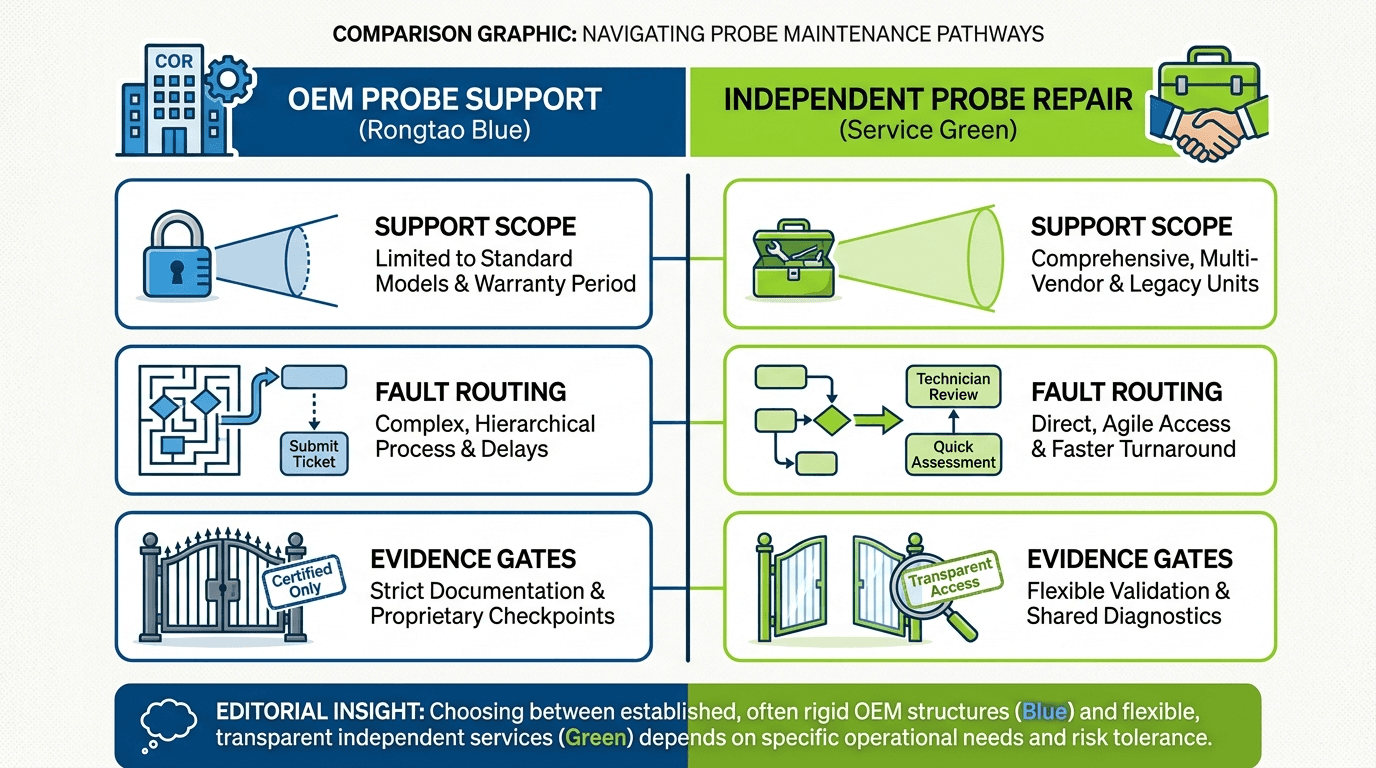
When evaluating service options, procurement leads must understand how OEM probe support and independent probe repair differ in operational execution:
- **OEM Probe Support:** Depending on the manufacturer, model, region, and contract, OEM support may use repair, exchange, or replacement. Confirm whether the returned unit is new, refurbished, or exchanged; which documentation and warranty apply; and whether the original serial-number core is returned.
- **Independent Probe Repair Laboratories:** Specialized labs may isolate lens, cable, strain-relief, connector, or TEE steering faults and quote a targeted repair. Whether the original core is preserved, cost is reduced, or a fault is repairable must be confirmed for that unit. Evaluate the QMS scope, technical capability, acceptance evidence, warranty, and commercial terms.
Common field symptoms can arise from the lens, cable, strain relief, connector, steering assembly, or acoustic array. The fault must be isolated before deciding whether component-level repair is technically and economically sensible; [this repair-versus-replace guide](/blog/reports/ultrasound-probe-repair-vs-replace) explains that decision.
A probe cable contains many fine signal conductors and shielding paths. Crushing, repeated flexing, or pinching can create intermittent channels, noise, or image artifacts. A qualified lab should isolate whether the defect lies in the cable, connector, electronics, or array, then document whether it performed a localized repair, harness replacement, or another route and how the result was verified.
Support-scope comparison matrix — warranty impact, turnaround, fault coverage, documentation, obsolescence, evidence
To establish an objective evaluation framework, compare OEM probe support and independent probe repair across six critical operational metrics:
| Evaluation Dimension | OEM Probe Support Pathway | Independent Probe Repair Laboratory Pathway |
|---|---|---|
| Warranty & Contract Impact | Usually the route least likely to conflict with active OEM coverage, subject to the written contract. | May affect active OEM coverage; review the exact warranty and service-contract language first. |
| Turnaround & Availability | Quote- and inventory-specific; obtain written dispatch or completion timing. | Provider- and fault-specific; obtain a written estimate after diagnosis. |
| Repairable Fault Scope | May offer repair, exchange, or replacement depending on model, contract, and region. | May offer targeted lens, cable, connector, or TEE work if the lab supports the model and fault. |
| Documentation & Lineage | Documentation varies; request the identity, condition, work, test, and warranty records for the route quoted. | Documentation varies; make the required repair and test records contractual before dispatch. |
| Obsolescence / EOS Support | Support may narrow or end after EOS; verify the model-specific lifecycle notice and remaining options. | May extend support for legacy models when repair capability or compatible stock exists. |
| Acceptance Evidence Provided | Ask what unit-specific release and test evidence is supplied; do not assume either presence or absence. | Ask for applicable electrical-safety, acoustic/element, compatible-host, and release evidence. |
Before selecting a service provider, healthcare managers should learn [how to qualify an ultrasound probe repair provider](/blog/reports/qualify-ultrasound-probe-repair-provider) to verify intake diagnostic capabilities, ESD controls, and warranty workflows.
Fault-by-fault routing: cable, lens, acoustic stack, connector, dead elements, TEE steering
Not all transducer defects should be routed to the same repair pathway. Match the observed failure symptom to the technical capabilities of each service model to select the right route:
- **1. Acoustic Lens Wear & Cracking:** Isolate whether damage is superficial or has affected underlying layers or sealing. Ask each provider whether it supports the model, what materials and process it uses, and how it verifies safety and imaging afterward.
- **2. Cable Strain Relief & Outer Sleeve Tears:** Visible damage can conceal conductor, shield, or fluid-ingress problems. Route only after electrical and functional diagnosis defines whether a localized repair or full harness replacement is appropriate.
- **3. Broken Connector Pins & Lock Mechanism Jamming:** Confirm that the provider has the correct connector tooling and compatible host for verification; replacement feasibility depends on the connector and damage extent.
- **4. Dead Elements & Array Line Dropout:** Do not route by a generic element-count threshold. Determine whether the cause is in the cable, connector, electronics, or acoustic array and compare the measured result with the OEM or buyer-approved acceptance criteria.
- **5. TEE Steering, Insertion Tube, and Sealing Faults:** These are specialized, safety-relevant repairs. Use a provider with model-specific capability, validated leak/electrical and functional tests, reprocessing instructions, and clear release criteria; compare with the OEM route when damage is extensive.
- **6. Acoustic Stack or Array Damage:** A lens-only repair cannot correct every internal array failure. Diagnosis may lead to head replacement, exchange, or whole-probe replacement, depending on capability, evidence, and economics.
A TEE repair can involve the insertion tube, bending section, control mechanism, cable, connector, acoustic head, or seals. Architecture and allowable articulation vary by model. Ask the provider to identify the failed assembly, document materials and work performed, and test articulation, leak integrity, electrical safety, imaging, and reprocessing compatibility against the device-specific instructions before release.
The acceptance evidence both routes should produce (and the FDA servicing-vs-remanufacturing line)
Regardless of route, define the evidence required before a returned probe re-enters clinical use. Professional guidance supports routine quality assurance and objective transducer testing, while the exact acceptance plan should reflect probe type, repair scope, manufacturer instructions, facility policy, and risk 1.
A risk-based post-repair evidence pack can include:
- **Electrical Safety & Leak Integrity:** Where applicable, record the probe/equipment configuration, applied-part classification, method, limits, instrument, and numeric results from the manufacturer or validated procedure 4.
- **Acoustic or Element Evaluation:** Record the method and results for element uniformity, sensitivity, cable-flex behavior, or other relevant checks, judged against OEM specifications or buyer-approved validated criteria rather than a universal dead-element percentage.
- **Compatible-Host Imaging:** Where applicable, record system model/software, probe identity, modes exercised, phantom or test object, duration, observed artifacts, and pass/fail authority.
- **Reprocessing Compatibility:** Confirm that repaired materials and instructions remain compatible with the specific probe manufacturer's approved cleaning/disinfection methods and the facility's infection-control procedure; do not substitute a generic chemical list.
Biomedical departments should incorporate these verification gates into their official [ultrasound probe acceptance testing protocol](/blog/reports/ultrasound-probe-acceptance-testing) before releasing any repaired transducer back into clinical rotations.
Repair activities must also respect regulatory boundaries. FDA evaluates the specific activities performed on a particular finished device and whether they significantly change performance, safety specifications, or intended use 3. A lens, cable, connector, or array activity cannot be classified from its short name alone. If the work is remanufacturing, applicable manufacturer obligations may include QMSR and a marketing submission where required; a 510(k) is not automatic for every change. See [FDA servicing vs remanufacturing](/blog/reports/ultrasound-servicing-vs-remanufacturing-fda).
Hard-stop cases and route-specific cautions
To prevent operational missteps, procurement leads should establish clear hard-stop rules for transducer routing:
- **Use the OEM or recall-designated route when required:** Follow the written warranty/service contract, recall instructions, and device-specific restrictions. Also use that route when an independent provider cannot demonstrate the necessary model-specific tooling, software, parts, and acceptance testing.
- **Evaluate a qualified independent route when appropriate:** It may be useful when OEM support is unavailable, a targeted repair is technically feasible, or the documented price and timing fit the operational need. No independent route is automatically mandatory; compare the actual quote, evidence, warranty, logistics, and lifecycle plan.
To evaluate the historical context of independent servicing evidence, review [what the data says about independent medical-device servicing](/blog/reports/right-to-repair-independent-ultrasound-servicing).
Where Rongtao fits — and where it does not
Guangzhou Rongtao Medical Technology Co., Ltd. provides multi-brand ultrasound probe repair and tested transducer solutions. We define our operational scope clearly:
- **Where Rongtao Fits:** We specialize in multi-brand probe repair and tested transducer supply across major OEM platforms. Rongtao states that repaired probes are verified on a compatible live system and that warranty is typically 90 days. Repairability, test records, completion timing, exact coverage, and any extended terms are confirmed per probe and quote; the published 5–8 business-day target applies to standard board repair, not every probe job.
- **Where Rongtao Does Not Fit:** We do not provide factory OEM-new warranty replacement probes for systems under active OEM coverage, nor do we claim OEM authorization or affiliation. If your facility requires factory OEM documentation to satisfy warranty covenants, those requests must proceed directly through the OEM.
Quote-ready intake handoff checklist
Accelerate your probe service evaluation by submitting complete diagnostic details with your inquiry:
- **1. Transducer Identification:** Exact probe model number (e.g., GE C1-5-D, Philips X5-1, Siemens 4V1c), serial number, and connector style.
- **2. Host System Details:** Host ultrasound OEM, model line, and active software revision.
- **3. Specific Symptom Description:** Detailed defect description (e.g., lens peeling, image line dropout, Color Doppler noise, TEE steering knob slipping) accompanied by high-resolution photographs of the defect and connector label.
- **4. Infection Control Status:** Confirmation that the probe has been cleaned and disinfected for shipment according to its instructions for use, facility policy, and the receiving lab's requirements; use the level of disinfection appropriate to the probe and prior use.
- **5. Warranty / Contract Status:** Note whether the probe is under active warranty or if independent service is requested.
To request a probe repair evaluation or explore tested transducer options, visit our dedicated [probe repair service page](/services/probe-repair) or contact our engineering team via our [contact page](/contact).
Frequently Asked Questions
Is independent ultrasound probe repair as good as OEM?
'As good as' cannot be established from the provider category alone. Compare identity, fault diagnosis, work performed, applicable electrical and acoustic results, compatible-host imaging, release authority, warranty, and field history. For an out-of-warranty or EOS probe, that evidence can support a case-specific decision, but it does not guarantee equivalence to an OEM route.
Will using a third-party probe repair void my OEM warranty or service contract?
It can affect coverage, but the answer depends on the written warranty, service contract, jurisdiction, and work performed. Review the agreement and ask the OEM to identify the relevant clause before dispatch. An expired equipment warranty removes that particular coverage issue, but other contracts, regulatory duties, recalls, and facility policies can still apply.
What should I require from a fast-turnaround probe repair service?
Require pre-repair diagnosis, an explicit repair scope, applicable electrical-safety and leak-integrity results, acoustic or element checks, compatible-host verification, infection-control shipping instructions, written warranty/RMA terms, and a realistic completion estimate. Specify which records must accompany the returned probe; do not trade away acceptance evidence for a faster promise.
What probe damage is usually not repairable at the component level?
Severe piezoceramic array shattering, complete backing block delamination, fluid-corroded multi-layer flex circuits, and extensive mechanical distal tip destruction on complex matrix TEE probes are typically unrepairable at the component level. In these instances, whole-unit core exchange or replacement is recommended.
How does chemical disinfection affect acoustic lens degradation over time?
Using a cleaning or disinfection method outside the probe manufacturer's instructions—such as an incompatible agent, concentration, temperature, contact time, rinse, or immersion depth—can damage lenses, seals, adhesives, labels, and cable materials. Follow the device-specific instructions for use and facility infection-control policy. For a repaired probe, obtain written confirmation of compatible reprocessing methods; do not accept unsupported claims that replacement materials exceed OEM performance.