
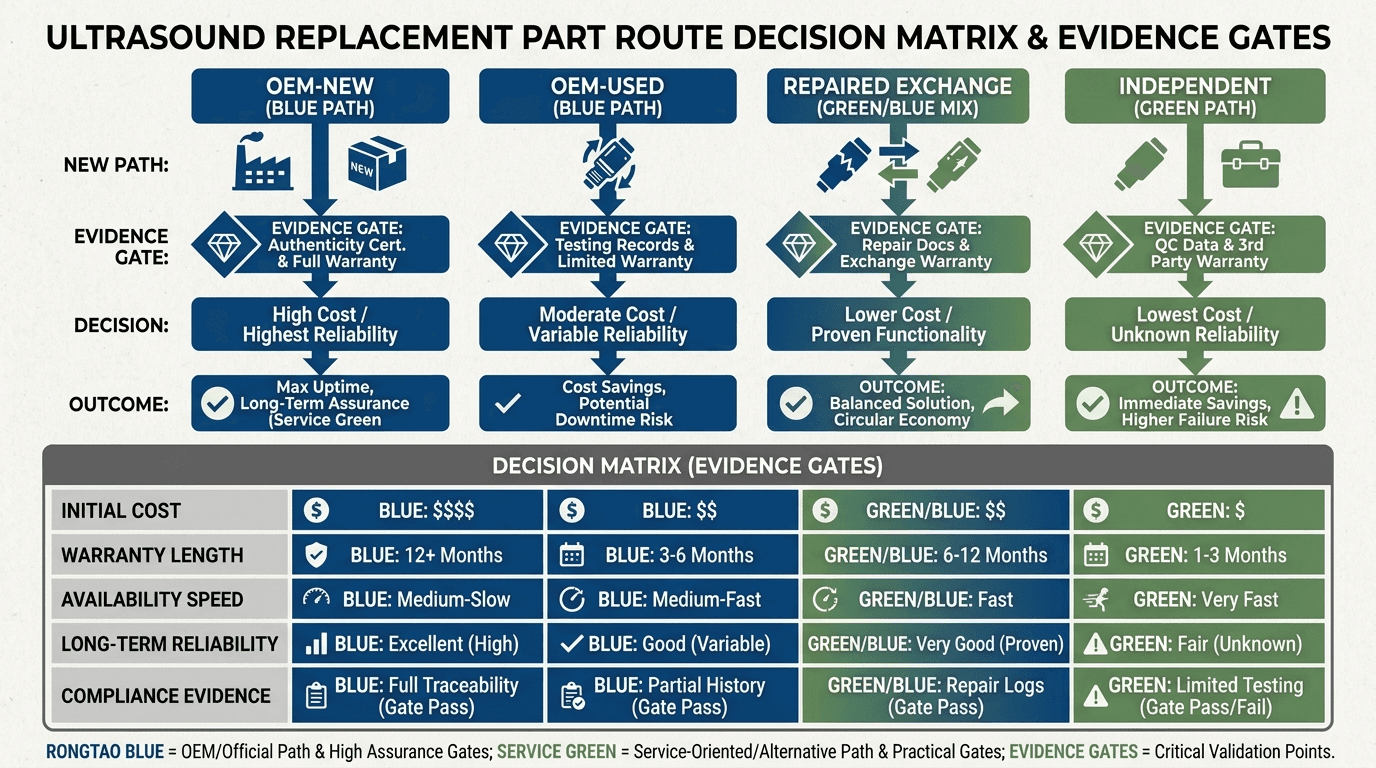
What the four sourcing routes actually are — and what each label really covers
In medical device asset management, terminology surrounding replacement components is frequently conflated. Procurement specialists must distinguish among four specific sourcing routes before issuing purchase orders:
- **1. OEM-New Replacement Parts:** Manufactured directly by or under contract for the original equipment manufacturer (e.g., GE HealthCare, Philips, Siemens Healthineers, Canon Medical Systems). Factory lineage, packaging, documentation, warranty, price, and lead time should be confirmed for the specific part and sales channel rather than inferred from the label alone.
- **2. Tested OEM-Used / Pulled Parts:** Original OEM circuit boards, power modules, or mechanical assemblies harvested from decommissioned host systems in working condition. The quality of a pulled part depends entirely on the reseller's incoming inspection and functional re-test protocol. Without verified real-machine validation, a 'pulled' part carries latent thermal stress, aged passive components, or unrecorded operational hours.
- **3. Repaired / Exchange Parts:** Customer core assemblies that have undergone component-level remediation (such as power MOSFET replacement, trace repair, or BGA reballing) or core-exchange inventory where a failed unit is swapped for a pre-serviced OEM assembly. The viability of this route hinges on the service provider's bench capabilities, electrostatic discharge (ESD) governance, and post-repair functional validation.
- **4. Independent / Third-Party Replacement Parts:** Brand-new hardware manufactured by independent medical component specialists (e.g., replacement high-voltage power supplies, control panel trackballs, LCD display panels, cable harnesses, or acoustic lenses). These assemblies do not originate from the OEM supply chain but are designed to interface directly with target system architectures.
Understanding [why replacement-part provenance is the riskiest link](/blog/reports/ultrasound-parts-provenance-quality) requires recognizing that supplier labels alone do not guarantee functional integrity. A part sold as 'pre-owned' could range from an unverified scrap pulled unit to a fully bench-tested and calibrated assembly.
Route-by-route decision matrix: criticality, lead time, cost-in-risk, evidence required, obsolescence
To remove guesswork from procurement decisions, healthcare technology managers (HTM) and biomedical engineering teams should apply a structured decision matrix. Sourcing decisions must weigh system criticality against downtime tolerance and vendor evidence.
| Sourcing Route | Optimal Application Scenario | Typical Lead Time | Risk Profile & Cost-in-Risk | Evidence to Request | Obsolescence Handling |
|---|---|---|---|---|---|
| OEM-New Parts | Safety-critical assemblies under active OEM warranty; systems requiring strict OEM software lineage. | Quote-specific; backorders and regional stock can materially change timing. | Strong factory lineage when documentation is authentic; cost and downtime exposure remain quote-specific. | Matching identity/revision and the factory or authorized-channel documents supplied for that item. | Availability may narrow or end after the OEM changes service support. |
| Tested OEM-Used / Pulled | Mid-to-high criticality out-of-warranty systems; urgent downtime situations requiring original hardware. | Stock- and destination-specific; require a written dispatch target. | Moderate technical risk; risk is reduced when seller supplies unit-specific test evidence. | Device identity verification, photographic intake log, real-machine boot/scan evidence, electrical safety log. | Primary route for maintaining legacy systems where OEM-new inventory is depleted. |
| Repaired / Exchange Parts | Board-level failures (beamformers, transmitters, power supplies) on supported multi-brand fleets. | Provider- and job-specific; Rongtao publishes 5–8 business days for standard board repair, while exchange dispatch depends on confirmed stock and terms. | Low to Moderate technical risk; depends directly on provider ESD and micro-soldering governance. | Available failure/repair records, item-appropriate test evidence, compatible-host verification where applicable, and warranty terms. | Highly effective for extending service life on mature architectures with active repair benches. |
| Independent Replacement | High-wear mechanical/electronic peripherals (trackballs, power modules, monitors, probe cables). | Inventory- and supplier-specific; require written availability and dispatch timing. | Low to Moderate technical risk; requires verifying electrical and mechanical form-fit-function. | Dimensional compliance, mechanical life cycle testing, electrical safety certification, warranty. | Critical for replacing vulnerable wear items on both active and legacy platforms. |
When evaluating costs, procurement leads should consider total cost of ownership (TCO), not just the quoted price. A discounted but unverified board can become more expensive if it fails early and triggers another field visit, more downtime, freight, and clinical rescheduling; enter your actual price, failure, labor, and downtime assumptions instead of relying on a generic percentage.
The evidence you must demand from every route (and why 'FDA-registered' and 'OEM-equivalent' are not proof)
A central vulnerability in medical parts procurement is accepting seller marketing rhetoric as technical proof. Buyers must establish non-negotiable acceptance evidence gates regardless of which sourcing route is selected.
First, clarify regulatory and QMS definitions:
- **'FDA-Registered' is Not Part Approval:** Establishments that fall within 21 CFR Part 807 registration and listing requirements must comply, but a registration entry is administrative and does *not* mean FDA has inspected, tested, cleared, approved, or certified an individual spare part, board, probe, or repair service 3. To audit this claim, review [how to qualify an ultrasound parts and service supplier](/blog/reports/ultrasound-supplier-qualification-fda-registration-scorecard).
- **ISO 13485 Addresses a Quality Management System, Not a Product Certificate:** A certification can cover an organization's defined QMS scope and sites; it does not by itself certify the performance of a particular ultrasound board 2. Treat 'ISO-certified part' as imprecise unless the seller explains the claim and supplies unit-specific evidence. For a detailed breakdown, consult [which standards actually matter when buying ultrasound parts](/blog/reports/ultrasound-parts-standards-checklist).
- **'OEM-Equivalent' is Unsubstantiated Marketing:** Without published engineering specifications, tolerance stack-ups, and comparative bench testing under IEC 60601-2-37 parameters 4, claiming 'OEM-equivalent performance' is an unverified assertion. Buyers should demand empirical test data rather than accepting verbal claims.
Before accepting any replacement assembly into inventory or installing it into a clinical system, demand a complete incoming evidence pack:
- **1. Unit-Specific Device Identity Verification:** High-resolution photographs showing part numbers, revision levels, serial numbers, and PCB barcode labels matching the shipping documentation.
- **2. Functional & Compatible-Host Test Evidence:** Ask what was tested, on which system and software revision, for how long, against what limits, and with what result. The appropriate modes and stress checks depend on the assembly.
- **3. Applicable Safety Evidence:** IEC 62353 covers recurrent and post-repair testing of medical electrical equipment or systems and relevant parts. Request the method, configuration, limits, instrument, and results where it applies instead of expecting the same certificate for every loose component 4.
- **4. Clear Warranty & Return Terms:** Obtain written coverage duration, exclusions, remedies, RMA steps, response target, and freight allocation. Advance replacement should be treated as a separate contracted option, not an assumed warranty feature. For details, see [ultrasound parts condition grades and acceptance evidence](/blog/reports/ultrasound-parts-condition-grades-acceptance-evidence).
Where the FDA draws the line: servicing, remanufacturing and what changes your obligations
When sourcing repaired, refurbished, or modified components, healthcare organizations must understand the regulatory boundaries governing medical device maintenance. On May 10, 2024, the U.S. FDA issued its final guidance document, *Remanufacturing of Medical Devices* (89 FR 40490, doc 2024-10230) 1.
The guidance distinguishes between routine servicing and remanufacturing:
- **Servicing:** Maintenance or repair intended to return a finished device to its original safety and performance specifications and intended use 1. Whether a particular capacitor, trackball, board, or probe repair remains servicing depends on the actual activity and its effect on the finished device—not the component name alone.
- **Remanufacturing:** Processing, conditioning, renovating, repackaging, or restoring a device can be remanufacturing when the activity significantly changes the finished device's performance, safety specifications, or intended use 1. Applicable manufacturer obligations may then include registration/listing, QMSR, reporting, labeling, and a marketing submission where required; a 510(k) is not automatic for every case.
Procurement leads should review [where the FDA draws the line on servicing vs remanufacturing](/blog/reports/ultrasound-servicing-vs-remanufacturing-fda) to ensure that independent repair partners operate within servicing boundaries and do not inadvertently introduce unapproved design modifications.
When OEM-new is unavailable: end-of-support and the case for a tested independent source
A common operational challenge in hospital biomedical departments is managing systems past their OEM End of Service (EOS) date. Support windows and parts availability vary by manufacturer, model, region, contract, and inventory, so buyers should obtain the applicable lifecycle notice rather than assume a fixed number of years.
When an EOS declaration occurs, OEM-new parts are no longer manufactured. Healthcare facilities face two options: execute a capital-intensive system replacement or transition spare-parts sourcing to tested independent providers and component-level repair benches.
In EOS scenarios, an independent supplier offering tested OEM-used components or component-level board repairs provides substantial strategic value. By maintaining real-machine test beds for mature platforms (e.g., GE Logiq E9, Philips EPIQ 7, Siemens S2000, Toshiba/Canon Aplio series), qualified independent suppliers enable healthcare facilities to extend the clinical life of functional diagnostic assets, optimizing capital expenditure schedules without compromising diagnostic uptime.
Where Rongtao fits — and where it does not
Guangzhou Rongtao Medical Technology Co., Ltd. operates as an independent multi-brand ultrasound solutions provider, specializing in board-level repair, probe restoration, and tested replacement parts.
To maintain transparent buyer expectations, we define precisely where Rongtao's capabilities align with customer requirements—and where they do not:
- **Where Rongtao Fits:** We serve biomedical engineering departments, ISOs, refurbishers, and distributors seeking tested OEM replacement parts, component-level board repairs, or probe restoration for out-of-warranty or EOS systems across major platforms (GE, Philips, Siemens, Canon/Toshiba, Mindray, Samsung Medison). Rongtao publishes ISO 13485:2016 and ISO 9001:2015 quality-system credentials, 48-hour real-machine QA for every repaired board, a standard board-repair target of 5–8 business days, compatible-live-system verification for repaired probes, and a typical 90-day warranty. Probe timing and exact coverage are quote- and service-specific.
- **Where Rongtao Does Not Fit:** We are an independent service provider and do not claim OEM authorization, affiliation, or endorsement from GE, Philips, Siemens, Canon, or any other manufacturer. We do not provide factory OEM-new parts under active manufacturer warranty, nor do we issue OEM software licenses. Sourcing decisions requiring strict factory-new OEM lineage should proceed through the respective OEM distribution channels.
Quote-ready intake handoff checklist
When requesting a quote or submitting a part for exchange or component-level repair, providing complete technical data accelerates processing and prevents part misidentification. Prepare the following details prior to submitting an inquiry:
- **1. Exact System Identification:** OEM brand, full model name, system revision (e.g., GE Logiq E9 Revision R5 vs R6), and host software version.
- **2. Part & Assembly Markings:** Manufacturer part number, board revision code, serial number, and clear photographs of both sides of the circuit board or component label.
- **3. Failure Description & Error Logs:** Specific symptom description, system error codes generated during boot or operation, and relevant diagnostic log dumps.
- **4. Target Service Route:** Specify whether your requirement is for an outright tested part purchase, core exchange, or component-level repair of your original core.
- **5. Logistics & Urgency:** Quantity required, destination postal code, and required delivery timeframe.
To submit an inquiry or verify component availability from our catalog, visit our [parts catalog](/parts) or contact our technical engineering team directly through our [contact page](/contact).
Frequently Asked Questions
Below are natural-language answers to common questions regarding OEM and third-party ultrasound parts procurement.
Is it better to use OEM parts or aftermarket/third-party ultrasound parts?
It depends on part criticality, lead time, system warranty status, compatibility, and seller evidence. OEM-new can provide the clearest factory lineage when sourced through the appropriate channel. For out-of-warranty or EOS systems, tested OEM-used, repaired, or independent options may reduce cost or delay, but buyers should compare unit-specific evidence and written terms rather than assume comparable reliability.
What makes an ultrasound replacement-parts supplier trustworthy?
Trustworthiness is supported by objective evidence: a verifiable QMS certificate whose scope and sites fit the work, matching device identity, item-appropriate functional and safety records, transparent warranty/RMA terms, and traceable intake-to-shipment workflows. IEC 62353 evidence should be requested where applicable to the equipment or relevant part, not as a universal loose-part certificate. Do not rely solely on labels such as 'ISO-certified part' or 'OEM-equivalent.'
Are OEM parts the same as original parts?
An 'OEM-new' part is manufactured by or for the original equipment manufacturer and supplied unused. A 'tested OEM-used' or 'pulled' part is an original OEM component harvested from a decommissioned host system; its quality depends on incoming re-test validation. An 'independent replacement' part is manufactured by a third party. Distinguish between original brand origin and component operational condition.
How do I compare repair parts, pre-owned, refurbished, and component-level repair routes?
Map each option to system criticality and evidence. Pre-owned or pulled parts need identity and re-test proof; a refurbished label needs a defined scope and release evidence, with IEC 63077 relevant to refurbishment processes for used medical imaging equipment and systems; component-level repair may preserve the original board revision when that same core is returned, but the commercial and technical outcome depends on the job and provider.