
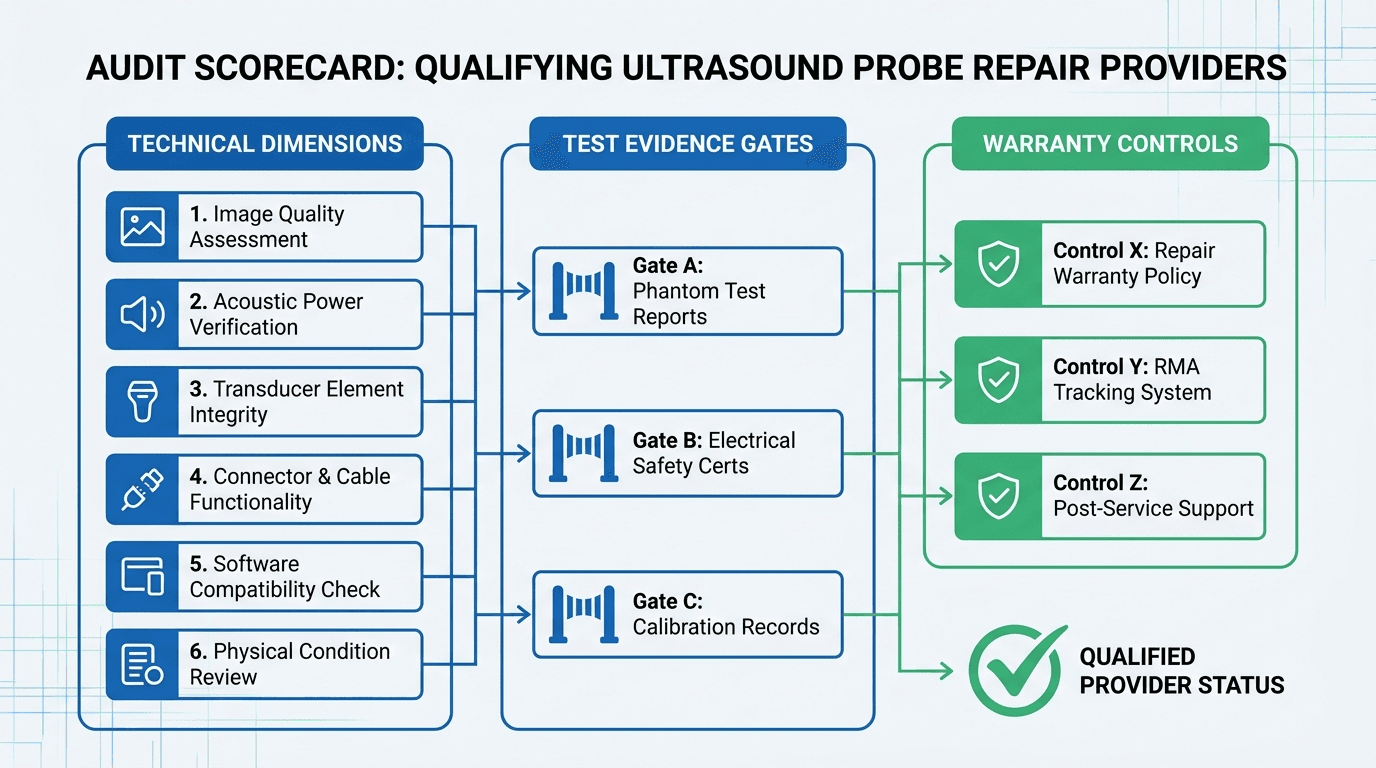
The six-dimension probe repair provider audit, and how to score it on evidence
Evaluating an ultrasound probe repair partner requires a systematic framework that scores physical evidence rather than verbal assurances. The scorecard structures provider evaluation across six technical and operational domains:
| Audit Dimension | Key Evaluation Criteria | Evidence to Request |
|---|---|---|
| 1. Intake & Fault Isolation | Pre-repair visual inspection, acoustic matrix mapping, photographic defect logging, pre-quote diagnostic report. | Verifiable pre-repair diagnostic report identifying specific failure mechanisms prior to repair quotation. |
| 2. Repair-Scope Boundaries | Explicit repair capability definitions (lens, strain relief, cable, connector, TEE articulation) and escalation limits. | Written boundary statement defining which components are repaired vs declined or escalated to exchange. |
| 3. Post-Repair Test Evidence | Item-appropriate electrical/leak-integrity checks, acoustic or element evaluation, and compatible-host imaging. | Unit-specific record naming the method, configuration, criteria, results, instrument where relevant, and release authority. |
| 4. Cleaning & Infection Control | Incoming decontamination requirements and device-specific reprocessing compatibility after repair. | Written shipping instructions and confirmation that repaired materials remain compatible with the probe IFU. |
| 5. Warranty & RMA Workflow | Written warranty duration, explicit exclusion clauses (e.g., fluid immersion, physical drop), clear RMA path. | Written coverage, exclusions, remedies, RMA steps, response targets, freight allocation, and any separately contracted exchange option. |
| 6. TEE & High-Risk Escalation | Dedicated TEE leak testing, mechanical steering tension calibration, distal tip sealing, recall-affected probe routing. | Specialized TEE audit protocol including fluid ingress testing and articulation angle calibration. |
Procurement teams can mirror this structure with the site's parallel scorecard for circuit boards: [how to qualify a component-level ultrasound board repair provider](/blog/reports/qualify-component-level-ultrasound-board-repair-provider).
Intake and fault isolation: what a credible lab does before it quotes
A common red flag in vendor evaluation is receiving a repair quote based solely on a customer's brief description without physical bench inspection. A qualified probe repair facility executes a strict intake inspection before issuing a binding quote.
A credible intake plan selects checks that fit the probe type and reported fault; common elements include:
- **1. High-Magnification Optical Inspection:** Inspecting the silicone acoustic lens for micro-pinholes, delamination pockets, or chemical swelling under stereo microscopes.
- **2. Cable & Strain Relief Inspection:** Flexing the cable harness while monitoring signal continuity to detect intermittent wiring fractures or outer sheath tears.
- **3. Connector Housing & Pin Audit:** Checking multi-pin array connectors for recessed, bent, oxidated, or broken signal pins and inspecting locking mechanisms.
- **4. In-Air Reverberation Element Scan:** Executing an automated acoustic matrix scan to map individual element sensitivity, identifying dead, weak, or noisy channels across the transducer array 3.
- **5. Pre-Repair Electrical Safety Check:** Measuring baseline insulation resistance and chassis leakage current prior to disassembly.
Automated probe-analysis systems can provide channel-level measurements, but capabilities and metrics vary by fixture and probe. Ask the lab to explain what its method measures, how it establishes a baseline, and which validated acceptance criteria it uses. Depending on the equipment, outputs may include:
- **Electrical channel measurements:** Values such as capacitance or continuity can identify an outlier, but a single value rarely proves the physical root cause.
- **Relative element response:** Sensitivity or uniformity plots can reveal weak or missing channels when compared with a validated baseline.
- **Frequency-domain or pulse-response measurements:** These may help characterize the array when the fixture and probe support them.
- **Compatible-host imaging:** System diagnostics and controlled images help connect bench measurements to observed probe behavior.
Requiring intake photo logs and baseline diagnostic reports ensures that quotes reflect actual physical defects rather than flat-rate overcharges.
Repair-scope boundaries — cable, lens, acoustic stack, connector, TEE — and what gets escalated
A reputable probe repair laboratory maintains clear operational boundaries regarding which defects can be safely restored at the component level and which must be escalated to core exchange.
- **Standard Repair Scope (In-House Restoration):** Re-lensing using medical-grade RTV silicone, strain relief boot replacement, cable harness re-sheathing, connector pin re-soldering and housing replacement, TEE bending rubber re-sealing, and TEE control cable tension adjustment.
- **Escalation / Non-Repairable Boundaries:** Extensive piezoceramic array cracking caused by severe physical drops, severe backing block delamination, fluid-corroded multi-layer PCB mainboards inside matrix array probe heads, and structural frame fractures. A trustworthy lab will decline micro-lens patching on severely shattered arrays and recommend core exchange instead.
The acoustic lens is part of the probe's protective and acoustic stack, so a re-lensing process should control material identity, geometry, bonding, voids, curing, sealing, biocompatibility where applicable, and compatibility with approved reprocessing methods. Do not qualify a lab from an unsupported material number or 'medical-grade' label alone. Ask how the provider validates the finished probe against model-specific imaging, safety, dimensional, and durability criteria.
Reviewing [OEM probe support vs independent ultrasound probe repair](/blog/reports/oem-vs-independent-ultrasound-probe-repair) provides additional context on matching specific fault types to service pathways.
Post-repair evidence you must receive: leakage (IEC 60601-2-37/62353) + acoustic/element checks
The core pass/fail criterion in provider qualification is the quality of post-repair validation evidence. AIUM guidelines stipulate that regular assessment of transducer operation and quality control of repaired transducers are essential for patient safety 1 2.
Audit candidate providers against three evidence categories, adapting each to the probe and repair:
- **1. Applicable Electrical Safety and Leak Integrity:** Request the probe/equipment configuration, applied-part classification, method, criteria, instrument, numeric results, and pass authority. IEC 62353 applies to medical electrical equipment or systems and relevant parts; not every probe needs the same test sequence 4.
- **2. Quantitative Acoustic or Element Evaluation:** Ask for the method, baseline, results, and acceptance limits. Use OEM specifications or buyer-approved validated criteria rather than a universal zero-dead-element or percentage rule 3.
- **3. Compatible-Host Imaging:** Where applicable, record the host model/software, modes exercised, test object or phantom, duration, observed artifacts, and pass/fail result.
Incorporate these criteria into your facility's formal [ultrasound probe acceptance testing protocol](/blog/reports/ultrasound-probe-acceptance-testing) before placing repaired probes back into active clinical service.
Cleaning/infection-state disclosure, warranty exclusions, and repeat-failure/RMA handling
Infection control and clear commercial terms are vital components of provider governance:
- **Infection Control & Decontamination Disclosure:** Agree on how the probe must be cleaned and disinfected for shipment and what status declaration accompanies it. After repair, confirm that materials and instructions remain compatible with the device-specific IFU and facility procedure; the appropriate disinfection level depends on probe type and use.
- **Transparent Warranty Coverage & Exclusions:** A published duration—such as Rongtao's typical 90-day warranty—is only a starting point. Require the quote to define coverage, exclusions, remedies, evidence needed for a claim, response target, and freight allocation.
- **RMA & Repeat-Failure Workflow:** Require a documented contact and RMA path, intake and diagnosis process, status communication, escalation, disposition, and closeout record. Priority scheduling or advance replacement should be written into the agreement if purchased, not assumed.
TEE, high-risk and recall-affected probes: the stricter gate
Transesophageal Echocardiography (TEE) transducers and surgical intraoperative probes require heightened audit scrutiny due to direct contact with internal mucous membranes and semi-critical/critical clinical environments.
Stricter audit requirements for TEE and high-risk probes include:
- **1. Fluid Ingress & Leak Testing:** Use the TEE manufacturer's specified leak-test method, fluid, immersion boundaries, test equipment, limits, and sequence; a generic prolonged saline soak can damage a probe or produce invalid results.
- **2. Mechanical Steering and Articulation:** Verify motion range, controls, locks, insertion tube, bending section, and distal tip against the model-specific instructions and documented acceptance criteria.
- **3. Recall-Affected Probe Protocols:** Probes subject to active FDA safety alerts or recalls must follow designated manufacturer or regulatory recall procedures rather than standard commercial repair.
Where Rongtao fits — and where it does not
Guangzhou Rongtao Medical Technology Co., Ltd. provides transparent multi-brand probe repair solutions:
- **Where Rongtao Fits:** We operate a multi-brand probe repair service backed by published ISO 13485:2016 and ISO 9001:2015 quality-system credentials. Rongtao says repaired probes are verified on a compatible live system and that warranty is typically 90 days. Repair scope, available records, completion timing, exact coverage, and any extended terms are confirmed per probe and quote; the 5–8 business-day published target is for standard board repair.
- **Where Rongtao Does Not Fit:** We are an independent service provider and do not claim OEM authorization or affiliation. Buyers should review active OEM warranty and contract language before authorizing third-party work and use the OEM or recall-designated route where required.
Quote-ready intake handoff checklist
Prepare the following details prior to submitting a probe for audit evaluation or repair quote:
- **1. Probe Model & Serial Number:** Exact transducer model string, serial number, and connector type.
- **2. Host System Compatibility:** Host OEM brand, model series, and software release version.
- **3. Failure Description & Photographs:** Clear description of observed physical or acoustic defects, accompanied by photos of the lens, strain relief, cable, and connector.
- **4. Decontamination Confirmation:** Statement confirming that the probe has undergone facility decontamination prior to dispatch.
- **5. Facility Service Expectations:** Target turnaround time, required warranty duration, and logistics requirements.
To request a probe repair audit evaluation or submit a transducer for service, visit our [probe repair service page](/services/probe-repair) or reach our engineering team directly via our [contact page](/contact).
Frequently Asked Questions
How do I choose a qualified ultrasound probe repair provider for long-term stability?
Apply a six-dimension audit covering intake diagnosis, repair boundaries, item-appropriate electrical/acoustic evidence, infection-control disclosures, warranty/RMA terms, and TEE escalation. Define the unit-specific records required for each probe type and repair instead of demanding the same IEC 62353 sequence from every returned transducer.
How can I find a reputable ISO-oriented ultrasound probe restoration service?
Verify the ISO 13485 certificate number, status, scope, sites, and issuing certification body. Certification concerns the stated QMS scope, not an individual probe. Pair it with unit-specific diagnosis, work, applicable test, compatible-host, release, and warranty records.
What post-repair evidence should a probe repair provider give me?
Define a dossier appropriate to the job: probe identity, incoming fault, authorized repair scope, work performed, applicable electrical/leak-integrity results, acoustic or element checks, compatible-host imaging, release approval, reprocessing compatibility, and written warranty/RMA terms. Record 'not applicable' with a reason where a test does not fit the probe or repair.
How should a provider handle TEE and high-risk probes?
TEE and surgical probes need device-specific leak, electrical, mechanical, imaging, reprocessing, and—where applicable—thermal checks based on the manufacturer instructions and repair scope. Do not substitute a universal soak or articulation procedure. Probes under an active recall should follow the official recall instructions.
Why does acoustic impedance matching matter during RTV silicone probe re-lensing?
The lens is part of the acoustic path, so its material and geometry can affect coupling, focusing, bandwidth, sensitivity, and artifacts. A provider should control material identity, molding/bonding, cure, thickness, voids, sealing, biocompatibility where applicable, and reprocessing compatibility, then validate the finished probe against model-specific criteria. A claimed impedance number alone does not prove performance.