
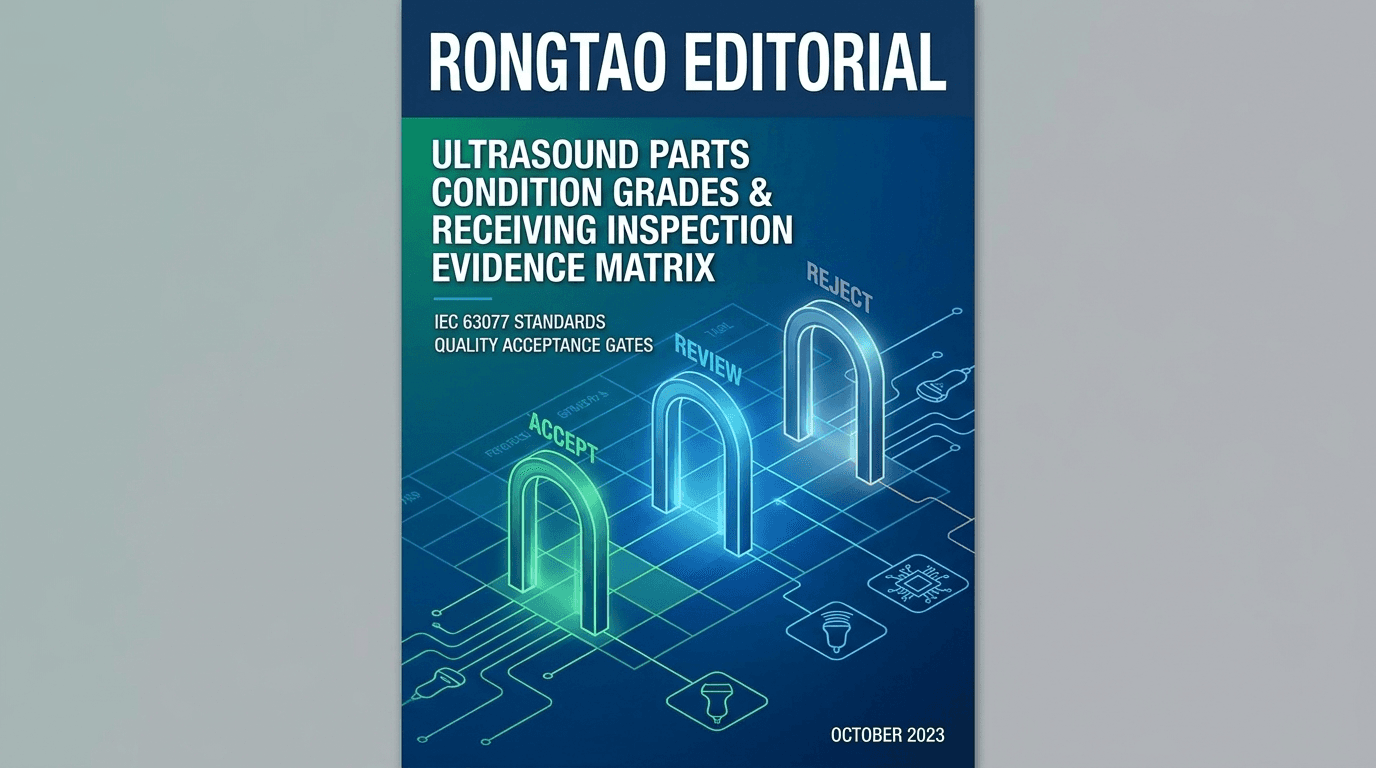
What do used, as-is, pulled, tested, repaired, refurbished, exchange and remanufactured actually mean for ultrasound parts?
The medical imaging replacement parts market encompasses diverse sourcing channels ranging from direct OEM distribution to independent service organizations, broker networks, and secondary equipment liquidators. Because terminology is not uniformly regulated across international commercial platforms, buyers must decode the underlying technical realities represented by common industry labels.
To establish clarity, procurement managers should understand [the six origins of a replacement part](/blog/reports/ultrasound-parts-provenance-quality) to differentiate between original factory stock, system pulls, and repaired assemblies. Below is the technical breakdown of prevailing market condition labels:
- **Used / As-Is:** This usually signals that the buyer should assume little or no verification until the seller defines otherwise. Ask what cleaning, inspection, testing, provenance, warranty, and return rights actually apply; the label alone does not establish any of them.
- **Pulled / De-Installed:** The part was removed from a working system during equipment teardown. While sellers often imply functionality because the host scanner was operational prior to disassembly, the part itself has not undergone individual bench testing, static isolation, or post-extraction verification.
- **Tested Working:** The supplier claims to have executed a diagnostic test. However, without a formal test protocol disclosure, 'tested' may range from a simple power-on LED check on a bench fixture to a comprehensive multi-hour real-machine clinical scan. Buyers must ask: *Tested how, on what system, and to what performance criteria?*
- **Repaired / Service Exchange:** A specific, identified hardware fault (such as a blown power MOSFET or shorted capacitor) on the assembly was isolated and remediated. The part is restored to functional operation, but non-failed adjacent components remain original.
- **Refurbished:** Treat this as an evidence claim, not a self-proving grade. Ask which documented process was applied, whether the seller is claiming alignment with IEC 63077 for used medical imaging equipment, what was repaired/reworked/updated, and how safety and performance were verified 1.
- **Core Exchange:** A commercial transaction model where the buyer receives a tested or repaired replacement assembly in exchange for returning their failed 'core' unit. The delivered part's history depends on whether it was repaired or refurbished.
- **Remanufactured:** FDA focuses on the specific activities performed on a finished device and whether they significantly change performance, safety specifications, or intended use 2. If the activity is remanufacturing, applicable manufacturer obligations can include registration/listing, QMSR, reporting, labeling, and a marketing submission where required; a 510(k) is not automatic in every case.
To evaluate these categories systematically, examine the regulatory and technical distinctions across maintenance activities:
| Activity Level | Governing Standard / Guidance | Technical Scope & Requirements | Regulatory Responsibility |
|---|---|---|---|
| Routine Servicing | FDA 21 CFR Part 820 / ISO 13485 | Maintenance or repair returning a device to its original intended specifications without design changes. | Service provider maintains service records; device manufacturer status unchanged. |
| Refurbishment | IEC 63077:2019 Standard | Systematic process restoring used equipment to OEM safety/performance specifications under QMS. | Refurbisher acts under ISO 13485 QMS; requires comprehensive test travelers and serial trace. |
| Remanufacturing | FDA Guidance (89 FR 7496) | Significant processing altering performance, safety, or clinical intended use of finished device. | The entity may assume applicable manufacturer/remanufacturer obligations; the needed marketing submission depends on the device and change. |
Why is a condition label never sufficient on its own?
A central vulnerability in medical device parts procurement is treating vendor condition labels as self-authenticating quality grades. In commercial practice, two suppliers listing a 'Philips EPIQ 7 Power Supply' as 'Refurbished' may deliver vastly different products.
Two sellers can use 'refurbished' while performing very different work. One may mean cosmetic cleaning and a short functional check; another may use a documented restoration plan, controlled repair/rework, applicable updates, verification, and traceability. Do not infer capacitor replacement, firmware work, calibration, or IEC testing unless the item-specific record actually shows it.
Without demanding the underlying inspection and test evidence, buyers pay premium prices for Supplier A's cosmetic cleaning while assuming they received Supplier B's engineering restoration. Buyers must cross-reference part claims against [which standards actually matter when buying ultrasound parts](/blog/reports/ultrasound-parts-standards-checklist) to separate marketing terminology from verifiable technical execution.
The subjective nature of commercial descriptors becomes acutely dangerous when evaluating ultrasound transducers. A probe labeled 'Tested Good' by a broker may pass a basic system boot check, but hide delaminated acoustic matching layers, cracked piezoelectric crystal elements, or fluid ingress inside the connector block. Unless the vendor provides an acoustic element sensitivity report (such as FirstCall probe testing data showing capacitance, phase, and sensitivity across all 128 or 192 array elements), the buyer has no empirical proof of image quality.
Evaluating ultrasound transducers requires understanding five physical degradation modes that standard boot checks fail to catch:
- **1. Acoustic Matching Layer Delamination:** Microscopic air gaps between acoustic matching layers and piezoelectric elements produce severe reverberation artifacts and acoustic shadows, degrading image penetration.
- **2. Piezoelectric Element Crystal Cracking:** Physical drops or thermal shock cause individual PZT crystal elements to fracture. A probe with 8 dead elements may show a acceptable image on low-gain B-mode, but produce severe velocity drops on Color Doppler.
- **3. Lens Membrane Disbonding & Chemical Degradation:** Corrosive disinfectant wipes degrade silicone acoustic lenses, allowing air bubbles or acoustic coupling fluid to enter the lens array.
- **4. Cable Harness Shielding Breakdown:** Bending fatigue fractures individual coaxial copper micro-wires inside the cable bundle, causing intermittent interference lines across the B-mode sector when the cable is flexed.
- **5. Pin Housing Contamination & Oxidation:** Corroded gold pins inside the probe connector block introduce contact resistance, creating channel noise and inter-channel crosstalk.
What do IEC 63077:2019 and FDA guidance actually require?
To protect healthcare organizations from deceptive marketing, international standards bodies and national regulators have established clear boundaries governing equipment restoration.
**IEC 63077:2019 (Good Refurbishment Practices for Medical Imaging Equipment):** IEC describes and defines the process for restoring used medical imaging equipment to safety and performance comparable to new equipment without changing its intended use 1. Its scope is equipment and systems; buyers should not assume a seller's loose-part label demonstrates conformity. Relevant evidence themes include:
- **Documented Process & Responsibility:** Identify the organization, equipment, scope, controlled procedures, and release authority.
- **Original Specification Baseline:** Show how the equipment is restored without changing the applicable safety/performance specifications or intended use.
- **Replacement-Part Controls:** Document the selection and suitability of parts used during the restoration rather than claiming undefined 'factory grade.'
- **Verification & Traceability:** Retain equipment identity, work performed, updates, inspections/tests, results, and release records.
**FDA Servicing vs. Remanufacturing Guidance:** FDA distinguishes servicing from remanufacturing by examining the specific activities performed on a particular finished device 2. Servicing returns a device to the OEM-established safety/performance specifications and original intended use; an activity likely becomes remanufacturing when it significantly changes performance, safety specifications, or intended use. Remanufacturers are subject to applicable manufacturer requirements, but the exact regulatory pathway and any marketing submission are device- and change-specific.
How do receiving teams build a receiving-inspection evidence matrix?
Regardless of whether a vendor labels a part as used, pulled, tested, or refurbished, receiving teams should apply a documented, risk-based evidence matrix upon arrival. The examples below are procurement controls—not regulatory grades—and should be adapted to the part, host system, supplier agreement, and facility procedure:
| Condition Grade | Vendor Documentation Required | Receiving Verification Gate | Risk Level |
|---|---|---|---|
| Used / As-Is | None (sold as-is). | Visual damage check plus the technical checks your risk assessment requires before installation. | Highest uncertainty unless independently verified |
| Pulled / De-Installed | Donor system model/serial ID; extraction date tag. | Inspect for ESD damage, trace oxidation, and connector pin wear. | High uncertainty until identity and function are verified |
| Tested Working | Bench test report; fixture diagnostic log; serial tag. | Verify serial number matches report; run real-machine system test. | Depends on the disclosed test scope and results |
| Repaired / Exchange | Root-cause repair report; component replace log; test data. | Review repair and test records; perform applicable post-repair and system-level checks. | Depends on repair scope and evidence |
| Refurbished | Defined refurbishment scope, identity, work record, and verification/release evidence. | Confirm what was refurbished and verify applicable system performance. | Depends on process scope and evidence |
| Remanufactured (FDA) | Applicable regulatory status and quality records; marketing submission reference only where required. | Confirm device identity, change scope, release evidence, and applicable regulatory pathway. | Depends on change scope and evidence |
Receiving protocols should follow a structured step-by-step physical and electronic workflow upon package unboxing:
- **Step 1: Outer Shipping Box & Environmental Seal Check:** Inspect the shipping container for physical crush damage, puncture marks, or moisture staining. Verify that environmental shock/tilt indicator tags (such as ShockWatch or TiltWatch) are intact and non-activated.
- **Step 2: ESD Packaging Verification:** For ESD-sensitive electronics, confirm that packaging is intact and appropriate for the device and the supplier's documented ESD-control process; a symbol or bag alone does not prove process conformity.
- **Step 3: Label & Revision Code Verification:** Compare the physical part number label, serial barcode, and hardware revision letter directly against the vendor invoice and your host system's hardware compatibility matrix.
- **Step 4: Microscopic Visual Inspection:** Inspect PCB surfaces under illumination for micro-cracks, cold solder joints, unauthorized jumper wires, flux residue, or bent connector pins.
- **Step 5: Pre-Installation Technical Gate:** Perform the checks applicable to the part and host system. IEC 62353 addresses recurrent and post-repair testing of medical electrical equipment or systems and relevant parts, so select the method and limits from the equipment instructions and facility procedure rather than applying one loose-board test universally.
A receiving team can record its selected checks in a **Parts Receiving Traveler Log**. The following six fields form a useful template; the actual tests and acceptance limits should come from the relevant service documentation, validated procedure, and risk assessment:
- **Gate A: Shipping Box & Cushioning Audit:** Record box condition, internal anti-static foam density, and seal integrity tags.
- **Gate B: Moisture & Packaging Check:** Record moisture-barrier integrity, desiccant or humidity indicator status where supplied, and follow the component manufacturer's handling instructions after any suspected moisture exposure.
- **Gate C: Part Number & Revision Matching:** Match board part number (P/N), revision code (REV), and serial number (S/N) against host system software compatibility matrix.
- **Gate D: Physical Hardware Inspection:** Check for oxidized PCB gold fingers, cracked SMD ceramic capacitors, damaged connector headers, or burnt PCB traces.
- **Gate E: Applicable Electrical-Safety Check:** Record the method, configuration, limits, instrument, and results required for the equipment or relevant part; do not reuse generic limits without confirming applicability.
- **Gate F: Functional Host Verification:** Where safe and practical, test on a compatible host using the modes and duration appropriate to the repaired or replacement assembly, and retain the results.
Specialized receiving protocols may apply to high-voltage power modules and control-console displays. Qualified personnel should use the manufacturer's service procedure and rated test equipment for a power module; unverified generic resistance limits can be unsafe or misleading. For displays and user-interface panels, document touch response, backlight stability, physical condition, and any model-specific diagnostics before release.
When required evidence is missing or packaging integrity is questionable, keep the item from unintended use under the organization's nonconforming-product or receiving-control procedure. Record the discrepancy, request clarification, and release, reject, or return it according to pre-agreed acceptance and RMA terms. ISO 13485 certification can support a supplier's quality-system claim, but the buyer should apply its own documented process rather than assume a universal color label or 48-hour deadline.
TEE probes need model-specific inspection because articulation, leak testing, electrical safety, and reprocessing requirements vary by device. Follow the manufacturer's instructions for use and service procedure for articulation range and leak-test method; document lens, bending section, controls, cable, connector, and any evidence of fluid ingress before clinical release.
Inspectors should also learn to spot physical evidence of environmental contamination on harvested donor boards. Circuit boards retrieved from flood-damaged or fire-damaged systems often exhibit telltale white mineral corrosion lines around SMD component leads, yellowing epoxy substrate discoloration, or lingering smoke odor. Any board exhibiting mineral crusting or substrate scorching must be rejected immediately, as internal PCB copper traces suffer latent corrosion that causes unpredictable field opens.
How do receiving inspection procedures differ for active matrix probes versus passive linear transducers?
Receiving inspection procedures must adapt to the underlying architectural complexity of the incoming transducer array. In modern ultrasound imaging, transducers fall into two broad structural categories: conventional passive arrays and active matrix single-crystal transducers.
Conventional passive linear, convex, and phased array probes contain direct coaxial wiring harnesses connecting each individual PZT element back to the system connector pin array (e.g., a 192-element probe houses 192 individual coaxial micro-wires). Receiving inspection for passive probes focuses on pin continuity, acoustic element sensitivity measurement, lens disbonding inspection, and cable flex noise testing.
By contrast, active matrix probes (such as GE XMatrix or Philips xMATRIX 4D volume probes) integrate micro-beamformer ASICs directly inside the probe handle assembly. Instead of running thousands of coaxial cables through the flex bundle, the handle ASIC multiplexes thousands of active elements into a streamlined signal bus. Receiving inspection for active matrix probes requires specialized host system software diagnostics to verify handle ASIC power rail voltages (+3.3V, +5V, -5V), digital control bus communication, dynamic thermal monitoring sensors inside the probe handle, and active acoustic element matrix steering.
Active matrix probes may require host diagnostics and thermal-behavior checks beyond the inspection used for a conventional array. Use the probe and system manufacturer's validated procedure to select operating modes, duration, temperature limits, and shutdown criteria; retain actual results rather than relying on a universal 10- or 45-minute rule.
How do you ask a seller for proof before issuing a purchase order?
To prevent quality disputes and eliminate unverified parts from your supply chain, procurement teams must demand specific technical proof during the quotation stage. Never issue a purchase order based on a verbal confirmation.
Use the following five-point **Pre-Commitment Evidence Questionnaire** when soliciting quotes for replacement ultrasound parts:
- 1. **Exact Part Number & Revision Code:** 'Can you supply high-resolution photographs of the actual assembly showing the OEM part number label, serial barcode, and hardware revision letter?'
- 2. **Test Protocol & Environment:** 'Was this part tested on a bench fixture or a real-machine OEM host system? Can you provide the exact host model ID and software version used for validation?'
- 3. **Safety Verification:** 'Which electrical-safety or post-repair checks apply to this item and host system, and can you provide the method, acceptance criteria, instrument, and results?'
- 4. **Packaging & ESD Protocol:** 'How will the item be protected from ESD, moisture, impact, and connector damage, and what documented controls does the supplier use?'
- 5. **Warranty & RMA Terms:** 'What warranty duration, exclusions, remedies, response target, freight allocation, and RMA steps will appear in the quote or contract?'
If you are purchasing complete pre-owned diagnostic systems rather than individual circuit boards, consult our comprehensive guide on [buying a used ultrasound system](/blog/reports/used-ultrasound-machine-buying-guide) to evaluate system-level inspection criteria.
What are the no-go gates that trigger immediate rejection?
Receiving teams must be empowered to execute immediate **No-Go Rejections** when incoming shipments fail critical safety or quality gates. Regardless of whether a part is marked 'tested,' 'refurbished,' or 'OEM new,' return the assembly immediately if any of the following six red flags are observed:
| Red Flag Defect | Observed Physical Condition | Underlying Technical Risk |
|---|---|---|
| ESD Protection Breach | Part arrives in plain bubble wrap or an unsealed conductive bag. | High risk of latent semiconductor ESD gate destruction during transit. |
| Mismatched Hardware Rev | Revision letter on PCB (e.g., Rev C) differs from quote (e.g., Rev F). | Incompatible timing parameters or FPGA firmware version with host scanner. |
| Physical Component Alteration | Unprofessional manual wire jumpers, flux residue, or scorched traces. | Indicates crude, un-governed bench repair without quality controls. |
| Missing Serial Tracking | Serial number sticker missing, defaced, altered, or unreadable. | Breaks the identity-to-record chain and can make compatibility, test evidence, and warranty review unreliable. |
| Probe Acoustic Dropout | Transducer test results fail the applicable OEM or buyer-approved acceptance criteria. | May indicate clinically relevant image-quality risk; hold pending qualified review. |
| Refusal of RMA Rights | Vendor invoice specifies 'No Returns' or 'All Sales Final.' | Signals low vendor confidence in part reliability and zero buyer recourse. |
Where Rongtao Medical fits, and where it does not
At Rongtao Medical, we believe transparent disclosure of part condition grades and testing protocols is essential for building long-term partnerships with distributors, ISOs, and hospital engineering departments worldwide.
**Where Rongtao Medical Fits:**
- **Item-Appropriate Verification:** Rongtao publishes a 48-hour real-machine QA process for repaired boards and says repaired probes are verified on a compatible live system. Ask what inspection and test evidence is available for the specific replacement part being quoted 5.
- **ISO 13485:2016 Quality System:** Rongtao states that its quality system covers a catalog of 3,000+ parts SKUs. Buyers should match the physical part identity and revision to the quote and request the records available for that unit.
- **Transparent Condition Grading:** We clearly distinguish between OEM-new stock, tested pulled assemblies, component-repaired boards, and refurbished probes. We never mislabel used pulls as 'refurbished.'
- **Written Warranty Terms:** Rongtao publishes a typical 90-day warranty, with exact coverage and any extended terms varying by category, service, and quote. Confirm the remedy, exclusions, RMA steps, response target, and freight allocation before purchase.
- **International Shipping Experience:** Rongtao reports serving customers in 140+ countries and shipping by major couriers. Customs treatment, duties, delivery timing, and required documents remain shipment- and destination-specific 5.
**Where Rongtao Medical Does Not Fit:**
- **No Untested 'As-Is' Bargain Liquidations:** We do not sell raw, untested junk pulls or unverified scrap lots. If your purchasing strategy seeks the absolute lowest-dollar 'as-is' salvage pricing without warranty, third-party broker liquidations are a better match.
- **Not an OEM Direct Representative:** Rongtao is an independent aftermarket provider. We do not claim official authorization or distribution rights from GE HealthCare, Philips, Siemens Healthineers, Canon Medical, or Mindray.
To verify replacement part availability, request high-resolution part photos and test certificates, or consult with our technical specialists, visit the [Rongtao Medical Parts & Catalog Center](https://rongtaomedical.com/parts) or email info@rongtaomedical.com.
Frequently Asked Questions
**Q: Is a 'refurbished' ultrasound part the same as a 'used' part?** A: Not necessarily, but neither commercial label proves condition by itself. Ask the seller to define the exact process, identity, work performed, tests, results, release, warranty, and returns. IEC 63077 addresses refurbishment processes for used medical imaging equipment and systems; it should not be treated as an automatic grade or certificate for every loose part.
**Q: What is the difference between 'pulled' and 'tested'?** A: 'Pulled' indicates a part was removed from a decommissioned scanner, but it has not undergone post-extraction diagnostic verification. 'Tested' means the supplier performed a diagnostic check, but buyers must verify whether that check was a simple bench power-up or a comprehensive real-machine clinical scan under load.
**Q: When does 'refurbished' become 'remanufactured' under FDA rules?** A: FDA guidance defines servicing/refurbishing as maintenance that returns a finished device to its original performance specifications without altering its design or intended use. Remanufacturing occurs when processing significantly alters the device's safety, performance, or clinical purpose, which triggers legal device manufacturer obligations under 21 CFR Part 820.
**Q: What evidence should I require for ANY part, regardless of label?** A: Require four non-negotiable items: (1) physical serial and revision matching photos; (2) origin and provenance documentation; (3) functional test records (bench fixture or real-machine); and (4) IEC 62353 electrical safety verification for electrical assemblies prior to clinical installation.
**Q: What documentation should accompany a refurbished transducer array?** A: A refurbished ultrasound probe should be accompanied by an acoustic element sensitivity report (such as FirstCall acoustic test output showing capacitance, phase, and sensitivity across all individual crystal elements), a lens disbonding inspection tag, a strain-relief flex check log, and an electrical leakage safety report.
**Q: How can buyers verify that incoming static-shielding packaging complies with ANSI/ESD standards?** A: Inspect the packaging for recognized ESD shielding symbols (e.g., MIL-STD-129 or ESD Association caution labels), verify that static shielding bags are heat-sealed or zip-locked without tears or punctures, and ensure that circuit boards inside are wrapped in static-dissipative bubble film rather than plain commercial plastics.