
1. The probe is the part that fails
Takeaway: The repair-versus-replace decision is almost always a decision about the probe. Peer-reviewed quality-control data attributes the overwhelming majority of ultrasound-system failures to the transducer, and the probe's layered construction makes it a continuous failure surface — there is no single thing to "fix," only a stack of components each with its own characteristic fault.
It is the transducer, not the scanner
When an ultrasound system goes down, the cause is far more often the part in the sonographer's hand than the cart it plugs into. A four-year clinical quality-control program covering more than 300 probes found that 88.2% of all system failures were the transducer, at a 13.9% average annual failure rate 3. The professional body's guidance echoes the figure: the American Institute of Ultrasound in Medicine (AIUM) cites roughly 88% of failures being transducer-related and a comparable share of probes carrying some compromise — though that latter figure reached us via a vendor summary of the AIUM material, so we treat it as secondary corroboration of the peer-reviewed number, not an independent measurement 8. From the service bench the same pattern shows up as workload: independent repair operations report that more than 70% of ultrasound service calls are probe-related — a second, volume-based read that points the same way as the peer-reviewed failure share 73.
This is intuitive once you handle the device. The probe is the only major component in continuous physical contact with patients, gel, disinfectant, drops to the floor, cable strain from being dragged across a room, and — for invasive probes — bite forces, body fluids, and tight bend radii. Service-side observers describe the transducer as "often the first part to fail" and one of the most expensive parts to replace 10; the clinical-physics literature calls it "the most sensitive and most often damaged component in the ultrasound image-quality chain" 9. The scanner is electronics in a box; the probe is a precision acoustic instrument living in a hostile environment.
View chart data
| Category | Share of ultrasound-system failures |
|---|---|
| Transducer (probe) | 88 |
| Scanner / system | 12 |
Peer-reviewed QC attributes 88% of all ultrasound-system failures to the transducer at a 13.9% annual failure rate, with only ~7% of faults caught in clinical use - a recurring, repairable cost.
Source: PMC5098704 (Hangiandreou et al., multicentre QC); AIUM official statement (2025)
A note on weighting: the 88% / 13.9% pairing rests heavily on one rigorous, multi-year program 3. We lead with it because it is peer-reviewed and denominator-based, but a reader should treat it as the best available estimate rather than a universal constant. The broader point — that the probe, not the console, is where failure concentrates — is corroborated by every fault-survey and service-volume source in this report.
Anatomy is a failure surface
A modern transducer is not one part; it is a dozen, bonded into a sealed handpiece, and each layer fails in its own way. Working from the patient outward: an acoustic lens (the patient-contact wear surface) sits over one or more matching layers that step the acoustic impedance down from the hard piezoelectric stack (~33 MRayl) toward soft tissue (~1.5 MRayl) so that roughly 90% of the energy crosses into the body instead of reflecting back 13. Behind the lens is the piezoelectric array itself, then a backing/damping block, a flex-PCB, the sealed housing, the cable — typically 128 to 320 fine coaxial wires, far more in a matrix probe — its strain relief, and the connector with its multiplexer 1112. A 3D/4D mechanical probe adds a drive motor and an acoustic-fluid bath; a 2D matrix probe packs 9,000 to 60,000 elements behind a proprietary in-handle beamforming ASIC; a transesophageal (TEE) probe adds an insertion tube, bending rubber, articulation wires, and handle controls 1136.
Every one of those layers is a documented failure mode, and the failure usually has both an image consequence and a safety consequence. A worn or cut lens blurs the near field and can compromise infection control and electrical isolation; a degraded matching-layer bond attenuates the signal; cracked or dead elements cause dropout, lost resolution, and Doppler error; a housing crack lets fluid in and creates a shock and infection hazard; a frayed cable produces image dropout and continuous-wave Doppler noise 119. The probe's reliability has even been modeled formally as a multi-cause system precisely because no single component dominates — failures arise across the stack 70. The practical implication for a buyer is the through-line of this report: because the failure surface is layered, the only reliable way to know a probe's true condition is to test it across multiple axes, not to power it on and glance at the screen.
| Component | Typical fault | Consequence |
|---|---|---|
| Acoustic lens | Wear, cuts, holes, swelling, delamination (alcohol/harsh disinfectant, drops, biopsy needles) | Near-field blur; infection-control risk; electrical leakage |
| Matching / backing layer | Bond degradation, edge-seal/epoxy defect | Signal attenuation; altered image |
| Piezoelectric array | Cracked / dead / weak elements (drops, age) | Dropout; reduced resolution; Doppler error |
| Housing / seal | Crack, seam/cap separation (glue ageing + harsh cleaning) | Fluid ingress; shock hazard; HAI risk |
| Cable / strain relief | Tears, broken wires, stiffening, pulled-away relief | Image dropout; CW-Doppler noise |
| Connector / multiplexer | Bent/dirty pins; MUX circuit failure | Dropout; transducer not recognised |
| Matrix ASIC (2D arrays) | Proprietary micro-beamformer failure | Often not field-repairable -> refurb/exchange |
From lens to connector, each component has a characteristic fault and a specific safety or image consequence.
Source: Acertara Acoustic Laboratories; FDA ITX recall narratives; Bigelow et al. 2018
2. How common — and how hidden
Takeaway: Independent, peer-reviewed surveys of physically tested fleets converge on roughly a third of in-service probes carrying a fault and about one in eight being unfit for use — well above the much-quoted "one in four" rule of thumb, which turns out to trace to a single industry lineage and is, if anything, a conservative floor. The more important finding is that the vast majority of these faults are detectable with cheap tests, yet almost none are caught in routine clinical use.
What the independent surveys actually find
Set aside the marketing numbers for a moment and look only at peer-reviewed studies that physically tested a defined fleet of probes — i.e., studies with a real denominator. They cluster tightly:
- 37% of 219 probes across 12 UK sites had at least one fault; 25% needed action and 13% were unfit for use on image, electrical, or infection grounds 2.
- 40% (39.8%) of 676 probes were defective in routine clinical practice on an electronic tester 14.
- 39% of 135 probes were faulty under a multi-method QA regime 15.
- 31% of 99 transducers were defective across two tertiary centers 16.
- 27.1% of 299 probes that had passed a test a year earlier were defective twelve months later — the basis for that study's blunt title, "annual testing is not sufficient" 17.
The synthesis is robust: point-prevalence runs ~27–40%, median around 37%, with roughly one probe in eight unfit for use. "At least one in four, often closer to one in three" is a defensible, independently corroborated statement.
View chart data
| Category | Probes with at least one fault (%) |
|---|---|
| Mårtensson 2009 (676 probes) | 40 |
| Sipilä 2011 (135 probes) | 39 |
| Dudley & Woolley 2016 (219 probes) | 37 |
| 3-method study 2025 (99 probes) | 31 |
| Mårtensson 2010 (299 probes, 1-yr incidence) | 27 |
| Industry rule of thumb — single-lineage | 25 |
| Acertara/Moore sample (10,000+) — single-lineage | 27.5 |
Peer-reviewed fleets cluster at 27-40% defective (median ~37%); the much-quoted '1 in 4' is a conservative single-lineage floor, not an exaggeration.
Source: Mårtensson 2009; Sipilä 2011; Dudley & Woolley 2016; 3-method study 2025 - Rongtao Medical analysis, accessed August 2026
The Dudley & Woolley traffic-light result is worth isolating because it is the cleanest single picture of a real fleet: of 219 probes in routine use, only 63% were "green" (no fault), 25% were "amber" (a fault needing action, though some could stay in cautious use), and 13% were "red" — unfit for use 2. More than one in three probes scanning patients on the day of the survey was carrying a fault.
- Green — no fault62%(63)
- Amber — fault, action needed (may stay in use)25%(25)
- Red — unfit for use13%(13)
View chart data
| Category | Share of probes |
|---|---|
| Green — no fault | 63 |
| Amber — fault, action needed (may stay in use) | 25 |
| Red — unfit for use | 13 |
More than one in three probes were faulty and one in eight (13%) were unfit for use due to image, electrical or infection risk.
Source: Dudley & Woolley 2016, Ultrasound 24(4):190-197 (PMC5098704)
The "one in four" rule of thumb — and its single lineage
The most-quoted statistics in this industry — that ~25% (one in four) of probes in use are defective, that ~75% are repairable if caught early, and that repair delivers 60–70% savings — deserve a flag, because they are repeated everywhere as if independently established and they are not. All three trace to a single lineage: work by Weigang and Moore in the early 2000s, surfaced in a 2013 trade-magazine article, and later restated through an independent lab's "unscientific sampling" of more than 10,000 transducers (which put the defective share at roughly 25–30%) 1811. The trade article and the lab share the same underlying source — so they are one lineage, not two corroborations.
The honest framing is twofold. First, on prevalence, the direction is corroborated and then some: the five independent peer-reviewed surveys above sit at or above the single-lineage 25%, which makes "one in four" a conservative floor rather than an exaggeration. Second, on repairability, the "~75% repairable" figure is not independently established — it remains a vendor metric, and we do not state it as fact in this report. We make the repairability case in Section 4 from engineering and lab evidence, not from this number.
The detection gap is the real problem
Here is the finding that should reshape how a service buyer thinks about probes. The faults above are not subtle — they are just not looked for. In the four-year QC program, only about 7% of probe failures were caught during ordinary clinical use, and a tissue-mimicking depth-of-penetration phantom caught only 1.6% 3. Yet more than 90% of faults are detectable with simple, low-cost methods — visual inspection plus in-air reverberation/uniformity imaging — a figure derived from studies reporting 91% and 94% detection 215. A blinded comparison found the cheap in-air method essentially matches a dedicated electronic probe tester 2.
View chart data
| Category | Share of probe faults |
|---|---|
| Detected during normal clinical use | 7 |
| Detectable with simple, low-cost tests | 90 |
Only ~7% of probe failures are caught during clinical use, yet >90% are demonstrable with simple low-cost tests - the bottleneck is routine execution, not technology.
Source: Hangiandreou et al. 2011; Dudley & Woolley 2016 (PMC5098704)
The gap between 7% caught and 90%+ detectable is the entire argument for this report's central buying rule: test every unit, every time. A latent fault that is invisible on a routine scan is trivially visible on a proper bench test — which means most degraded probes are quietly producing worse images than the operator realizes.
Why a hidden fault matters
The clinical relevance is real but should be stated only at the level the literature supports. Disabling probe elements drops detected maximum and average Doppler velocities by more than 20%, and with four or more dead elements Doppler measurements "cannot be considered accurate or reliable" 19. In a graded image-quality study, defective transducers were judged capable of affecting the diagnosis in 121 of 640 assessments (~19%) 20. The professional guidance is blunt that "defective as well as poorly remanufactured or repaired transducers can lead to a wrong or missed diagnosis" — a sentence that cuts in two directions at once, indicting both unrepaired faults and bad repairs, and previewing this report's emphasis on verified testing 21. As an engineering threshold, a dead or weak element is one running ≥6 dB below mean sensitivity, and three consecutive dead elements in the main aperture is a do-not-use condition 11.
There is also a second axis that pure image testing misses: infection control. A cracked or torn probe cannot be reliably disinfected, can tear protective covers, and can harbor pathogens. A documented multidrug-resistant Pseudomonas outbreak was traced to a single damaged TEE probe 22, and high-risk HPV DNA has been recovered from endocavity probes after standard cleaning 23. This is why best-practice reprocessing guidance treats physical integrity as a safety property, not a cosmetic one 24 — and why, in Section 7, the buying spec demands an electrical-leakage and integrity test alongside the acoustic one.
3. What the failure record actually says
Takeaway: When you go to the primary federal record and read it carefully — rather than counting headlines — the "ultrasound transducer recall" story is mostly not about transducer hardware, the adverse-event record is overwhelmingly malfunction rather than patient harm, and the most-serious recalls are about consumable gel, not probes. A second regulator, the UK MHRA, shows the same shape. This is the analytical core of the report, and it rests on figures we aggregated ourselves from public databases.
The 147-recall correction
It is easy to find the claim that there have been "147 FDA ultrasound-transducer recalls" and to read it as 147 probe failures. That reading is wrong, and the correction is one of the more useful things in this report. We decomposed all 147 ITX recalls (2004–2025) by what was actually recalled, and only 23 of them (15.6%) are discrete transducer or endoscope hardware faults 7. The rest are dominated by things that are not probe hardware at all:
- Single-use accessories (covers, needle guides, brackets): 35 (23.8%)
- Coupling gel and lotion (a consumable): 26 (17.7%)
- A single 2025 OEM program recalling transducers as "refurbished beyond useful life": 21, plus 13 related useful-life labeling clarifications (together 23.1%)
- Probe covers lacking 510(k) clearance: 18 (12.2%)
- Non-probe system software, measurement, battery, and electrical issues: 11 (7.5%)
Disposable accessories alone account for 53 of 147 recalls (36.1%) — more than double the hardware-fault count 7. (A broader decomposition that folds in a few "other transducer" actions reaches roughly 31 records, about 21%; we use the strict 23/15.6% as the headline and note the broader read here.)
View chart data
| Category | ITX recalls by category |
|---|---|
| Single-use accessories: covers / needle guides / brackets | 35 |
| Coupling gel / lotion (consumable) | 26 |
| Transducer 'refurbished beyond useful life' (OEM action, 2025) | 21 |
| Probe covers without 510(k) clearance | 18 |
| Transducer / endoscope hardware faults (all modes) | 23 |
| Transducer useful-life labeling clarification (2025) | 13 |
| System (non-probe): software / measurement | 7 |
| System (non-probe): battery / electrical | 4 |
Only ~1 in 6 ITX recalls is a discrete transducer hardware fault; disposables, coupling gel and a 2025 OEM useful-life program dominate the count.
Source: FDA Medical Device Recall & Enforcement databases (product code ITX) - Rongtao Medical analysis, accessed August 2026
There is a methodological point here that out-researches the usual treatment. The single most common field fault — image-quality and dead-element degradation, the wear failure that fills the QA literature in Section 2 — appears in the recall record essentially once 7. That is not because it is rare; it is because recalls capture lot-level manufacturing, design, and labeling defects, not per-unit wear. The recall database structurally under-counts the most common repairable fault. You need the QA-survey literature to see prevalence and the recall record to see severity and cause — neither alone tells the story, which is precisely why most single-source treatments get it wrong.
The recall root-cause field is dominated by manufacturer/lot-level causes — process control (49), "other" (30), device design (23), no marketing application (18), process design (7), software design (5), and equipment maintenance just (2) 7 — i.e., factory, design, and labeling matters that the recall mechanism (a manufacturer- or specification-developer-initiated action) is built to capture, rather than per-unit field wear.
Severity: every Class I is gel
Severity is where the malfunction-not-harm thesis becomes undeniable. Of the 121 ITX recalls that carry a classification, 91 (75.2%) are Class II (the malfunction tier, reversible or remote harm), 17 (14.0%) are Class I (the most serious), and 13 (10.7%) are Class III 7. Then the crosstab that nobody else aggregates: every one of the 17 Class I recalls is coupling-gel or lotion bacterial contamination — a consumable, not a probe 725. All 13 Class III recalls are the single 2025 useful-life labeling action. And of the 18 classified transducer-hardware recalls, 100% are Class II — none Class I, none Class III 7.
- Class II - malfunction (reversible/remote harm)75%(91)
- Class I - reasonable probability of serious harm14%(17)
- Class III - unlikely to cause harm11%(13)
View chart data
| Category | Severity class |
|---|---|
| Class II - malfunction (reversible/remote harm) | 91 |
| Class I - reasonable probability of serious harm | 17 |
| Class III - unlikely to cause harm | 13 |
Three in four ITX recalls are Class II malfunctions; every Class I is coupling-gel contamination, and no transducer hardware recall is Class I.
Source: FDA Recall & Enforcement databases (product code ITX) - Rongtao Medical analysis, accessed August 2026
Read plainly: when an ultrasound probe is recalled for a hardware fault, the FDA has — across the entire classified record — judged it a Class II malfunction every single time. The catastrophic, reasonable-probability-of-serious-harm recalls in this product code are a gel-contamination story.
The 23 genuine hardware-fault recalls break down by mode into electrical safety, leakage, and thermal overheating (9); fluid ingress, sealing, and reprocessing (7); mechanical handle, faceplate, connector, and articulation (3); delamination, lens, and acoustic bonding (2); image quality and weak elements (1); and coating deterioration (1) 7. The FDA's own language is the cleanest available fault taxonomy: a Hitachi probe that "may not have adequate protection against electrical shock"; a Siemens continuous-wave probe that could overheat and cause burns; an Esaote probe where "liquid may leak from the terminal part of the casing near the cable" (the canonical ingress failure); a Hitachi probe with "mis-wiring in the inner cables, causing decreased sensitivity"; a Philips 3D probe whose bonded parts "may come apart"; an ImaCor TEE probe whose epoxy "exceeded specification" and "could attenuate the ultrasound signal" 729. These are mentioned not to single out any maker — they are used purely as the public record's description of how probes fail — but because each maps exactly onto a repairable mode in Section 4.
MAUDE: malfunction, not harm
The adverse-event database tells the same story at far larger scale. Across 3,848 ITX reports (through June 2026), the event-type mix is 89.0% malfunction (3,423), 8.5% injury (326), 1.5% other (58), 0.6% death (23), and 0.5% unknown (18) 1. About 76.4% of reports (≈2,940) were explicitly coded as involving no patient harm, impact, or involvement 1. And 90.1% of the reports were manufacturer-submitted — a device-reliability and servicing signal, not a clinical-complaint stream 1. In the modern era the malfunction share is consistently 73–97%, reaching 95–97% in 2024–2026 1.
- Malfunction89%(89)
- Injury8%(8.5)
- Other / unspecified2%(2)
- Death1%(0.6)
View chart data
| Category | ITX event-type mix (n=3,848) |
|---|---|
| Malfunction | 89 |
| Injury | 8.5 |
| Other / unspecified | 2 |
| Death | 0.6 |
Across 3,848 diagnostic-transducer reports, 89% are device malfunctions and under 1% are deaths - a reliability/servicing signal, not a harm record.
Source: FDA MAUDE (product code ITX) - Rongtao Medical analysis, accessed August 2026
Three honest caveats must travel with this chart. First, MAUDE records scale and nature, not cause. It has no servicer-identity field and no installed-base denominator, so it cannot be used to compute a failure rate, and it cannot attribute any event to a servicer — OEM or independent. Second, year-on-year spikes are reporting artifacts, not quality verdicts: the 2024 total of 989 reports was driven by single-product-line manufacturer batches (one maker filed 691, including 465 for a single brand; another filed 242), and should be read as a reporting pattern, nothing more 1. Third, the rare harm-coded reports cluster in the invasive probe families — TEE and endoscopic ultrasound (esophageal-perforation reports 13, laceration 5) and vascular-access/needle-guidance use (pneumothorax 22, foreign body 21, hemorrhage 19), plus a handful of electrical events (thermal burn 5, shock 3) 1. These are reported events, not proof that the transducer caused the harm. For the bulk of the installed base — the cart-based linear, convex, and phased probes doing general imaging — failure is a performance and uptime problem, not a patient-harm one. (The manufacturer mix in the data — one maker 25.2%, another 20.2%, and so on — tracks installed base and reporting behavior, not relative safety, and we draw no maker-ranking conclusion from it 1.)
A second jurisdiction agrees
No thesis should rest on one database, so we checked a second regulator. Across 1,407 UK MHRA alerts and field-safety notices (2013–2026), the only ultrasound-transducer escalations that reach the formal national patient-safety alert tier are infection-control and decontamination matters — reusable-probe decontamination, prion advice for lumen-bearing biopsy probes, and a contaminated probe cover 30. Performance and integrity failures sit one tier down, in manufacturer field-safety notices: a Philips fetal transducer reporting an artificial heart rate in multiple pregnancies (2024), the Philips 3D probe "may come apart due to chassis bonding" notice (2023), and notices for other major platforms 3132. This is the same shape as MAUDE: probes fail often, the failures are malfunction and integrity issues, and they rarely escalate to patient-harm alerts.
The MHRA record also confirms that all official failure databases under-count: a survey of UK interventional radiology found only 42% of device-failure incidents were reported to the regulator at all 33. The true rate of real-world probe failure is materially higher than any official record shows — which strengthens, not weakens, the case that latent probe faults are pervasive.
4. What fails maps onto what is repairable
Takeaway: The faults that dominate the record — delamination, cable damage, dead elements, lens wear, and seal/ingress problems — are precisely the categories that board- and component-level repair targets. Most probes are restorable if the fault is caught before fluid ruins the electronics. The honest boundary, where repair stops being economical, is narrow and definable: advanced ingress, shattered arrays, proprietary matrix ASICs, and probes past their useful life. The buyer's risk control is not "OEM-or-nothing"; it is documented per-unit testing.
Start where you are: a symptom-first triage
Most repair decisions begin not with a database but with a symptom — a black line on the screen, an image that drops out when the cable moves, a probe that runs hot. The table below maps the symptoms a service buyer actually arrives with onto their likely cause, the image-versus-safety consequence, whether the fault is typically repairable, and the immediate action. It fuses the engineering thresholds in this report — Doppler velocities reading more than 20% low and "cannot be considered accurate or reliable" at four or more dead elements 19, three consecutive dead elements in the aperture as a do-not-use condition 11 — with the symptom-recognition patterns independent guides and the radiology reference literature document 7576.
| Symptom you see | Likely cause | Image vs safety consequence | Typically repairable? | Do this now |
|---|---|---|---|---|
| Black vertical line / dropout in the image | Dead/weak elements or a break in the channel/cable | Image: lost resolution, Doppler error (3 consecutive dead in the aperture = do-not-use) | Usually - element/cable/connector work | Bench element-map; remove from service if >=3 consecutive dead |
| Shadowing / non-uniformity / haze | Lens wear or delamination of the matching/acoustic stack | Image: near-field blur, attenuation, missed findings | Often - lens recoat/replace, re-bond if caught early | In-air reverberation/uniformity test; send for evaluation |
| Image cuts in and out when the cable is flexed | Broken coax wires / failing strain relief or connector | Image: intermittent dropout, CW-Doppler noise | Yes - cable, strain-relief and connector rebuild | Stop flexing to test; send for cable/connector repair |
| Probe runs hot in use | Electrical/drive fault; for TEE, a tip exceeding the IEC 60601-2-37 ~43 C limit | Safety: thermal/burn risk (esophageal burn risk on TEE) | Depends on cause; verify after repair | Remove from patient use immediately; leakage + thermal test |
| Oil 'wave effect' when rotating a mechanical 3D probe at full power | Acoustic-fluid loss / air ingress in the fluid bath | Image: 3D/4D artifact, volume distortion | Often - fluid-bath/motor service at a specialist lab | Send for specialist 3D/4D evaluation |
| Cracked strain relief | Repeated bending/pulling at the cable entry | Image now / leakage + ingress risk if it progresses | Yes - routine strain-relief rebuild | Repair early - this is the cheap catch before ingress |
| Cracked lens or housing | Drop, harsh disinfectant, age | Safety: cannot be reliably disinfected; shock/infection risk | Often if internals are dry; verify leakage + integrity | Remove from service; do not disinfect-and-reuse a cracked probe |
| Doppler noise / velocities reading >20% low | Dead elements (>=4) or cable fault | Image: Doppler 'cannot be considered accurate or reliable' (>=4 dead) | Usually - element/cable work | Element-map; do not trust quantitative Doppler until verified |
| 'Transducer not recognised' / no image | Connector pins, multiplexer/channel board, or ID circuit | Image: total loss on that port | Often - connector/MUX board repair (board-level discipline) | Try a second port to isolate; send for connector/board repair |
The entry point a service buyer actually arrives with - a visible symptom mapped to its likely cause, its image-vs-safety consequence, repairability, and the immediate action.
Source: Acertara (dead-element thresholds); Vachutka et al. 2014 (Doppler); Bigelow et al. 2018; DirectMed; Radiopaedia; FDA ITX recall narratives
Two cautions on using it. First, the same symptom can have more than one cause — a black line can be a dead element or a broken channel — so triage narrows the question, it does not close it. Second, anything in the safety column (a probe running hot, a cracked lens or housing) means remove from patient use now: a cracked probe cannot be reliably disinfected, and a TEE tip that exceeds the IEC 60601-2-37 thermal limit of about 43 °C can burn the esophageal lining 7724. The triage tells you what to investigate; the bench test (below) tells you the truth.
What actually breaks
The largest fault-mode series make the repairable spine obvious. In a 676-probe series, delamination accounted for 67% of faults, cable faults 30%, and dead/weak elements 4%; a 299-probe follow-up found delamination 50% and cable 35% 1417. A 2025 US multi-institution survey of 4,542 transducer tests classified 79.9% of findings as uniformity/artifact (i.e., element and acoustic) issues and 15.5% as physical/mechanical integrity 34. Different instruments, different decades, same picture: the bulk of probe faults are lens/stack delamination, cable and connector damage, and element problems.
View chart data
| Category | Share of probe faults (%) |
|---|---|
| Lens / stack delamination | 67 |
| Cable faults | 30 |
| Dead / weak elements | 4 |
Lens/stack delamination, cable faults and dead/weak elements dominate - the same categories independent repair labs classify as repairable.
Source: Mårtensson et al. 2009 and 2010, Eur J Echocardiogr
The repairable spine
Each of those dominant modes has an established repair path. Independent labs routinely rebuild strain reliefs, cables, and connectors; repair or replace the off-the-shelf multiplexer/channel board rather than scrap the whole probe (the board-level discipline); recoat or replace lenses; and re-bond the acoustic stack where delamination is caught early 3536. Service labs report that on the order of 85% of evaluated probes are repairable, with some TEE models reaching 100% 3536. Like the "~75% repairable" rule of thumb, this 85% is a vendor/service-lab figure with no independent peer-reviewed corroboration; we use it directionally, to show the repairable spine is wide, not as a universal rate.
This appears to contradict clinical-physics guidance, which lists delamination, cable faults, damaged arrays, and severe lens wear under "replace the probe" 37. The contradiction is semantic. In a hospital QA manual, "replace" means remove this probe from clinical service today — it is a patient-safety instruction, not an engineering verdict that the device cannot be restored. Independent labs restore most of those same faults to original form, fit, and function. Indeed, the British Medical Ultrasound Society's own fault-management decision tree is repair-first — "repair if functional / re-bond case if functional / replace probe" — only escalating to replacement when restoration fails 37.
The not-economical boundary
Honesty about where repair stops is what makes the rest of the case credible. Repair is the wrong answer when:
- Fluid ingress has already corroded the PCB or array. TEE probes in particular arrive with gross fluid invasion 50–60% of the time; once internal electronics are corroded, restoration is uneconomical 1136. The same fault caught early — a pinhole in the bending rubber — is a routine repair.
- The array is shattered with a large central dropout (typically a drop). Element work can address scattered dead elements; it cannot rebuild a destroyed stack.
- The probe uses a proprietary matrix ASIC. The in-handle micro-beamformers in high-end 2D matrix probes (the Philips X-series and analogous designs) are not field-replaceable; here, exchange or refurbishment is the realistic path, not component repair 736.
- The probe is already past its OEM-defined useful life, the trigger behind the 2025 recall program discussed in Section 3.
The whole decision compresses into one view if you read it by probe type — dominant fault, what repair fixes, the repair-cost band against the refurbished/new band, and the typical lead time and loaner — which is the table below.
| Probe type | Dominant faults | What repair fixes | Repair cost (typical) | Replace: refurb / new | Lead time / loaner | When refurb / replace is right |
|---|---|---|---|---|---|---|
| Linear | Cable fray, lens wear, strain relief, dead elements | Cable & connector rebuild, lens, element work | ~$1,500 | refurb ~$1,400-$4,500 / new up to ~$15,000 | ~3-8 business days; loaner common | Shattered array (drop) with large central dropout |
| Curved / convex | Shell crack, connector-pin corrosion, delamination, lens | Re-seal/re-bond, lens, connector, element work | ~$1,500 | refurb ~$3,200-$3,500 / new higher | ~3-8 business days; loaner common | Array shattered or widely failed |
| Phased array | Elements, cable, connector, lens | Element/array, cable, connector, lens | ~$1,500 | refurb ~$2,500 / new higher | ~3-8 business days; loaner common | Large central dropout / damaged stack |
| Endocavity / transvaginal | Strain relief, lens, housing crack / seal break (infection + leakage) | Re-seal + leakage test, lens, strain relief | standard band (~$1,500) | refurb varies / new mid-range | ~3-8 business days; loaner common | Integrity unrecoverable; advanced ingress |
| TEE / transesophageal | Bite marks, insertion-tube split, fluid ingress, articulation-wire corrosion, miscalibration | Insertion tube/sleeve, articulation, recoat/relabel, recalibrate - even catastrophic if caught early | ~$5,000-$8,000 (early bending-rubber catch ~$1,000) | OEM exchange ~$21,000-$30,000 / new ~$36,000-$50,000+ | ~5-10 business days; loaner pool | Deep fluid corrosion of internals; beyond useful life |
| 3D/4D matrix | Motor (mechanical 3D), matrix-electronics, elements, ASIC | Motor/fixture, matrix-electronics & element work at specialist labs | specialist; well below replacement | exchange / new (highest tier) | specialist; loaner where available | Proprietary ASIC failure; altered acoustic-stack geometry |
Most faults are restorable if caught before fluid ruins the electronics; repair runs a fraction of replacement, and the not-economical boundary is shattered arrays, advanced ingress, proprietary matrix ASICs, and end-of-life.
Source: Acertara; BMUS/IPEM fault management; Innovatus; MXR; Bigelow et al. 2018; ITN/MedPro 2010 and LabX/Elzhen 2024-26 pricing
The guardrail: tested, not "OEM-or-nothing"
If repair is usually possible, the buyer's real question becomes quality assurance — and here the evidence is unambiguous that the differentiator is testing, not the identity of the repairer. The cautionary data point is a single peer-reviewed case in which a poorly re-terminated repaired probe ran at 63% of its original sensitivity 9. The same source enumerates the ways a bad repair can go wrong: it can dump energy as heat above FDA thermal limits, throw off scanner-calibrated measurements if the acoustic-stack geometry changes, or introduce non-OEM patient-contact materials with unverified biocompatibility 9. Every one of those risks is detectable — by acoustic-output measurement, element mapping, electrical-leakage testing, and a check on patient-contact materials. The conclusion is not "don't repair"; it is "verify the repaired unit before it goes back on a patient." That is the buying spec in Section 7.
The premium-probe reality
One sub-segment deserves its own note because the economics there are extreme. A single specialist lab reports repairing roughly 1,800 TEE probes a year, more than 60% of them for gross fluid invasion, with some sites replacing a TEE probe as often as once a month 38. TEE and 3D-matrix probes fail most, cost most to replace, and — caught early — are among the most rewarding to repair. They are also the clearest case where a bad repair is dangerous, not just expensive: a TEE tip must stay within the IEC 60601-2-37 thermal limit (about 43 °C) or it risks burning the esophageal lining, so a TEE repair must be verified for thermal output and electrical leakage, not merely for image quality 7741. They are the clearest case where reflex replacement destroys value — and where the verification spec in Section 7 is non-negotiable.
5. The economics: repair vs refurbish vs renew
Takeaway: On sticker price alone, repair is a fraction of refurbishment and roughly a tenth of new — and the absolute saving balloons on premium probes. But the decisive number is the one most buyers omit: downtime. An idle scanner forgoes on the order of $1,000–$2,100 a day, so a multi-week wait for a new probe can cost more in lost revenue than the repair, or even the new probe. And because the probe is a recurring failure at ~14% of the fleet a year, this is a standing operational lever, not a one-off.
The cost ladder
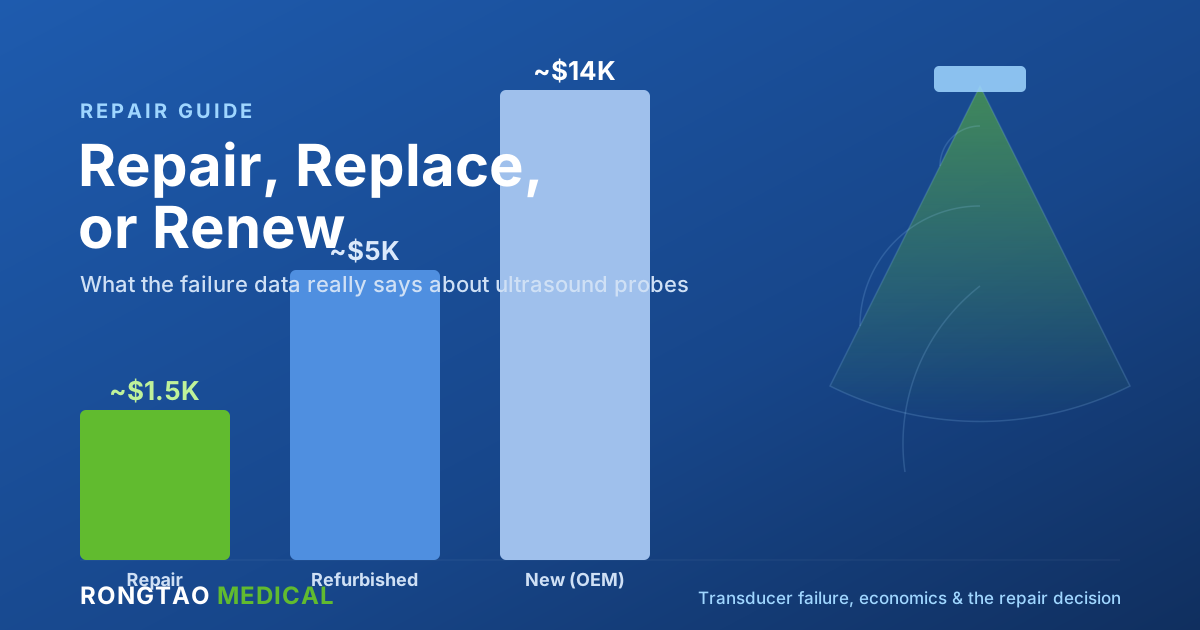
The most concrete pricing on record — dated 2010, and therefore understated in 2026 dollars — puts a standard probe repair at about $1,500, a refurbished replacement at about $5,000, and a new probe at about $14,000 4. Live 2024–2026 marketplace listings bracket this sensibly: new standard transducers run roughly $1,000–$15,000 and used/refurbished units $400–$7,500 (for example, a GE C1-6-D around $3,400, a Sonosite HFL38xp around $3,900) 56. By type, refurbished linear probes run roughly $1,400–$4,500, convex around $3,200–$3,500, and phased around $2,500 6.
View chart data
| Category | Typical cost per standard probe (USD) |
|---|---|
| Tested repair | 1500 |
| Refurbished replacement | 5000 |
| New OEM probe | 14000 |
Repairing a standard probe runs a fraction of refurbished replacement and roughly one-tenth of a new probe (2010 anchors, understated in 2026 dollars; live ranges: refurbished $400-$7,500, new $1,000-$15,000).
Source: Imaging Technology News / MedPro Imaging (2010), cross-checked vs LabX & Elzhen listings (2024-2026)
Premium probes widen the gap
On TEE and 3D-matrix probes the ladder stretches dramatically. Repair runs $5,000–$8,000 against an OEM exchange of $21,000–$30,000 and a new price of $36,000–$50,000 (occasionally up to ~$70,000) — repair "normally no more than 25% of replacement" 4142. The timing leverage is stark: catching a hole in the bending rubber early costs on the order of $1,000, versus roughly $28,000 once the probe floods 4144. One lab notes that an OEM exchange "can range from $2,000 to over $40,000 just to address a small cut to the cable sheathing" 39. Over a fleet's life the compounding is large: a ten-year framing puts a replace-by-default policy at roughly $300,000 against under $75,000 for repair 41.
Savings corroborated beyond the single lineage
Because the famous "60–70% savings" figure is single-lineage (the Weigang/Moore lineage flagged in Section 2), it needs independent corroboration — and it has it. A five-year comparison study found ISO replacement parts 35% cheaper than OEM on standard transducers and 23% cheaper on TEE, with parts making up more than 70% of a repair budget 40. Independent servicers' published ranges converge: 30–70% at one lab, 20–50% at another, and the ~75% TEE saving above 424341. And the savings are realized, not theoretical: one large platform reports its customers saved $7.5M in 2022 and $14M in 2023 by repairing rather than replacing 45. The direction — meaningful double-digit-to-majority savings — survives well outside the single lineage, even as we decline to assert the specific "60–70%" point figure as fact.
Downtime is the other half of TCO — and the bigger half
Here is the number most repair-versus-replace analyses miss entirely. A probe is not a spreadsheet line; it is the thing that determines whether a scanner earns revenue. General enterprise-imaging downtime benchmarks run around $22,075 per hour and ~$371,000 a year for a 200-bed hospital, with single-modality estimates of $10,000–$15,000 a day for MRI and $60,000–$120,000 per unit in other analyses 464748.
For ultrasound specifically we built a conservative model from public inputs. Blended CMS reimbursement runs roughly $90–$290 per exam (call it $100–$150 blended), and published throughput is about 11.25 general exams per 8-hour day in one national average, rising to 15–20 in busy private settings and 30–40 in maternal-fetal medicine 4950. Multiplying through, a single idle scanner forgoes on the order of $1,000–$2,100 per day in reimbursement alone — before idle-staff wages and the cost of rescheduling patients. (This is our own analysis of forgone revenue, an illustrative model, not a quoted price.)
Now put lead time against that. Independent repair turns around in roughly 3–8 business days, often with a same-day loaner — one large platform evaluates an incoming probe within 24 hours and ships loaners from a pool of more than 14,000 units 4543. A new probe is a weeks-long procurement; for legacy and end-of-life models it is unavailable new at any lead time 51. So a ~three-week wait for a new probe with no spare on hand forgoes roughly $15,000–$31,000 (about 15 working days at $1,000–$2,100) — frequently more than a tested repair (~$1,500), and more than the new probe itself. A tested repair plus a loaner collapses that downtime cost toward zero.
View chart data
| Category | Hardware / repair cost | Downtime / forgone revenue |
|---|---|---|
| Tested repair + loaner | 1500 | 0 |
| Refurbished (in stock) | 5000 | 3000 |
| New OEM probe (~3-wk wait) | 14000 | 22500 |
Procurement lead time, not sticker price, dominates TCO; an idle scanner forgoes ~$1,000-$2,100/day, so a ~3-week new-probe wait costs ~$15k-$31k in lost revenue, while a tested repair plus loaner closes the gap to near zero.
Source: Hardware: ITN/MedPro (2010). Downtime: CMS fee schedule & throughput surveys - Rongtao Medical analysis, accessed August 2026
The contract question: repair-as-needed vs a full-service agreement
For a hospital biomed/HTM team, the repair-versus-replace decision usually lives inside a prior one: whether to carry a full-service or preventive-maintenance contract at all. The single most important fact here is one OEM service literature rarely volunteers — probes are commonly excluded from cart/system service contracts; the OEM offer on a failed probe is replacement, not repair, and a second probe failure on the same machine in the same year is frequently not covered 72. Maintenance agreements themselves are not cheap; published clinical-engineering work treats them as a recurring cost and contrasts parts-only, shared-risk, and full-service models 48.
Run the break-even on the probe line alone. An independent analysis frames it bluntly: on a standard 2D probe at roughly $1,500 a repair, you would need to break about six probes per machine, every year, for a full-service contract to pay off against simply repairing probes as they fail — and over a 7–10-year machine life, repairing as-needed (about one probe per machine per year) saves on the order of $45,500–$65,000 versus carrying the contract 72. Those are third-party, single-vendor estimates, shown to frame the decision rather than to price it — but the structural point is robust and matches the rest of this report: with probes failing at ~14% of the fleet a year (Section 1) and a per-incident tested repair available in days with a loaner, the contract pays only where a single machine is failing many probes a year. For everyone else, repair-as-needed is the cheaper and more flexible posture.
| Dimension | Repair-as-needed (per incident) | Full-service / PM contract |
|---|---|---|
| What you pay | Only when a probe fails (~$1,500 standard) | Fixed annual fee whether or not anything fails |
| Is probe repair covered? | Yes - that is the service | Often not - probes are commonly excluded; OEMs offer replacement, not repair |
| Second probe failure, same machine, same year | Repaired at cost again | High probability it is not covered - extra spend |
| Break-even | Wins unless you break ~6 probes per machine per year | Pays off only at high failure volume per machine |
| Lifetime cost (7-10 yr machine) | ~$45,500-$65,000 saved vs the contract (one probe/yr at ~$1,500) | Contract fees compound over the machine's life |
Probes are typically excluded from cart/system service contracts - OEMs offer replacement, not probe repair - so a per-incident tested repair often beats the contract unless a fleet is failing many probes per machine per year.
Source: ProbeLogic; CADTH (maintenance service agreements); ITN/MedPro pricing - third-party estimates
Why the bill keeps coming
Finally, this is recurring, which is what makes it a strategic lever rather than an incident. With the probe representing 88% of system failures at a 13.9% annual rate, and systems running five to twelve years, on the order of 14% of a fleet's probes need repair-or-replace every year 3. US non-OEM probe-repair volume is estimated at roughly 20,000–30,000 probes a year, with broader global estimates of 200,000+ (treat the global figure as an estimate) 9. A buyer who optimizes this line once is optimizing it every year thereafter.
A buying lever worth naming here: warranty. The industry floor is 90 days, with six months common on TEE repairs 3542. A warranty is the only mechanism that puts the repairer's own balance sheet behind the test result — which is why it belongs in the spec in Section 7.
The cheapest repair is the one you catch early
One operational practice does more for this line than any negotiating tactic: catch the fault before it compounds. The economics are already on the page — a bending-rubber pinhole caught early is on the order of $1,000; the same probe once it floods is roughly $28,000 41 — and the detection data says the catch is cheap and almost never made: only ~7% of faults surface in routine clinical use, while >90% are demonstrable with a quick visual inspection plus an in-air reverberation/uniformity check 32. A documented inspection cadence — a magnified visual check of lens, housing, strain relief, connector and (for TEE) the insertion tube, plus a periodic in-air image — converts invisible degradation into a scheduled, low-cost repair instead of an emergency replacement 41. The cheapest repair, in other words, is the one a probe-management program catches first.
6. A structurally growing repair market
Takeaway: Probe repair is not a fringe activity; it is a large, fast-growing market with structural tailwinds. The installed base bought in the 2010s is now in its peak repair window, the real cost of hardware is flat-to-rising rather than falling, EU public buyers are commissioning repair faster than they buy new equipment, and the probe is the single most-patented — i.e., most engineered and best-understood — subsystem in ultrasound. The repair economy is growing faster than the new-transducer market it shadows.
An aging installed base
The capital wave of the 2010s has aged into its service years. Imaging-device density across OECD countries roughly doubled between 2005 and 2023 — in some markets CT rose 40–50% and MRI more than doubled — which means the equipment bought then is now 6–15 years old, squarely in the peak service-and-repair window 55. (Ultrasound itself is not tracked separately by the OECD or WHO, so we use the heavier modalities as a directional proxy for fleet aging; ultrasound units are more numerous and more widely distributed, so the aging signal is, if anything, conservative.) Fleets are also breaching the COCIR/European Society of Radiology "golden rule" that no more than 10% of equipment should be over ten years old: Canada's mean CT age rose from 4.7 years (2001) to 8.2 (2019–20), and MRI from 3.8 to 8.6, with the average used MRI sold in the US in 2022 being 14 years old 5657. Ultrasound's own replacement cycle is roughly 5–7 years for probes and 7–12 for consoles 5859 — fast enough that repair demand is continuous.
A mature, multi-vendor, repairable transducer population
The transducer landscape is fragmented and durable — both of which favor repair. We counted 409 ITX 510(k) clearances (1978–2025), all Class II, from 178 distinct applicants across roughly 19 maker families plus a long tail 52. Crucially, 60.9% of cleared designs (249 of 409) predate 2000, the 1990s alone produced 175 clearances (42.8%), and new clearances fell to single digits after 2013 52. The installed base is therefore dominated by 15-to-45-year-old designs living well past their OEM support windows — a large repairable population by construction. The maker families span the major platforms (Siemens 33, GE 31, the Hitachi/Aloka/Fujifilm group 22, Boston Scientific 21, Philips 20, Toshiba/Canon 20, and so on), with a 205-clearance "all other" tail — the opposite of a monopoly 52.
And the population is durable by design: of 409 cleared device names, only 5 describe a single-use or disposable probe, four of which are needle guides — mainstream imaging probes remain reusable, system-specific capital assets 52. Because each system carries several transducers (a single platform may expose five active ports), the worldwide probe population is several multiples of the system count — plausibly several million units, a directional estimate rather than a census 5354. This durability is the structural reason repair, not disposal, is the rational default.
Hardware is not getting cheaper
If finished hardware were rapidly commoditizing, reflex replacement might be defensible. It is not. World imports of diagnostic-ultrasound apparatus grew from US$16.1B (2010) to US$24.2B (2024), but the unit value held in a narrow $259–$305/kg band, rising only ~0.5% a year in nominal terms — a real-terms decline against inflation, but nowhere near fast enough to make whole-probe replacement cheap 60. Put differently: ultrasound apparatus carries a value density around $280/kg versus roughly $79/kg for a broad medical-parts basket — about 3.5× denser — and a sub-kilogram, multi-thousand-dollar transducer is denser still 60. That is exactly the high-value-per-gram profile where repair economics dominate. Meanwhile the broad medical-instrument aftermarket has grown about 2.3× faster than new-equipment trade over the same period (we cite this parts basket for direction only, as it spans all instrument categories, not ultrasound, and our trade extract carries no country dimension — so no export-share or country claims are drawn from it) 60.
EU buyers are already commissioning repair faster than purchase
European public procurement is the cleanest revealed-preference dataset available, and it points one way. Across 29,979 TED notices (2016–2026), repair-and-maintenance-of-medical-equipment tenders outnumber ultrasound purchases 1.65:1 (18,648 vs 11,331) 62. More telling is the trajectory: repair/maintenance notices grew +12.9% a year (2.6× from 2017 to 2025) against +6.7% for equipment purchasing 62. Repair is also a structurally separate, services-led market — 71% of these are services contracts, versus 98–99% "supplies" for the ultrasound-purchase codes — with comparable median award values (roughly €300,000 for repair/maintenance against €219,000 for purchase, eurozone only to avoid currency noise) 62. (We use counts, not euro sums, because the dataset mixes currencies and framework ceilings; CPV 50421 covers medical-equipment repair broadly, shown as a directional repair-demand trend against ultrasound-specific purchasing.)
View chart data
| Category | Repair & maintenance of medical equipment (CPV 50421) | Ultrasound equipment purchase (CPV 33112) |
|---|---|---|
| 2017 | 1166 | 958 |
| 2018 | 1259 | 1118 |
| 2019 | 1342 | 1001 |
| 2020 | 1420 | 882 |
| 2021 | 1741 | 949 |
| 2022 | 2052 | 948 |
| 2023 | 2114 | 1341 |
| 2024 | 2385 | 1115 |
| 2025 | 3074 | 1605 |
Repair/maintenance procurement grew 2.6x (2017-2025, +12.9%/yr) vs +6.7%/yr for buying ultrasound equipment.
Source: Tenders Electronic Daily (EU public procurement) - Rongtao Medical analysis, accessed August 2026
The probe is the most-engineered subsystem — and OEMs own the IP
Patents confirm that the probe is both complex enough to fail and well-understood enough to repair. 5,418 of 30,965 ultrasound patents (~17.5%, about one in six) name the transducer or probe in the title — more than any other subsystem — and filings roughly tripled from 2001 to the mid-2010s 61. The IP is OEM-concentrated (the largest assignees hold 80–155 transducer patents each), which is exactly why the installed base needs independent repair capacity: OEMs own the design IP, but the millions of probes in the field still need servicing once they are out of warranty and support 61. Repair is itself an established discipline, with at least 24 explicit probe-repair, serviceability, and refurbishment patents (2001–2025), including a granted "Method for Ultrasound Probe Repair" and an OEM "Ultrasound Servicing System and Method" 61. (We exclude the most recent filing years from the trend read, given publication lag and a US-pull bias in the source.)
The repair economy is outgrowing the new-probe market
Pulling the market estimates together — and labeling them as forecasts, not facts — the probe-repair market is put at roughly $0.94B (2024) growing toward $2.5B by 2035 at a 9.3% CAGR, against a new-transducer market of about $3.7B (2024) growing at 6.8% 6364. Repair is therefore about a quarter the size of the new-probe market and growing faster. The refurbished-ultrasound market is forecast to grow around 8% a year, and the overall ultrasound-equipment market from $10.3B (2025) toward $19.5B (2034) 6566. For context, the installed base is estimated at roughly 1.6 million systems (a single-source figure, flagged) running ~140 million exams a year 67. (We exclude one widely repeated "$2.98M probe-repair market" figure as an obvious units error.)
View chart data
| Category | 2024 market size ($B) | Forecast size ($B) |
|---|---|---|
| Probe repair | 0.94 | 2.5 |
| New transducers | 3.7 | 5.5 |
Probe repair (~$0.94B, 9.3% CAGR) is about a quarter the size of the new-transducer market (~$3.7B, 6.8%) and growing faster; figures are forecasts.
Source: WiseGuyReports (probe repair); Strategic Market Research (transducers)
7. How to buy probe repair without quality risk
Takeaway: Everything above converges on one buying rule — test every unit, every time, on three axes — and a short, verifiable scorecard around it. The risk in probe repair is real but it is controllable, and it is controlled by documented per-unit verification, not by paying an OEM premium. This is where to apply the evidence.
The spec: test every unit, on three axes
The under-detection data is the buying spec. Because only ~7% of faults surface in clinical use while >90% are detectable on a proper bench 32, and because the cautionary 63%-sensitivity case shows a bad repair is itself detectable 9, a credible repair process tests every unit before it ships, across three independent axes:
1. Acoustic/functional — element map (no dead/weak elements beyond threshold), sensitivity, uniformity, and image quality on a real machine, not just a power-on check.
2. Physical integrity — lens, housing, seal, cable, and strain relief, because a crack is an infection-control failure as much as an image one 2422.
3. Electrical leakage — patient-isolation safety, the failure mode behind the electrical-shock recalls in Section 3 7.
The professional risk-control guidance is explicit on the rest: ensure any repaired or remanufactured transducer is FDA-cleared as required, and verify the repairer's qualification rather than assuming it 21. The differentiator, to be clear, is testing — not "OEM versus independent."
The scorecard
For a service company, distributor, or HTM team sourcing probe repair or repair capacity, the defensible bar is short, specific, and auditable. It is not a matter of trust; every item below can be evidenced.
- Documented per-unit, multi-axis test evidence — photos or video of the actual tested unit (acoustic/element map, integrity, leakage), not a paper attestation.
- Holistic, whole-probe testing — the entire probe is re-tested after repair, not just the component that was fixed, so a repair does not leave a latent secondary fault behind.
- An audited quality system — ISO 13485:2016 (medical-device QMS) plus ISO 9001:2015 — so the process behind the test is itself controlled.
- Parts sourcing you can trace — ask where parts come from and how they are qualified. New or specialty-built parts are more stable than harvested cables and components that may already have been repaired several times.
- Biocompatibility of repair materials — patient-contact materials verified to ISO 10993 and checked for chemical compatibility against the disinfectants the site actually uses (approved and the unapproved ones that get used in practice), because a non-OEM lens or coating that fails under a disinfectant is a patient-safety problem, not a cosmetic one 9.
- Repair, not undocumented remanufacture — a repairer who alters a probe's performance without documenting equivalence to the original specification may be remanufacturing it, a regulatory status shift that can move liability to the buyer; insist on documented equivalence and FDA clearance where the work crosses that line 6821.
- A warranty that puts the repairer's balance sheet behind the result (industry floor 90 days; six months common on TEE) 3542.
- Auditable vendor metrics — a scorecard an HTM team can re-check over time: valid-warranty rate, repair-vs-replace rate, response/turnaround time, and loaner availability 38.
| What to insist on | Why it matters | How to audit it |
|---|---|---|
| Per-unit, multi-axis test evidence | Only ~7% of faults show in clinical use; >90% are detectable on a bench; a bad repair is itself detectable | Photos/video of the actual tested unit - acoustic/element map, integrity, leakage - not a paper attestation |
| Audited quality system | Controls the process behind the test | ISO 13485:2016 + ISO 9001:2015 certificates; FDA-cleared status where required |
| Parts sourcing and qualification | Harvested cables/parts repaired multiple times are less stable than new/specialty-built | Ask where parts come from (new vs harvested) and how they are qualified and traced |
| Biocompatibility of repair materials | Non-OEM patient-contact materials can fail with disinfectants and harm patients | ISO 10993 biocompatibility + chemical compatibility vs approved AND unapproved disinfectants |
| Holistic whole-probe testing | Repairing one fault can leave a latent secondary failure | Confirm the whole probe is tested, not just the repaired component |
| Repair, not undocumented remanufacture | Altering performance without documenting equivalence can be remanufacturing - a regulatory status shift that moves liability to the buyer | Documented equivalence to OEM spec; FDA clearance where the work is remanufacturing |
| Warranty | Puts the repairer's balance sheet behind the test result | Industry floor 90 days; six months common on TEE |
| Vendor scorecard metrics | Lets HTM teams compare and re-audit suppliers over time | Valid-warranty rate, repair-vs-replace rate, response/turnaround time, loaner availability |
Quality in probe repair is demonstrated per unit, not bought with a logo - here is the auditable bar a service company, distributor or HTM team can hold a repairer to.
Source: AIUM; SDMS; Bigelow et al. 2018; FDA Remanufacturing/Servicing guidance; Innovatus/TechNation - Rongtao Medical compilation
Answering the OEM's strongest argument
OEMs make one genuinely strong sales argument, and it is worth meeting head-on rather than ignoring: that complexity has increased, and that — in the words of one OEM's certified-repair program — "only [the manufacturer] has detailed knowledge of the original transducer test specifications" 74. The rational answer is not to concede the logo. Independent labs validate against published performance specifications and measure acoustic output in accredited test environments (the relevant standard for a calibration/test laboratory is ISO/IEC 17025), and the regulatory frame already holds independent servicers to the same quality bar as anyone else: FDA's 2018 study found device servicing to be a source of harm only vanishingly rarely, and the QMSR — incorporating ISO 13485:2016 — is in force as of February 2026 6869. A bad repair is detectable and a good one is provable 9. The differentiator is therefore documented, per-unit equivalence testing — not which logo is on the box.
Two traps to price in
The useful-life trap. The 2025 recall program that flagged transducers as "refurbished beyond their useful life" — and an OEM internal document, surfaced in a September 2025 FDA Warning Letter, putting transducer useful life at just three years — is best understood as a force pushing buyers toward replace-by-default 262728. Read it precisely: the OEM reported zero patient-harm events in that program, and the action is a lifecycle/labeling matter, not evidence about independent-versus-OEM safety 27. The rational counter to a short defined life is not reflexive replacement; it is a qualified, tested refurbishment — because, as this whole report argues, the qualification of a refurbished probe matters more than who refurbished it.
The legacy/EOL trap. For probes whose models have been retired, a new unit is simply unavailable at any price 51. Repair and tested refurbishment are the only paths to keeping that equipment in service — exactly where independent capacity is decisive rather than optional.
Where Rongtao fits
This report's argument is independent of any one provider, but it maps cleanly onto what a buyer should look for — so it is worth naming a concrete example of the configuration. Guangzhou Rongtao Medical Technology, an independent medical-imaging service provider founded in 2013, runs probe solutions and core-board repair as core lines and operates the verification discipline this report argues for: a 48-hour real-machine test before shipment (with photos and videos), ISO 13485:2016 and ISO 9001:2015 certification, a typical 90-day warranty (extendable on request), a 5–8 business-day standard turnaround, 3,000+ parts SKUs (plus hundreds of complete systems and probes), 35+ senior engineers and hundreds of testing platforms in a 3,000 m² Guangzhou center, bonded-zone international shipping, and service to 140+ countries 71. For a regional service partner that wants probe-repair capacity rather than a one-off send-it-in repair, the same auditable configuration is what to look for in an outsourced or co-located repair line — the test protocol, certifications, parts traceability, warranty, and turnaround travel with the work. The point is not that one provider is uniquely virtuous — it is that this configuration of per-unit testing, certification, parts traceability, warranty, and turnaround is what turns "independent probe repair" from a category claim into an auditable one. (Rongtao provides service and compatibility coverage for major OEM platforms — GE Healthcare, Philips, Siemens, Hitachi, Mindray, Samsung Medison, Toshiba/Canon, Aloka, and Biosound Esaote — and does not claim OEM authorization, endorsement, or affiliation.)
One line bridges to our prior report so we do not repeat it: the broad regulatory record already establishes that independent servicing is safe, essential, and regulated — FDA's 2018 study found servicing-attributable harm vanishingly rare, and the QMSR (incorporating ISO 13485:2016) is in force as of February 2026 6869. This report adds the probe-specific proof beneath that conclusion.
Conclusion
The probe is where the money and the risk concentrate — and the record says repair it. The transducer is 88% of ultrasound-system failures at a ~14% annual rate 3, roughly a third of in-service probes carry a fault 2, and yet the federal adverse-event record is 89% malfunction and 0.6% death-coded reports 1. This is a recurring reliability-and-uptime problem, not a patient-safety crisis — and reliability problems are repaired, not reflexively replaced.
The "recall" and "MAUDE" headlines do not mean what they are usually taken to mean. Only about one in six ITX recalls is a transducer-hardware fault, every Class I recall is contaminated gel rather than a probe, and no transducer-hardware recall in the classified record is worse than Class II 7. A second regulator shows the identical shape 30. Read carefully, the primary record supports tested repair as the default.
The economics are decisive once downtime and the contract are counted. Repair is a fraction of replacement on standard probes and saves tens of thousands on premium ones 441; a multi-week wait for a new probe forgoes more revenue than the repair or the new probe costs 46; and because probes are usually excluded from service contracts, per-incident tested repair beats the contract for all but the highest-failure machines 72. The buyer who counts only the sticker price is optimizing the wrong number.
The only real variable is testing. A bad repair is detectable; a good one is provable 9. The buying rule that follows from the entire evidence base is simply test every unit, every time, on acoustic, integrity, and leakage axes — backed by ISO-certified process, traceable cleared parts, and a warranty. Quality in probe repair is not bought with an OEM logo; it is demonstrated, per unit, on the bench.
FAQ
Can a dropped probe be repaired? Often, yes. Scattered dead elements, cable and connector damage, lens wear, and strain-relief cracks are routine repairs. The boundary is a shattered array with a large central dropout, which usually follows a hard drop — element work can address scattered dead elements but cannot rebuild a destroyed stack 1136.
How long does probe repair take? Independent repair typically turns around in 3–8 business days, often with a same-day loaner so the scanner keeps earning; one platform evaluates an incoming probe within 24 hours 4345. A new probe, by contrast, is a weeks-long procurement, and a retired model may be unavailable new at any lead time 51.
Is a repaired probe safe? Safety is a function of testing, not of who did the work. A poorly re-terminated probe has been measured at 63% of its original sensitivity — but that failure is detectable, and so is a good repair, on acoustic-output, element-map, integrity, and electrical-leakage tests 9. Insist on per-unit test evidence before a repaired probe goes back on a patient.
When is a probe not worth repairing? When fluid ingress has already corroded the internal electronics (common in late-stage TEE damage), when the array is shattered, when the design depends on a proprietary matrix ASIC that is not field-replaceable, or when the probe is already past its OEM-defined useful life 1136.
Are repaired probes FDA-compliant? Independent device servicing is regulated, not a gray market: FDA's 2018 study found servicing-attributable harm vanishingly rare, and the QMSR — incorporating ISO 13485:2016 — is in force as of February 2026 6869. Ensure any repaired or remanufactured transducer is FDA-cleared as required and that the repairer runs an audited quality system 21.
How often do probes actually fail? On the order of 14% of a fleet's probes need repair-or-replace every year (the probe is ~88% of system failures at a ~13.9% annual rate), and at any given moment roughly a third of in-service probes are carrying at least one fault 32.