
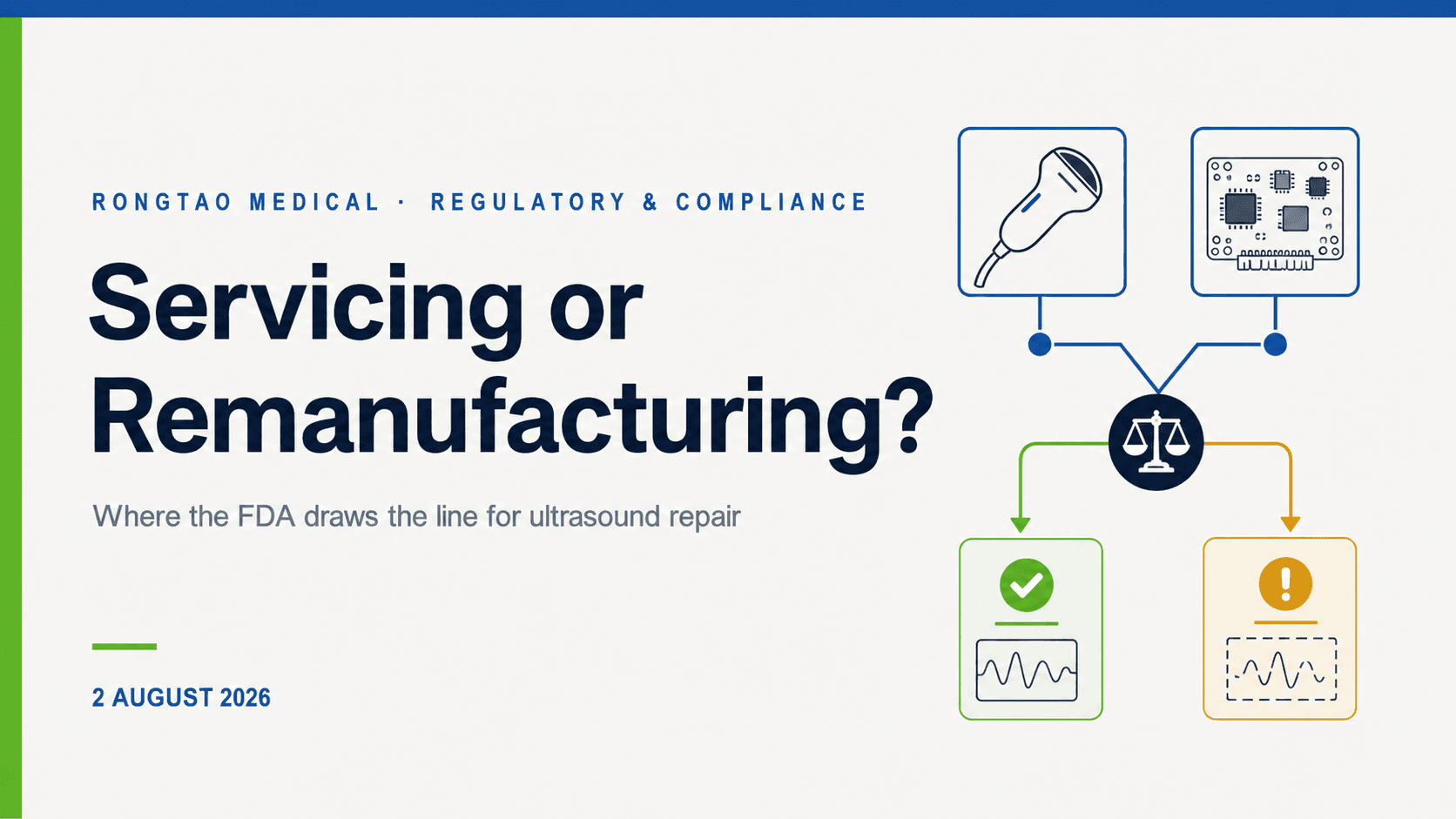
What is the difference between servicing and remanufacturing under FDA guidance?
- Servicing Definition: 'The repair and/or preventive or routine maintenance of one or more parts in a finished device, after distribution, for purposes of returning it to the safety and performance specifications established by the OEM and to meet its original intended use.' 1 Servicing maintains or restores the device to its established design baseline.
- Remanufacturing Definition: 'Any processing, conditioning, renovating, repackaging, restoring, reconditioning, or other act which significantly changes the finished device's performance or safety specifications or intended use.' 1 Remanufacturing creates, in the eyes of the law, a new finished device.
How Has the FDA Servicing vs. Remanufacturing Guidance Evolved Since 2018?
| Date | Docket Document ID | Document Title & Milestone | Key Stakeholders & Industry Impact |
|---|---|---|---|
| 2018-10-22 | FDA-2018-N-3741-0001 | White Paper: Evaluating Whether Activities are Servicing or Remanufacturing | Introduced 6-factor decision concept; opened initial 90-day public comment window. |
| 2019-01-22 | FDA-2018-N-3741-0002 | Final White Paper with Extended Comment Period | Extended comment deadline following petitions from MITA, AdvaMed, and AMDSO. |
| 2019-02-04 | FDA-2018-N-3741-0006/7/8 | Stakeholder Extension Requests (MITA, AdvaMed, AMDSO) | OEMs argued for strict definition limits; ISOs advocated for component-repair preservation. |
| 2021-06-24 | FDA-2018-N-3741-0044 | Draft Guidance: Remanufacturing of Medical Devices | Formal draft guidelines issued; established explicit software change criteria. |
| 2021-08-18 | FDA-2018-N-3741-0053 | Extension Request from Roche Diagnostics | Second extension granted; industry debated software patch vs. upgrade definitions. |
| 2024-05-10 | FDA-2018-N-3741-0097 | Federal Register Notice of Availability (89 FR 40487) | Official publication notice; guidance becomes effective immediately for all US servicers. |
| 2024-05-10 | FDA-2018-N-3741-0098 | Final Guidance: Remanufacturing of Medical Devices | Expanded title to cover servicing entities; finalized 6-factor test and buyer documentation rules. |
Source: U.S. FDA Regulations.gov public docket FDA-2018-N-3741; Rongtao Medical analysis
What are the six factors FDA uses to tell servicing and remanufacturing apart?
- Factor 1 — Change in Intended Use: Does the activity modify the intended use of the device? If a repair or software modification changes the clinical indication (e.g., converting a general abdominal ultrasound scanner into a specialized intraoperative surgical tool), the activity is remanufacturing.
- Factor 2 — Cumulative Specification Changes: Does the activity, considering all previous changes made to the device, significantly alter its performance or safety specifications? Cumulative micro-modifications over multiple repair cycles can cross the remanufacturing threshold.
- Factor 3 — New Marketing Submission Requirement: Is the change of a type that would require a new premarket notification (510(k)) or premarket approval (PMA) supplement under FDA's modification guidance? If an OEM would need a 510(k) for the design change, a third party performing the same modification is remanufacturing.
- Factor 4 — Component / Material Specification Impact: Does the activity alter the dimensional, material, electrical, optical, acoustic, or mechanical specifications of a component beyond OEM-established tolerances? Replacing an electronic component on a circuit board with an exact spec-equivalent component is servicing; replacing it with a non-equivalent part that shifts operating frequency or heat dissipation is remanufacturing.
- Factor 5 — Risk Assessment Impact: Does the activity introduce new risks or significantly increase existing safety/performance risks? If a repair alters electrical safety isolation or acoustic output energy levels, risk analysis must determine if safety controls are compromised.
- Factor 6 — Documentation of Decision: Has the entity documented its decision-making process, rationale, testing protocols, and verification evidence demonstrating that the activity is servicing rather than remanufacturing? Failure to maintain documentation creates regulatory non-compliance.
How Do Common Ultrasound Board, Probe, and Software Repairs Map to the Six Factors?
| Ultrasound Service Task | Specific Repair Action | FDA 6-Factor Assessment | Regulatory Classification | Required Evidence / Gate |
|---|---|---|---|---|
| Board-Level Component Repair | Replacing failed capacitors, ICs, relays, or MOSFETs on a GE or Philips mainboard with identical OEM-spec components | Factor 4: Component spec unchanged; Factor 5: Risk unchanged; Factor 6: Documented bench test | Servicing | Component datasheet spec matching; post-repair 48-hr full-function load testing |
| Board Revision Substitution | Installing an updated OEM circuit board part revision listed as backward-compatible by the OEM manual | Factor 2: Within OEM cumulative spec; Factor 3: Covered by OEM system 510(k) | Servicing | OEM compatibility documentation; system software revision verification |
| Non-Equivalent Board Rework | Modifying board trace paths or substituting non-equivalent logic chips that alter clock rates or power limits | Factor 3: Would require 510(k); Factor 4: Alters electrical spec; Factor 5: Alters thermal risk | Remanufacturing | Requires FDA establishment registration, 510(k) clearance, and full QMS compliance |
| Transducer Lens & Cable Repair | Replacing damaged acoustic lens material, strain relief, acoustic flex cable, or probe housing using OEM-equivalent materials | Factor 4: Mechanical/acoustic spec maintained; Factor 5: Electrical isolation verified | Servicing | Acoustic beam profiling, leakage current safety test (IEC 60601-2-37 / IEC 62353) |
| Transducer Element Array Rework | Replacing piezoceramic element array with custom non-OEM crystal geometries that change acoustic center frequency | Factor 1: Alters acoustic resolution; Factor 4: Alters acoustic spec; Factor 5: Modifies thermal index (TI) | Remanufacturing | Requires 510(k) clearance, acoustic output measurement, UDI relabeling |
| System Software Reload | Re-installing the original OEM software version following hard drive failure using OEM installation media | Factor 1: Intended use unchanged; Factor 2: Specs unchanged; Factor 4: Software version matches baseline | Servicing | License key preservation; OEM software build verification; diagnostic self-test pass |
| Software Feature / Option Enabling | Modifying software configuration files or firmware to enable unlicensed clinical options (e.g., 4D cardiac, elastography) | Factor 1: Expands intended use; Factor 3: Alters system performance specifications | Remanufacturing / Unauthorized Modification | PROHIBITED as servicing; requires OEM license authorization or new regulatory submission |
Source: Synthesized from FDA May 2024 Remanufacturing Guidance (Docket FDA-2018-N-3741) & Rongtao Medical Engineering Data
What regulatory obligations trigger if an ultrasound repair counts as remanufacturing?
| Regulatory Domain | U.S. FDA Code / EU Rule | Obligation for Servicing (OEM Specs) | Obligation for Remanufacturing (Altered Specs) |
|---|---|---|---|
| Establishment Registration | 21 CFR Part 807 | EXEMPT — Pure third-party servicers do not register as device manufacturers | MANDATORY — Must register establishment annually with FDA (§ 807.20) |
| Medical Device Listing | 21 CFR Part 807 Subpart B | EXEMPT — Servicers do not list distributed OEM device models | MANDATORY — Must list remanufactured device models in FDA FURLS database |
| Premarket Review / Clearance | 21 CFR Part 807 Subpart E (510(k)) | EXEMPT — Routine servicing does not require premarket notification | MANDATORY — Must submit 510(k) or PMA supplement if changes affect safety/efficacy |
| Quality Management System | 21 CFR Part 820 (QMSR / ISO 13485) | VOLUNTARY (Recommended) — Servicers maintain internal QMS for quality assurance | MANDATORY — Full compliance with QMSR / 21 CFR 820 incorporating ISO 13485:2016 |
| Medical Device Reporting (MDR) | 21 CFR Part 803 | EXEMPT from direct 803 MDR reporting (hospitals/OEMs report) | MANDATORY — Must report adverse events, serious injuries, and deaths directly to FDA |
| Corrections & Removals | 21 CFR Part 806 | EXEMPT — Servicers performing maintenance do not submit 806 reports | MANDATORY — Must submit written reports of device removals/corrections to FDA |
| Unique Device Identifier (UDI) | 21 CFR Part 830 & 801.20 | EXEMPT — Servicers preserve existing OEM UDI label on host system | MANDATORY — Must assign new UDI and apply label if remanufactured |
| European Union Alignment | EU MDR 2017/745 Art. 15 / Art. 23 | Art. 23: Parts supplied must not reduce device safety or performance | Art. 15: Must designate a Person Responsible for Regulatory Compliance (PRRC) |
Source: U.S. eCFR Titles 21 CFR 807, 820, 803, 806, 830; EU MDR 2017/745 Articles 15 & 23; Rongtao Regulatory Synthesis
Which ultrasound service activities are most likely to cross the line into remanufacturing?
- 1. Acoustic Matching Layer & Piezoceramic Array Replacement: In probe repair, replacing damaged acoustic lenses or outer strain reliefs is servicing. However, replacing the underlying piezoceramic crystal array or changing acoustic matching layer thickness alters spatial resolution, beam profile, and Acoustic Output (Mechanical Index / Thermal Index). Unless the repair vendor can demonstrate exact acoustic material equivalence through hydrophone tank testing, crystal replacement risks crossing into remanufacturing.
- 2. System Firmware & Beamformer Code Alterations: Reloading factory software from legitimate OEM media is servicing. In contrast, flashing custom firmware onto high-voltage transmitter boards or modifying FPGA code on beamformer boards changes the acoustic pulse sequence and energy limits. This represents a cumulative specification change under Factor 2.
- 3. Power Supply Threshold Modifications: Modifying internal power supply sensing circuits to bypass over-voltage or over-current shutdown thresholds changes electrical safety parameters (Factor 4) and introduces thermal and fire risks (Factor 5). Servicing requires repairing the PSU to OEM voltage and current tolerance limits.
- 4. Non-Equivalent Transducer Connector Wiring: Rewiring a probe connector to adapt a transducer designed for one system architecture (e.g., GE Voluson E8) onto an incompatible console (e.g., GE Logiq P5) modifies the intended use and electrical interface of both the probe and console, triggering Factor 1 and Factor 3.
What evidence should a buyer request before hiring an independent ultrasound service organization?
| Verification Requirement | Target Metric / Standard | Acceptable Vendor Artifact | Red Flag / Reject Criteria |
|---|---|---|---|
| Quality Certification | ISO 13485:2016 or ISO 9001:2015 | Valid accredited registrar certificate covering medical device servicing | Unaccredited self-claim or expired certificate |
| Specification Baseline | Return to OEM specification | Written spec-conformance policy & component datasheet equivalence record | Claim of 'improved' or 'modified' beamformer specs |
| System Functional Testing | 48-hour live system load validation | Serialized test video/photo log on target OEM console (e.g. GE E9, Philips EPIQ) | Bench-only multimeter test without live machine validation |
| Electrical Safety | IEC 62353 / IEC 60601-1 leakage limits | Calibrated electrical safety analyzer test printout with exact microamp values | Generic 'passed safety check' checkmark without values |
| Acoustic Integrity (Probes) | Element sensitivity uniformity ±2 dB | Acoustic beam profile scan / Doppler signal-to-noise record | Visible element dropout or mismatched lens thickness |
Source: Rongtao Medical Engineering & Compliance Guidance for ISOs and Hospital HTM Directors
Where Does Rongtao Medical Fit in the Servicing vs. Remanufacturing Framework?
Guangzhou Rongtao Medical Technology Co., Ltd. operates strictly within the servicing and repair boundary. As an independent medical device service organization serving distributors, refurbishers, ISOs, and hospital biomedical engineering teams worldwide, Rongtao provides component-level circuit board repair, probe restoration, and tested replacement parts designed to return ultrasound equipment to original OEM operating specifications 15.
- Where Rongtao Fits: Component-level micro-soldering and PCB repair for GE, Philips, Siemens, Mindray, Canon/Toshiba, Samsung Medison, Aloka, and Hitachi ultrasound platforms; power supply overhaul and voltage stabilization; transducer lens, cable, strain relief, and connector pin repair; supply of 3,000+ verified replacement-part SKUs; 48-hour real-machine live testing prior to export; ISO 13485:2016 and ISO 9001:2015 quality-managed servicing 15.
- Where Rongtao Does NOT Fit: Rongtao does not perform device remanufacturing, does not modify OEM clinical intended use, does not alter beamformer pulse timing beyond OEM specifications, does not flash unauthorized firmware to alter feature licenses, and does not manufacture non-cleared medical devices. OEM brand names are referenced strictly to identify equipment compatibility.
What Technical Information Is Required for an Ultrasound Diagnostic & Repair Quote?
- 1. System Details: OEM brand, exact model name (e.g., GE Logiq E9, Philips EPIQ 7), software version revision, and system serial number.
- 2. Board / Part Identification: Manufacturer part number (MPN), board revision letter, label part numbers, and high-resolution clear photographs of both sides of the PCB.
- 3. Fault Behavior & Error Codes: Detailed description of the symptom (e.g., intermittent boot freeze, no high voltage output, acoustic image streak, error code on boot screen).
- 4. Probe Specifics (If Probe Repair): Model name (e.g., GE C1-5-D, Philips X5-1), visible physical defects (lens tear, cable strain relief split, connector pin bend), and acoustic image screen capture showing dropout.
- 5. Specification Requirement Confirmation: Confirmation that the service objective is restoration to original OEM operating specifications without custom modifications.
- 6. Quantity & Urgency: Number of units requiring repair/exchange and requested turnaround requirement.
- 7. Destination & Customs Information: Destination country and preferred bonded logistics carrier (DHL, FedEx, UPS) for international delivery.
Frequently Asked Questions
Q1: Does board-level component repair on an ultrasound system count as remanufacturing under FDA guidance?
No. When a qualified service technician replaces failed electronic components (capacitors, ICs, transistors) on an ultrasound circuit board with components that meet the exact electrical and dimensional specifications established by the OEM, the activity is classified as servicing. It restores the device to its established baseline without altering performance limits or intended use 19.