
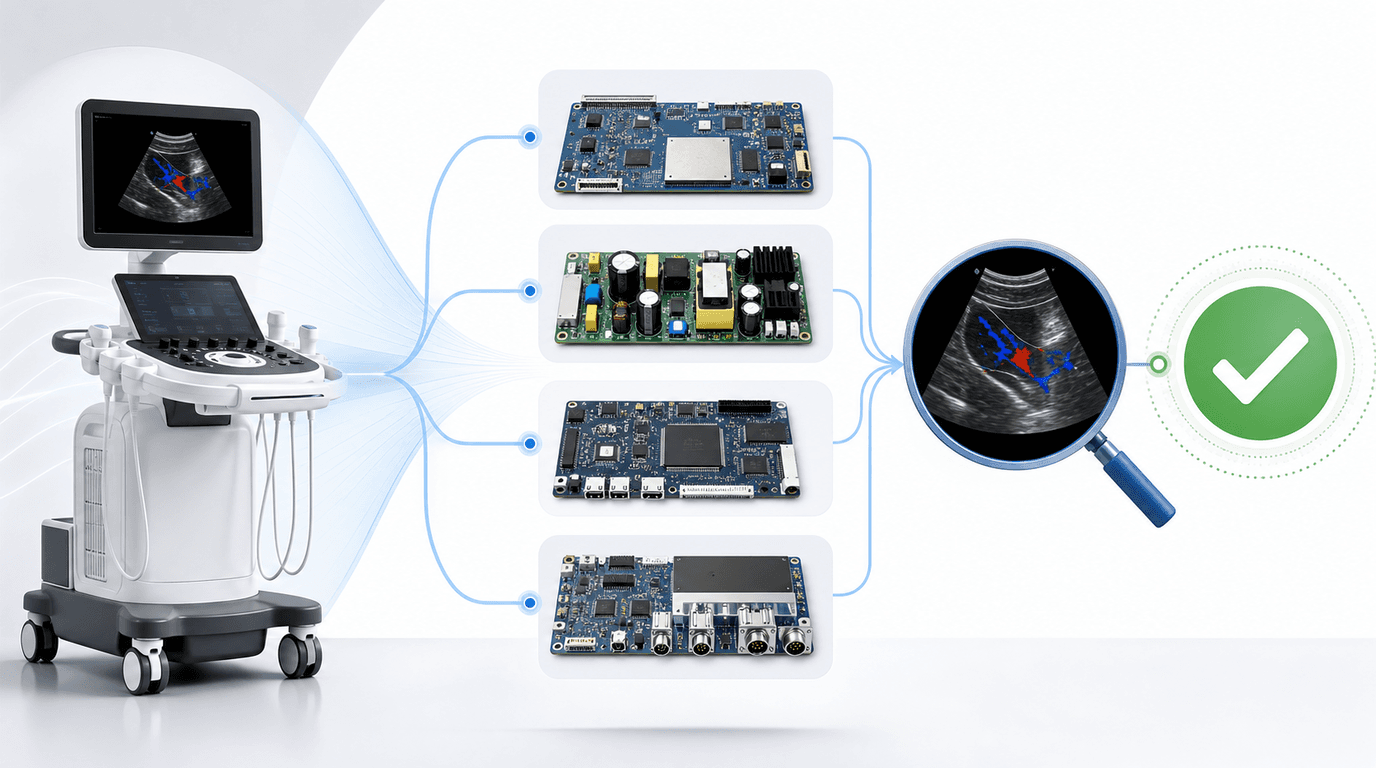
Introduction: Decoupling Philips Board Failures from OEM Module Swaps
Philips Healthcare diagnostic ultrasound platforms—ranging from legacy workhorses like the iU22, iE33, HD11, and HD15 to modern high-channel consoles like the EPIQ 5, EPIQ 7, Affiniti 50/70, and compact CX50—form the operational backbone of clinical imaging departments worldwide. Built on FDA 510(k) cleared device architectures 2, these systems integrate complex high-density transmit beamformers, ultra-quiet receiver channels, high-speed digital signal processors, and switching power supplies.
When a hardware failure occurs—such as a dark stripe across B-mode images, an unhandled software exception during boot, or a sudden loss of system power—OEM field service engineers frequently recommend replacing complete multi-board acquisition cages or trading in the machine. On legacy platforms past official OEM end-of-support milestones (such as the iU22 and iE33), OEM parts replacement is no longer available through factory channels 6.
For hospital biomedical equipment technicians (BMETs), independent service organizations (ISOs), and international equipment distributors, board-level repair and targeted board replacement offer a practical path to extend system life. However, effective repair requires mapping clinical hardware symptoms to specific physical board assemblies and verified manufacturer part numbers. This decision guide establishes an empirical isolation framework across the Philips ultrasound family.
For a comparative view of how board-level isolation is conducted on other major platforms, readers can consult our diagnostic field guides for Siemens Acuson board-level symptom isolation and GE Voluson and Vivid failure patterns.
Which Philips board family does my symptom point to?
To systematically diagnose a faulting Philips console, service engineers must classify observed symptoms into four functional electronic zones: High-Voltage Acquisition & Transmit/Receive Front-End, Signal Processing Back-End, Power Conversion & Distribution, and Control/User Interface.
Circuit failure modes in high-end ultrasound systems obey fundamental physical stress principles 3. High-voltage switching circuits on acquisition boards (such as the iU22 AIM or EPIQ ACQ) experience thermal cycling and semiconductor junction degradation. Power supply modules experience electrolytic capacitor drying and MOSFET switching breakdown. Control panels experience mechanical switch degradation and fluid ingress.
Table 1 correlates common clinical hardware symptoms across Philips console families directly to suspected functional sub-systems, candidate board assemblies, and verified manufacturer part numbers from Rongtao Medical's verified catalog 4:
| Philips Console Platform | Observed Hardware / Imaging Symptom | Suspected Functional Sub-System | Primary Candidate Board Assembly | Verified OEM Part Number |
|---|---|---|---|---|
| iU22 (A through F revisions) | Vertical black acoustic line dropouts across all array probes | High-Voltage Acquisition / Transmit | AIM (Acquisition Interface Module) | AIM 453561279498 / 453561175653 |
| iU22 / iE33 | B-mode image noise floor elevation, RF signal distortion | Front-End Signal Conditioning | AVIO Board / FEC (Front End Control) | AVIO 453561278213 / FEC 453561278267 |
| iU22 / iE33 | System hangs at boot, DSC software communication error | Digital Signal Processing | DSC (Digital Scan Converter) Board | DSC 453561233805 / 453561198642 |
| iU22 (F-Version) | Complete power deadness, main breaker trips on power-on | Main AC/DC Power Conversion | iU22 Main Power Supply Assembly | Power Supply 4535611151071 |
| iU22 / iE33 | Trackball freeze, mode select buttons unresponsive | User Interface & Keyboard Matrix | Control Panel Assembly (F-Version) | Control Panel 453561304221 |
| EPIQ 5 / EPIQ 7 | Channel dropout lines on 3D/4D matrix array probes (xMATRIX) | High-Density Acquisition Sub-System | EPIQ ACQ-A / ACQ-B Board Assembly | ACQ-A 453561704246 / ACQ-B 453561798362 |
| EPIQ 5 / EPIQ 7 | System shuts down abruptly during high-PRF Color Doppler | High-Voltage DC Power Regulation | EPIQ Power Board / Power Supply Module | Power Board 453561803892 / PS 453561879752 |
| EPIQ 5 / EPIQ 7 / Affiniti | Probe initialization fail, select port fails handshake | Transducer Interface & Power Dist. | PRB (Probe Select) Board Module | PRB 453561799432 / 453561432891 |
| CX50 Compact | Console boots to blue screen / boot loop, battery charge fail | Main Processing & Power Management | CX50 Motherboard Assembly | Motherboard 453561239048 |
| CX50 Compact | Transducer port 1 fails to recognize connected probes | Transducer Interface Sub-System | CX50 TI (Transducer Interface) Board | TI Board 453561473251 |
| HD15 | System boots but video display remains black, status LED 3 lit | Back-End System Control | HD15 ACB (Acquisition Control Board) | ACB 453561197145 |
| HD15 / HD11 | Vertical image dropouts on linear and convex probes | Front-End Beamforming & Channel Drive | HD15 FE Channel Board / HD11 TR Board | FE 453561182933 / TR M2540-60240E |
| A50 / CV-Series | Acquisition error code 201 during self-test initialization | Acquisition Master Control | A50 ACQ Board Assembly | ACQ 453562010421 |
Source: Rongtao Medical parts engineering database; Philips service manual technical specifications; Acertara electronic failure physics model
How do I tell a probe fault from an iU22 or EPIQ front-end fault?
A frequent diagnostic pitfall in ultrasound service is misidentifying a damaged transducer as a console acquisition board defect—or swapping acquisition boards when the true root cause is a broken probe coaxial wire. On high-channel Philips platforms like the iU22 or EPIQ 7, a vertical black line in the B-mode sector can stem from damaged PZT elements in an S5-1 or X5-1 transducer, bent pins in the probe connector, or a blown high-voltage pulser on an AIM board (PN 453561279498) or ACQ-A board (PN 453561704246) 5.
To conclusively isolate probe defects from console front-end failures before ordering parts, service technicians must execute a four-step isolation protocol:
- Cross-Chassis Transducer Swap: Where compatibility is documented, compare the suspect probe on a known-good chassis and a known-good probe on the suspect console using matched presets. Use the result to separate probe-path from console-path suspicion, then confirm connector, port and channel evidence before assigning the failed assembly.
- Multi-Port Connector Shift: On systems equipped with multi-port probe select modules (such as the iU22 or EPIQ PRB board PN 453561799432), move the suspected probe from Port 1 to Port 2 and Port 3. If the dropout disappears on Port 2, the defect is localized to Port 1's pin-receiver block or relay bank on the PRB board, rather than the primary acquisition AIM/ACQ board.
- Acoustic Shadow vs. Hard Channel Line Inspection: Inspect the geometric morphology of the visual artifact. True acquisition board channel failures produce razor-sharp, vertical dark lines that extend from the top array origin to the bottom of the display screen at fixed column coordinates, regardless of depth or gain adjustments. In contrast, probe element decay typically presents as soft-edged acoustic shadows that widen with depth and change position when bending the probe strain relief.
- Air Reverberation Line Audit: Perform an in-air reverberation test by holding the un-coupled transducer in air at maximum gain. An intact front-end channel yields uniform, evenly spaced horizontal reverberation bands. A missing channel displays a continuous vertical blanking line cutting through all reverberation bands, proving channel-line hardware failure.
For a complete breakdown of transducer failure modes and repair boundaries, see our detailed guide on ultrasound probe repair versus replacement decision factors.
Is a no-boot Philips a power, motherboard or back-end board fault?
A 'no-boot', 'black screen', or 'unplanned power-off' condition on a Philips console can involve main power conversion, distribution or sequencing, a downstream load, cooling, the host computer, storage, display path or acquisition processing. The presentation defines the next evidence gate, not a remote board diagnosis.
Qualified field engineers should capture diagnostic indicators, logs and workload correlation, then use the OEM procedure for the exact cart and revision. Energized measurements are restricted to qualified service work. Four useful evidence paths are:
- Path A: Complete Power Deadness: Verify approved external source and cord checks. The inlet/protection path, main supply and downstream shorts remain candidates. Treat iU22 4535611151071 and EPIQ 453561879752 only as catalog references until the installed identity is matched.
- Path B: Brief Power Activity Followed by Shutdown: Record protection indicators and the repeatable sequence. Power regulation, sequencing and overloaded downstream assemblies are competing hypotheses; do not bypass protection or infer a specific EPIQ board from timing alone.
- Path C: Power Indicators Stable, Boot Does Not Complete: Capture the last boot stage, diagnostic LEDs and available logs. DSC, host, storage, display and power-good sequencing remain candidates; operating fans do not prove that power conversion is fully in specification.
- Path D: Shutdown During a Repeatable Scan Mode: Record mode, probe, elapsed time and thermal condition. Power delivery is one candidate alongside cooling, acquisition/transmit assemblies and software-controlled protection; confirm with the OEM test flow before assigning root cause.
For a practical example of isolating a no-display fault on an iU22 console, review our documented iU22 no-display repair case note.
What openFDA MAUDE data reveals about Philips ultrasound consoles
To establish an empirical baseline of field failure observations across Philips ultrasound platforms, we analyzed openFDA MAUDE (Manufacturer and User Facility Device Experience) adverse event records 1.
Filtering openFDA records for Philips console model families across the 2023–2026 dataset snapshot (excluding transducer probes, catheters, and peripheral accessories) yields 1,052 reported console event records. Table 2 summarizes the distribution of event types and reported failure modes across Philips console families:
| Philips Console Family | Total MAUDE Console Events | Malfunction Count (%) | Injury Count | Death Count | Example Narrative Theme (Not Verified Root Cause) |
|---|---|---|---|---|---|
| EPIQ Series (EPIQ 5, 7, CVx) | 916 events | 885 (96.6%) | 25 | 6 | Acquisition board handshake fail, power module over-temp, touch screen freeze |
| Affiniti Series (50, 70) | 95 events | 91 (95.8%) | 4 | 0 | PRB board port switch failure, power supply thermal trip, display artifacts |
| CX50 Compact | 23 events | 22 (95.7%) | 1 | 0 | Motherboard boot loop, battery management IC trip, TI board port drop |
| iU22 / iE33 (Legacy) | 11 events | 10 (90.9%) | 1 | 0 | AIM board channel dropout, main power supply MOSFET breakdown, DSC freeze |
| HD15 / HD11 / Other | 7 events | 6 (85.7%) | 0 | 1 | FE channel board noise, ACB board communication timeout, power supply trip |
Source: FDA MAUDE Database (openFDA extract through June 2026); passive reports, no incidence or causality inference; Rongtao aggregate analysis
Three interpretation rules apply to this openFDA snapshot:
- Event-Type Classification: Of 1,052 records, 1,014 are classified as Malfunctions, 31 as Injuries and 7 as Deaths. Those labels do not establish that an electronic board caused the outcome; individual reports require review and may be incomplete or duplicated.
- Model Distribution: EPIQ appears in 916 records in this extract. Without installed-base, utilization and reporting denominators, that concentration cannot be attributed to market share, clinical use or product reliability.
- Regulatory Surveillance Posture: MAUDE is passive surveillance and does not measure incidence, comparative failure rates or causality. Use narratives as qualitative investigation prompts, not as a board-replacement or vendor-ranking rule.
Does iU22/iE33 end-of-life change the repair-versus-replace decision?
The Philips iU22 and iE33 platforms reached official OEM End-of-Life (EOL) and End-of-Support (EOS) status years ago 6. When an iU22 AIM board (PN 453561279498) or power supply (PN 4535611151071) fails today, healthcare facilities face a strategic choice: replace the entire system with a new capital purchase or maintain the console through independent board repair and tested pre-owned parts.
From a financial and operational standpoint, board-level maintenance remains highly compelling for three reasons:
- Capital Conservation: Acquiring a new premium ultrasound console requires capital expenditure ranging from $80,000 to $180,000. In contrast, an advance-exchange AIM board or power supply repair costs a fraction of that capital outlay.
- Probe Inventory Preservation: Facilities with extensive inventories of specialized iU22/iE33 transducers (such as xMATRIX, cardiac TEE, or vascular probes) avoid probe replacement costs by keeping existing consoles operational.
- Proven Serviceability: Because the iU22 architecture is thoroughly documented and non-proprietary component replacement is established, tested replacement boards carry high reliability when backed by quality screening and warranties.
For a broader operational framework on managing end-of-support fleets across multiple manufacturers, consult our detailed report on life after the ultrasound end-of-service letter.
Rongtao Ground Truth & Quote-Ready Handoff
Rongtao Medical serves as a global independent partner for ultrasound board repair, advance exchanges, and tested replacement parts. While Rongtao's documented photo case archive is GE-platform centered to date, Rongtao maintains a comprehensive stock of 41 photo-backed Philips board SKUs 4 across iU22, iE33, EPIQ, CX50, HD11, HD15, and CV-series platforms.
For a quoted pre-owned Philips board, request identity/revision photos, condition, test scope, acceptance result, live availability and warranty terms. Rongtao publishes a standard 5-to-8-business-day repair turnaround and a typical 90-day warranty; confirm applicability and exclusions for the specific order.
To request an immediate quotation for Philips board repair or tested replacement parts, please visit our dedicated Philips board repair and tested replacement parts page or contact our technical team via Rongtao Medical contact engineering.
When submitting a Philips board repair request or parts inquiry, provide: (1) OEM brand and exact model (e.g., Philips iU22 F-Version, EPIQ 7), (2) manufacturer board part number (e.g., AIM 453561279498 or ACQ-A 453561704246), (3) clear photos of both sides of the board and part labels, (4) observed hardware symptoms or error codes, (5) required quantity, and (6) destination location for accurate shipping quotes.— Rongtao Medical Repair Handoff Protocol