
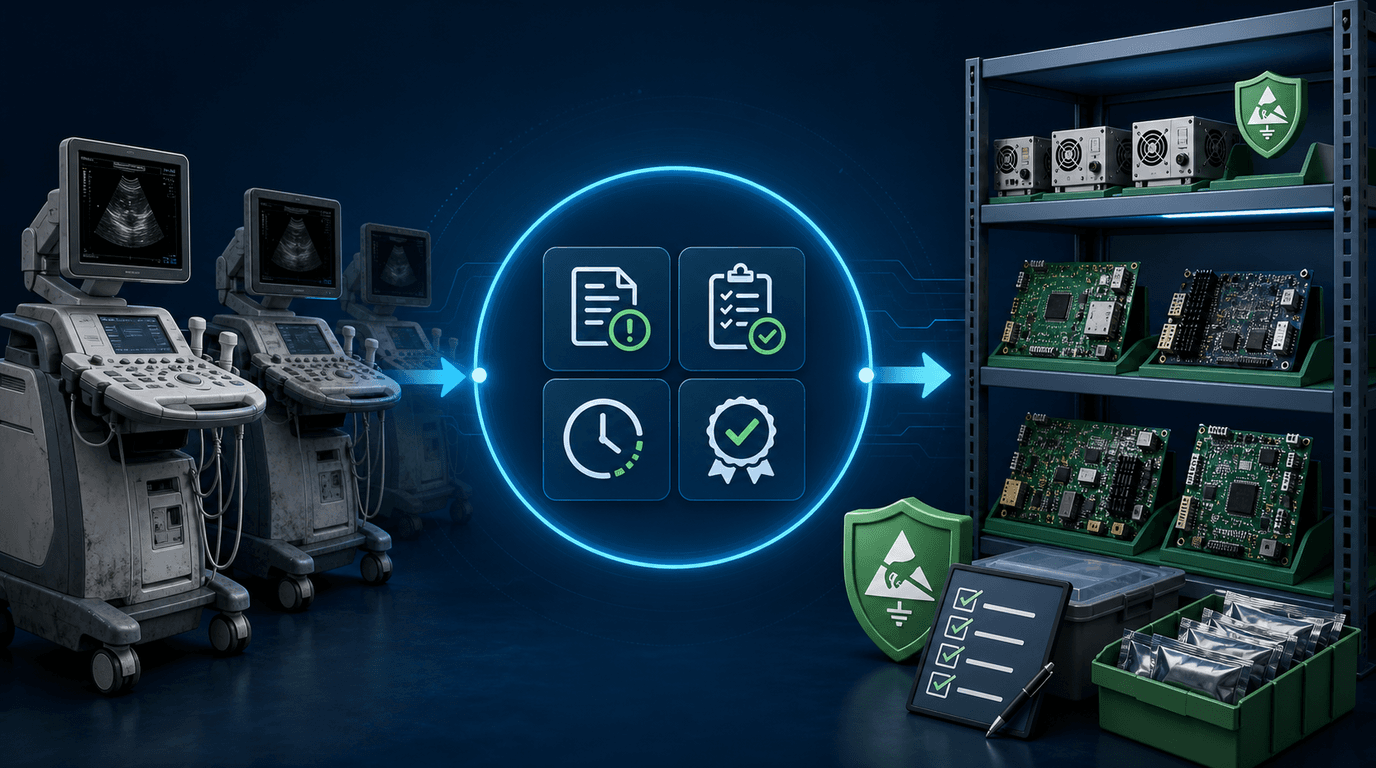
Introduction: Transitioning from OEM Service Contracts to Fleet Self-Sufficiency
Managing a hospital or health system ultrasound fleet involves balancing clinical demands against equipment aging. Support timelines differ by OEM, platform, hardware or software revision, geography and contract. Procurement teams should obtain the applicable End-of-Service (EOS) or End-of-Life (EOL) notice and confirm exactly which service, software and parts commitments change for each installed system 1.
For biomeds and HTM executives, an OEM end-of-support letter is not a mandate to decommission clinically viable ultrasound systems. As established in our strategic analysis of ultrasound fleet life after end-of-service notifications, well-maintained ultrasound consoles can continue delivering high-diagnostic image quality for years past their official EOS date—provided the operating team secures a stable supply of replacement parts.
However, relying on spot-market purchasing after an EOSL letter exposes healthcare facilities to severe operational risks: extended equipment downtime, inflated rush-order pricing, and unverified part quality. To maintain fleet uptime cost-effectively, HTM procurement teams must establish a structured critical-spares inventory strategy. For related guidance on verifying part quality before stocking, see our report on ultrasound replacement parts provenance and incoming qualification.
How do I decide which ultrasound parts are critical spares for an EOSL fleet?
Attempting to stock every circuit board, power module, and cable harness for an aging multi-brand fleet is financially impractical and wasteful. Effective critical-spares planning requires evaluating candidate parts across three distinct data-driven signals:
- Signal 1: Verified OEM Lifecycle Scope: Record the notice identifier, effective date, affected serial or revision range, geography, and the service elements that actually change. Do not apply one model-family notice to every installed configuration 1.
- Signal 2: Local Failure and Downtime Demand: Recompute annual removals, repeat failures, no-fault-found returns, repair yield and downtime from the facility's own CMMS records. MAUDE is passive surveillance: it can supply qualitative investigation leads but cannot measure incidence, causality, relative reliability or expected spare consumption 2.
- Signal 3: Qualified Supply Availability: Cross-reference exact part and revision labels against candidate catalogs 4, then measure quoted lead time, incoming acceptance yield, repairability and warranty terms. A catalog record is a sourcing lead, not proof of live stock or interchangeability.
Table 1 turns these signals into a fleet worksheet. The listed assemblies and part numbers are catalog references to verify; lifecycle status, demand and stocking quantity must be completed from the applicable OEM notice and the buyer's own fleet records.
| OEM & Console Platform | Lifecycle Evidence to Verify | Candidate Assembly to Check in CMMS | Verified OEM Part Numbers (Catalog Ground Truth) | Stocking Priority & Sourcing Recommendation |
|---|---|---|---|---|
| Siemens Acuson S2000 / S1000 | Confirm the exact S1000/S2000 revision, serial range, region and contract against the applicable OEM notice | TR Transmit/Receive & AC Power Supply | TR 7475028, RC 7466043, AC Power 10439494, PSD 07303659 | Set priority from site removals, validated repair yield and quoted replenishment lead time |
| Siemens Acuson SC2000 | Confirm SC2000 hardware/software generation and local support scope | PC Controller, RAD9, & High-Voltage Power | PC 10439995, RAD9 10435396, TI 10855828, Power Supply 07846681 | Validate installed labels and CMMS demand before reserving a controller or TI spare |
| Siemens Acuson Sequoia (Legacy) | Identify legacy versus current Sequoia generation and verify the applicable support notice | TI Transducer Interface & System Power | TI 11149770, Master Power Supply 10855235 | Qualify both repair and replacement routes; quantity remains fleet-specific |
| Philips iU22 / iE33 | Confirm cart revision, software level, serial range and local contract support | AIM Acquisition, DSC Processing, Power Supply | AIM 453561279498, AVIO 453561278213, DSC 453561233805, PS 4535611151071 | Use local AIM and power-supply removals plus lead time to calculate buffer stock |
| Philips HD15 / HD11 | Verify HD11 and HD15 separately; do not infer one platform's status from the other | HD15 ACB Control & HD11 FE Channel | HD15 ACB 453561197145, FE 453561182933, HD11 TR M2540-60240E | Require incoming functional testing and derive quantity from each model's CMMS history |
| Philips EPIQ 5 / 7 (Early Rev) | Confirm exact EPIQ generation, revision and current regional support status | EPIQ ACQ-A/B Acquisition & Power Board | ACQ-A 453561704246, ACQ-B 453561798362, Power Board 453561803892 | Treat catalog records as candidates; confirm interchangeability, lead time and exchange terms |
| GE LOGIQ E9 (R1-R5) | Confirm LOGIQ E9 revision and the scope/date of the applicable OEM support notice | GTX Transmit, DRX Receive & Power Supply | GTX 5201044-3, DRX5 5301040-5, MRX CW 5393908, Power Supply 5433408-21 | Calculate separate GTX, DRX and PSU buffers from site consumption and replenishment time |
| GE Voluson E8 / E10 (BT10-BT13) | Confirm Voluson E8 versus E10 BT/revision and current support scope independently | BF Beamformer, RFM Receive & Power | BF64 5396937-2, RFM323 5729044-7, CPS Power 5393431-3 | Verify suffix compatibility and use local BF/RFM/PSU demand to set quantity |
| GE Vivid E9 / E95 (Early Rev) | Separate Vivid E9 and E95 generations; verify revision-specific support and software dependencies | PC System Board & Control Panel | PC 5380000, Control Panel 5776030-S | Qualify exchange and repair routes before committing stock |
Source: Rongtao Medical catalog references; lifecycle and quantity fields require buyer verification against OEM notices, CMMS history and supplier quotations
Deep-Dive Platform Sourcing Analysis: Siemens, Philips, and GE
A successful critical-spares strategy requires model- and revision-specific verification. The examples below are candidate assemblies found in the catalog, not claims of failure rate, live availability or universal compatibility.
- 1. Siemens Acuson Consoles (S2000, SC2000, Sequoia): Candidate catalog records include S2000 TR 7475028, RC 7466043 and AC Power 10439494, plus SC2000 PC 10439995 and RAD9 10435396. Confirm the physical label, revision and system configuration, then compare each assembly against local removal and no-fault-found history.
- 2. Philips Consoles (iU22, iE33, EPIQ, CX50): Candidate records include iU22 AIM 453561279498 and power supply 4535611151071, EPIQ ACQ-A 453561704246 and ACQ-B 453561798362, and CX50 motherboard 453561239048. Software provisioning and interchangeability must be confirmed for the exact cart and revision before purchase.
- 3. GE HealthCare Consoles (LOGIQ E9, Voluson E8, Vivid E9): Candidate LOGIQ E9 records include GTX 5201044-3, DRX5 5301040-5, MRX CW 5393908 and power supply 5433408-21. Use the installed board label and service documentation to verify suffixes, then calculate any buffer from measured fleet consumption rather than a fixed ratio.
When should I make a last-time buy for an end-of-support platform?
Timing a last-time buy (LTB) requires balancing inventory holding costs against the risk of total parts starvation. Procuring spare parts too early ties up capital in components that may sit unused on storage shelves; waiting too long risks market depletion, where tested pre-owned parts become unavailable anywhere globally.
To determine the optimal window for executing a last-time buy, HTM leaders should document a repeatable evidence gate:
- Trigger Condition: Open the LTB decision when a verified support change and current quoted replenishment time together exceed the fleet's tolerated clinical downtime, or when incoming-test yield falls below the facility's acceptance threshold.
- Target Quantity Calculation: Estimate buffer stock from active fleet count, site-observed annual consumption, replenishment lead time, repair yield and planned extended-operation horizon. Recompute the inputs at least annually and document uncertainty when the history is sparse.
- Storage & Requalification: Preserve assemblies in appropriate ESD and environmental controls specified by the manufacturer or qualified service procedure. Define periodic inspection and functional requalification before clinical use; do not energize stored power modules solely to follow a generic interval.
For formal procurement procedures and RFQ templates when issuing multi-brand spares orders, consult our operational guide on how to write a multi-brand ultrasound board-repair RFQ.
Should I cannibalize a donor, repair at component level, or buy a tested replacement?
When an EOSL ultrasound console experiences a board failure, HTM teams can choose between three primary sourcing pathways: cannibalizing retired donor machines, repairing defective boards at the component level, or purchasing pre-owned tested replacement boards.
Table 2 evaluates the trade-offs, risk factors, and recommended applications for each sourcing pathway:
| Sourcing Pathway | Turnaround Speed | Relative Cost Index | Quality & Reliability Risk | Recommended Operational Use Case |
|---|---|---|---|---|
| Tested Pre-Owned Advance Exchange | Quote-dependent; confirm dispatch and transit separately | Usually below new OEM; obtain a board-specific quote | Variable: depends on provenance, test coverage, revision match and warranty | Use when an accepted exchange unit can meet the documented downtime target |
| Component-Level Board Repair | Moderate (5-8 business days) | Board- and fault-dependent; obtain a repair quote | Variable: require repair record, acceptance results and warranty terms | Use when the original assembly is repairable and turnaround fits the fleet plan |
| Donor System Cannibalization | Potentially fast after compatibility and acceptance checks | Low upfront (internal asset) | Elevated uncertainty unless provenance, compatibility and function are documented | Use only through the same identity, safety and functional acceptance gates as purchased parts |
Source: Rongtao Medical engineering analysis; IEC 63077:2019 refurbishment guidelines
Regulatory & Quality Guardrails: Servicing vs. Remanufacturing under IEC 63077:2019
When stocking and replacing circuit boards on post-EOSL ultrasound systems, healthcare service teams must remain strictly within the regulatory boundaries of routine device servicing and avoid activities that cross into remanufacturing under FDA guidelines and international standards.
Under international standard IEC 63077:2019 (Good Refurbishment Practices for Medical Imaging Equipment) 3 and FDA guidance on servicing versus remanufacturing:
- Routine Servicing: Replacing a defective circuit board (e.g., an iU22 AIM board 453561279498 or Siemens TR board 7475028) with an identical, verified part number to restore the device to its original OEM specifications constitutes legitimate servicing.
- Remanufacturing Boundary: Circuit, output, firmware or intended-use changes can move work beyond routine servicing. Document the change and obtain qualified regulatory review against current FDA definitions before release; do not assume that every change has the same submission consequence.
- Supplier Qualification: Define traceability, storage, test evidence, change control, complaint handling and warranty requirements appropriate to the risk. Verify claimed certifications and their scope rather than relying on a logo or certificate number alone.
For a complete legal and quality analysis of servicing boundaries, see our detailed compliance report on ultrasound servicing versus remanufacturing under FDA guidelines.
Frequently Asked Questions (FAQ) on EOSL Critical-Spares Stocking
Q: What is the difference between OEM End-of-Sale and End-of-Support (EOSL)?
A: End-of-Sale generally marks the end of new-system sales, while an End-of-Support notice defines later changes to service, software or parts commitments. Timing and scope vary by OEM, model, revision, region and contract, so the notice itself—not a generic number of years—must drive the stocking review.
Q: How long can a hospital safely maintain an ultrasound fleet after OEM End-of-Support?
A: With a structured critical-spares stocking plan and a qualified independent repair partner, hospitals routinely maintain post-EOSL ultrasound fleets for several additional years past OEM contract expiration, controlling capital-replacement costs — provided stocking is planned proactively rather than reactively. The achievable serviceable life depends on parts availability, clinical utilization, and preventive-maintenance discipline.
Q: How should power supply modules be stored and requalified?
A: Follow the assembly or component manufacturer's environmental, ESD and shelf-life instructions. Track storage time and condition, inspect before use, and run the OEM-appropriate functional and electrical-safety acceptance procedure. Any capacitor re-forming or energized bench work belongs to qualified personnel using a model-specific controlled procedure—not a universal calendar rule.
Quote-Ready Handoff & Stocking Order Preparation
Rongtao Medical acts as a global stocking and repair partner for post-EOSL ultrasound fleets. With a verified catalog of photo-backed replacement parts across GE, Philips, Siemens, Hitachi, and Toshiba consoles 4, Rongtao supports hospital HTM departments and ISOs in building customized critical-spares stocking packages.
For any quoted pre-owned board, request the exact identity and revision, test scope, acceptance record, warranty and current dispatch estimate. Catalog presence does not guarantee live stock, compatibility or a fixed lead time; those terms should be confirmed on the order.
To search our live catalog or request a customized critical-spares inventory quote for your fleet, explore our Rongtao replacement parts catalog or submit your fleet requirements directly via Rongtao Medical contact portal.
When submitting a critical-spares stocking inquiry or LTB request, provide: (1) full breakdown of active fleet inventory by brand, model, and system revision, (2) specific manufacturer board part numbers required (e.g., GE 5201044-3, Philips 453561279498, Siemens 7475028), (3) target stocking quantities per platform, (4) preferred fulfillment model (advance exchange vs. outright purchase vs. board repair contract), and (5) destination location for logistics planning.— Rongtao Medical Critical-Spares Procurement Protocol