
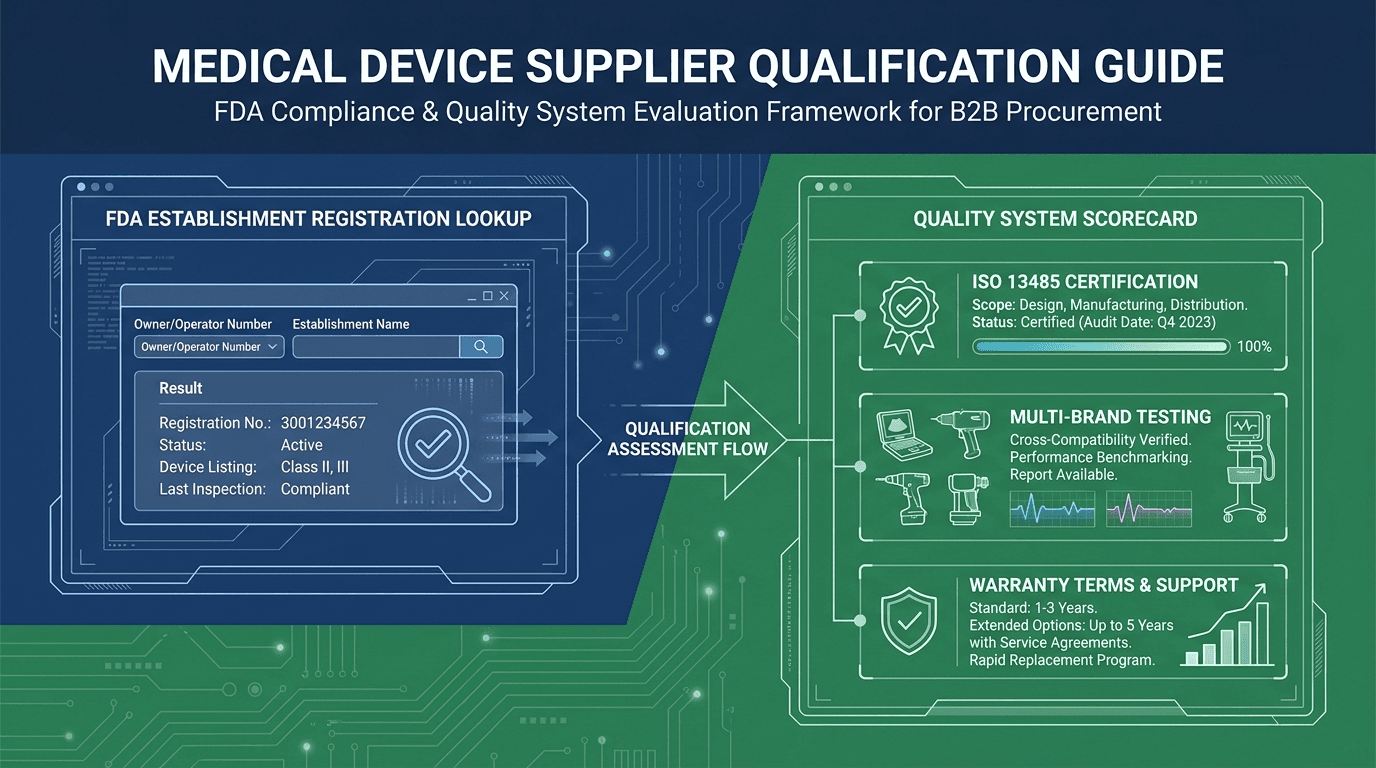
Introduction: Decoupling Regulatory Registration from Technical Capability
When a clinical engineering department, independent service organization (ISO), or medical equipment distributor faces an urgent hardware outage—such as a non-booting GE Logiq E9 system, an intermittent Philips EPIQ 7 beamformer board, or a damaged Siemens S2000 4V1c acoustic array—securing verified replacement parts or specialized board repair is time-critical. During supplier discovery, procurement leads encounter vendor websites displaying prominent badges declaring 'FDA-Registered Establishment' alongside 'ISO 13485 Certified' and 'OEM Quality Guaranteed.' For non-regulatory personnel, these marketing claims often merge into a single impression of official regulatory approval and verified technical competency 1.
However, treating administrative regulatory registration as a proxy for technical repair capability introduces severe operational, financial, and clinical risks. Filing an annual establishment registration with the U.S. Food and Drug Administration requires paying an administrative Congress-authorized user fee and submitting facility address details; it does not evaluate whether the supplier owns calibrated multi-channel oscilloscopes, operates electrostatic discharge (ESD) protected workstations, maintains a fleet of functional OEM test beds, or enforces rigorous component provenance inspection. Conflating regulatory notification with operational execution exposes health systems to premature component failure, uncalibrated diagnostic output, and unrecoverable downtime.
To establish a defensible supplier qualification protocol, healthcare organizations must implement a two-tiered audit structure: an administrative Verification Layer that decodes official public regulatory filings, paired with a rigorous Capability Layer that evaluates quality management systems, real-machine test infrastructure, multi-brand engineering coverage, and commercial transparency.
What does 'FDA-registered ultrasound supplier' actually prove — and what does it not?
FDA establishment registration and device listing is authorized under Section 510 of the Federal Food, Drug, and Cosmetic (FD&C) Act and codified in 21 CFR Part 807 4. The primary objective of Part 807 is administrative transparency: it provides the FDA with a comprehensive registry of physical locations where medical devices are manufactured, processed, packaged, relabeled, or imported into the United States 2.
To prevent commercial entities from leveraging administrative registration to imply government endorsement, the federal regulation contains an explicit statutory prohibition. Under 21 CFR 807.39, the FDA dictates:
"Registration of a device establishment or assignment of a registration number does not in any way denote approval of the establishment or its products. Any representation that creates an impression of official approval because of possession of a registration number is misleading and constitutes misbranding." 3
Furthermore, the FDA does not issue physical paper certificates of registration. Third-party 'FDA Registration Certificates' displayed on vendor websites are produced by private regulatory consulting agencies to confirm that an annual electronic registration was submitted via the FDA Unified Registration and Listing System (FURLS) and the mandatory congressional user fee was remitted. Understanding what registration legally proves versus what it does not prove is essential for procurement compliance.
| Evaluation Dimension | What FDA Registration Proves | What FDA Registration Does NOT Prove | Mandatory Evidence Required for Audit |
|---|---|---|---|
| Facility Identity & Ownership | Confirms physical address, FEI number, and owner/operator registration on FDA database. | Does not prove the facility possesses cleanrooms, ESD-safe benches, or diagnostic tools. | Verify FEI number in openFDA database; request facility video tour or third-party audit report. |
| Device Activity Listing | Declares that the establishment handles specific product codes (e.g., ITX, IYO, IYN). | Does not prove the firm repairs, refurbishes, or calibrates modules to OEM specifications. | Inspect listed product codes; require 48-hour continuous real-machine load test logs. |
| Regulatory Establishment Type | Identifies entity role: Manufacturer, Contract Manufacturer, Importer, or Remanufacturer. | Does not grant 510(k) clearance, PMA approval, or safety endorsement for third-party repairs. | Cross-reference establishment_type field; cite 21 CFR 807.39 misbranding prohibition in RFQs. |
| Quality Management System | Confirms annual registration fee payment and electronic filing for the current calendar year. | Does not verify compliance with ISO 13485:2016 or 21 CFR Part 820 quality system rules. | Require accredited ISO 13485:2016 certificate covering ultrasound repair and distribution. |
| Technical Diagnostic Depth | No technician skill, circuit schematic, soldering technique, or test fixture is audited. | Does not prove staff can diagnose FPGA errors, crystal element decay, or power supply ripple. | Require symptom-to-board root cause failure reports and technician certification records. |
| Component Provenance | Does not audit incoming component supply chains, grey-market parts, or chip origin. | Does not prevent installation of harvested, counterfeit, or degraded microelectronic chips. | Require documented anti-counterfeit incoming inspection and component traceability logs. |
| Warranty & Commercial Honor | FDA does not monitor commercial contracts, lead times, exchange policies, or warranties. | Does not guarantee the vendor will honor 90-day warranties or provide emergency advance exchange. | Require written warranty contract terms, defined RMA turnaround SLAs, and credit references. |
Source: U.S. FDA 21 CFR Part 807; openFDA Device Registration dataset; Rongtao Medical analysis
How do you look up a supplier's FDA establishment registration and listed product codes?
Procurement leads and HTM managers can execute an independent audit of any candidate supplier's regulatory status in under two minutes using the public FDA Establishment Registration & Device Listing database or openFDA API endpoints 5. When performing a regulatory lookup, follow this step-by-step procedure:
- Request Official Facility Identifiers: Require candidate vendors to provide their 10-digit Facility Establishment Identifier (FEI) number, 7-digit Registration Number, or Owner/Operator Number on all formal quotes.
- Search the Official FDA Database Portal: Query the FDA Establishment Registration database. Search using the exact corporate name, FEI number, or registration number.
- Verify Registration Expiry & Expiration Window: Ensure the establishment registration status is marked as 'Active' for the current year. Annual registration renewal must occur between October 1 and December 31 each calendar year.
- Audit Diagnostic Ultrasound Product Codes: Verify that the facility actively lists product codes relevant to diagnostic ultrasound hardware:
• ITX: Transducer, Ultrasonic, Diagnostic (21 CFR 892.1570, Class II)
• IYO: System, Imaging, Pulsed Echo, Ultrasonic (21 CFR 892.1560, Class II)
• IYN: System, Imaging, Pulsed Doppler, Ultrasonic (21 CFR 892.1550, Class II)
• JAF / JOP / MUI / KNG: Additional ultrasonic monitors, transducers, and coupling media. - Inspect Operational Establishment Types: Examine the declared operational roles assigned to the facility, such as 'Manufacture Medical Device', 'Contract Manufacturer', 'Specification Developer', 'Initial Importer', or 'Remanufacture Medical Device'.
Industry Snapshot: What openFDA Data Reveals About Registered Ultrasound Establishments
To establish an empirical baseline of the global registered ultrasound supply base, we conducted an analysis of the official openFDA Device Registration & Listing database (FDA Establishment Registration snapshot as of July 2026, comprising 419,651 total establishment-listing records) 5.
Filtering the dataset for core diagnostic ultrasound product codes (ITX, IYO, IYN, JAF, JOP, MUI, KNG) yields exactly 504 distinct establishment facilities (FEIs) worldwide. Key findings from this global dataset include:
- Full-Spectrum vs. Niche Facilities: Out of 504 registered establishments, exactly 191 distinct FEIs list all three core system and transducer codes (ITX & IYO & IYN). This indicates that less than 38% of registered ultrasound facilities maintain comprehensive hardware and probe manufacturing or distribution scope.
- Rarity of Declared Remanufacturers: Only 6 distinct FEIs across the entire global database explicitly declare a 'Remanufacture Medical Device' establishment type for ultrasound product codes. This confirms that medical device remanufacturing—which involves actions that alter a device's performance, safety, or intended use—is a specialized, highly restricted activity distinct from routine third-party servicing 8.
- Geographic Concentration: Registered ultrasound establishments are located across 12+ countries. The United States accounts for 230 distinct FEIs (45.6%), followed by China (66 FEIs, 13.1%), Japan (27 FEIs, 5.4%), France (17 FEIs), South Korea (16 FEIs), Canada (15 FEIs), Mexico (15 FEIs), the United Kingdom (12 FEIs), the Netherlands (11 FEIs), Germany (9 FEIs), Malaysia (7 FEIs), and Taiwan (7 FEIs).
- Operational Role Distribution: Across the 504 FEIs, declared establishment types include: Manufacture Medical Device (228 FEIs), Contract Manufacturer (100 FEIs), Specification Developer (73 FEIs), Complaint File Establishment per 21 CFR 820.198 (66 FEIs), Repack or Relabel (66 FEIs), Export Device to US (61 FEIs), Contract Sterilizer (47 FEIs), and Remanufacture Medical Device (6 FEIs).
| Country / Jurisdiction | Distinct FEI Count | Share of Global Base | Primary Regional Operations | Key Supply Chain Contribution |
|---|---|---|---|---|
| United States (US) | 230 FEIs | 45.6% | OEM headquarters, ISO service hubs, imports | Domestic hospital service, contract assembly, global distribution |
| China (CN) | 66 FEIs | 13.1% | Transducer manufacturing, PCB repair, module assembly | Global replacement board supply, acoustic array fabrication |
| Japan (JP) | 27 FEIs | 5.4% | OEM primary R&D (Canon/Toshiba, Hitachi/Fujifilm) | High-tier system engineering, single-crystal transducer technology |
| France (FR) | 17 FEIs | 3.4% | Specialized transducer assembly, probe repair facilities | European specialized probe repair, piezo-element manufacturing |
| South Korea (KR) | 16 FEIs | 3.2% | OEM manufacturing (Samsung Medison), probe development | Mid/high-tier console production, semiconductor probe assembly |
| Canada (CA) | 15 FEIs | 3.0% | Specialized sub-assembly fabrication, software R&D | Regional ISO service operations, module reconditioning |
| Mexico (MX) | 15 FEIs | 3.0% | Nearshore contract manufacturing, sub-assembly repair | North American bonded logistics, console board refurbishing |
| United Kingdom (GB) | 12 FEIs | 2.4% | ISO service centers, transducer repair labs | UK/NHS fleet maintenance, specialized probe strain-relief repair |
| Netherlands (NL) | 11 FEIs | 2.2% | OEM European logistics (Philips), distribution centers | European master parts warehousing and refurbishment |
| Germany (DE) | 9 FEIs | 1.8% | OEM primary manufacturing (Siemens Healthineers) | High-end console assembly, advanced beamformer engineering |
Source: openFDA Device Registration & Listing snapshot (July 2026); local aggregate analysis
Comparing Global Medical Device Registration Frameworks: US, EU, UK, China & Japan
For international hospital groups and multi-regional equipment distributors, supplier qualification extends beyond U.S. FDA regulations. Different geographic jurisdictions enforce distinct establishment registration, single registration numbers, and third-party servicing boundaries:
- United States (FDA - 21 CFR Part 807): Focuses on annual establishment registration via FURLS and device product code listing. Registration is administrative notification and does not constitute device clearance or approval.
- European Union (EU MDR 2017/745 - EUDAMED): Economic operators (manufacturers, authorized representatives, importers) must register in EUDAMED to obtain a Single Registration Number (SRN). Under EU MDR Article 23, economic operators supplying spare parts specifically intended to replace parts of a device without changing performance are not classified as manufacturers.
- United Kingdom (MHRA): Post-Brexit, all medical devices placed on the UK market must be registered with the Medicines and Healthcare products Regulatory Agency (MHRA). Foreign manufacturers must appoint a UK Responsible Person (UKRP).
- China (NMPA): Domestic and overseas manufacturers must register production facilities and obtain medical device registration certificates (Class II/III). Third-party servicing entities operate under strict quality management standard rules for medical device maintenance.
- Japan (PMDA / MHLW): Manufacturers must obtain Business License for Manufacturing Medical Devices and register manufacturing sites (Toroku). Foreign establishments must submit Foreign Medical Device Manufacturer Registration.
Who must register: manufacturers, contract manufacturers, remanufacturers, importers — and who is exempt?
Determining whether an ultrasound parts or repair vendor is legally required to maintain FDA establishment registration depends on the precise physical activities performed at its facility 2. Under 21 CFR 807.20, regulatory obligations are categorized as follows:
- Entities Required to Register & List: Original equipment manufacturers (OEMs), contract manufacturers assembling components to third-party specifications, specification developers, repackagers/relabelers, initial importers of foreign devices, and entities performing remanufacturing.
- Exempt Servicing Entities: Independent service organizations (ISOs), third-party repair shops, biomedical engineering departments, and field service engineers who perform routine servicing—defined as restoring a device to its original performance and safety specifications without altering design or intended use—are exempt from establishment registration and listing requirements.
- The Servicing vs. Remanufacturing Decision Line: In May 2024, the FDA published its final guidance Remanufacturing of Medical Devices 8. The guidance establishes a six-factor test to evaluate whether an activity constitutes servicing or remanufacturing. As analyzed in the FDA servicing-vs-remanufacturing boundary that decides when a servicer must register and list, replacing a failed component on a GE Logiq E9 beamformer with an equivalent OEM-spec component is servicing. However, redesigning circuit board traces, altering processing firmware, or re-housing a probe with non-equivalent materials constitutes remanufacturing—triggering mandatory establishment registration, 510(k) filings, and QMS compliance.
Detailed Technical Breakdown: Circuit Board & Component Failure Modes on Key Ultrasound Platforms
A truly qualified independent ultrasound repair provider must demonstrate deep technical diagnostic capabilities across major OEM platforms. A superficial parts reseller cannot perform chip-level diagnostics or root-cause failure analysis. Below is a comprehensive breakdown of observed component failure modes across high-density ultrasound platforms:
| Ultrasound Platform | Target Module / Board | Observed Diagnostic Symptom | Root-Cause Component Failure | Required ISO Testing Fixture |
|---|---|---|---|---|
| GE Logiq E9 / Voluson E10 | GRX / GTX Beamformer Board | Vertical image dropouts, acoustic line artifacts, channel noise | High-voltage MUX IC failure, BGA FPGA solder fatigue, decoupling cap short | Full console burn-in with 4D matrix probe, 48-hr thermal cycling |
| GE Logiq E9 / E10 | APS / GFI Power Supply | System power-down during high-pulse Doppler, boot loop | Primary switching MOSFET breakdown, electrolytic cap ESR degradation | Programmable electronic load bank, ripple voltage oscilloscope audit |
| Philips EPIQ 7 / Affiniti | AIM (Acquisition Interface) | Transducer recognition error, probe ID handshake fail, signal loss | Relay contacts erosion, EEPROM corruption, front-end protection diode blow | EPIQ test console, multi-probe automated connector insertion test |
| Philips EPIQ 7 / Affiniti | Host Controller PC Board | System freeze on splash screen, DICOM export error, OS crash | PCIe bridge IC overheating, SSD sector failure, RAM bit-error degradation | Stress-test software suite, temperature chamber stress cycle |
| Siemens S2000 / Sequoia | TI (Transmitter Interface) Board | Dark acoustic sectors, color Doppler velocity shift, low gain | High-voltage pulser IC thermal breakdown, transformer insulation failure | S2000 test bed, acoustic hydrophone output verification |
| Mindray Resona 7 / DC-80 | Core Processing / Transmission | Image noise floor elevation, 3D volume rendering distortion | DSP chip thermal throttling, high-speed ADC sampling clock drift | Resona console test bed, phantom calibration target audit |
Source: Rongtao Medical engineering database; observed field failure analysis across GE, Philips, Siemens, and Mindray platforms
Auditing ISO 13485:2016 Purchasing & Service Control Clauses for Ultrasound Suppliers
When auditing an ultrasound supplier's ISO 13485:2016 Quality Management System, procurement officers must look beyond the cover certificate and audit the operational implementation of specific QMS clauses 6:
- Clause 7.4.1 (Purchasing Process): The supplier must maintain documented criteria for evaluating, selecting, and monitoring sub-tier component vendors. Ask candidate suppliers: 'How do you qualify suppliers for high-voltage integrated circuits and piezo-ceramic materials?'
- Clause 7.4.3 (Verification of Purchased Product): The supplier must establish incoming inspection procedures to verify that raw components meet specified requirements. Acceptable evidence includes X-ray inspection logs for BGA chips and component pin anti-oxidation audits.
- Clause 7.5.1 (Control of Production & Service Provision): The supplier must maintain documented service instructions, calibrated test equipment, and validated test environments. Acceptable evidence includes calibration certificates for oscilloscopes, safety analyzers, and acoustic output meters.
- Clause 7.5.8 (Identification) & 7.5.9 (Traceability): The supplier must maintain complete serial number and batch traceability for every board repaired or component replaced. Every repaired module must bear a tamper-evident serial barcode linked to its work order history.
What capability evidence should you require beyond registration? (ISO 13485, real-machine testing, multi-brand coverage, turnaround, warranty)
Because FDA establishment registration verifies administrative filing rather than operational competence, procurement leads must enforce a thorough Capability Layer. Leading industry peers, such as Innovatus Imaging, explicitly advise buyers to 'insist that a repair provider be ISO 13485:2016 certified in order to qualify' 7. To build an airtight vendor audit, require candidate suppliers to produce verifiable evidence across six core operational pillars:
Pillar 1: Accredited ISO 13485:2016 QMS Certification: Require a copy of an active ISO 13485 certificate issued by an ANAB- or UKAS-accredited Registrar. Ensure the certificate scope explicitly lists 'repair, testing, refurbishment, and distribution of ultrasound systems, circuit boards, power supplies, and transducers.' ISO 13485 Clause 7.4 mandates that certified suppliers maintain strict risk-based controls over sub-tier component suppliers 6.
Pillar 2: 48-Hour Real-Machine Load & Thermal Testing: Desktop component testers cannot simulate multiaxial beamforming, acoustic pulse generation, or thermal stress under continuous clinical imaging. Require suppliers to maintain in-house fleets of matching OEM test beds—such as GE Logiq E9/E10, Philips EPIQ 7/Affiniti, Siemens S2000, Mindray Resona, and Canon Aplio—and perform continuous 48-hour burn-in testing. Diagnostic depth should match the technical rigor detailed in our symptom-to-board-to-root-cause field guide that a capable board-repair supplier should be able to speak to.
Pillar 3: Component Provenance & Anti-Counterfeit Verification: Request written incoming component inspection protocols. As detailed in the parts-provenance taxonomy and incoming-qualification protocol, qualified suppliers must inspect solder joints under high-magnification stereomicroscopes, verify silicon date codes, and eliminate grey-market or counterfeit integrated circuits.
Pillar 4: Deep Multi-Brand Engineering Coverage: Verify that the supplier maintains chip-level repair capabilities across multiple OEM platforms (GE, Philips, Siemens, Canon, Mindray, Samsung Medison), rather than operating as a simple parts broker or single-model shop.
Pillar 5: Commercial SLA & Warranty Transparency: Require clear contractual Service Level Agreements (SLAs) specifying standard 5 to 8 business-day repair turnaround, advance exchange inventory options, and minimum 90-day comprehensive warranties covering parts and labor.
Pillar 6: Bonded-Chain Logistics & Export Compliance: For international healthcare networks, verify that the supplier operates from customs-supervised bonded facilities with established carrier protocols (DHL, FedEx, UPS) to ensure seamless customs clearance and anti-static ESD protective packaging.
How do you build a weighted ultrasound supplier scorecard?
To eliminate bias from vendor selection, healthcare procurement teams should evaluate candidate suppliers using a 100-point weighted scorecard. In this balanced framework, price accounts for only 15% of the total score, ensuring that quality management, real-machine testing rigor, and compliance remain the primary decision drivers 7.
| Evaluation Category | Weight | Full Points Evidence Standard (Pass) | Zero Points / Disqualifying Red Flags |
|---|---|---|---|
| Quality Management System (ISO 13485) | 25% | Accredited ISO 13485:2016 certificate covering ultrasound repair/distribution; annual audit records. | No QMS, self-declared compliance without third-party audit, expired certificate. |
| Testing Rigor & Test Bed Fleet | 25% | In-house fleet of OEM system test beds; documented 48-hour burn-in logs; DICOM image validation. | Bench-only testing, no real-machine testing, lack of load/thermal testing equipment. |
| Technical Depth & Brand Coverage | 20% | Multi-brand engineering capability (GE, Philips, Siemens, Canon, Mindray); chip-level board repair. | Single-model capability, reliance on unverified third-party sub-contractors. |
| Warranty & Commercial SLAs | 15% | Written 90-day+ warranty, clear warranty replacement protocol, standard 5-8 day turnaround. | No written warranty, ambiguous defect clauses, turnaround exceeding 20 days. |
| Regulatory Verification (FDA Filing) | 10% | Active openFDA listing/FEI verified; product codes matched; transparent regulatory disclosures. | Claiming 'FDA Approved', displaying fake certificates, refusing FEI disclosure. |
| Logistics & Support Responsiveness | 5% | ESD-safe packaging, international customs clearance capability, dedicated technical support callback. | Unprotected shipping, no international shipping experience, delayed support. |
Source: Rongtao Medical QMS procurement framework; adapted from ISO 13485 Clause 7.4 audit standards
What RFQ language protects a buyer sourcing ultrasound parts or repair?
When issuing Request for Quotation (RFQ) documents or negotiating Master Service Agreements (MSAs) for ultrasound hardware repair or replacement parts, procurement leads should embed mandatory compliance and technical evidence clauses. These legal and operational safeguards protect the health system from counterfeit components, uncalibrated repairs, and regulatory misrepresentations. Furthermore, integrating the five-gate acceptance test for a used ultrasound system ensures system-level integrity when acquiring reconditioned units, supported by the primary-record evidence on independent ultrasound servicing.
Procurement teams can copy and insert the following mandatory evidence clause directly into their tender specifications and purchase order terms:
"Mandatory Supplier Evidence Requirement: All bidders submitting proposals for ultrasound circuit board repair, transducer refurbishment, or replacement parts must submit: (1) Official Facility Establishment Identifier (FEI) number if registered with the U.S. FDA, alongside a disclosure of listed product codes; (2) Valid ISO 13485:2016 Quality Management System certificate issued by an accredited registrar; (3) Written certification that all repaired circuit boards and probe assemblies undergo a minimum 48-hour continuous real-machine functional test on matching OEM system test beds prior to dispatch; and (4) Documented incoming component provenance protocols guaranteeing 100% anti-counterfeit verification. Proposals relying solely on administrative FDA registration filings without ISO 13485 certification and real-machine test evidence will be deemed non-responsive and rejected."
Step-by-Step Vendor Qualification & Procurement Workflow
To operationalize this evaluation model, procurement teams should follow a five-stage supplier qualification workflow before issuing purchase orders or signing long-term service contracts:
- Stage 1: Initial Screening & Administrative Verification: Collect candidate supplier FEI numbers, business licenses, and ISO certificates. Search the public openFDA database to verify active registration status, listed product codes, and establishment roles.
- Stage 2: QMS & Certification Audit: Inspect the supplier's ISO 13485:2016 certificate scope. Confirm that the issuing Registrar is accredited by ANAB or UKAS. Request the table of contents for the supplier's Quality Manual (covering Clause 7.4 Purchasing and Clause 7.5 Production & Service Provision).
- Stage 3: Technical Infrastructure Audit: Request a documented inventory of the supplier's in-house OEM test beds (models, software options, transducer compatibility). Require sample 48-hour burn-in test reports and DICOM image validation records for recent board repairs.
- Stage 4: Pilot Order & Provenance Inspection: Place a single pilot repair or advance exchange order for a non-critical module (e.g., an auxiliary power supply or system user interface board). Upon receipt, conduct an incoming inspection verifying ESD packaging, serial traceability, physical cleanliness, and test certificate inclusion.
- Stage 5: Master Service Agreement (MSA) Finalization: Upon successful pilot evaluation, execute an MSA embedding the 100-point scorecard standards, standard 5-8 day turnaround SLAs, 90-day warranty guarantees, and the mandatory RFQ evidence clause.
Frequently Asked Questions (FAQ)
Q1: Does an ultrasound repair supplier need to be FDA-registered to fix my board?
Answer: Not necessarily. Under 21 CFR Part 807, independent service organizations that perform routine servicing—returning a board or probe to its original OEM performance and safety specifications without altering design or intended use—are exempt from establishment registration 2. However, if the supplier manufactures new components, imports foreign devices, or performs remanufacturing, FDA registration and listing are legally required.
Q2: Is 'FDA-registered' the same as 'FDA-approved'?
Answer: Absolutely not. Under 21 CFR 807.39, registration is an administrative notification informing the FDA of a facility's location and activities 3. It does not denote FDA approval, 510(k) clearance, or quality endorsement. Marketing a registered facility as 'FDA-approved' is illegal and constitutes misbranding under federal law.
Q3: Can I trust an ultrasound parts supplier that is not FDA-registered?
Answer: Yes, provided the supplier produces robust technical and quality evidence. Look for ISO 13485:2016 certification, multi-brand test bed fleets, transparent warranty terms, chip-level repair diagnostic depth, and positive peer references within the biomedical engineering community.
Q4: If a supplier's repair crosses into remanufacturing, does it have to register and list with the FDA?
Answer: Yes. If an ISO's repair activities significantly alter the device's original performance, safety, or intended use (evaluated under FDA's 2024 Remanufacturing Final Guidance), the entity is legally classified as a remanufacturer and must register its establishment, list the device, and comply with QMS (21 CFR Part 820) and MDR (21 CFR Part 803) regulations 8.
Q5: What is the single most important piece of evidence to request from an ultrasound parts or repair supplier?
Answer: An accredited ISO 13485:2016 Quality Management System certificate paired with a real-machine 48-hour functional test report for the exact board or transducer model being serviced.
Q6: How do international suppliers handle customs and bonded shipping for board repairs?
Answer: Qualified international suppliers operate from customs-supervised bonded facilities. They utilize bonded transport channels via global express carriers (DHL, FedEx, UPS) and issue formal customs declarations (such as temporary export for repair), ensuring rapid outbound clearance without tax or duty delays.
Q7: What happens if a repaired board fails within the warranty period?
Answer: A qualified supplier enforces a clear Return Merchandise Authorization (RMA) protocol. Under standard warranty terms (typically 90 days), the supplier provides either an immediate advance exchange unit from stock or expedited warranty repair with priority turnaround at zero additional charge.
Q8: Why is bench-only testing insufficient for complex ultrasound circuit boards?
Answer: Modern ultrasound beamformers, processing channels, and high-voltage power supplies operate under dynamic multiaxial loads. Bench multimeters and passive component testers cannot simulate real-time acoustic signal processing, dynamic aperture shading, or thermal dissipation under continuous imaging. Only 48-hour real-machine testing on an operational console can catch intermittent thermal breakdowns.
Where does Rongtao Medical fit — and where it does not?
To maintain complete commercial and technical transparency, healthcare buyers should understand precisely where Rongtao Medical fits within the global ultrasound supply chain—and where our boundaries lie.
Where Rongtao Medical Fits:
- Certified Quality Systems: Rongtao Medical maintains dual ISO 13485:2016 and ISO 9001:2015 QMS certifications, governing all repair, testing, and distribution processes.
- Real-Machine Test Infrastructure: Operating a 3,000 m² specialized repair facility equipped with hundreds of OEM systems, probes, and test platforms (GE, Philips, Siemens, Canon/Toshiba, Mindray, Samsung Medison), ensuring every repaired board undergoes 48-hour continuous load testing.
- Transparent Service Terms: Providing standard 5 to 8 business-day repair turnaround, advance exchange options, and minimum 90-day comprehensive warranties on all serviced boards and probes.
- Bonded-Zone Logistics: Operating bonded-warehouse export logistics with customs-supervised international shipping via DHL, FedEx, and UPS.
Where Rongtao Medical Does NOT Fit:
- Not an OEM Authorized Representative: Rongtao Medical is an independent service organization and parts supplier. We are not affiliated with, sponsored by, or authorized by GE HealthCare, Philips, Siemens Healthineers, Canon Medical, or Mindray.
- Not an On-Site Clinical Field Service Team: We do not provide local in-hospital emergency field dispatch outside supported regions; our core model is centralized board repair, transducer refurbishment, and parts supply.
- No Unverified Component Sales: We do not ship unverified or untested salvage parts without full real-machine inspection.
Quote-Ready Request Handoff:
When requesting an ultrasound board repair, probe service, or replacement part quote, please provide: (1) OEM brand and system model family; (2) Manufacturer part number and revision; (3) High-resolution photos of both sides of the board and label; (4) Observed symptom or error code; (5) Quantity; and (6) Destination country. Our engineering team will provide a technical assessment, stock availability, and a verified service quote within 24 hours. Explore our ultrasound service offerings, review our quality assurance standards and repair workflow process, or contact our technical engineering team directly.