
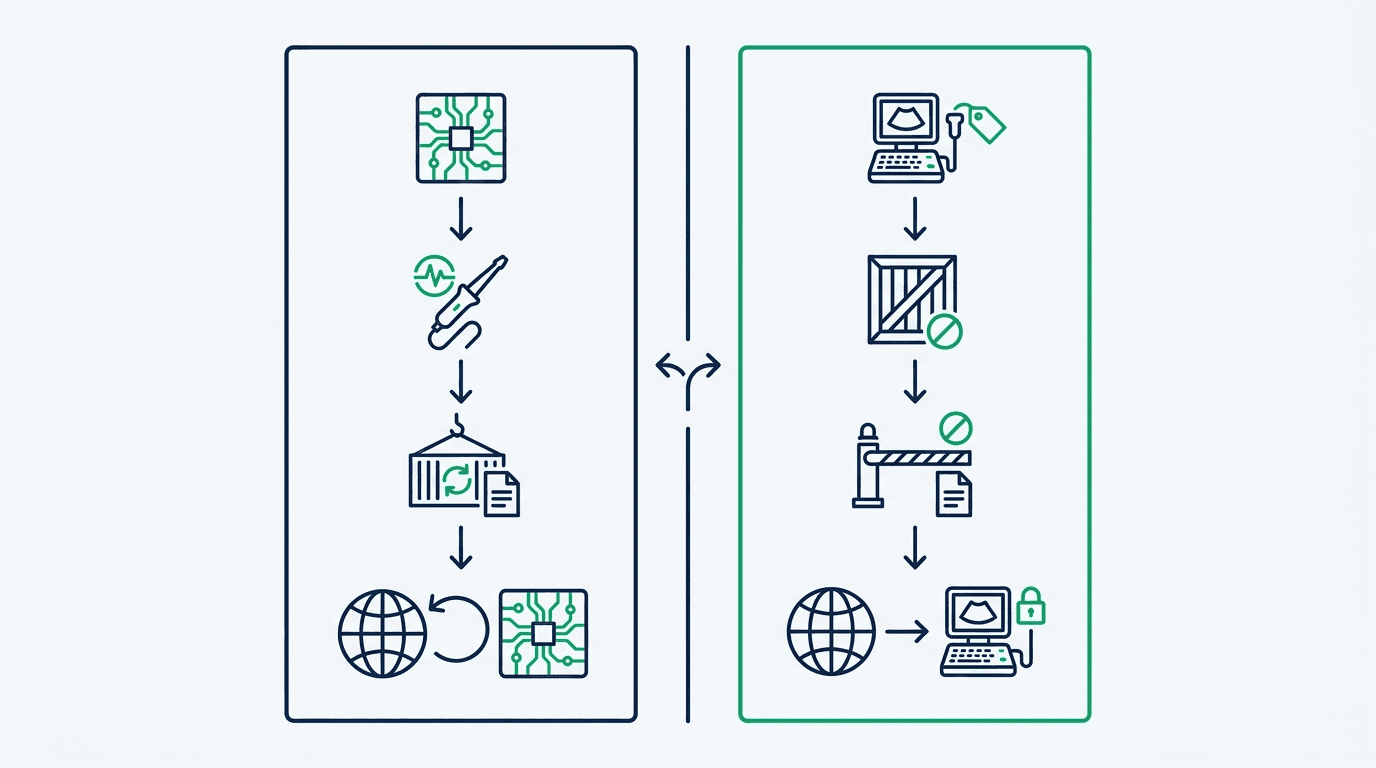
The 38 names and the seven-year residual life are read from the 15 October 2024 MoEFCC memorandum and apply to that used-equipment list. The turnaround and warranty are Rongtao service terms. They are not Indian customs timelines and they are not the annexure's one-year warranty plus three-year maintenance contract.
Source: MoEFCC Office Memorandum, 15 October 2024, read 29 September 2026; Rongtao published service terms
Is this a repair return or a refurbished system for sale?
The buyer who writes to a repair bench usually has one failed article: a beamformer, a power supply, or a probe from a scanner the hospital already uses. The headline the buyer has also seen is different. In January 2025 the press reported that CDSCO had told Customs not to allow import of refurbished medical devices. Trade pages have also said that an official list lets used ultrasound equipment into India. Those are two sentences about two files. Neither sentence, read against the documents below, tells you that your board is cleared, or that a refurbished console is cleared, or that the two shipments are the same event.
The fork is commercial intent and identity. Buying a refurbished ultrasound console abroad and bringing it in for installation or sale is the fact pattern the January 2025 letter, as quoted by The Economic Times, addresses: no specific provision for refurbished medical devices under the Medical Devices Rules, 2017, no import licence issued, and no import under those rules for sale and distribution. 4 Sending out a board the hospital already holds, and bringing that board back after repair, is not described in that quotation. It is also not described by a dedicated medical-device procedure in the guidance section titled Re-Imports. That section, in the copy read for this page, is about drugs and cosmetics of Indian origin. 3
Do not promote either path into a guarantee. A missing outward shipping record, or a return of a different serial, can make a repair shipment look like a different import. Describing a system offered for sale as a repair return does not change what is in the box. The shipping guide covers packing, incoterms, and the US repair-return trap. It stops at the Indian border and leaves duty to the buyer. Cross-border ultrasound repair shipping and turnaround is that page. This one starts with the Indian documents.
| Question | Repair return of the same article | Refurbished system for sale or distribution | MoEFCC list of 15 October 2024 |
|---|---|---|---|
| What you are trying to do | Bring back a board, power supply, probe, or system the hospital already had, after repair | Bring in a pre-owned diagnostic system for installation or sale | Import one of the 38 named used or refurbished equipment types under the hazardous-waste rules |
| What the documents in hand decide | Not decided by the sale-and-distribution quotation. The port office may require testing and is told to examine re-import consignments. Same-article identity is the fact to document. | The press quotation says there is no refurbished-device provision in the Medical Devices Rules, 2017, no import licence is issued, and such devices cannot be imported under those rules for sale and distribution. | Only the 38 printed names. Diagnostic ultrasound consoles, probes, and boards are not among them. |
| Which text to open first | FAQ addendum of 9 July 2025, then the 2024 port guidance. Customs duty is a separate broker question under the Customs Act. | The Economic Times quotation of the 10 January 2025 letter, read with Chapter V of the Medical Devices Rules, 2017, which is the import chapter | The memorandum of 15 October 2024 and Annexure I. Do not use a trade paraphrase of the list. |
| Identity | The article that left should be the article that returns. A core swap is a different article. | A different unit, purchased abroad | A foreign unit, with the annexure certificate of residual life and the other annexure conditions |
| Duty | Not calculated on this page. Do not assume duty is limited to the repair invoice. Any exemption or repair-value assessment depends on the customs notification that fits the bill of entry, and on proof the goods are the same article. | A commercial import valuation. The press account says a refurbished device is not licensable for sale and distribution under the Medical Devices Rules, 2017. | The annexure is an import-permission list, not a duty formula |
| How this file goes wrong | No outward record, or the serial that returns is not the serial that left | Calling a system offered for sale a repair return | Using row 35, or the annexure's seven-year life and warranty lines, for a diagnostic scanner or a board repair |
Source: Economic Times, 18 January 2025; CDSCO FAQ addendum, 9 July 2025; 2024 port-office guidance copy; MoEFCC memorandum, 15 October 2024
What does the 15 October 2024 equipment list actually name?
The memorandum is Office Memorandum F. No. 23/104/2022-HSMD, dated 15 October 2024, from the Ministry of Environment, Forest and Climate Change, signed by Ved Prakash Mishra, Director. The subject line is a revised list of high-end and high-value used or refurbished medical equipment other than critical-care medical equipment. It supersedes the ministry's memorandum of 19 June 2023 of the same number, and it says it adopts the revised list forwarded by the Directorate General of Health Services on 20 August 2024. The revised list is in force from the date of the memorandum. Other conditions for import permission remain those in Annexure I. 1
The PDF on the ministry site is a four-page scan. It was read on 29 September 2026. The 38 names below are that reading. Business Standard, on 16 January 2025, and Acuity Law, on 30 January 2025, both say an earlier DGHS list had 50 devices and that the October 2024 memorandum reduced it to 38. 56 The memorandum itself does not print the number 50, and it does not say why any name was removed. Business Standard quotes Rajiv Nath of the Association of Indian Medical Device Industry welcoming the separate CDSCO step on patient-safety grounds. That quotation is not a finding that the association caused the change from 50 names to 38.
| No. | Name of equipment, as printed |
|---|---|
| 1 | MRI |
| 2 | CT |
| 3 | PET-CT |
| 4 | SPECT/SPECT-CT/Gamma Camera |
| 5 | Mammography |
| 6 | Interventional Radiology Equipment |
| 7 | Radiotherapy Devices |
| 8 | OT Integration System |
| 9 | 4K Advance Laparoscopy Surgery System |
| 10 | Molecular Diagnostic – Molecular infectious disease diagnostics system |
| 11 | Microbiology – advanced mass spectrometry microbial identification system |
| 12 | Robotic Assisted Surgical System, Instruments and Accessories |
| 13 | Femtosecond ophthalmic solid – state laser system |
| 14 | Phacoemulsification and vitrectomy system |
| 15 | Ophthalmic Excimer Laser system |
| 16 | OCT posterior and anterior segment |
| 17 | Fundus imaging system preferably ultrawide field along with FFA and ICG |
| 18 | Corneal topography |
| 19 | Optical Bio meter |
| 20 | High end operating microscope |
| 21 | Ablation system |
| 22 | Endoscopic Camera system |
| 23 | Endoscopes |
| 24 | Orthopaedic Robotic Navigation System |
| 25 | High End Medical – grade monitors |
| 26 | Image Management System |
| 27 | Medical – grade electromechanical drill |
| 28 | Flow control pump |
| 29 | Insufflation device |
| 30 | NCV/EMG system |
| 31 | EEG system |
| 32 | Repetitive transcranial magnetic stimulator |
| 33 | Video Urodynamic system with Chair |
| 34 | Cryo Ablation system |
| 35 | High Intensity Focused Ultrasound System |
| 36 | 3D – 4K Laparoscopy System |
| 37 | High End Dental Chair |
| 38 | Cone-Beam Computed Tomography Systems (CBCT) |
Source: MoEFCC Office Memorandum, 15 October 2024
Row 35 is High Intensity Focused Ultrasound System. No other row uses the word ultrasound. The list does not name a diagnostic ultrasound scanner, an echocardiography system, a color-Doppler console, a transducer, or a circuit board. It also does not say 64-slice CT, 1.5T or 3.0T MRI, high-energy linear accelerator, or biplane cath lab. Those are specifications a summary might expect. They are not what the rows say. The imaging names that are printed are MRI, CT, PET-CT, SPECT/SPECT-CT/Gamma Camera, mammography, interventional radiology equipment, and cone-beam CT, plus the rest of the table: ophthalmology, endoscopy, laboratory, robotics, neurophysiology, a dental chair, and monitors.
Medical Buyer writes that the October 2024 list of 38 includes ultrasound and X-ray equipment, and some laboratory and critical-care devices. 7 The ultrasound sentence does not survive the rows. The only ultrasound name is the high-intensity focused system. The word X-ray is not a row either. The memorandum's own subject line says the list is other than critical-care medical equipment. Laboratory-type rows are present, including the molecular-diagnostic and microbiology lines. A paraphrase that folds all of this into "ultrasound and X-ray" is the claim this table is here to correct.
Annexure I sets conditions for import of the listed used or refurbished equipment. The lines an ultrasound buyer is most likely to see quoted, and the lines that do not become a board-repair checklist, are these. The annexure has further undertakings, including hazardous-substance, pollution-control, and e-waste items. Read the PDF for the full set. 1
- Form 5. The application is Form 5 under the Hazardous and Other Wastes (Management and Transboundary Movement) Rules, 2016, as amended.
- Seven-year residual life. The used or refurbished device must have a residual life of at least seven years, certified by a chartered engineer or by an accredited agency of the exporting country. The certificate is to indicate functionality, manufacturing date, residual life, and serial number.
- Not phased out, in the annexure's words. The undertaking says the equipment has not been phased out from the importing country and is not considered obsolete in that country. The scan uses "importing country." This page does not rewrite that bullet.
- OEM-factory refurbishment for capital equipment. For capital items, particularly medical equipment, the annexure asks for the fact that the machine has been refurbished at the OEM factory and that after-sales service is provided by the supplier or importer. That line is the opposite of a third-party board repair.
- Warranty and parts support. The equipment should have a minimum warranty of one year, followed by three years of comprehensive maintenance contract. The OEM or the Indian subsidiary is to ensure hardware and software support, including spare parts and consumables, for the warranty and the maintenance contract, and to confirm spare-parts availability in writing. That is not a third-party repair warranty.
- DGFT where the policy is restricted. The importer has to obtain a DGFT import authorisation wherever the item is restricted under the ITC (HS) foreign-trade policy, plus any other statutory clearance that applies.
- A third-party applicant still needs an end user. If the import application is made by a third party on behalf of the actual user, the annexure requires a list or mapping of end users for each equipment item and a confirmed purchase order from the end user. It does not say that only a tertiary hospital may apply, and it does not use the words stock-and-sale.
- A cross-reference to the memorandum this one supersedes. Annexure I still says the equipment must be enlisted in the ministry's memorandum of 19 June 2023, as advised by DGHS. The covering page of 15 October 2024 supersedes that memorandum and says the revised list is in force, while the older conditions stay in the annexure. Do not read the 2023 cross-reference as putting a diagnostic ultrasound console back on the list. The operative names are the 38 rows dated 15 October 2024.
Because a diagnostic console, probe, and board are not in those 38 rows, the annexure's seven-year life, OEM-factory refurbishment, and one-year-plus-three-year maintenance contract are not a route for importing them as used equipment. They are also not the terms of a repair returning to the hospital that already owns the article. Rongtao's typical 90-day repair warranty is a service term. How to read a repair warranty, and how not to confuse it with an OEM maintenance contract, is the subject of the parts warranty and RMA checklist.
Why is high-intensity focused ultrasound not your console?
Item 35 is easy to misuse because it contains the word ultrasound. A diagnostic console, whether it is used for abdomen, vascular, cardiac, or obstetric imaging, makes pictures and Doppler traces from a handheld or endocavity probe. A high-intensity focused ultrasound system, which is all the memorandum says, is a different product name. In clinical use that name belongs to equipment built to deposit energy and ablate tissue, not to the scanner that takes an abdominal or vascular probe. The memorandum does not define the technology, and it does not publish acoustic-output numbers. This page does not supply numbers from an uncited standard.
| Question | Diagnostic console, probe, or board | Row 35 |
|---|---|---|
| Is the name on the 15 October 2024 list? | No | Yes. The printed name is High Intensity Focused Ultrasound System. |
| What is the device for? | Imaging. The list does not need a physics table to show that this article is absent. | The row names a high-intensity focused ultrasound system. The memorandum does not define it further. Do not treat that name as a synonym for a diagnostic scanner. |
| Can the annexure conditions be used for it? | No. The conditions attach to the listed names. | Only if the equipment is actually that listed system, and the annexure conditions are met, including OEM-factory refurbishment for capital equipment. Meeting those conditions is still not a CDSCO import licence for sale. |
| What a shipping description cannot do | A silent row is not permission to import a refurbished diagnostic system for sale. | Calling a diagnostic scanner, probe, or repaired board "item 35" because both involve ultrasound does not make it that row. |
Source: MoEFCC Office Memorandum, 15 October 2024, row 35 and the surrounding names
The port office and Customs compare the product literature with the declaration. A diagnostic scanner described as row 35 is a different article from the one the row names. That is a description problem, not a drafting trick. Words such as refurbished, used, and tested also mean different things on a parts invoice than they mean in this import argument. The parts condition grades and acceptance evidence guide is about those condition words. It is not an India import rule.
What do the CDSCO FAQ and the port-office guidance say about re-import?
Addendum No. 02 to the CDSCO FAQ on the Medical Devices Rules, 2017, is dated 9 July 2025. Question 1 asks the requirements for re-import of a medical device. The answer has two sentences. Re-import requirements are prescribed in the guidance document for functions and responsibilities of zonal, sub-zonal, and port offices of CDSCO, 2024. The decision on whether that consignment needs laboratory testing before re-import, and on its release, may be taken by the port office in consultation with the concerned zonal office or the state drugs control office. 2 The addendum's own notice says the replies are for public awareness and are not meant to be used as a substitute for the statute and the guidelines. The answer does not say that a repaired ultrasound board is outside the refurbished-device correspondence. It sends the reader to the port guidance, and it leaves testing to the port office.
The 2024 guidance was not retrieved from cdsco.gov.in for this page. The copy that was read is a 1,103-page Word PDF, created 12 September 2024, hosted by Medical Dialogues. Treat it as that host's copy until a CDSCO-hosted file is the one in hand. In the port-office function list, three items bear on this question. The list repeats some numbers, including two items numbered (13) and two numbered (14). The citations below use the words, not an assumption that the numbering is clean. 3
- Import permission, function (6). "To ensure that no Medical Device is imported into the country unless its import is permitted by the Central Licensing Authority under Chapter V and VIII of Medical Devices Rules, 2017." In the rules themselves, Chapter V is Import of Medical Devices. Chapter IV is manufacture for sale or distribution. Chapter VIII is import or manufacture of a medical device which does not have a predicate device. 8 Function (6) is not a statement that Chapter V is the manufacturing chapter. The FAQ addendum, in a later answer about special economic zones, also says an import licence is obtained under Chapter V. 2
- Intimation, function (11). The same list tells port officers to intimate several categories to the state drugs controller for a post-import check, with a copy to the zonal deputy drugs controller: raw materials under duty-exemption and export-oriented-unit schemes, re-imported raw materials, drugs, cosmetics, refurbished medical devices, and bonded-warehouse items under the MOOWR scheme. Refurbished medical devices are in that group. The bullet is an intimation duty. It is not a licence, and it is not a finding that every repaired board is a refurbished device.
- Re-import examination, the later items (14) and (15). Port officers are told to examine the re-import or re-export consignment as per the procedures, and to draw samples from import, export, and re-import consignments as per laid-down procedures. The text does not say examination happens only when identity is in doubt.
The heading Re-Imports, later in the same copy, is narrower than the word suggests. It addresses re-import of drugs and cosmetics of Indian origin by the manufacturer or exporter, including sampling, a decision by the deputy drugs controller, and notice to the state drug controller. It does not set out a procedure for a foreign-origin ultrasound board returning after third-party repair. 3 The absence of that procedure is not permission. It means the guidance the FAQ points to does not contain a medical-device repair-return protocol under that heading. Clearance still sits with the port office and with Customs. A complete identity file — the same serial out and back, the outward customs record, and a repair report that describes that article — is what you can prepare. It is not a ruling that the port officer must release the box.
What did the January 2025 Customs letter say, and what did it not say?
CDSCO's letter of 10 January 2025 to the principal commissioner of Customs was not found as a PDF on cdsco.gov.in. Two press accounts describe one letter. They are not two official sources.
The Economic Times, in a PTI report last updated 18 January 2025, quotes the letter this way: there is no specific provision for regulation of refurbished medical devices under the said rules; hence no licence is issued for import of such devices, and it cannot be imported under the Medical Devices Rules for sale and distribution. 4 Business Standard, last updated 16 January 2025, says it reviewed the 10 January letter and reports the same point: refurbished medical devices cannot be imported for sale and distribution because there is no specific regulation for them under the Medical Devices Rules, 2017, and no licence is issued for their import. The same article reports that Deputy Drugs Controller Aseem Sahu told a CDSCO and Confederation of Indian Industry workshop that any consignment of refurbished devices then at the ports would not be released and would have to be returned. 5
That workshop sentence is the counterweight. It is about refurbished consignments present at the ports. It does not define a repair return, and it does not let a repair shipper assume the letter cannot be applied to a poorly described box. If a later CDSCO file or a Customs instruction says repair returns of medical devices follow the sale restriction, this page has to be revised. Until that file is the one in hand, the honest limit is narrower.
- What the quotation covers. Sale and distribution of refurbished medical devices, and the absence of a licensing provision for them under the Medical Devices Rules, 2017. Form MD-14 and Form MD-15 sit in the import chapter, Chapter V. The quotation says no licence is issued for refurbished devices. It does not create a refurbished category inside those forms.
- What the quotation does not say. It does not say that a hospital may not maintain equipment it already has. It does not mention ultrasound boards, probes, or re-import after repair. It does not set the duty on a repair return.
- Where a repair shipment still gets caught. Function (11) of the port guidance tells officers to intimate refurbished medical devices for a post-import check. An invoice that says "refurbished board," "used ultrasound assembly," or "reconditioned transducer" borrows the word the January 2025 correspondence is about. The port office can read that invoice as the file the letter describes. The remedy is a description of the actual transaction: repair of the same article, returned to the same owner. The remedy is not a softer synonym for a system you are selling.
What should the repair packet contain before the goods move?
Build the identity file before the courier collects the board. This is not a customs filing instruction and it is not a broker's endorsement. Do not print section 149 of the Customs Act on the shipping bill from this page: that section concerns amendment of documents, not export of a board for repair. Do not print Notification 158/95-Customs from this page either. Ask a licensed customs broker which shipping-bill scheme and which current re-import notification apply. This page does not calculate duty, and it does not say that basic customs duty and IGST are assessed only on the repair invoice. If an exemption or a repair-value assessment exists, it exists in a notification, and only where that notification's conditions, including identity of the goods, are met.
- An outward customs record the broker can tie to the return. The article should leave India on a shipping bill the broker is willing to cite when it comes back. A courier parcel with no export filing is a weak identity file. Do not invent the legal endorsement from this page.
- Photographs taken before packing. The whole board or probe, the OEM part number and revision as printed on the part, the serial or barcode, and any hospital asset tag. Attach them to the file you will show on the way back. Do not substitute an example part number for the one on the label.
- An invoice that states the transaction. Defective component, property of the named hospital or service company, exported for repair and return to that owner, not for sale. Leave the customs value to the broker. Do not put a sample repair price on the invoice because a guide used one.
- The fault as the console actually presented it. Model, symptom, and any error text on the screen. An invented error code does not help the port office, and it can disagree with the service report.
- A repair report for the article received. Serial received, serial returned, work performed, and the test that was run. Rongtao's published test for a repaired board is 48 hours in an actual ultrasound system. If the unit that returns is not the unit that left, say so. A replacement is a different import and should not be described as a repair return.
- A return invoice that separates the repair charge from a sale of goods. Identify the outward shipping bill the broker named, the repair charge, and the freight. Do not declare the full replacement value of a different unit as if it were a repair of the original.
| What went out in the file | Why it collides | What to prepare instead |
|---|---|---|
| The serial that returns is not the serial that left | A core swap is a different article. It can be read as an import of another used part, not as a repair return. | Repair the exported article, or declare the replacement as the different transaction it is |
| The invoice says refurbished, reconditioned, or second-hand | Those are the words in the January 2025 correspondence and in port function (11)'s refurbished-device intimation | State repair of the named article, returned to the named owner |
| There is no outward customs record | The port office cannot match the arrival to an export of the same article | Ask the broker to create the outward record before the part leaves |
| The label is gone or the photograph does not show it | Identity then rests on a story rather than on the part | Photograph the part number and serial before cleaning or packing, and do not remove the label |
Source: Read against the January 2025 press quotation and the port-guidance intimation duty. Outcomes at a given port are for that port office and the customs broker, not a prediction from this page.
If the repair bench is in a Chinese bonded zone, the China-side catalogue and the return declaration are a different border. China bonded-zone ultrasound repair is that analysis. Do not copy its tariff lines onto an Indian bill of entry, and do not treat that page's programme tag as part of this one.
Where Rongtao fits, and where it does not
Rongtao Medical is an independent repair business in Guangzhou. It is not GE HealthCare, Philips, Siemens Healthineers, Canon, Samsung, or Mindray, and it is not an Indian subsidiary of any of them. It cannot sign the annexure's OEM or Indian-subsidiary warranty and spare-parts undertaking. Service across more than 140 countries, a typical board-repair turnaround of 5 to 8 business days, a 48-hour real-machine test of a repaired board, and a typical 90-day warranty are published service terms. The quote confirms the terms for the item. None of those terms is an Indian import permission or a comprehensive maintenance contract under Annexure I.
What the repair bench can add to the file
- Component-level repair of ultrasound boards and power supplies, and probe repair through the probe repair service.
- A test report for a repaired board. The published test is 48 hours inside an actual ultrasound system, not a bench meter alone.
- The serial received and the serial returned, the part number on the label, and a description of the work. If you need the same article back for an Indian re-import file, say that when you ask for the quote. A different unit is a different shipment.
- The usual commercial documents for the repair charge. The service process is where the 5 to 8 business-day board-repair turnaround is stated. Final timing depends on the fault.
What this page will not ask Rongtao to do
- File an Indian bill of entry, pay Indian duty, or act as a customs broker.
- Apply for Form MD-14, obtain an import licence, or represent you before CDSCO.
- Invoice a different unit as the board you exported, understate the repair charge, or describe a system offered for sale as a repair return.
- Sign a seven-year residual-life certificate, an OEM-factory refurbishment statement, or a three-year comprehensive maintenance contract under the MoEFCC annexure.
Send the quote request through contact. The useful packet is the OEM, the model and software revision, the board or probe name, the manufacturer part number and serial as printed, photographs of both sides and of the label, the symptom or error text, the quantity, the Indian airport or port you expect to use, and whether the part will leave under a customs shipping bill for repair. The parts catalogue is for a tested replacement you intend to buy. A catalogue row is not a statement that the part may be imported into India as a repair return.
Frequently Asked Questions
Can a repaired ultrasound board be brought back into India?
The documents read for this page do not say that a same-article repair return is the refurbished-device import described in the January 2025 press quotation. They also do not clear the shipment. The FAQ addendum of 9 July 2025 leaves testing and release to the port office, in consultation with the zonal office or the state drugs controller. Bring the outward customs record, photographs of the part number and serial, a repair report for that serial, and an invoice that states repair of the same article for the same owner. Ask the broker which re-import notification applies. Do not treat this answer as a bill-of-entry instruction.
Is diagnostic ultrasound on India's used medical equipment import list?
No. The 15 October 2024 memorandum prints 38 names. Row 35 is High Intensity Focused Ultrasound System. Diagnostic consoles, probes, and boards are not named. The annexure conditions, including seven years of residual life and a one-year warranty followed by three years of comprehensive maintenance contract, attach to the named equipment.
Does the refurbished-device letter ban every used ultrasound part?
The quotation published by The Economic Times addresses import of refurbished medical devices for sale and distribution. It does not mention repair returns. Business Standard's account of the 16 January 2025 workshop says refurbished consignments then at the ports would not be released and would have to be returned. A repair invoice that uses the word refurbished can be read as that file. The letter was not retrieved as a CDSCO PDF, so this page does not pretend to quote a broader order than the press accounts give.
What is the difference between a high-intensity focused ultrasound system and a diagnostic scanner?
Row 35 names a high-intensity focused ultrasound system and nothing else on the list uses the word ultrasound. A diagnostic scanner is the imaging console and its probes. The memorandum does not publish acoustic intensities, and this page does not import figures from an uncited standard. Describing a diagnostic scanner as row 35 does not put it on the list.
Who decides whether a re-imported device is tested at the port?
The FAQ addendum of 9 July 2025 says the port office may decide whether laboratory testing is required before release, in consultation with the zonal office of CDSCO or the state drugs control office. The 2024 guidance copy, separately, tells port officers to examine re-import consignments and to draw samples as laid down. Neither document gives that decision to a repair vendor or to this page.
What should we send with an overseas ultrasound board repair?
Before the part leaves India: the broker's outward shipping bill, photographs of the part number and serial, an invoice that says the defective article is exported for repair and return to the named owner, the actual fault text, and an instruction that a different unit is not a repair of the exported serial. On the way back: a repair report with both serials and a return invoice for the repair charge. Leave the duty calculation to the customs broker.