
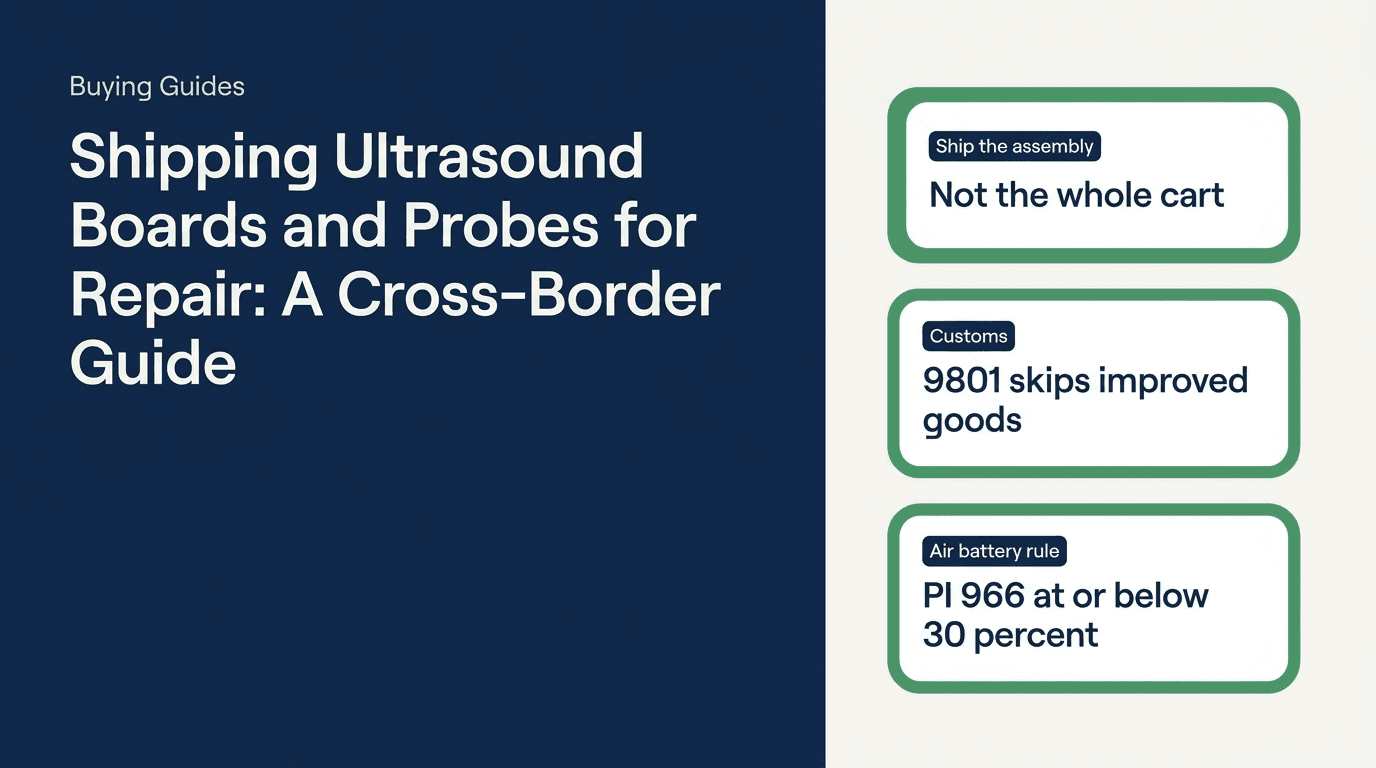
What should ship for repair — and what should be swapped locally instead?
When an ultrasound system fails, the first shipping decision is how much of the system has to cross a border. Sending a whole console for a supply fault, or a card cage because the service record never isolated a board, adds freight weight, a larger customs value, and more transit risk. Do not open an energized system, measure live rails, or bypass a safety interlock in order to prepare this shipment.
Before the carton is sealed, compare the asset with the ultrasound board repairability decision framework and the downtime choice in urgent ultrasound parts sourcing. If a tested replacement is available, an advance exchange removes the repair-cycle wait. Stock turns, so confirm the live catalog or the quote. Cross-border repair is the option to quote when the serialized board should stay with the system, when a replacement is not available, or when the service contract is written against a repair charge rather than a replacement. The repair price and the replacement price are quote lines. This page does not publish a savings rate.
The table below establishes the diagnostic pre-conditions, packaging specifications, and logistics boundaries across the primary ultrasound hardware classes.
| Hardware Class | Diagnostic Pre-Condition | Packaging Specification | Customs Risk Profile | When to Ship vs. When to Swap Locally |
|---|---|---|---|---|
| Power supply / DC distribution board | The service record already shows no output, a supply that will not latch, or a fuse finding from a qualified technician. | Metallized static-shielding bag, connector and tall-part clearance, rigid inner container, then 2–3 inches of cushioning and a second box with about 3 inches more. | Usually a discrete electronic assembly, still described by part number and serial on the invoice. | Ship the supply when the record isolates it and a tested replacement is not available for the downtime window. Use stock when the catalog or quote shows a match and the clinical need cannot wait. |
| Front-end / beamformer / transmitter board | Acoustic dropout or missing lines already isolated to one board or one probe port. | Metallized static-shielding bag, edge-connector protection, no load on gold fingers, rigid carton, box-in-box cushioning. | Needs a specific part description and serial. A generic computer-parts description invites a hold. | Ship the isolated board when a tested replacement is not available. Do not ship the card cage because the slot was never identified. |
| Back-end host / motherboard / PC module | Stops before boot, corrupt video, or a dead backplane after a qualified technician has already checked storage and memory. | Static-shielding bag, support that keeps the board from flexing, desiccant, box-in-box cushioning. | A proprietary medical processor can be misread as a consumer computer if the invoice says so. | Ship it when the system software or calibration has to stay with that board. A standard industrial PC is a local-swap question, confirmed from the label rather than the console badge. |
| Surface transducer (convex, linear, or phased) | Element dropout, lens damage, strain-relief failure, or a broken connector latch already seen on more than one port. | OEM case or a rigid tray, lens cap, connector immobilized, cushioning on all sides. Dry before it goes into foam. | Classify the article the broker assigns. A probe is not automatically the same code as a complete scanner. | Ship the probe when the record isolates the fault to it. Repair price and replacement price are quote items. |
| TEE or endocavity probe | Bite damage, articulation play, a lens blister, or a failed leakage test already in the service record. | Rigid case, tip immobilized, flexible shaft coiled no tighter than 30 cm (1 foot), connector secured. Cleaning follows that probe's instructions for use. | A soiled patient-contact probe can be refused by the carrier or held at intake. Put the decontamination statement in the external pouch. | Ship to a probe service that accepts that model. Cable and articulation work is not a packing-bench job. |
| Portable or point-of-care console | A mainboard, display, or internal power fault already isolated from the battery. | Original shell and carton if they are intact. The battery rule depends on whether the pack is inside the unit, beside it, or left behind. | Lithium-ion dangerous goods if a battery travels with or inside the console. | Leave a healthy battery at the facility when the fault is the mainboard. Do not air-ship a pack that is swollen, leaking, or identified as defective for safety reasons. |
| Full-size cart | Frame damage, or a fault that a qualified technician could not isolate to a board or probe. | A crate, shock isolation, and tilt indication are a freight job, not a small-parcel pack. | The customs value and the inspection delay follow the whole system. | Do not ship the cart across a border when a board or probe can travel instead. |
Source: Editorial triage for shipment scope. Packaging dimensions follow the FedEx fragile-item guide. Battery configuration follows the IATA 2026 lithium-battery guidance. Diagnostic detail belongs in a qualified service record, not in a packing instruction.
Do not ship an entire ultrasound cart across a border when the fault is already isolated to a field-replaceable board or transducer. The freight, the temporary-import exposure, and the chance of transit damage all sit on whatever you put in the crate.
How should a board, a probe, or a portable be packed so transit does not create the next fault?
Express networks drop, vibrate, and temperature-cycle cartons. A pack that lets a board or a connector move can turn a repairable fault into broken laminate, a cracked lens, or a sheared strain relief 8.
FedEx's fragile-item packing guide asks for at least 2–3 inches of cushioning on all six sides, or a box-in-box pack: 2–3 inches around the item in the inner box, then about 3 inches more between that box and the outer box. Seal both with an H of pressure-sensitive tape, at least six strips, each at least 2 inches wide 4. Those are carrier packing recommendations for a damage claim, not a guarantee that a claim will be paid.
- Static-shielding bag, not pink dissipative wrap: Pink anti-static wrap is meant to limit charge generation. It does not shield the board from an external discharge. Seal a beamformer, receiver, or host board in a metallized static-shielding bag before the cushioning goes on.
- Keep the load off pins and tall parts: Edge fingers, headers, and tall capacitors should not carry the pack. Use an edge protector or a slot so a hit lands on the mounting points.
- Box-in-box, with the board immobilized: Put the sealed board in a rigid inner carton that cannot rattle. Put that carton in an outer carton with the FedEx fragile-item cushioning above. Loose peanuts are a void fill in some FedEx guides, not a substitute for immobilizing a heavy connector. If the board can migrate, add foam that holds it.
- H-tape on both boxes: Use pressure-sensitive shipping tape at least 2 inches wide. Apply at least three strips on the top and three on the bottom so the tape crosses the center seam and the edges, forming an H 4.
| Verification Step | Required Action & Method | Photographic Proof to Retain | Failure Consequence if Skipped |
|---|---|---|---|
| Label and serial | Read the rating plate, etched part number, barcode, and revision on both sides. Copy that text onto the invoice. | Macro photos of both sides, including the etched number and revision. | A serial that does not match the invoice can stall clearance or the return entry. |
| Connectors before bagging | Look for bent pins, cracked latches, and corrosion that are already present. | Close-up of each connector before the shielding bag is sealed. | Without the photo, pin damage found at intake cannot be separated from transit damage. |
| Shielding bag | Seal the board in an intact metallized static-shielding bag. Add desiccant if the lane is humid. Fold and tape the open edge. | Photo of the board fully inside the bag. | A cushioned but unshielded board can still be damaged by a discharge in sorting. |
| Inner box | The assembly cannot shift, rattle, or touch the inner wall. | Photo of the assembly seated before the inner lid goes on. | Movement inside the inner box is what snaps a mounting ear. |
| Outer cushioning | Center the inner box with the fragile-item cushioning on all six sides. | Photo looking into the outer carton before the flaps close. | A carrier can dispute a damage claim when the cushioning does not match its packing guide. |
| External pouch | Packing list, decontamination statement for a probe, and the commercial invoice go in a pouch on the outside. | Photo of the closed, H-taped carton with the pouch and label visible. | Missing external paperwork is a reason for an officer to open the carton. |
Source: Intake photos Rongtao asks for on a board or probe shipment, paired with the FedEx fragile-item pack. The photos support identity and a damage dispute. They do not by themselves prove customs value.
What cleaning and disclosure gates apply before a probe leaves the building?
A visibly soiled probe is a carrier refusal and an intake refusal, not a label you can add to an ordinary express carton. GE's card says a dirty or contaminated transducer will contaminate the foam insert. Clean and disinfect to that probe's instructions for use and the facility policy before it is packed. This page does not assign a disinfection level or a chemical. Intracavitary and TEE high-level disinfection boundaries are in the probe disinfection report.
GE Healthcare's Probe Care Quick Cards, document JB6921701, state the transport rules this way 1:
Always clean and disinfect any transducer before transporting between sites or sending via freight carrier. Warning: Placing a dirty or contaminated transducer in a carrying case or shipping carton will contaminate the foam insert. Do not use cloth or plastic bags to transport transducers. This may result in damage to the transducer. If possible, use a rigid container with a lid and that secures the system connector in place so as not to damage the transducer head or lens.— GE Healthcare, Probe Care Quick Cards: Transportation & Storage (Document JB6921701)
Four packing consequences follow from that card, without adding a chemical or a failure mechanism the card does not state:
- Clean and disinfect before the case: The card says to clean and disinfect any transducer before transport or freight, and that a dirty transducer will contaminate the foam insert. Follow the probe instructions for use. The high-level disinfection report is the boundary for intracavitary and TEE probes. Do not put a soiled probe in the foam and plan to clean it later 1.
- No cloth or plastic bag: The same card says not to use cloth or plastic bags, because that may damage the transducer. For endocavity and TEE probes, CIVCO's storage note says a plastic bag can promote microbial growth and that the probe must be completely dry. GE's transport card, not that storage note, is what tells you to use the carrying case after cleaning 1 11.
- Secure the connector when you can: The card says, if possible, to use a rigid container with a lid that secures the system connector so the head or lens is not damaged. A loose connector is the heavy object in the box 1.
- TEE coil of 30 cm (1 foot) or greater: For TEE transducers, the card says not to coil the flexible shaft too tightly. The coil should be 30 cm (1 foot) or greater in diameter 1. The TEE damage repair route covers what a tight coil does to the insertion tube. The card itself states the diameter, not a repair procedure.
Put a decontamination statement in the external pouch with the invoice. Name the probe model and serial, the facility, the date, the process the probe instructions for use allow, and the person who performed it. Do not list a chemical this page has not tied to that probe. A seller's twelve-check list is a useful probe-only pretest: second port, second machine, a photo of the lens and pins, and a loose cable coil. It does not state the GE 30 cm TEE diameter, the 9801 test, or the 2026 split between PI 966 and PI 967 13.
Which 2026 lithium-battery rule applies when the pack stays in the portable, and which applies when it is packed beside the unit?
Point-of-care ultrasound (POCUS) and laptop-style portable systems rely on high-capacity lithium-ion battery packs to support emergency room, intensive care, and field scanning. However, shipping lithium batteries by air freight is subject to stringent international dangerous goods oversight governed by the International Air Transport Association (IATA) and the International Civil Aviation Organization (ICAO). Misinterpreting these regulations results in immediate cargo rejection at airport sorting hubs, heavy carrier fines, or severe civil penalties.
The IATA Lithium Battery Guidance Document revised for the 2026 Dangerous Goods Regulations, 67th Edition, separates a battery packed with equipment from a battery contained in equipment 3. The document is guidance. It says it should not be relied on as the regulatory text. The shipper still has to meet the Dangerous Goods Regulations and the carrier's variation.
- Packed with equipment (UN 3481, PI 966): The pack is out of the console and in the same outer package. From 1 January 2026, Section I requires cells and batteries to be offered at a state of charge not exceeding 30% of rated capacity. Section II applies that requirement to lithium-ion cells and batteries with a watt-hour rating in excess of 2.7 Wh. A higher state of charge needs approval from the State of Origin and the State of the Operator under the written conditions those authorities set 3. Read the watt-hour rating on the pack. Do not assume a portable-ultrasound battery is under 2.7 Wh.
- Contained in equipment (UN 3481, PI 967): The pack stays installed. The 2026 guidance recommends offering those cells and batteries at no more than 30% of rated capacity, or at an indicated battery capacity not exceeding 25%. It says a reduced state of charge is not mandatory for these items 3. Check the carrier variation before tender. This guidance document does not make the PI 967 figure a mandate.
- Shipped alone (UN 3480, PI 965): A pack without the ultrasound console is a standalone lithium-ion battery. The guidance says all lithium-ion cells and batteries shipped by themselves are forbidden as cargo on a passenger aircraft, and that they must be shipped at a state of charge not exceeding 30% of rated capacity unless the State of Origin and the State of the Operator approve a higher state of charge 3. Do not make a standalone battery the default repair shipment.
- Damaged, or defective for safety reasons (Special Provision A154): IATA's guidance FAQ says lithium batteries the manufacturer identifies as defective for safety reasons, or batteries that have been damaged and can produce a dangerous evolution of heat, fire, or short circuit, are forbidden for air transport. The same answer applies that prohibition to equipment recalled because of the battery. A battery that only fails to hold a charge, and equipment recalled for a fault that is not the battery, are not automatically forbidden 3.
FDA recall Z-1555-2025 is a Class 2 action on GE Venue Go, and Z-1556-2025 is the Class 2 action on Venue Fit. Both sit in event 96538, initiated 6 March 2025. The reason is that the battery can potentially develop an internal failure which could result in smoke or fire. GE's customer notice told users to turn the system off, unplug it, remove the batteries, and check the manufacture date. Batteries more than two years old were to be discharged and then removed 15. The portable fleet service gap analysis records that correction. Do not offer a battery from that action as air cargo. Use the portable battery versus DC-board path only to decide whether a different, unaffected power fault is the one being sent. If the fault is the mainboard and the battery is not part of a safety recall and is not damaged, leave the battery at the facility and ship the console.
| Packaging Configuration | UN Number & Packing Instruction | 2026 State of Charge (SoC) Rule | Air Freight Aircraft Eligibility | Clinical Engineering Recommendation |
|---|---|---|---|---|
| Battery removed and packed in the same box as the console | UN 3481, PI 966 | From 1 January 2026, mandatory ≤30% of rated capacity for Section I. Section II applies that cap above 2.7 Wh. A higher state of charge needs State of Origin and State of Operator approval. | Not the standalone UN 3480 passenger-aircraft ban. Section, watt-hour rating, and quantity still decide the aircraft and the marks. | Read the watt-hour label. Discharge to the cap that applies before packing. Use the marks that section requires. |
| Battery installed in the console | UN 3481, PI 967 | Recommended, not mandatory: ≤30% of rated capacity, or indicated capacity ≤25%. | Not the UN 3480 passenger-aircraft ban. Protect against accidental activation and confirm the operator variation. | Power the console down. If the fault is not the battery, prefer to leave the pack at the facility. |
| Battery shipped without the console | UN 3480, PI 965 | Mandatory ≤30% of rated capacity unless the State of Origin and the State of the Operator approve a higher state of charge. | Forbidden as cargo on a passenger aircraft. Cargo-aircraft handling, subject to any approval path in the DGR. | Do not make a lone pack the repair shipment. Source a replacement pack through a channel that already knows the rule. |
| Swollen, leaking, or identified as defective for safety reasons, including a battery recall for heat, fire, or short-circuit risk | Special Provision A154 | State of charge does not make it acceptable. | Forbidden for air transport. | Do not tender it. Follow the manufacturer notice and the facility hazardous-battery procedure. |
Source: IATA Lithium Battery Guidance Document, revised for the 2026 DGR 67th Edition. Aircraft eligibility still depends on section, watt-hour rating, quantity, and the operator variation.
What must a repair-and-return commercial invoice state so customs does not tax the full replacement value?
A repair shipment is a temporary export of a hospital-owned article that is supposed to come back. If the invoice reads like a sale, the entry can be treated as an ordinary import and assessed on the full article value rather than on the repair 10.
The total-cost report treats freight and customs as a cost driver and tells the buyer to calculate the actual treatment with the supplier and the broker. It does not publish a duty percentage for a misclassified repair return. A wrong classification can move the assessment from the repair value to the whole article. The rate is whatever that country's tariff applies to the classification the entry actually receives.
U.S. HTS subheading 9801.00.10 is the worked example of that trap. Shippers sometimes assume a U.S.-made board can leave for repair and come back duty-free as American goods returned. CBP's page quotes the subheading that has to be met 2:
Products of the United States when returned after having been exported, or any other products when returned within 3 years after having been exported, without having been advanced in value or improved in condition by any process of manufacture or other means while abroad.— HTS subheading 9801.00.10, as quoted by U.S. Customs and Border Protection (page last modified 5 June 2023)
A board or probe that was repaired abroad has been improved in condition. It does not meet the condition in that sentence, so 9801.00.10 is the wrong claim for the repaired return. The same CBP page still matters as a negative: there is no time limit for U.S.-origin goods and a three-year limit for other products, shipments over $2,500 can draw a demand for foreign-shipper and importer declarations plus proof of export, and the same article has to come back. None of those facts repairs the improved-condition test 2. A U.S. return after repair or alteration is commonly entered under subheading 9802.00.40 or 9802.00.50. 19 CFR 10.8 describes the documents for that claim and limits the dutiable repair value to the cost or value of the work actually performed abroad, including articles furnished for the repair, and not U.S. engineering, plans, or tools 14. The entry has to qualify. Work that changes the identity of the article may fall outside those subheadings. The broker makes that call. This page is not a ruling for a specific board. A seller checklist can still say that seller prepays return freight and import duties on its own lane. That offer is not a waiver by destination customs, and it is not 9801 treatment 13. A freight forwarder's repair-paperwork page shows 9801.00.10 on an unrepaired return into the United States. That example can fit CBP's text only because the article has not yet been improved abroad. The same page is right that a return is not automatically duty-free, that neither zero nor the original purchase price is the right repair value, and that DDP can block a temporary repair entry. None of that makes 9801 the code for the repaired board coming home 10.
Separate three figures on the invoice so the broker can see them apart 10:
- Value of the defective article for the temporary export: An honest depreciated value of the failed hardware, described as defective and not for sale. This is the figure customs uses to identify the article on the way out. It is not a token.
- Repair value, separated: The expected charge for diagnosis and the repair. On a qualifying U.S. 9802 entry, that foreign repair value is the dutiable amount. Other countries use their own outward-processing rules, which are not automatic.
- Declared value for carriage is not cargo insurance: The courier's declared-value box raises the carrier's liability limit and can add a surcharge. It does not buy all-risk cargo insurance. If the shipment needs that cover, buy it separately 8.
Do not put a token such as $10 or $50 on a high-value board or transducer to avoid questions. A nominal value for goods that are obviously worth more is a false customs declaration and can bring a hold, a penalty, or a seizure. State that the article is defective, that it is leaving temporarily for repair, and give the serial number 10.
| Commercial Invoice Field | Mandatory Compliant Phrasing / Entry | Regulatory Function & Purpose | Common Expensive Error to Avoid |
|---|---|---|---|
| Header | Temporary export for repair and return. Not a sale. | Tells the officer this is a repair cycle. | A plain commercial invoice with no repair reason is easy to treat as an import for sale. |
| Reason for export | Defective ultrasound assembly, temporarily exported for repair, to be returned to the same owner. | Supports a repair or outward-processing procedure if that procedure is available. | "Sale", "sample", or a blank reason leaves the officer to assume a sale. |
| Description | Used defective ultrasound assembly, OEM, model, board or probe name, part number, and serial, copied from the label. | Gives the exam and the return entry the same identity. | "Computer parts" or "used electronics" is how a medical assembly gets held. |
| Tariff code | The code the broker assigns to the article that is actually moving. | 9018.12 is the heading for ultrasonic scanning apparatus. It is not automatically the code for a loose board or a probe. | Do not invent a parts code to chase a lower rate. A mismatch is its own hold. |
| Values | Statistical value of the defective unit, and a separate estimated repair charge. No commercial sale. | Lets a qualifying repair entry assess duty on the repair value rather than on a new-article price. | A value of zero, one dollar, or ten dollars is a false declaration. |
| Incoterms | The term the shipper and the depot actually agreed. DAP or FCA is common when the buyer keeps the customs entry. | Says who pays freight and who is the importer of record. | DDP, promised without a tax agreement, pushes the depot into the buyer's import. |
Source: Fields a repair-and-return invoice needs so the broker can tell a temporary repair from a sale. HS codes and Incoterms are the broker's entry, not a code this page assigns.
How do you budget the real end-to-end turnaround — and what must the depot send back?
A domestic rapid-repair claim is a bench clock. Innovatus Imaging publishes a rapid-repair option of as little as 2–3 business days on selected probe models, including Philips X8-2t and X7-2t, and next-day dispatch of a loaner 9. That number is not a cross-border door-to-door date, and it is not a number this page assigns to any other depot.
A board moving to the Guangzhou bonded workshop has six planning bands. They are sequential for planning. They are not a guarantee, and they do not all land on their maximum on the same shipment. The provider comparison is the place for who does the work. This list is only the calendar.
- Outbound express, 2 to 4 business days: DHL Express, FedEx, or UPS from the origin gateway to Guangzhou. The band is a planning range, not a carrier commitment.
- Bonded intake, 1 to 2 business days: Manifest check and intake under customs supervision. This is the China-entry step the bonded approval changes. It is not destination-country clearance.
- Board bench, 5 to 8 business days: Rongtao's published board-repair turnaround, including the 48-hour run inside an actual ultrasound system 7. Probe repair is quoted per probe and is not this 5-to-8-day board window.
- Sign-off and export paperwork, 1 business day: The client reviews the repair report. The process page ships after that confirmation 7.
- Return express, 2 to 4 business days: Tracked air express back to the origin country.
- Destination clearance and incoming inspection, 1 to 3 business days: The buyer's broker and the hospital's own acceptance. Electrical-safety return-to-service stays with the facility.
Adding those bands gives 12 business days at the low end and 22 business days at the high end for a board. A shipment rarely sits at every maximum, so 22 is the top of the planning envelope, not a forecast. It is not a measured average, and it is not a promised date. If that window is too long for the room, ask whether a tested replacement is in stock instead of starting the repair cycle 12.
| Stage | Cross-border board to the bonded workshop | Domestic probe claim (Innovatus, selected models) | Tested replacement from stock |
|---|---|---|---|
| Outbound | 2 to 4 business days, international express. | Not stated as a universal ground or air figure. The published claim is the bench, plus next-day loaner dispatch. | Whatever transit the quote gives for that unit. Stock turns. |
| Customs into the repair country | 1 to 2 business days, bonded intake. No China import duty or import VAT on eligible B-mode ultrasound equipment in that cycle. | No international customs leg. | Only if the stocked unit itself is crossing a border. |
| Bench | 5 to 8 business days for a board, including the 48-hour run in an actual ultrasound system. Probes are quoted per probe. | As little as 2–3 business days on selected probe models. Not a universal depot SLA. | The unit was tested before it was offered. Confirm that on the quote. |
| Sign-off, export, return air | 1 business day for sign-off and export paperwork, then 2 to 4 business days of return express. | A domestic return. No second customs border. | Included in the stock shipment, not in a repair export. |
| Destination clearance and hospital acceptance | 1 to 3 business days with the buyer's broker, then the facility's own incoming inspection. | Hospital acceptance only. | Hospital acceptance of the replacement. |
| Planning total | 12 to 22 business days if the bands are added. A planning envelope, not a promised date. | Do not add the 2–3 day bench claim to an international route and call it door-to-door. | The quote for that unit. There is no published same-day parts SLA on the process page. Same-business-day on the service list is remote consultation. |
Source: Rongtao process and quality pages for the 5–8 business-day board window and the 48-hour test. Innovatus Imaging page for the 2–3 business-day rapid-repair claim on selected probes. The 12-to-22 total is the arithmetic sum of the planning bands, not a sampled transit study.
When the repaired assembly returns from the depot, the transaction is not complete until the service provider delivers full engineering and regulatory evidence. As detailed in our ultrasound parts warranty and RMA checklist, hospital HTM teams must ensure the returning shipment contains:
- Repair report: What was found, what was done, and the result of the test. Do not expect a parts-level schematic the process page does not promise.
- 48-hour test record: The quality page says every repaired board runs for 48 hours inside an actual ultrasound system, with photo or video where applicable 7.
- Re-export identity: A waybill and customs record whose serial matches the board that left, so the broker can close the repair entry.
- Warranty line: Typically 90 days, confirmed for the product category and the service type on the quote 7. The warranty and RMA checklist is the list of terms to read before relying on that line.
Where a bonded-zone repair route helps, where it does not, and what stays with your broker
The company announcement on the bonded approval describes the friction that used to sit on a China repair: duty and VAT assessed as if a failed board were an ordinary import, controls on used electronics aimed at disguised waste, and temporary-import deposits, guarantees, and deadlines 5. This page does not add a tax rate to that description.
In July 2026 Rongtao received government approval to operate bonded repair of B-mode ultrasound diagnostic equipment at the Huangpu Comprehensive Bonded Zone headquarters in Guangzhou 5 6. The announcement covers customers in more than 140 countries. The approval changes the China-entry step. It does not clear the buyer's border on the way home.
It is essential, however, that international buyers understand precisely what bonded repair accomplishes—and what remains outside its legal scope.
- What the bonded cycle changes inside China: Equipment entering the Huangpu zone for this repair is not charged China import duty or import VAT for the cycle, does not need a temporary-import deposit, and is tracked under customs supervision until re-export. Dismantling for scrap and waste disguised as repair are prohibited 5.
- What it does not change: Duty, tax, and clearance when the repaired article re-enters Germany, Brazil, the United States, India, or any other destination. Those are the buyer's procedure 12.
- Scope of the approval: B-mode ultrasound diagnostic equipment, including systems, boards, and probes as the announcement describes them 5. An MRI magnet or a radiation system is outside this approval.
- What stays with the broker: Registering the temporary export before the package leaves, any outward-processing filing the destination requires, and clearing the return against the repair invoice.
For a comprehensive overview of contractual terms and vendor qualification criteria, service managers should review our multi-brand ultrasound board repair RFQ template before establishing international service contracts.
What belongs in the quote packet before you seal the box?
The most effective way to eliminate customs delays, prevent miscommunications, and accelerate bench turnaround is to assemble an airtight Quote Packet before the shipping carton is sealed. Providing comprehensive technical and logistical data allows depot engineers to pre-screen component inventory, verify testing harness availability, and prepare customs pre-clearance documents while the shipment is in mid-air.
When initiating an inquiry through /contact or via our direct engineering communication channels, submit the following technical packet:
- OEM and console model: The platform name as it is badged, for example GE Voluson E8, Philips EPIQ 7, Siemens Acuson S2000, Mindray DC-70, or Samsung RS80A.
- The label on the assembly, not a similar number: Photograph and copy the etched part number and revision. Catalog examples of what that looks like are VOLUSON E6 RSP2f KTI302752-10 and LOGIQ S7 GBF128II 5392446-4. A nearby number can be a different assembly. The quote has to match the board in hand. A catalog photo is not a stock promise.
- Both sides of the board, or the probe label and the damage: Sharp photos of the part number, serial, and any visible damage.
- The fault in the console's own words: Quote the on-screen message, the code the system displayed, and what the image did. Do not substitute a generic description for the message.
- Probe decontamination statement: Model, serial, date, the process the instructions for use allow, and the person who performed it.
- The lane: Package count, size, weight, destination country, and the courier account if you have one.
For detailed information on our facility capabilities, dual ISO certifications, and end-to-end repair process, explore our ten-step workshop workflow and review our verified quality and real-machine testing standards.
Frequently Asked Questions
Do I pay import duty when my repaired ultrasound board comes back into my country?
That depends on the destination procedure, and it is a broker question. In the United States, a repaired return does not meet HTS 9801.00.10, because the goods were improved abroad. A qualifying entry under 9802.00.40 or 9802.00.50 is dutiable on the cost or value of the foreign repairs or alterations, not on a duty-free return of the whole article 2 14. United Kingdom and European Union outward processing is a different regime and is not automatic. Other countries can assess a different base or refuse the relief. Register the export with the broker before the package leaves.
Can a soiled probe be shipped for repair if it is labeled as contaminated?
No. GE's transport card says to clean and disinfect any transducer before freight, and that a dirty transducer will contaminate the foam insert 1. Carriers restrict visibly soiled and infectious shipments, and a depot can refuse intake. Clean and disinfect to that probe's instructions for use, then put the decontamination statement in the external pouch.
Do I have to declare the full replacement value on the shipping paperwork?
Declare an honest value for the defective article and a separate repair estimate. A token such as $10 or $50 for a high-value board or TEE probe is a false customs value and can lead to a hold, a penalty, or a seizure 10. Keep that customs value separate from the courier's declared value for carriage, which is a liability limit rather than cargo insurance.
Can I leave the lithium battery inside a portable ultrasound when shipping it for repair?
Only when the pack is physically sound and is not the subject of a battery safety recall. PI 967 permits batteries contained in equipment, and the 2026 IATA guidance recommends a state of charge not exceeding 30% of rated capacity or 25% indicated capacity. That figure is a recommendation, not the PI 966 mandate 3. A pack the manufacturer identifies as defective for safety reasons, or a damaged pack that can produce heat, fire, or a short circuit, is forbidden in air transport under Special Provision A154. Venue Go Z-1555-2025 and Venue Fit Z-1556-2025 are Class 2 battery actions for a possible smoke or fire failure. Do not air-ship those packs 15. If the fault is the mainboard, leave a healthy battery at the facility.
How long does a cross-border ultrasound board repair take end to end?
Add the planning bands: outbound express 2–4 business days, bonded intake 1–2, the published 5–8 business-day board window including the 48-hour real-machine test, sign-off and export paperwork 1, return express 2–4, and destination clearance 1–3. The low ends add to 12 business days and the high ends add to 22. That is a planning envelope, not a measured average and not a promised date. Probe repair is quoted per probe. A domestic claim such as Innovatus Imaging's as-little-as 2–3 business days is a bench clock on selected probe models. It does not include these legs.