
What separates a recurring repair partnership from a one-time RFQ?
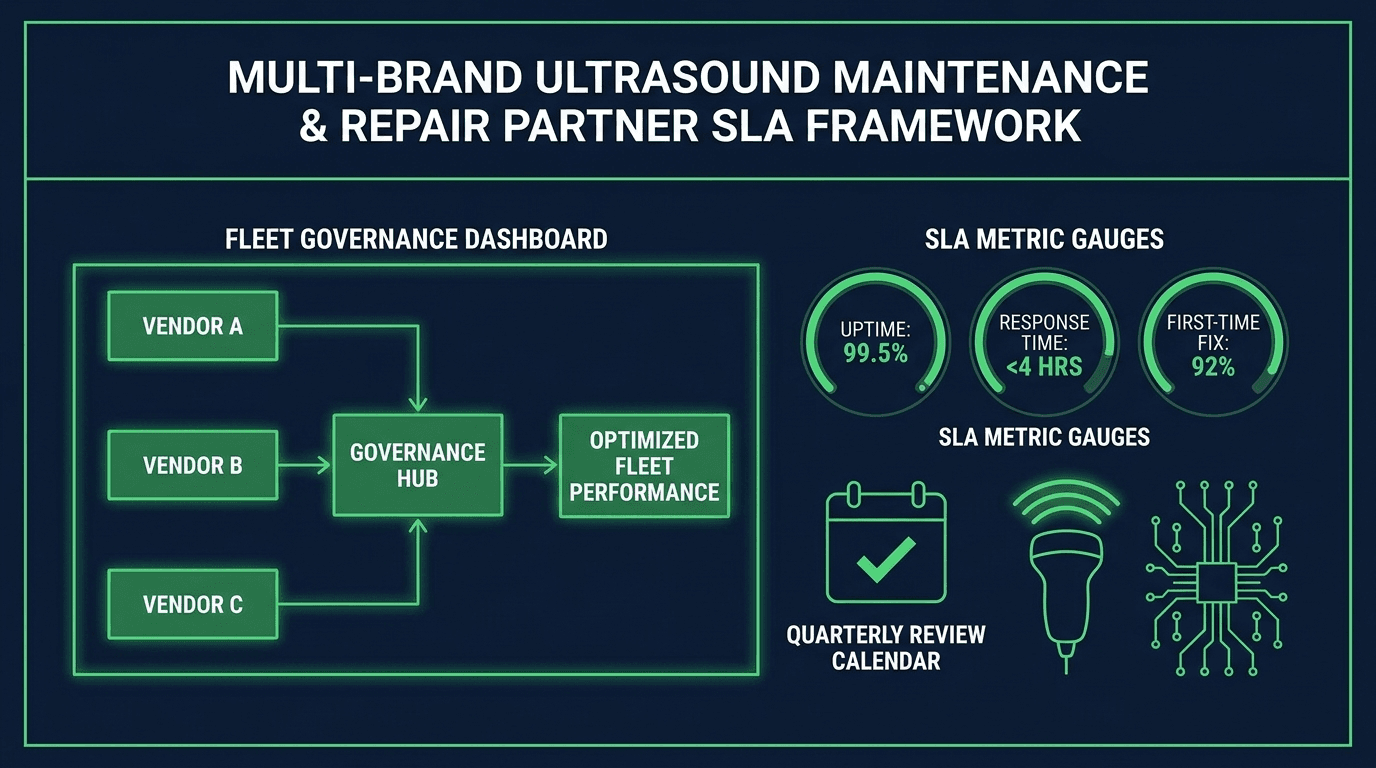
In healthcare facility management, procurement teams frequently treat repair services as isolated transactional events. When a power supply fails, an RFQ is issued; when a TEE probe develops acoustic dropouts, a separate repair shop is contacted. Over time, managing a fleet of 20 to 100 ultrasound systems via transactional bids leads to fragmented warranty tracking, incompatible quality evidence, and administrative friction.
Public procurement data demonstrates a strong market shift toward long-term recurring service contracts. In an analysis of 29,979 EU Tenders Electronic Daily (TED) ultrasound procurement records, repair and maintenance notices dominated new system purchases, growing from 613 notices in 2016 to 3,074 notices in 2025 3. Healthcare systems increasingly recognize that recurring partner governance offers superior operational efficiency over constant spot bidding.
| Operational Dimension | One-Time Transactional Sourcing (Spot RFQ) | Recurring Multi-Brand Partner Relationship |
|---|---|---|
| 1. Procurement Focus | Lowest single-unit bid price per repair event. | Total Cost of Maintenance (TCO), fleet uptime, and service consistency. |
| 2. Intake & Logistics | Variable intake protocols; separate vendor onboarding per event. | Single intake portal, standardized RMA workflow, pre-negotiated freight terms. |
| 3. Service Level Agreement (SLA) | Estimated turnaround verbal targets; non-binding. | Contractual turnaround SLAs (e.g., 5-8 business days for boards) with defined exclusions. |
| 4. Quality & Test Evidence | Inconsistent vendor reporting; unverified 'passed' tags. | Standardized, unit-linked QA records: Rongtao's published 48-hour real-machine record for repaired boards, plus the applicable live-system, functional, or safety evidence for other job types. |
| 5. Escalation & Repeat Failures | Case-by-case dispute handling; risk of denied warranty claims. | Documented repeat-failure investigation and escalation terms; loaners or advance exchange only when separately offered and contracted. |
| 6. Performance Governance | No ongoing tracking or retrospective performance audits. | An agreed performance dashboard and review cadence proportionate to program volume. |
To transition from one-off quotes to structured governance, procurement leads can compare this framework with the one-time board-repair RFQ template and the supplier-qualification scorecard.
How do you map and baseline a multi-brand ultrasound fleet?
Before structuring a recurring service level agreement, healthcare organizations must conduct a comprehensive inventory mapping across all active diagnostic scanners. In a typical hospital system or ISO service region, the equipment base spans multiple OEM generations (e.g., GE Logiq/Vivid/Voluson, Philips EPIQ/Affiniti, Siemens Sequoia/S2000, Toshiba/Canon Aplio, Mindray Resona, and Samsung Medison).
To build an accurate multi-brand service baseline, document four key parameters for each system:
- Hardware & Software Revision Matrix: Record exact software build numbers and hardware revisions. High-voltage transmit boards and beamformers often have revision-dependent compatibility limits.
- OEM Support Status (EOSL Dates): Identify which platforms have reached OEM End-of-Service-Life status, where independent repair and parts sourcing represent the sole maintenance route.
- High-Failure Component Profiles: Track historical failure patterns by model. Power supply module aging on older consoles and TEE probe lens acoustic wear represent high-volume recurring service events.
- Core Exchange Credits & Inventory: Catalog bad-board cores accumulated during previous repairs to leverage core-exchange credits with the recurring partner.
Which SLA definitions and KPIs actually govern a multi-brand repair relationship?
A Service Level Agreement is only as effective as the clarity of its definitions. Ambiguity regarding when turnaround time starts or what constitutes a valid warranty claim leads to operational friction. When drafting a multi-brand repair contract, insist on precise metrics and explicit measurement boundaries 4.
Contractual SLA clauses must establish explicit operational boundaries:
- Turnaround Time Clock Start: The turnaround clock begins upon physical receipt of the failed board or probe at the repair facility with a complete intake form, NOT upon initial email inquiry.
- Turnaround Time Clock Stop: The clock stops when the repaired/tested component is packaged and handed to the priority express courier, accompanied by a completed QA test report.
- Exclusions & Holds: Delays resulting from pending client authorization (e.g., waiting for PO approval on non-standard repairs) pause the SLA clock until formal approval is received.
- Turnaround Baseline: Rongtao publishes a standard 5-to-8-business-day turnaround for board repair. Probe turnaround is quoted per probe, and any expedited target must be confirmed for the exact model, fault, parts availability, intake completeness, and test scope.
| KPI Name | Formula / Metric Definition | Target SLA Standard | Action Threshold (QBR Review) |
|---|---|---|---|
| 1. First-Pass QA Yield | (Units passing their applicable initial QA gate / Total completed units) × 100 | Example target: ≥ 95.0% | Example buyer-defined trigger: sustained performance below the contracted threshold prompts a process review. |
| 2. On-Time Delivery (OTD) | (Shipments dispatched within SLA window / Total completed shipments) × 100 | Example target: ≥ 92.0% | Example trigger: sustained performance below the contracted threshold prompts a logistics review. |
| 3. Repeat-Failure Rate (RMA) | (Units failing within 90-day warranty window / Total repaired units) × 100 | Example target: ≤ 3.0% | Example buyer-defined trigger: a sustained increase prompts a documented repeat-failure investigation. |
| 4. Evidence Completeness | (Jobs shipped with full QA & IEC safety test reports / Total jobs) × 100 | Contracted target (often 100% for required records) | < 98.0% halts automated invoicing. |
| 5. Emergency Expedite SLA | (Emergency requests completed within 48 hours / Total emergency requests) × 100 | ≥ 90.0% | < 80.0% requires reserve inventory audit. |
How do you run a quarterly business review of a repair partner?
A Quarterly Business Review (QBR) provides the governance mechanism to hold a repair partner accountable over time. Rather than meeting only when a repair fails, a structured QBR convenes clinical engineering, procurement, and vendor leadership every 90 days to evaluate service health.
A high-yield 60-minute QBR agenda follows this four-part structure:
- Part 1: Monthly KPI & SLA Performance Review (15 mins): Review aggregated monthly dashboards for First-Pass Yield, On-Time Delivery, and warranty RMA rates across all OEM platforms.
- Part 2: Random Case Audit & Quality Evidence Sample (15 mins): Sample completed repair files and verify serial-number-matched evidence appropriate to each job—for example, repaired-board real-machine logs, probe live-system records, and any safety test required by the equipment procedure.
- Part 3: Repeat-Failure & Root-Cause Analysis (15 mins): Deep dive into any unit that failed within the warranty period, reviewing the Root-Cause Failure Analysis (RCFA) report to identify whether the failure stemmed from component fatigue, thermal stress, or environmental system issues.
- Part 4: Fleet Lifecycle & EOSL Planning (15 mins): Evaluate upcoming OEM End-of-Service-Life (EOSL) declarations across the fleet and establish reserve component stocking strategies using the parts-and-repair backbone scorecard.
How do core return credits and RMA workflows operate under contract?
In exchange-based parts programs, bad-board core returns can be a significant financial variable. The agreement should state whether an advance exchange is offered, the exact return window, eligible condition, shipping responsibility, inspection process, deposit or core charge, and any devaluation rules. Do not assume a universal 14-to-30-day window.
- Core Eligibility Criteria: Define what constitutes an acceptable core board. Cores must be repairable, matching the same hardware revision, and free from catastrophic burn damage, fluid immersion, or missing major IC chips.
- Core Return Window & Timelines: Standard agreements allow 21 calendar days from receipt of the replacement part for the defective core to reach the repair facility. Timely core return unlocks full core credit.
- Pre-Negotiated Core Credit Tables: Establish a transparent schedule of core credit values by OEM part number. This allows procurement teams to calculate net repair costs before issuing purchase orders.
- RMA Pre-Authorization: Define how field teams obtain an RMA, who pays each freight leg, what tracking is provided, and how core inspection status is communicated. Do not assume a portal or prepaid label unless it is part of the quoted program.
How should repeat failures, escalation and loaners be contracted?
Even in high-capability repair facilities, complex multi-layer PCBs or high-frequency transducers occasionally experience repeat failures due to underlying system power spikes or thermal degradation. A robust recurring contract details exact procedures for repeat failures, warranty claims, and temporary replacement loaners.
Contractual terms should specify:
- Warranty Coverage: Rongtao publishes a typical 90-day standard warranty, with extended plans available on request and terms confirmed by product category and service type. The agreement should state coverage, exclusions, remedies, and start/end points for each job type.
- Repeat-Failure Protocol: Define diagnosis priority, responsibility determination, re-repair or replacement options, and freight allocation. Advance exchange, zero-cost remedies, and priority service apply only when expressly included in the agreed terms.
- Root-Cause Failure Analysis (RCFA): For any repeat failure, the partner must supply a formal engineering RCFA report identifying whether failure was caused by component defect, board trace fatigue, or external system fault (e.g., failing system power supply).
- Loaner or Advance-Exchange Availability: If continuity requires temporary equipment or a replacement component, confirm availability, eligibility, fees, liability, cleaning status, and return deadlines in writing; do not assume a dedicated pool.
When evaluating whether a specific component warrants repair versus full replacement, engineering teams rely on the repair-vs-replace decision framework and stay within the FDA servicing-vs-remanufacturing line.
What does a recurring-partner scorecard track over a year?
At the conclusion of each annual contract cycle, procurement managers evaluate total partner performance using a weighted scorecard to determine contract renewal or tier adjustments.
| Governance Dimension | Weight | Evaluation Criteria | Max Score |
|---|---|---|---|
| 1. Quality & QA Rigor | 30% | Illustrative buyer target: consistently high first-pass yield and complete job-appropriate QA evidence; numerical thresholds should be based on the buyer's baseline and negotiated contract. | 30 pts |
| 2. SLA & Delivery Speed | 25% | On-time delivery against the quoted job-specific SLA and an agreed emergency-intake response target. | 25 pts |
| 3. Multi-Brand Platform Depth | 20% | Proven component-level capability across major platforms (GE, Philips, Siemens, Canon, Mindray, Samsung) without sub-contracting. | 20 pts |
| 4. Warranty & Failure Handling | 15% | Illustrative buyer target: low repeat-failure rate, transparent investigation, and clearly contracted escalation or continuity options. | 15 pts |
| 5. Commercial Transparency | 10% | Predictable line-item pricing, clear core-return credit policies, zero hidden expedite fees. | 10 pts |
Frequently Asked Questions
What KPIs should a recurring ultrasound repair partner report each month?
Useful measures include first-pass QA yield, on-time delivery, repeat-failure or warranty-RMA rate, evidence completeness, and expedite-SLA performance. Percentage targets in this guide are illustrative negotiation examples, not universal industry standards or Rongtao commitments.
How is a recurring partnership different from a service contract or a one-time RFQ?
A one-time RFQ handles an isolated repair event based primarily on spot price. A full OEM service contract is a high-cost annual commitment for comprehensive machine coverage. A recurring multi-brand repair partnership provides a structured, pay-per-repair or capped framework governed by strict SLAs, giving ISOs and HTM teams contract-level reliability without locked-in OEM service pricing.
What turnaround and response definitions belong in the SLA?
Define when the clock starts, which holds pause it, and whether it stops at QA release or courier handoff. Rongtao publishes 5 to 8 business days as its standard board-repair turnaround; probe and emergency timing must be quoted case by case.
What happens if the repair partner fails to meet the SLA turnaround target?
A balanced SLA agreement includes performance remedy clauses, such as expedited shipping fee waivers, core exchange credit upgrades, or temporary loaner equipment provisions if turnarounds exceed contractual limits without agreed hold reasons.
Can a multi-brand partner handle both board-level repair and probe rebuilding?
Yes. Leading multi-brand service partners maintain dual bench capability—component-level circuit board diagnostics and SMT soldering alongside transducer acoustic matrix replacement, strain relief repair, and TEE insertion tube rebuilding.
How are multi-brand parts warranties tracked and managed?
Track each job by the supplier RMA or service identifier, part/probe serial, release date, warranty term, and linked evidence. The agreement should define the claim channel and response records; a barcode portal or automated courier workflow is optional, not assumed.
How are shipping costs handled for warranty returns under a recurring agreement?
There is no universal default. State who pays outbound and return freight, duties, insurance, and expedited service for DOA, covered warranty failures, no-fault-found cases, and customer-caused damage.
Where Rongtao Medical Fits — Your Multi-Brand Service Partner
Rongtao Medical serves as a high-reliability, multi-brand parts and repair partner for biomedical engineering departments, ISOs, and medical equipment distributors worldwide. Operating under dual ISO 13485:2016 and ISO 9001:2015 certified quality management systems, Rongtao delivers consistent quality evidence across GE, Philips, Siemens, Hitachi Aloka, Toshiba/Canon, Mindray, and Samsung Medison platforms.
Rongtao publishes a standard 5-to-8-business-day board-repair turnaround, a typical 90-day warranty whose final terms depend on product category and service type, and a 48-hour real-machine QA step for every repaired board 5. Probe turnaround is quoted per probe. RMA, freight, exchange, loaner, and extended-warranty terms should be confirmed in the specific quotation or program agreement.
Explore our complete multi-brand service capabilities on our Services Page, review our quality standards on our Service Process page, or contact our partner team directly on our Contact Page to establish a recurring SLA agreement tailored to your fleet.