
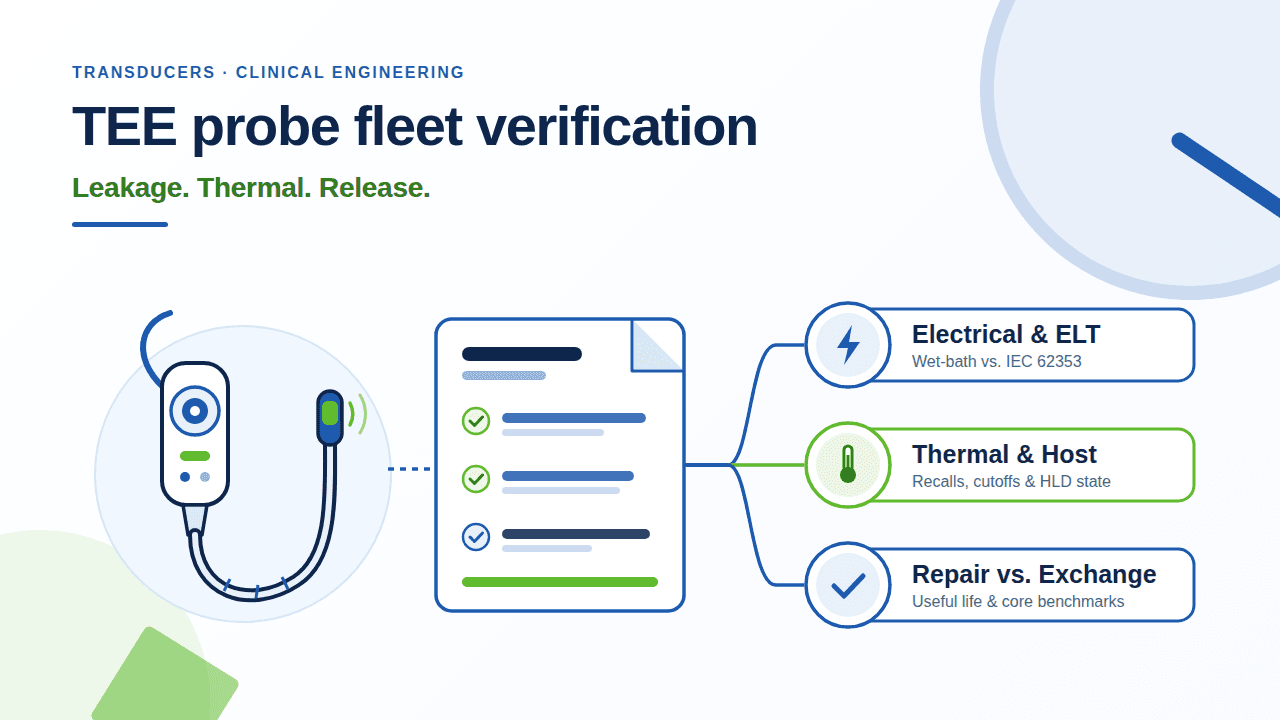
Which Returned TEE Probe Can HTM Release?
When a $25,000 to $41,000 transesophageal probe returns from an outside repair depot or arrives as an exchange unit, standard hospital receiving workflows often compress verification into two quick checks: inspect the outer jacket under room lighting and capture a B-mode gray-scale image on a phantom. Recent federal field actions show why those two steps miss four distinct failure modes that remain invisible on a static B-mode scan.
Four Documented Hazards Invisible to Visual and B-Mode Triage
First, mechanical deflection inversion passes static imaging completely. In FDA Class II recall Z-0038-2026 (initiated August 29, 2025; posted October 3, 2025; open), ImaCor recalled affected ClariTEE CLT-010 miniaturized TEE probe lots after a production assembly error reversed tip articulation polarity 1. For affected CLT-010 lots, ImaCor's notice instructs consignees to immediately discontinue use, quarantine all affected units, and return them to ImaCor—an active recall disposition that overrides local bench testing or third-party repair 1. For non-recalled articulating probes returning from routine depot service, the same failure mode illustrates why static phantom B-mode imaging misses steering-wire inversion completely.
Second, thermal-monitoring and host-interlock failures hide behind normal B-mode output. Five separate FDA Class II recall actions across three OEM platforms—one open console correction and four historically terminated remedies—confirm that thermal risk spans both probe-side electronics and host-console software or hardware:
- Open correction (
Z-1757-2024,ev=94328, initiated March 23, 2024): Philips5000 Compact Seriessystems paired with a Multi-Port Adapter (MPA) could leave a connected yet unselected TEE transducer powered without active temperature monitoring; Philips' field notice instructs users to connect TEE probes directly to the system side port or disconnect/reconnect the MPA whenever changing probes until an FSE applies the correction 15. - Terminated probe-programming recall (
Z-1841-2020..Z-1844-2020,ev=84902, initiated August 30, 2019; terminated November 27, 2024): Improper factory temperature-sensor programming on PhilipsS7-3tandS8-3tTEE transducers prevented host systems from measuring distal-tip temperature accurately and defeated automatic cooling shutdown 16. - Terminated console-correction recalls (
Z-0588-2019,Z-1081-2013,Z-0896-2011,Z-1392-2011): GELOGIQ E10potential undetected TEE over-temperature (initiated September 14, 2018; terminated May 29, 2019) 17; SiemensACUSON SC2000MPI board revision 4 displaying lower-than-actualV5Mtemperature (initiated March 28, 2013; terminated February 14, 2014) 18; SiemensACUSON Antaressoftware temperature-guard malfunction requiring customers to disconnect and reconnect theV5Mstransducer between uses pending a software update (Z-0896-2011,ev=54718, initiated September 30, 2009; terminated June 18, 2012) 7; and SiemensV5Mpaired withACUSON S2000where43 °Cthermal guards failed to re-engage if the probe stayed connected after automatic shutdown (initiated August 28, 2009; terminated March 29, 2011) 19.
Third, seal-adhesive variation degrades acoustic output without tripping an electrical fault. On September 16, 2024, ImaCor initiated open Class II recall Z-0231-2025 (ev=95459) on specified ClariTEE lots (20250509 and 20250823) because edge-sealing epoxy exceeded specification and attenuated ultrasound signal, instructing facilities to return affected lots to ImaCor for replacement 20. Third-party lens or beading repairs that alter elastomer thickness or adhesive geometry can reproduce that attenuation defect while passing dry electrical checks.
Fourth, 2025 Philips useful-life recalls define distinct model-specific remedies that HTM must separate by event. Under Class II event 96994 (May 28, 2025; 5 TEE records: S7-2/S7-2t, S7-3t, S8-3t, X7-2t, X8-2t refurbished beyond useful life), Philips replaces affected units with new transducers and permits conditional continued use while awaiting replacement provided User Manual visual inspections and electrical safety tests pass 2 3. Under Class III events 97217 and 97643 (July 3 and September 5, 2025; 12 TEE labeling records including S7-2t Z-2396-2025, X11-4t Z-2406-2025, and Mini Multi TEE Z-1622-2026), Philips defines a 5-year expected useful life for TEE and X-Matrix transducers via transducer.philips.com manufacturing certificates and instructs owners of over-life units to conduct transducer performance tests or contact Philips for guidance 21 22 8. Any stricter hospital decision to retire over-life units automatically without using that OEM test-or-guidance pathway represents local capital policy, separate from the field notice itself.
How This Workpaper Extends the August 2026 TEE Damage Framework
To avoid duplicating baseline clinical routines, HTM readers should treat Rongtao Medical's August 10, 2026 TEE probe damage guide as the upstream floor for point-of-use bite protection, initial damage triage, and first-line quarantine 4. This November 30, 2026 workpaper addresses what happens downstream of quarantine: reconciling the full FDA recall and MAUDE evidence behind incoming checks, separating IAC, IEC, AAMI, and OEM IFU test jurisdictions cleanly, structuring a model-specific acceptance matrix that preserves terminal disinfection state, and evaluating repair versus exchange against dated public market benchmarks.
Evidence Behind the Acceptance Checks: Reconciling All 39 FDA TEE Recalls and 936 Live MAUDE Reports
Sound incoming acceptance criteria derive from documented failure mechanisms rather than generic checklists. Auditing the entire live FDA ultrasound recall archive alongside unique-key live MAUDE filings establishes both what fails repeatedly and where public surveillance data stops.
Full-Parent FDA Recall Census: 530 Ultrasound Records Reconciled to 39 Verified TEE Records (22 Events)
Public openFDA device/recall extracts frequently get undercounted when analysts screen only product and reason text or omit pre-2012 enforcement classes. Screening the complete 530-record live parent population across diagnostic ultrasound product codes IYN (300), ITX (147), and IYO (83, updated November 26, 2026; capturing three newer non-TEE actions—Z-0152-2027, Z-3249-2026, and Z-3276-2026—added after the July 24, 2026 527-record baseline) across product, reason, action, and identifier (code_info) fields reconciles every screening stage by exact recall number 5:
- Parent population (
530records): All liveIYN,ITX, andIYOmedical device recall product records through November 26, 2026 5. - All-field broad TEE and model-alias screen (
150candidates): Every record matching transesophageal terminology or known OEM TEE model aliases acrossproduct_description,reason_for_recall,action, orcode_info—including PhilipsS7-2(Z-2059-2025, verified via UDI(01)00884838067646and Model No.989605440772as identical toS7-2tZ-2396-2025),X11-4t(Z-2406-2025),S7-3t,S8-3t,X7-2t,X8-2t,OMNI II/III,Mini Multi TEE, SiemensV5M,V5Ms(includingZ-0896-2011identified in theactionfield of anACUSON Antaresthermal-guard correction),V7M,Z6Ms, ImaCorClariTEE, ToshibaPET-511BTM, and SonoSiteTEE5 7. - Excluded non-TEE products inside shared useful-life notices (
68records): Non-TEE surface and endocavity probes under Philips events97217and97643whose shared multi-category notice text mentions the 5-year TEE useful-life category alongside non-TEE models 5. - Excluded generic console and lockup notices (
43records): Console-wide actions mentioning "transesophageal" inside general indications lists (40records, such asVividbattery orSequoiapower-switch notices) plus three adjudicated action-field console lockups—Z-0373-2014(GE Vivid E9general system lockup mentioning TEE only as a clinical reboot contingency) andZ-2483-2021/Z-2484-2021(Philips EPIQ/Affinitigeneral Review-Mode lockup citing one cardiac TEE case as clinical impact rather than a TEE-specific probe or thermal fault) 5. - Verified TEE-specific census (
39product recall records across22distinct FDA event IDs): Spanning initiation dates from2008-08-08(Z-2191-2010) through2025-09-05(Z-1622-2026,Z-1623-2026,Z-1624-2026; latest FDA posting2026-03-24, archive cutoff2026-11-26) 5. Distinguishing product recall numbers (39) from FDA event IDs (22) prevents fleet managers from mistaking multi-model administrative notices (such as9TEE models under single event97217) for separate engineering failures.
Backfilling all seven pre-2012 recall records individually against FDA's CDRH Recall Database eliminates every missing enforcement class: Z-1392-2011, Z-0896-2011, Z-2062-2011, Z-2061-2011, Z-1100-2010, Z-1884-2011, and Z-2191-2010 are all officially designated Class II 19 23 7. Under FDA's official enforcement definitions, Class II applies to products that may cause temporary or medically reversible adverse health consequences, or where the probability of serious adverse health consequences is remote; Class III applies to situations unlikely to cause adverse health consequences 6. Across all 39 verified TEE records, 27 (69.2%) are Class II, 12 (30.8%) are Class III, and 0 are Class I 5.
View chart data
| Category | Class II | Class III |
|---|---|---|
| Device Design | 3 | 12 |
| Process Control | 11 | 0 |
| Software Design | 7 | 0 |
| Under Investigation | 2 | 0 |
| Process / Component Change | 2 | 0 |
| Other | 2 | 0 |
Reconciling all 530 live IYN/ITX/IYO recalls across product, reason, action, and identifier fields (recovering all seven pre-2012 Class II records including Z-0896-2011 ACUSON Antares / V5Ms) yields 27 Class II (69.2%) and 12 Class III (30.8%) TEE product records (zero Class I). Device Design (15) and Process Control (11) account for 66.7%, followed by Software Design (7, all Class II).
Source: FDA Medical Device Recalls Database (openFDA device/recall API, full 530-record IYN/ITX/IYO parent screened across product, reason, action, and code_info fields, updated November 26, 2026), FDA Enforcement archive, and FDA CDRH Recall detail records for all 7 pre-2012 Class II entries — Rongtao Medical analysis, accessed November 2026
Official FDA root_cause_description totals concentrate in Device Design (15 records, 38.5%: 3 Class II, 12 Class III) and Process control (11 records, 28.2%: all 11 Class II)—together representing 66.7% (26/39) of the census—followed by Software design (7, 17.9%, all Class II), Under Investigation by firm (2, 5.1%, Class II), Other (2, 5.1%, Class II), Component change control (1, Class II), and Process change control (1, Class II) 5.
| Exact Recall Numbers & FDA Event ID | Initiation / Status | Official FDA Class & Root Cause | Affected Models & Host Systems | Documented Engineering Failure Mechanism | Field-Notice Priority & Incoming Control |
|---|---|---|---|---|---|
Z-1622-2026, Z-1623-2026, Z-1624-2026 (ev=97643) & Z-2385-2025, Z-2387-2025, Z-2388-2025, Z-2395-2025, Z-2396-2025, Z-2398-2025, Z-2406-2025, Z-2412-2025, Z-2413-2025 (ev=97217) | 2025-07-03 & 2025-09-05 (posted 2025-08-22 & 2026-03-24; open) | 12 Class III (Device Design) | Philips Mini Multi TEE, OMNI II, OMNI III, S7-2t, S7-3t, S8-3t, X7-2t, X8-2t, X11-4t | Labeling clarification defining 5-year TEE/X-Matrix useful life via transducer.philips.com certificates 5 21 22 8 | Follow notice first: obtain manufacturing certificate; if over 5 years, run transducer performance tests or contact Philips for guidance (retiring automatically is local capital policy) |
Z-2059-2025, Z-2060-2025, Z-2061-2025, Z-2066-2025, Z-2067-2025 (ev=96994) | 2025-05-28 (posted 2025-07-02; open) | 5 Class II (Process control) | Philips S7-2 (S7-2t UDI 00884838067646), S7-3t, S8-3t, X7-2t, X8-2t | Transducers refurbished beyond their defined useful life 2 3 | Follow notice first: request Philips new replacement; notice permits conditional continued use while awaiting replacement if User Manual visual and electrical checks pass |
Z-0038-2026 (ev=97505) | 2025-08-29 (posted 2025-10-03; open) | Class II (Process control) | ImaCor ClariTEE CLT-010 miniaturized TEE | Production assembly error reversing articulation polarity (lever forward caused anteflexion instead of retroflexion) 1 | Active recall lots: discontinue use, quarantine, and return to ImaCor immediately; non-recalled articulating probes: verify physical tip deflection polarity after depot service |
Z-0231-2025 (ev=95459) | 2024-09-16 (posted 2024-10-25; open) | Class II (Process control) | ImaCor ClariTEE (CLT-010/CLT-010-1, lots 20250509 & 20250823) | Edge-sealing epoxy exceeded specification, attenuating ultrasound signal 20 | Affected lots: quarantine and return to ImaCor for replacement; repaired probes: combine magnification seal check with phantom sensitivity verification |
Open: Z-1757-2024 (ev=94328); Terminated: Z-1841..1844-2020 (ev=84902), Z-0588-2019 (ev=81165), Z-1081-2013 (ev=64855), Z-0896-2011 (ev=54718), Z-1392-2011 (ev=53691) | 2009-08-28 through 2024-03-23 (1 open; 8 terminated 2011–2024) | 9 Class II (Process control, Component/Process change, Device/Software design) | Philips 5000 Compact, S7-3t/S8-3t; GE LOGIQ E10; Siemens V5M/V5Ms on ACUSON SC2000 (MPI rev 4), Antares, & S2000 | Unselected-port power without monitoring (Z-1757-2024); sensor programming defeating auto-cool (ev=84902); undetected over-temp (Z-0588-2019); low temp display (Z-1081-2013); V5Ms Antares thermal-guard fault (Z-0896-2011); 43 °C guard reset fault (Z-1392-2011) 15 16 17 18 19 7 | Enforce open Z-1757-2024 direct-port/MPA workaround pending FSE fix; audit legacy/pre-owned hosts to confirm historical terminated remedies were applied, paired with three-part Gate 4 checks |
Z-0667-2017 (ev=75639) & Z-2571-2014 (ev=69138) | 2014-08-13 & 2016-11-07 | 2 Class II (Device Design & Under Investigation) | Siemens Z6Ms (ACUSON SC2000) & V5Ms TEE transducers | Deterioration of elastomer covering the articulating section paired with acquisition errors (Z-0667-2017) 24 | Inspect articulating bending rubber under magnification and pair with IFU wet-bath leakage testing |
Z-0123-2022 (ev=88728), Z-0944-2021 (ev=87012), Z-1592-2016 (ev=73854), Z-1572-2016 (ev=73886), Z-2062-2011, Z-2061-2011, Z-1100-2010, Z-1884-2011, Z-2191-2010 | 2008-08-08 through 2021-09-21 | 9 Class II (Software design, Device Design, Under Investigation, Other) | Philips EPIQ CVxi/EPIQ (X8-2t), S8-3t; Siemens SC2000/X700/X300/S2000 (V5M/V5Ms/Z6Ms/V7M); Toshiba PET-511BTM; SonoSite TEE | EchoNavigator freeze, Image Boost Doppler flow error, V5Ms rotation IMG_15 lockup (Z-1572-2016), CW mode loss (Z-1884-2011), over-current shutdown (Z-2061-2011), image degradation 23 25 | Verify returned probe on matching host software version across every model-supported Doppler and rotation mode |
Deduplicated Live FDA MAUDE TEE Cohort: Exact Unique-Key Counts and Surveillance Boundaries
To cross-check manufacturer field actions against post-market complaint patterns, we audited 936 unique mdr_report_key filings retrieved from live openFDA device/event.json (13,648 total IYN/ITX/IYO ultrasound MDRs, updated November 18, 2026) matching explicit TEE identifiers in structured device fields (835 ITX, 63 IYO, and 38 IYN by first listed device; 803 received 2014 through November 18, 2026; 713 received 2016–2026) 9. Because several retrieved records list both a host console and a TEE probe, this cohort represents a retrieved report set rather than a complete census of TEE events or proof of probe causation.
Three passive-surveillance limits apply throughout:
- No fleet-exposure denominator: MAUDE stores passive numerators without installed-base size, exam counts, or HLD cycle volume, preventing calculation of failure rates or brand comparisons 9.
- Temporal overlap during
2016–2017: Across2016(208reports) and2017(294reports),502of936filings (53.6%) arrived within two calendar years, including417reports namingZ6MSin structured device fields and296reports codedDevice Displays Incorrect Message9. Those filings overlap temporally with Siemens recallZ-0667-2017(initiated November 7, 2016) 24, though temporal overlap alone establishes concurrent reporting rather than formal recall linkage for every individual MDR. - VMSR ascertainment caveat (
summary_report_flag = N): Under FDA's Voluntary Malfunction Summary Reporting (VMSR) program (21 CFR § 803.19alternative, launched 2018), both product codesITX(21 CFR 892.1570) andIYN(21 CFR 892.1550) carry official Summary Malfunction Reporting: Eligible status, permitting eligible manufacturers to submit quarterly malfunction summaries while deaths and serious injuries remain individual filings 26 27 28. In our retrieved cohort, all51post-2020 filings (2021–2026) carrysummary_report_flag = N9. VMSR eligibility therefore remains an ascertainment boundary that may shift routine malfunction reporting away from individual rows, without proving the cause of the lower post-2020 single-row count.
By official event_type, the 936 unique MDRs comprise 818 Malfunction (87.4%), 91 Injury (9.7%), 12 Death (1.3%), and 15 Other (1.6%) 9. Inspecting the 12 death records individually prevents misattributing procedural or unconfirmed outcomes to probe defects: several describe known procedural risks of esophageal intubation with zero confirmed probe malfunction; MDR 536890 (2004) reports a patient death attributed to multidrug-resistant Pseudomonas aeruginosa without tracing transmission to the probe; MDR 6041902 (2016) records a customer allegation of cardiac-surgery cross-contamination on an X7-2t whose follow-up manufacturer bacterial evaluation returned negative; and MDR 19999213 (2024-08-18) illustrates why coded MAUDE problem terms must stay distinct from confirmed malfunctions—although initially filed with codes Overheating of Device and Positioning Problem after a post-ablation patient death involving a GE Vingmed 6VT-D probe and Vivid S70 console, GE Healthcare's completed follow-up evaluation in the same record found no probe defects and no overheating instances in the exam logfiles, concluding that neither the probe nor the console malfunctioned 9 29.
View chart data
| Category | Distinct MDR Reports |
|---|---|
| Device Displays Incorrect Message | 307 |
| Poor Quality Image | 135 |
| Device Operates Differently Than Expected | 89 |
| Use of Device Problem | 39 |
| Adverse Event Without Identified Device or Use Problem | 26 |
| No Display/Image | 25 |
| Mechanical Problem | 24 |
| Temperature Problem | 24 |
| Unknown (Device Problem Not Known) | 24 |
| Mechanics Altered | 22 |
| Mechanical Jam | 21 |
| Signal Artifact/Noise | 21 |
Unbroken rank order of deduplicated official MDR product-problem codes across 936 unique TEE report keys (updated November 18, 2026). Device Displays Incorrect Message (307 reports, 296 in 2016-2017) and Poor Quality Image (135) lead passive filings; counts reflect reporting volume rather than fleet failure incidence.
Source: FDA MAUDE Database (openFDA device/event API, product codes IYN, ITX, IYO filtered to structured TEE device fields, N = 936 unique MDR keys, updated November 18, 2026) — Rongtao Medical analysis, accessed November 2026
Deduplicating repeated product_problems strings inside each unique mdr_report_key produces an unbroken rank order across all 936 filings 9. Chart 1 displays the exact Top 12 ranked codes without omitting intermediate ranks: Device Displays Incorrect Message (307, 32.8%), Poor Quality Image (135, 14.4%), Device Operates Differently Than Expected (89, 9.5%), Use of Device Problem (39, 4.2%), Adverse Event Without Identified Device or Use Problem (26, 2.8%), No Display/Image (25, 2.7%), Mechanical Problem (24, 2.6%), Temperature Problem (24, 2.6%), Unknown (24, 2.6%), Mechanics Altered (22, 2.4%), Mechanical Jam (21, 2.2%), and Signal Artifact/Noise (21, 2.2%) 9. Immediately below rank 12 sit Positioning Problem (20), Insufficient Device Problem Information (20), Defective Device (17), Overheating of Device (14), Computer Operating System Problem (13), Device Operational Issue (13), Difficult to Insert (12), Break (12), Image Display Error/Artifact (9), Application Program Problem (7), Crack (6), Bent or Material Twisted/Bent (6 combined distinct reports), and Positioning Failure (5) 9.
Grouping official FDA/IMDRF Annex A codes 30 into four author-defined overlapping clusters across all 936 unique MDR keys shows Error Message / Software / OS (331 reports), Image Quality / Acoustic Output (204), Mechanical / Articulation / Structural (136), and Thermal / Electrical / Sheath / Fluid / Contamination (66, comprising 37 thermal/overheating reports, 20 sheath/fluid/decontamination reports, and 10 electrical/conduction reports) 9. Chart 3 plots all four clusters across 2014 through partial-year 2026 (803 total unique reports in window), showing directly how the Error Message / Software / OS line (93 in 2016; 216 in 2017) drives the 2016–2017 peak while mechanical/articulation and thermal/electrical/sheath codes persist through 2024–2026 9.
View chart data
| Category | Error Message / Software / OS | Image Quality / Acoustic Output | Mechanical / Articulation / Structural | Thermal / Electrical / Sheath / Fluid |
|---|---|---|---|---|
| 2014 | 1 | 15 | 1 | 4 |
| 2015 | 3 | 26 | 2 | 3 |
| 2016 | 93 | 24 | 54 | 12 |
| 2017 | 216 | 37 | 6 | 25 |
| 2018 | 4 | 23 | 10 | 1 |
| 2019 | 3 | 35 | 6 | 5 |
| 2020 | 0 | 21 | 17 | 0 |
| 2021 | 0 | 1 | 6 | 0 |
| 2022 | 1 | 1 | 1 | 0 |
| 2023 | 1 | 0 | 0 | 2 |
| 2024 | 1 | 0 | 2 | 3 |
| 2025 | 0 | 2 | 3 | 4 |
| 2026* | 0 | 2 | 2 | 1 |
Across 803 unique TEE reports received 2014 through November 18, 2026 (2026* partial year), the 2016-2017 peak is driven by Error Message / Software / OS codes (93 in 2016; 216 in 2017), coinciding temporally with 417 Z6MS-identified reports. All 51 post-2020 filings carry summary_report_flag=N; ITX/IYN VMSR eligibility is an ascertainment caveat rather than proven cause of lower single-row volume.
Source: FDA MAUDE Database (openFDA device/event API, 803 unique TEE MDR keys received 2014 through November 18, 2026; author-defined overlapping report-level MDR code clusters) — Rongtao Medical analysis, accessed November 2026
Individual manufacturer teardown reports inside MAUDE—paired with peer-reviewed hospital outbreak investigations—reinforce why clinical complaints demand structural and electrical triage rather than console troubleshooting alone. Seki et al. traced a cardiovascular-surgery outbreak of multidrug-resistant Pseudomonas aeruginosa directly to a 5 mm defect on a damaged TEE insertion tube that had completed centralized processing (PMID 23292134) 31. Van Maerken et al. documented a recurrent cardiac-surgery outbreak of ESBL-producing Enterobacter cloacae complex associated with TEE probes (PMID 31548884) 32, and Vesteinsdottir et al. reported excess postoperative infection burden following cardiac-surgery outbreaks traced to TEE probes (PMID 30888057) 33. Separately, Venticinque et al. described aerodigestive tract chemical burn injury resulting from probable post-processing residual Cidex OPA (PMID 14570634) 34, while a July 2023 Journal of Cardiothoracic and Vascular Anesthesia technical communication highlighted ongoing hospital misconceptions regarding structural and electrical TEE probe integrity (PMID 37062664) 35. International regulators flagged the same reprocessing vulnerability in the UK MHRA's December 17, 2014 Medical Device Alert on reusable TOE, transvaginal, and transrectal probes 36, echoed by a January 2022 AORN Journal systematic review on contaminated ultrasound probes (PMID 34958475) 37.
Receiving, Verification, and Safe Return to Use
Returning a repaired or exchange TEE probe safely into clinical circulation requires keeping five distinct domains strictly separate: accreditation rules, field electrical test standards, model-specific mechanical and thermal verification, OEM-validated final disinfection sequencing, and FDA's May 2024 servicing-versus-remanufacturing framework. Conflating those authorities causes hospitals either to clear unsafe equipment under an inapplicable generic limit or to invalidate terminal disinfection right before storage.
Separating Electrical Safety Authorities: IAC 2.2.4B, OEM Wet-Bath ELT, and IEC 62353:2014
Auditing all 1,898 active entries in FDA's Recognized Consensus Standards Database (August 26, 2026 snapshot) alongside primary IEC, IAC, and OEM manuals clarifies which authority governs each check 12 13 38 39 40 41:
| Standard, Rule, or Manual | Official Recognition / Authority Scope | Exact Technical Requirement for TEE Probes | Boundary Violation to Prevent |
|---|---|---|---|
IAC Adult Echocardiography Standards (2025), Section 2.2.4B | Voluntary clinical accreditation standard applicable to IAC-accredited echo facilities 38 | Separates manufacturer-directed probe care/cleaning from mandatory between-use structural and electrical integrity testing using an ultrasound leakage tester, logging "Passed" or "Failed" and corrective action 38 | Claiming IAC 2.2.4B mandates one universal pre-HLD timing across every OEM IFU, or extending IAC rules to non-accredited sites as federal statute |
OEM Stand-Alone Wet-Bath ELT (e.g., Philips Care & Cleaning Manual 300012825691, pp. 97–108) | Manufacturer IFU governing probe- and tester-specific leakage screening 14 | Uses a dedicated stand-alone ultrasound leakage tester in a conductive bath up to the shaft immersion marker; Philips notes stand-alone testing indicates electrical leakage only and places final rinse, drying, inspection, and storage at the end of the cycle 14 | Equating a passing wet-bath ELT with internal dryness or microbial clearance, or mixing stand-alone bath limits with IEC 62353 analyzer limits |
| IEC 62353:2014 (Table 3) | International recurrent and post-repair electrical safety standard (0 matches in FDA's Aug 2026 premarket recognition CSV) 12 41 | Governs non-destructive bench testing after repair: Class I equipment leakage (<= 500 µA Direct/Differential; <= 1,000 µA Alternative) and floating applied-part AC leakage configurations (Type CF <= 50 µA, Type BF <= 5,000 µA) 12 | Calling IEC 62353 FDA-recognized, or substituting a 5,000 µA BF ceiling for a Type CF probe or a model-specific stand-alone bath criterion |
IEC 60601-2-37:2024 (Ed. 3.0) & Ed. 2.1 (2015) | FDA Complete Recognition #12-380 (entered 05/26/2025); Ed. 2.1 #12-293 expires 07/02/2028 13 41 | Premarket design and simulated-use type-test standard (revised Clause 201.11) establishing the 43 °C maximum surface-temperature ceiling for internal ultrasound transducers in simulated tissue contact 13 | Treating a premarket simulated-use type-test ceiling as one universal hospital field alarm temperature or thermistor tolerance |
IEC 60601-1 Ed. 3.2 (2020-08) & ANSI/AAMI ES60601-1 | FDA Complete Recognition #19-49 (04/03/2023) & #19-46 (05/30/2022) 41 | Premarket general safety design standard defining insulation classes and Type BF vs. Type CF floating applied-part architectures 41 | Performing destructive factory dielectric withstand tests in a hospital biomedical shop |
| ANSI/AAMI ST58:2024, ST91:2021, AAMI TIR99:2024, ISO 17664-1:2021 | FDA Complete #14-607 (ST58:2024, detail 45711) 39, Partial #14-572 (ST91:2021, detail 43289) 40, Partial #14-578 (ISO 17664-1); 0 FDA premarket matches for TIR99:2024 41 | ST58:2024 governs chemical sterilization/HLD quality control 39; ST91:2021 targets flexible/semi-rigid endoscopes 40; AAMI TIR99:2024 provides dedicated facility processing guidance for dilators, TEE, and ultrasound probes; ISO 17664-1 governs OEM IFU disclosures 41 | Applying endoscope-channel pressure leak tests to solid TEE shafts, or using chemicals outside OEM-validated ISO 17664-1 lists |
| ISO 10993-1:2025 (Ed. 6) | FDA Partial Recognition #2-313 (entered 05/25/2026) 41 | Biological evaluation of patient-contacting materials within a risk management process 41 | Approving mucosal-contacting sheath or adhesive replacements without biocompatible material documentation |
| ASE/SCA Comprehensive TEE & AIUM Transducer Cleaning Guidelines | Clinical specialty practice statements 42 43 | ASE/SCA defines comprehensive clinical TEE examination performance 42; AIUM specifies Spaulding-class LLD (external) vs. mandatory HLD plus single-use cover (internal) and dry-heat sterile gel controls 43 | Citing ASE clinical exam guidelines as authority for a specific hospital bench leakage sequence |
Two operational boundaries deserve sharp enforcement from that table. First, stand-alone wet-bath ELT and IEC 62353 bench testing measure different electrical configurations and remain distinct gates. HTM must record each test under its own authority, fixture, and model-specific pass threshold rather than combining them into "the stricter of the two." Second, **never insert an unvalidated wet-bath electrical test after final HLD right before clean storage.** Philips' published Care & Cleaning manual (300012825691, pp. 97–108) terminates reprocessing with final rinse, drying, visual inspection, and clean vertical storage, while also recognizing compatible non-immersion or model-specific automated options (7 live FDA 510(k) clearances sit under product code PSW for automated liquid TEE HLD reprocessors: K051305, K150504, K160921, K182891, K192228, K230381, K233049) 14 44 45. If bench handling or wet leakage testing occurs after a disinfection cycle, infection-prevention protocols require restoring validated final disinfection before the probe enters clean clinical storage.
Defect Triage, Contaminated-Return Pathways, and FDA May 2024 Significance Assessments
Before approving repair or return shipment on a quarantined TEE probe, HTM and infection prevention must resolve two real-world operational risks: how to ship a physically damaged probe safely when normal HLD is contraindicated, and **how to evaluate third-party repairs under FDA's May 2024 Remanufacturing of Medical Devices final guidance (15,057 words audited verbatim)** 46.
When a probe exhibits a cracked strain relief, chipped acoustic-window beading, illegible immersion markings, or a suspected bending-rubber puncture, forcing it through an immersion HLD soak risks internal flooding—yet simply wiping it down and mailing it dry violates biohazard transport rules if the receiving depot expects clean devices. Hospitals must follow a documented infection-prevention and depot-agreed contaminated-device return pathway (approved surface pre-cleaning per OEM IFU, sealed leak-proof biohazard containment, clear external labeling, and advance depot intake authorization) rather than ad hoc wiping or unapproved soaking.
On the regulatory side, FDA's May 2024 final guidance (37 mentions of reprocess, 16 of endoscope, 13 of adhesive/epoxy, 13 of biocompatibility) establishes a two-stage analytical framework rather than mechanical pass/fail triggers 46:
- Significance Assessment (Sections VI–VII & Appendix A, Example E.8): Breaking a seal, replacing an elastomer, changing a component supplier, or applying an adhesive does not automatically constitute remanufacturing 46. Instead, the servicing entity evaluates whether the activity significantly changes the finished device's performance or safety specifications—specifically including biocompatibility and whether the device continues to withstand repeated reprocessing cycles under the OEM's validated instructions over its intended use life 46. Appendix A, Example E.8 (distinct from Appendix B's documentation examples) illustrates the exact line on an endoscope lens affixed with OEM-identical epoxy: replacing a cracked lens with a tested replacement matching original materials and optical specifications, paired with a risk-based biocompatibility and reprocessing assessment, stays servicing, whereas altering optical or safety specifications crosses into remanufacturing 46.
- Separate Premarket Submission Decision: Even where an activity crosses into remanufacturing—requiring manufacturer compliance under FDA's Quality Management System Regulation (
QMSR,21 CFR Part 820, incorporatingISO 13485:2016, effective February 2, 2026) 47—whether a new510(k)submission is required follows FDA's separate premarket modification guidance rather than automatic presumption 46.
Chart 4 consolidates those physical triage tiers, field-notice priorities, contaminated-return rules, FDA May 2024 significance checks, and model-scoped useful-life stops into a single receiving and quarantine matrix:
| Defect Category & Observable Finding | Quarantine & Contaminated-Return Control | FDA May 2024 Significance Assessment Check | Field-Notice Priority & Engineering Disposition |
|---|---|---|---|
| Tier 1: Superficial handle cosmetic scuff only (intact strain relief, legible depth/immersion marks, passed IFU inspection and ELT) | May remain in normal validated HLD workflow; log cosmetic baseline in CMMS | No material, dimensional, or reprocessing change; routine maintenance outside remanufacturing scope | Monitor at routine PM; no urgent depot removal required |
| Tier 2: Cracked strain relief, faded/illegible depth or immersion marks, lens beading chip, or dry outer-sheath abrasion/pinhole | Remove from clinical use; do NOT force damaged sheath through immersion HLD if OEM IFU forbids soaking damaged probes; coordinate infection-prevention and depot biohazard/contaminated-return packaging | Evaluate whether breaking a seal or replacing elastomer/adhesive significantly changes biocompatibility or OEM-validated reprocessing durability (App. A Ex. E.8); equivalence and validation govern (separate from any 510(k) decision) | Request itemized depot bench tear-down quote before approving repair; wet ELT indicates leakage only and cannot confirm a dry interior without physical bench evaluation |
| Tier 3: Articulation slack, worn brake lock, steering-wire fracture, or reversed/restricted tip deflection | Immediate hard quarantine; halt intubation to avoid buckling or stuck retroflexed tip; process per OEM IFU or contaminated-return route if outer sheath is also compromised | Restoring OEM-equivalent steering mechanics without altering angulation stops or intended performance stays inside servicing when verified | FIELD NOTICE PRIORITY: For recalled ImaCor ClariTEE CLT-010 lots (Z-0038-2026), discontinue use, quarantine, and return to ImaCor (do NOT repair locally). For non-recalled articulating probes, route to specialist mechanical rebuild followed by model-specific polarity, stop, and brake checks |
| Tier 4: Proximal connector pin oxidation, housing latch wear, or cable jacket fault outside patient-insertion zone | Quarantine probe and inspect host console receptacle pins before connecting a backup transducer | Restoring proximal electrical/mechanical connections to OEM specs without altering patient-contacting surfaces or reprocessing limits stays inside servicing | Component-level connector/cable repair when quote stays below local exchange threshold |
| Tier 5: Suspected fluid ingress into bending neck or insertion tube (failed wet ELT, moisture/oil separation, or acoustic window delamination) | Hard quarantine; follow local infection-prevention and receiving-depot contaminated-device return protocol rather than ad hoc wiping or unapproved soaking | Full dry-out, corrosion remediation, and resealing require documented verification that materials and seals preserve OEM safety, performance, and validated HLD cycles | Hold for bench tear-down; approve repair only if internal array/ASIC pass inspection and total quote sits cleanly below contracted exchange pricing |
| Tier 6: Distal-tip thermistor drift, EEPROM temperature-programming error, or host-probe thermal-monitoring mismatch | Immediate hard quarantine even if B-mode imaging appears normal; execute active OEM recall workaround/remedy first (e.g., open Z-1757-2024 direct-port/MPA reconnect) and check historical fixes on legacy hosts | Restoring unaltered OEM temperature calibration/software stays inside servicing; altering thermal-cutoff firmware logic or substituting unvalidated sensors triggers remanufacturing significance review | Escalate to OEM field correction (for console/factory recalls) or qualified depot thermal verification; hold from clinical release unless validated sensor and host checks pass |
| Tier 7: Gross fluid invasion destroying distal 3D matrix micro-beamformer ASIC or delaminated multi-row piezoelectric array | Permanent clinical lock-out; notify infection prevention if sheath breach may have occurred prior to earlier clinical exams | Reconstructing proprietary 3D matrix stacks with non-equivalent components risks significant performance/safety changes beyond servicing boundaries | Retire core; evaluate eligible-core OEM exchange, certified refurbished exchange, or new procurement |
| Tier 8: Probe covered by a 2025 Philips useful-life recall (Class II event 96994 refurbishment vs. Class III events 97217 & 97643 labeling) | Cross-check exact model, serial number, REF/UDI, and manufacturing certificate (transducer.philips.com) before taking disposition action | Applies strictly to named affected Philips models and serials; distinguish exact OEM recall remedies from stricter local hospital capital policies | SEPARATE BY EVENT: (1) Class II ev=96994: request Philips new replacement (notice permits conditional continued use while awaiting replacement if User Manual visual/electrical checks pass); (2) Class III ev=97217/97643 (>5-yr TEE useful life): perform transducer performance tests or contact Philips for guidance; retiring over-life units automatically is a stricter local capital policy |
Gives active OEM recall instructions strict priority over generic bench acceptance, repair, or local retirement rules; separates cosmetic handle wear from physical boundary defects and distinguishes FDA May 2024 significance assessments from premarket submission decisions.
Source: FDA Remanufacturing of Medical Devices Final Guidance (May 2024, App. A Ex. E.8), Philips Care & Cleaning Manual (300012825691), IEC 60601-2-37:2024 (#12-380), and FDA TEE Recall Census (N = 39, 2008-2025 initiations; notices Z-0038-2026, ev=96994, ev=97217/97643) — Rongtao Medical compilation, November 2026
The Model-Specific Incoming Acceptance and Return-to-Service Matrix
Under CMS Hospital Conditions of Participation (State Operations Manual Appendix A, Tag A-0724), general medical equipment maintenance sits at 42 CFR § 482.41(d)(2)—yet CMS explicitly excludes imaging and radiologic equipment (including ultrasound and echocardiography) from Alternate Equipment Maintenance (AEM) programs, requiring hospitals to follow manufacturer maintenance recommendations under 42 CFR § 482.26(b)(2) 48. Under The Joint Commission's 2026 Hospital Accreditation 360 crosswalk, corresponding medical-equipment maintenance requirements map to PE.04.01.01 EP 2 (replacing legacy EC.02.04.03) 49. Neither CMS nor The Joint Commission prescribes a single universal "six-gate" TEE checklist, and local clinical-release governance and optional third-party supplier packets remain distinct from the hospital's statutory OEM-maintenance obligation.
Within that governance structure, Chart 5 gives active FDA/OEM field notices strict priority over generic bench checks and maps each receiving verification gate to supported probe features, applicable OEM service procedures, and documented recall hazards—including explicit HOLD and escalate triggers whenever a validated local test procedure or OEM pass criterion is unavailable:
| Verification Gate & Applicability | Distinct Authority, Method & Ownership | Field-Notice Priority, Pass Criterion & Hold Rule | Documented Hazard / Recall Addressed |
|---|---|---|---|
| Gate 1: Recall Screening, Serial/Useful-Life Audit & 10x Surface Inspection (All returned or exchange TEE probes) | Local HTM / biomed receiving under hospital QA policy; verify serial number, lot, REF/UDI, and OEM useful-life certificate before running bench tests, plus 10x magnification check of acoustic window, beading, bending rubber, strain relief, and immersion/depth marks | ACTIVE RECALL PRIORITY: Quarantine & return affected CLT-010 lots (Z-0038-2026, Z-0231-2025) to ImaCor; follow Philips ev=96994 replacement/conditional-use instructions or ev=97217/97643 >5-yr performance-test/OEM-guidance rule (retiring over-life units automatically is local capital policy). Zero surface breaches or illegible marks; HOLD otherwise | Reversed articulation lots (Z-0038-2026), out-of-spec epoxy lots (Z-0231-2025), useful-life recalls (ev=96994, 97217, 97643), and sheath defects (Seki 2013; Z-0667-2017) |
| Gate 2A: Stand-Alone Wet-Bath Electrical Leakage Test (Per probe/tester IFU; required between uses at IAC-accredited labs under Sec. 2.2.4B) | Trained clinical/reprocessing or HTM staff using OEM-compatible stand-alone ultrasound leakage tester in validated conductive bath up to immersion limit only | Pass exact OEM probe- and tester-specific microampere limit (do NOT substitute generic IEC 62353 ceilings); note stand-alone wet ELT indicates electrical insulation leakage only and cannot confirm internal dryness or sterility | Undetected sheath pinholes, insulation wear, and IAC Adult 2.2.4B Pass/Fail/corrective-action compliance |
| Gate 2B: Recurrent / Post-Repair Electrical Safety Test (HTM / ISO bench after probe or console repair) | Qualified HTM or ISO engineer using calibrated electrical safety analyzer under IEC 62353:2014 Direct or Alternative applied-part method on the matching host system | Meet OEM service-manual acceptance limit and applicable IEC 62353 Table 3 applied-part configuration ceiling (Type CF <= 50 uA or Type BF <= 5,000 uA per probe nameplate symbol); HOLD if model classification or test setup is unverified | Post-repair isolation degradation on floating patient-applied parts (distinct test configuration from stand-alone wet-bath ELT) |
| Gate 3: Mechanical Articulation Polarity, Stops & Brake Check (Non-recalled articulating TEE probes per model design) | Local HTM / biomed bench inspection matching probe's supported degrees of freedom (e.g., 2-way pediatric/miniaturized vs. 4-way adult) and brake mechanism per OEM manual | For non-recalled units returning from service: 100% correct directional deflection polarity (lever/wheel input matches OEM IFU tip direction), smooth neutral return, OEM angle range without binding, and secure lock hold where equipped; HOLD if polarity or brake slips | Steering-wire inversion on repaired probes (hazard illustrated by Z-0038-2026), ferrule pull-out, and mechanical jam |
| Gate 4: Three-Part Thermal Verification — Sensor, Interlock & Open-vs-Historical Host Status (Model- and host-dependent) | Local HTM on matching clinical host console: (a) check displayed distal-tip temperature per OEM procedure; (b) confirm OEM thermal-interlock/auto-cool status where supported (IEC 60601-2-37 43 C simulated-use design ceiling is NOT a universal field alarm); (c) screen host against open recalls and legacy-fleet historical remedies | Enforce open recall controls first (e.g., Z-1757-2024 Philips 5000 Compact direct-port / MPA reconnect pending FSE fix); verify legacy/pre-owned fleets carry completed fixes for historically terminated recalls (Z-1841..1844-2020 term. 2024; Z-0588-2019 term. 2019; Z-1081-2013 term. 2014; Z-0896-2011 term. 2012; Z-1392-2011 term. 2011); HOLD if no validated check exists | Unselected-port heating without monitoring (open Z-1757-2024), historical auto-cool/sensor/guard defects (terminated Z-1841..1844-2020, Z-0588-2019, Z-1081-2013, Z-0896-2011, Z-1392-2011) |
| Gate 5: Model-Supported Acoustic Array, Multiplane & Host Compatibility Check | Local HTM + clinical lead on matching host console using tissue-mimicking phantom across only the modes supported by that probe/console (2D B-mode, Color, PW/CW Doppler, multiplane rotation where equipped, 3D/xPlane on matrix probes) | Uniform sensitivity without out-of-spec dead elements, smooth multiplane angle sweep without communication lockup (terminated Z-1572-2016) or CW loss (terminated Z-1884-2011), and verified host software compatibility (Z-0944-2021, Z-0123-2022) | Acoustic attenuation, masked element dropout, CW/Doppler software bugs, and multiplane rotation lockups |
| Gate 6: Depot Packet Audit, OEM-Maintained Records & Validated Final HLD-to-Storage Sequence (Hospital controlled) | Archive vendor ISO 13485 service report (e.g., Rongtao Medical's 48-hour real-machine test photos/videos where contracted) in CMMS per OEM maintenance requirements for imaging/echocardiography (CMS 42 CFR 482.41(d)(2) & 482.26(b)(2); Joint Commission PE.04.01.01 EP 2), then execute OEM-IFU and infection-prevention final cleaning -> HLD -> rinse -> dry -> inspection -> clean storage | Final clinical release follows the probe's validated IFU terminal state (Philips IFU pp. 97-108); if any post-HLD bench handling or wet testing occurs, re-run full validated final HLD before patient storage (never equate ELT with microbial clearance) | Invalidating final disinfection via unapproved post-HLD handling, omitting OEM-required imaging maintenance documentation, and premature clinical release |
Gives active FDA/OEM field notices priority over generic bench criteria, separates open recalls from historically terminated remedies, preserves IEC 62353 vs. stand-alone wet-bath ELT vs. IAC 2.2.4B boundaries, reflects CMS 42 CFR 482.41(d)(2) and 482.26(b)(2) imaging maintenance rules, and protects final HLD-to-storage state.
Source: IAC Adult Echocardiography Standards (2025, Sec. 2.2.4B), IEC 62353:2014 (Table 3), IEC 60601-2-37:2024 (#12-380), Philips Care & Cleaning Manual (pp. 97-108), CMS SOM App. A (42 CFR 482.41(d)(2) & 482.26(b)(2)), Joint Commission 2026 Crosswalk (PE.04.01.01 EP 2), and FDA TEE Recall Census (N = 39) — Rongtao Medical workpaper, November 2026
Three safeguards in Chart 5 prevent common receiving errors:
- Three-Part Gate 4 Thermal Separation (Open vs. Historical Remedies):
IEC 60601-2-37:2024's43 °Csimulated-use surface limit establishes a manufacturer design boundary rather than a universal field warning temperature or thermistor tolerance 13. Checking a37 °Creadout alone tests neither automatic thermal cutoff nor host-side faults like open recallZ-1757-2024(unselected port remaining energized on5000 CompactMPA setups) 15. Gate 4 therefore separates (1) sensor readout checks per OEM manual, (2) interlock/auto-cool verification where an OEM test exists, and (3) host software/hardware screening separating open corrections (Z-1757-2024) from historically terminated legacy-fleet remedies (Z-1841..1844-2020,Z-0588-2019,Z-1081-2013,Z-0896-2011,Z-1392-2011) 15 16 17 18 19 7—holding and escalating to the OEM or qualified depot whenever no validated local thermal test exists. - Model-Scoped Mechanical and Imaging Checks (Gates 3 & 5): Articulation checks match each probe's physical design (for example, two-way deflection on miniaturized pediatric/ICU probes versus four-way deflection on adult probes, and friction brake locks only where equipped), while phantom mode checks cover only supported clinical modes (
2D, Color,PW/CWDoppler, multiplane rotation where equipped, and3D/xPlaneon matrix probes). - Clear Separation of Vendor Proof vs. Local Release (Gate 6): Upstream vendor documentation—such as Rongtao Medical's documented
48-hour real-machine test before shipment with photos or videos where applicable,ISO 13485:2016service records, typical5–8business-day turnaround, and typical90-daywarranty 50—serves as contracted supplier verification input. Those are Rongtao Medical's verified operational commitments rather than sector-wide regulatory minimums, and local hospital receiving always finishes through the probe's OEM-IFU and infection-prevention-approved terminal cleaning, HLD, rinse, drying, inspection, and clean storage workflow 14.
Repair, Exchange, or Retire: Auditable Five-Year Scoped Expenditure Comparison
Once a quarantined TEE probe clears infection-control triage and useful-life screening, HTM directors and cardiology finance leads must decide whether to approve a depot component repair, execute a core-eligible exchange, or procure a replacement probe. Published hospital GPO contracts are confidential, and third-party depot repair quotes vary materially after physical bench teardown. To give finance committees an auditable starting template rather than opaque rule-of-thumb ranges, Chart 6 pairs two live, retrievable, dated November 28, 2026 PartsSource USD transaction benchmarks with explicitly labeled hypothetical component-repair and ELT inputs.
Verified Dated Replacement & Exchange Benchmarks (November 28, 2026, USD)
Two live PartsSource commercial listings accessed November 28, 2026 establish exact, model- and condition-specific USD baselines for two widely deployed 3D matrix cardiac TEE platforms (named strictly as market pricing illustrations):
- Philips
X8-2tCompact Transducer (OEM Part453561842276, replaces989605455171, 90-day warranty): Listed reference price$41,337.00; New OEM Original Outright Purchase$33,586.31; New OEM Original Exchange Purchase with eligible return core$25,835.06(listed exchange reference$31,797.00) 10. - Philips
X7-2tLive 3D xMATRIX TEE Transducer (OEM Part453561774927, replaces989605461941, 12-month warranty): Refurbished Outright Purchase$19,175.00; Refurbished Exchange Purchase with eligible return core$14,036.9511.
Notice the immediate capital consequence hidden inside exchange pricing: core eligibility carries $5,138 (X7-2t refurbished) to $7,751 (X8-2t new OEM) in immediate asset value 10 11. If unauthorized adhesive patching, non-OEM shell alterations, or catastrophic uncontained corrosion disqualifies a probe from exchange core credit, the hospital pays the full outright spread.
Modeled Five-Year Scoped Hardware & Repair Expenditure (Paired Comparisons)
Chart 6 compares three explicitly scoped five-year single-probe expenditure scenarios across both dated benchmark tiers (Philips X7-2t Refurbished Tier vs. Philips X8-2t New OEM Tier). Scope disclosure: Totals reflect direct probe hardware, exchange, hypothetical component-repair, and hypothetical ELT equipment/consumable allocation only; they explicitly exclude in-house HTM labor hours, clinical procedure downtime, courier freight, loaner rental fees, and daily HLD chemical consumables. Event counts and component-repair unit prices are explicitly hypothetical scenario assumptions—not observed clinical failure rates—so finance teams must substitute their own contracted depot quotes and historical CMMS failure counts before budgeting.
View chart data
| Category | Philips X7-2t Refurbished Benchmark Tier (USD) | Philips X8-2t New OEM Benchmark Tier (USD) |
|---|---|---|
| Scenario A: 1 Outright Replace + 1 Hypothetical Minor Repair | 21675 | 36086 |
| Scenario B: 2 Core-Eligible Exchanges Over 5 Years | 28074 | 51670 |
| Scenario C: Hypothetical ELT + 2 Minor + 1 Mid Depot Repair | 12500 | 15500 |
Scoped 5-year hardware and repair expenditure only (excludes in-house HTM labor, clinical downtime, loaner freight, and HLD chemistry). Outright and exchange unit prices are dated November 28, 2026 PartsSource USD listings for Philips X7-2t (453561774927, refurbished) and X8-2t (453561842276, new OEM); repair costs, ELT allocation, and 5-year event counts are explicitly hypothetical scenario inputs.
Source: PartsSource live USD listings accessed November 28, 2026 (Philips 453561842276 X8-2t New OEM Outright $33,586.31 / New OEM Exchange $25,835.06; Philips 453561774927 X7-2t Refurbished Outright $19,175.00 / Refurbished Exchange $14,036.95) paired with explicitly hypothetical component-repair and ELT inputs — Rongtao Medical cost model, November 2026
| Modeled 5-Year Scenario (Single Probe, Scoped Direct Spend Only) | Explicit Unit-Cost & Assumed Event Inputs (Dated Benchmarks vs. Hypothetical Inputs) | X7-2t Refurbished Tier Total (USD) | X8-2t New OEM Tier Total (USD) | Paired Difference vs. Scenario C (Same Tier) |
|---|---|---|---|---|
| Scenario A: 1 Outright Replacement + 1 Hypothetical Minor Repair | 1 outright purchase (dated PartsSource: $19,175 X7-2t refurb 11 or $33,586 X8-2t new OEM 10) + 1 hypothetical minor dry repair ($2,500 both tiers) | $21,675 | $36,086 | Scenario C sits $9,175 (42.3%) lower on X7-2t tier and $20,586 (57.0%) lower on X8-2t tier |
| Scenario B: 2 Core-Eligible Exchanges Over 5 Years | 2 core-eligible exchanges (dated PartsSource: 2 × $14,037 X7-2t refurb 11 or 2 × $25,835 X8-2t new OEM 10) | $28,074 | $51,670 | Scenario C sits $15,574 (55.5%) lower on X7-2t tier and $36,170 (70.0%) lower on X8-2t tier |
| Scenario C: Hypothetical ELT Allocation + 2 Hypothetical Minor Dry Repairs + 1 Hypothetical Mid-Tier Rebuild | Hypothetical amortized ELT hardware/consumables ($2,000/probe over 5 yrs) + 2 hypothetical minor dry sheath/beading repairs (2 × $2,500 X7-2t or 2 × $3,500 X8-2t) + 1 hypothetical mid-tier articulation/connector rebuild ($5,500 X7-2t or $6,500 X8-2t) | $12,500 | $15,500 | Reference scenario (assumes internal array/ASIC remains salvageable on all three events) |
Three Illustrative Local Capital Policy Rules
Because individual hospital contracts, clinical volume, and core-return terms vary widely, HTM leadership should treat the following three thresholds as illustrative local policy templates to calibrate against actual vendor quotes rather than universal mathematical laws:
- Quote-Anchored Repair Ceiling: Before approving a Tier 5 mid-tier repair involving internal dry-out or extensive cable rework, compare the depot's itemized post-teardown quote directly against the hospital's contracted core-eligible exchange price (e.g.,
$14,037to$25,835in our dated PartsSource benchmarks 10 11). Many HTM committees set an illustrative local ceiling near40%–50%of contracted exchange cost when remaining OEM useful life is short, shifting older or severely corroded probes directly to exchange or retirement. - Useful-Life Gate Before Major Spend: Following Philips' May–September 2025 recall events—where Class II
ev=96994provides OEM replacement (with conditional continued use pending replacement) while Class IIIev=97217andev=97643instruct owners of units past5 yearsto perform transducer performance tests or contact Philips for guidance 2 5 8—verify OEM-defined useful life and manufacturing certificates in CMMS before approving any multi-thousand-dollar overhaul. Treating documented useful-life expiration as an automatic retirement cutoff on capital overhauls is an illustrative local capital policy, distinct from the Class III notice's performance-test option, and is examined further in Rongtao Medical's companion transducer useful-life and refurbishment analysis 51. - Spare-Probe Coverage Matched to Turnaround Reality: Instead of applying a fixed spare-probe ratio blindly, size backup TEE inventory directly against peak simultaneous room demand plus actual contracted repair or loaner turnaround (for example, Rongtao Medical's typical
5–8business-day turnaround from its Guangzhou center 50, or local loaner pool availability). Adequate hot-spare coverage removes clinical schedule pressure that can otherwise push borderline or failed-ELT probes back onto active procedure carts.
Methodology and Source Reconciliation
All empirical counts in this workpaper derive from a single reproducible Python pipeline (analyze_tee_probes.py) executing deterministic queries across four primary evidence lanes:
- Full-Parent Live FDA Recall Census (
530 -> 150 -> 39Verified TEE Records,22Events): Retrieved live from openFDAdevice/recall.json(last_updated: 2026-11-26) by pulling 100% ofIYN(300),ITX(147), andIYO(83) records without pagination truncation, cross-checked identically against the July 24, 2026527-record baseline (reconciling the exact three newer non-TEE records:Z-0152-2027,Z-3249-2026,Z-3276-2026). Broad alias screening acrossproduct_description,reason_for_recall,action, andcode_infoyielded150candidates; excluding68non-TEE probes inside shared multi-category useful-life notices (ev=97217/ev=97643) and43generic console and lockup notices (including adjudicated console-wide lockupsZ-0373-2014,Z-2483-2021, andZ-2484-2021) yielded39verified TEE-specific product recall records across22distinct FDA event IDs (2008-08-08through2025-09-05initiations; latest posting2026-03-24). Official FDA classifications were joined from the FDA Enforcement archive (20Class II,12Class III) and individually backfilled for all7pre-2012 records from FDA CDRH Recall detail records (Z-1392-2011,Z-0896-2011,Z-2062-2011,Z-2061-2011,Z-1100-2010,Z-1884-2011,Z-2191-2010— all Class II), yielding27Class II,12Class III, and0Class I with zero unresolved classes 5 6 19 23 7. - Live FDA MAUDE Unique-Key Cohort (
N = 936Unique MDR Keys): Retrieved live from openFDAdevice/event.json(last_updated: 2026-11-18) acrossIYN/ITX/IYO(13,648total ultrasound MDRs) filtered strictly to structured device fields naming transesophageal/TEE transducers or dedicated OEM TEE models. All936uniquemdr_report_keyrecords were deduplicated at the report level before computing problem-code rankings and annual totals (803unique reports across2014through partial-year November 18,2026;417reports namingZ6MSacross all structured device fields in2016–2017;296reports codedDevice Displays Incorrect Messagein2016–2017;51/51post-2020 filings carryingsummary_report_flag = N) 9. Free-text regex keyword tallies were intentionally excluded from argument-carrying tables because unvalidated substrings (such asesophaginsidetransesophageal) inflate mention counts; individual MDR keys (536890,6041902, and19999213including GE Healthcare's completed follow-up evaluation) are cited strictly within their recorded text 29. - FDA Consensus Standards, Remanufacturing Guidance, 510(k) Clearances, and MHRA Alerts: Audited from SHA-256 verified August 2026 regulatory snapshots (
1,898active FDA Recognized Consensus Standards;15,057-word verbatim text of FDA's May 2024 Remanufacturing of Medical Devices final guidance;1,407UK MHRA alerts) combined with live openFDAdevice/510k.json(7PSWautomated liquid TEE HLD clearances updated November 16, 2026) 36 39 45 46 40 41. - Pricing and Scoped Cost Model: Anchored to two HTTP-verified live PartsSource USD listings accessed November 28, 2026 (
453561842276PhilipsX8-2tand453561774927PhilipsX7-2t) 10 11, paired with explicitly disclosed hypothetical repair and ELT inputs while excluding labor, downtime, freight, and HLD chemicals.
Frequently Asked Questions
If a repaired TEE probe passes a stand-alone wet-bath electrical leakage test, does that also satisfy IEC 62353:2014 post-repair testing?
No. Stand-alone wet-bath leakage testers evaluate outer elastomer insulation integrity inside a conductive liquid bath against probe- and tester-specific OEM limits 14, whereas IEC 62353:2014 evaluates complete medical electrical equipment safety (protective earth, equipment leakage, and applied-part leakage configurations such as Type CF <= 50 µA or Type BF <= 5,000 µA) on a calibrated safety analyzer 12. Both checks serve distinct technical roles and must be documented separately under their own pass criteria.
Why should HTM avoid running a wet-bath electrical test after final high-level disinfection right before clinical storage?
Running a non-sterile bench or wet-bath electrical check after terminal HLD re-introduces handling contact that can compromise the probe's final disinfected state. Published OEM care procedures—such as Philips' Care & Cleaning manual (300012825691, pp. 97–108)—finish with final rinse, drying, inspection, and clean storage 14. Whenever post-HLD bench testing or handling occurs, infection-prevention protocols require repeating the validated final disinfection sequence prior to clean storage.
Under FDA's May 2024 Remanufacturing Final Guidance, does breaking a TEE bending-rubber seal automatically require a new 510(k)?
No. FDA's May 2024 guidance separates its significance assessment (whether breaking a seal or replacing an elastomer/adhesive significantly changes safety, performance, biocompatibility, or validated reprocessing durability over intended use life, as illustrated in Appendix A, Example E.8) from a separate premarket 510(k) submission decision 46. Restoring a probe to OEM specifications using equivalent biocompatible materials validated to preserve OEM reprocessing instructions stays within servicing 46.
Why do our 39 verified TEE recalls span only 22 distinct FDA event IDs?
FDA assigns one res_event_number to a manufacturer's field action and separate product recall numbers (Z-xxxx-YYYY) to each affected transducer model or catalog SKU listed under that event 5. For example, Philips' July 3, 2025 useful-life labeling notice (ev=97217) accounts for 9 distinct TEE product recall records (Z-2385-2025 through Z-2413-2025 for affected TEE models including S7-2t Z-2396-2025 and X11-4t Z-2406-2025), while May 28, 2025 refurbishment event 96994 accounts for 5 Class II TEE records 2 5 21 22. Tracking both event IDs and individual model recall numbers keeps fleet audits accurate.
Conclusion and Next Steps
Four concrete actions turn this reconciled 2026 regulatory and pricing record into a defensible hospital TEE acceptance and lifecycle workflow:
- Execute active FDA recall instructions first, then verify legacy hosts against historical remedies. Cross-check every probe serial number, lot, REF/UDI, and paired console software/hardware version against open notices first—quarantining and returning affected
ClariTEE CLT-010lots (Z-0038-2026,Z-0231-2025) to ImaCor, applying Philips5000 CompactMPA workarounds (Z-1757-2024), requesting replacements under Philips Class IIev=96994(with conditional continued use only if User Manual checks pass), and executing performance tests or Philips outreach for over-5-year units under Class IIIev=97217/97643—while confirming legacy hosts carry completed fixes for historically terminated thermal recalls (Z-1841..1844-2020,Z-0588-2019,Z-1081-2013,Z-0896-2011,Z-1392-2011) 1 2 5 15 7 8. - Separate electrical test jurisdictions, follow OEM imaging maintenance rules, and protect final HLD state. Document IAC
2.2.4Bbetween-use wet-bath ELT (at accredited labs),IEC 62353:2014post-repair bench testing, OEM-required imaging maintenance under CMS42 CFR § 482.41(d)(2)and§ 482.26(b)(2)(Joint CommissionPE.04.01.01 EP 2), and OEM-IFU final HLD-to-storage sequencing as distinct, auditable steps—with infection-prevention-approved contaminated-device return handling for damaged probes 12 14 38 48 49. - Apply model-specific thermal, mechanical, and acoustic incoming gates with hard HOLD rules. Verify articulation polarity on non-recalled serviced probes, OEM-supported thermal checks, and host-console mode compatibility before clinical release; hold and escalate to the OEM or qualified depot whenever a validated local acceptance criterion is absent.
- Anchor repair-vs-exchange approvals in real exchange quotes and local capital useful-life policy. Preserve core-return eligibility (
$5,138to$7,751in dated November 28, 2026 PartsSource spreads onX7-2tandX8-2t) 10 11 by rejecting unvalidated adhesive fixes, and apply an explicit local capital policy deciding whether assets exceeding documented OEM useful life undergo OEM-recommended performance testing or move directly to exchange/retirement 8.
For hospital biomedical engineering teams, cardiac service lines, and multi-vendor ISOs managing multi-brand ultrasound repair workflows, Rongtao Medical operates an ISO 13485:2016 and ISO 9001:2015 certified 3,000 m² technical and warehousing center in Guangzhou, China. Founded in 2013 and staffed by 35+ senior engineers supporting service partners across 140+ countries and regions, Rongtao Medical maintains 3,000+ parts SKUs alongside hundreds of real ultrasound testing platforms—offering probe solutions, 48-hour real-machine testing before shipment with photos or videos where applicable, typical 5–8 business-day turnaround, typical 90-day warranty coverage (with extended options available on request), and bonded-zone DHL, FedEx, and UPS shipping 50. Review Rongtao Medical's quality management and 48-hour real-machine testing standards alongside our companion guides on TEE probe damage repair routing, ultrasound probe high-level disinfection, and cross-border component repair handoff 4 51.