
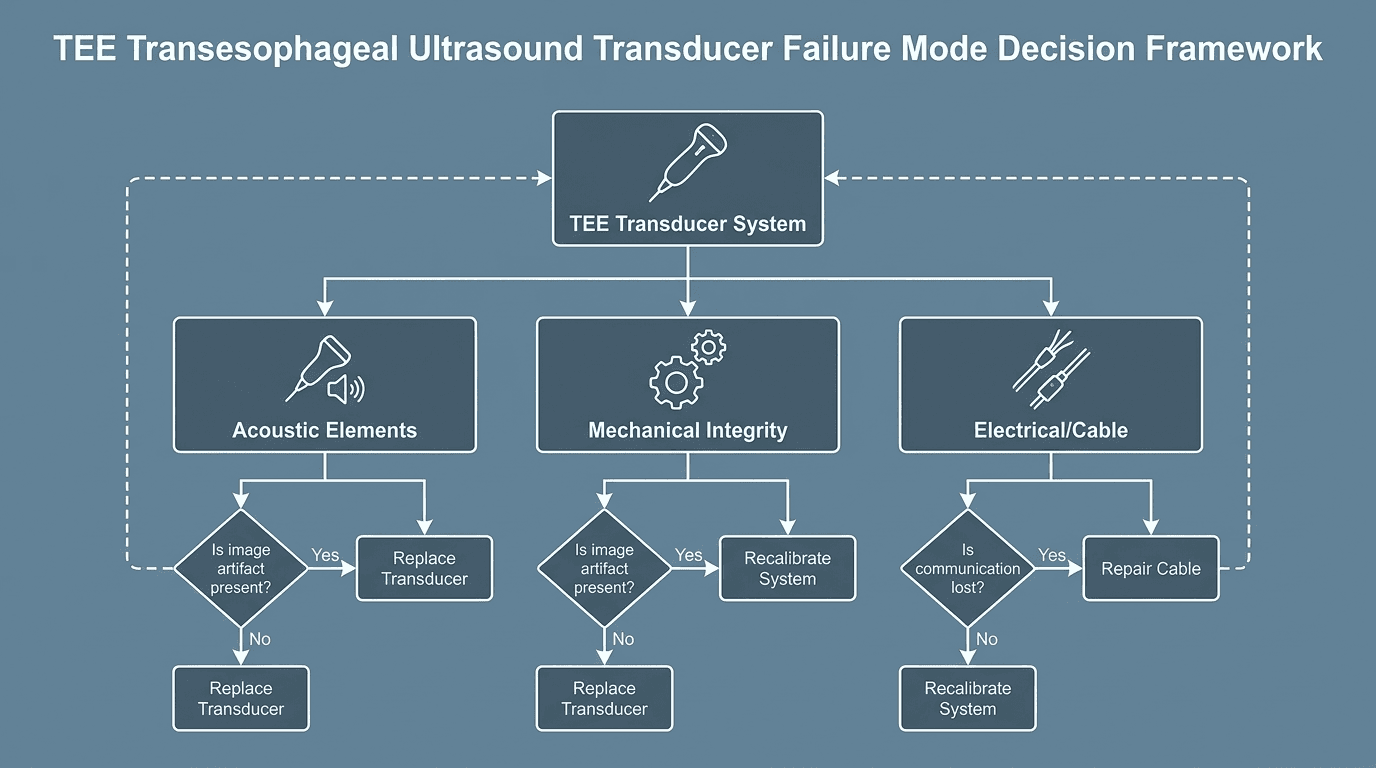
Why the TEE Probe is a Different Repair Problem from a Surface Probe
Standard transthoracic surface probes (linear, convex, and phased-array) operate externally against intact skin. In contrast, a transesophageal echocardiography (TEE) transducer is a semi-invasive endoscopic device passed into the patient's esophagus and stomach to acquire high-resolution cardiac images. This unique clinical role creates an operating environment with extreme mechanical stress, aggressive chemical exposure, and elevated electrical safety risks9.
Architecturally, a 3D/4D matrix TEE probe (such as the Philips X8-2t, GE 6VT-D, or Siemens Z6Ms) packs complex micro-mechanical deflection controls, tension steering wires, motor drives, thermal monitoring thermistors, and over 1,500 active acoustic channels into an insertion tube measuring under 10 mm in diameter. Because the distal tip rests millimeters from cardiac tissue, electrical insulation failure or thermal dissipation faults pose immediate patient safety hazards.
When evaluating overall ultrasound probe repair vs replacement economics, standard surface probes can often be evaluated simply by acoustic output and cosmetic housing integrity. TEE probes, however, require a dual-gate decision model: evaluating physical repairability while strictly enforcing non-negotiable electrical and reprocessing safety limits.
What Are the Distinct Ways a TEE Probe Fails, and Which Damage Classes Are Repairable?
To establish an actionable routing workflow, hospital biomedical departments and independent service organizations (ISOs) should classify TEE damage into five primary functional domains. Each domain carries distinct root causes, clinical symptoms, and repair routes.
| Damage Class | Visible / Operational Symptoms | Primary Root Causes | Repair Route & Feasibility |
|---|---|---|---|
| 1. Bending Rubber & Sheath Breach | Punctures, tears, bite marks, swelling, flaking, or chemical discoloration on insertion shaft. | Patient bite without bite-block, sharp tooth contact, aggressive high-level disinfectant (HLD) chemical attack. | High Feasibility: Replace bending-rubber boot, relubricate deflection joints, re-seal shaft sheathing. |
| 2. Articulation & Steering Mechanics | Stiff, loose, or non-returning control knobs; control lockup; excessive deflection play. | Stretched/snapped tension wires, guide-pulley wear, internal fluid intrusion causing corrosion/seizure. | High Feasibility: Re-string articulation control cables, adjust tension, replace internal steering gear assemblies. |
| 3. Acoustic Array & Lens Damage | Acoustic shadow lines, acoustic lens delamination, acoustic membrane holes, image dropout. | Physical drop impact, mechanical trauma, lens degradation after repeated automated cleaning cycles. | Moderate-to-High Feasibility: Re-lens array face, repair acoustic backing material, or replace micro-array assembly. |
| 4. Cable, Strain Relief & Connector | Intermittent image flicker on deflection, bent connector pins, cracked strain-relief boot, system unrecognized. | Excessive cable twisting, door-pinch trauma, fluid ingress into lock-handle housing, ID chip EEPROM corrupt. | High Feasibility: Re-terminate wiring harness, replace strain-relief boots, pin alignment, EEPROM re-flashing. |
| 5. Electrical Insulation & Thermal Faults | Failed pre-use leakage test, system thermal shutdown alarm, distal tip focal warming, surface burn risk. | Internal fluid intrusion breaching primary dielectric barrier, thermistor drift, short circuit in micro-coaxial bundle. | Hard-Stop Gate: Immediate quarantine. Requires complete rebuild with IEC 62353 safety recertification or exchange. |
Source: Rongtao Medical Engineering Triage Framework & OEM Field Inspection Standards
Most external mechanical damage (Classes 1 through 4) can be restored at component level by qualified repair facilities at a fraction of OEM replacement cost. However, Class 5 insulation failures or internal fluid contamination represent critical safety gates that must be cleared prior to returning any probe to clinical rotation.
What Does a Failed Electrical Leakage Test Mean, and When Must a TEE Probe Be Retired?
In clinical practice, the electrical leakage test is the single most important safety gate for a TEE transducer. Under IEC 60601-1, medical electrical equipment specifies stringent chassis and patient leakage current thresholds7. Because a TEE probe contacts mucous membranes near the heart, it is classified as a Body Floating (BF) or Cardiac Floating (CF) applied part.
- IEC 60601-1 Patient Leakage Limit (BF Applied Part): Maximum 100 µA under normal conditions.
- IEC 60601-1 Patient Leakage Limit (CF Applied Part): Maximum 10 µA under normal conditions.
- IEC 62353 Field & Post-Repair Recurrent Test Standard: Applied following any repair, component replacement, or major service overhaul prior to clinical release.
The Intersocietal Accreditation Commission (IAC) revised its echocardiography standards (effective December 31, 2015) to mandate that the structural and electrical integrity of TEE transducers be inspected and tested between every patient use with documented pass/fail results510.
A failed electrical leakage test indicates that fluid or mechanical trauma has breached the outer dielectric isolation barrier (such as a pinhole in the bending rubber or hairline crack in the lens resin). If an insulation breach is ignored, high-level disinfectant (HLD) chemicals can enter the shaft during reprocessing, leading to internal component corrosion and creating a risk of chemical burns (sometimes referred to as 'black mouth') or electrical micro-shocks during subsequent exams8.
OEM operator manuals specify distinct leakage test configurations: GE requires probes tested disconnected from the system host, Philips requires connection to the system host, and Toshiba utilizes proprietary megohm meters. Regardless of manufacturer protocol, any probe failing IEC 62353 post-repair leakage limits must remain quarantined until primary dielectric integrity is restored.— Acertara Acoustic Laboratories & IEC 62353 Compliance Protocol
How Reprocessing (HLD, Cleaning Cycles, Handling) Damages a TEE Probe Over Its Life
High-Level Disinfection (HLD)—whether conducted via manual immersion in glutaraldehyde/OPA solutions or through automated endoscope reprocessors (AER)—is essential for infection control. However, chemical exposure and handling wear represent the primary environmental stressors driving TEE probe degradation over time6.
- Fluid Ingress past Seal Barriers: Repeated thermal expansion during automated cleaning cycles causes adhesive seals around the acoustic lens and distal housing to flex, eventually allowing fluid to enter the acoustic stack.
- Bending Rubber Swelling & Hardening: Extended exposure to harsh enzymatic cleaners or improper chemical concentrations cause synthetic rubber boots to lose elasticity, crack, or bubble.
- Mechanical Strain during Transport: Coiling the insertion tube tighter than manufacturer-specified minimum bend radii (typically 15–20 cm) causes internal tension wires to stretch and micro-coaxial cables to fatigue.
- Disinfectant Residue Trapping: Punctures or bite breaches allow HLD chemicals to pool inside the articulation snake assembly, causing hidden internal corrosion that cannot be rinsed away during standard processing.
Biomedical teams must strictly enforce facility reprocessing policies that align with the specific OEM Instructions for Use (IFU). When a probe exhibits chemical discoloration, swelling, or lens delamination, it should undergo immediate inspection following established ultrasound probe acceptance testing guidelines before permanent internal damage occurs.
What Does the FDA Recall Record Tell Us About TEE Failure Modes (and What Can It Not Tell Us)?
Analysis of the U.S. FDA Medical Device Recall database (under diagnostic ultrasound product codes ITX, IYO, and IYN) yields over 30 specific recall actions involving TEE transducers from major manufacturers including Siemens, Philips, and Toshiba1. These public regulatory records confirm that TEE failures span structural, thermal, and software/calibration domains.
| Recalling Firm & Model | Recall RES Number & Date | Stated Failure Mode & Reason for Recall |
|---|---|---|
| Siemens Acuson V5Ms | Z-2571-2014 (Init: 2014-08-13) | Reports of material deterioration covering the articulating section of the V5Ms transesophageal transducer. |
| Siemens Acuson Z6Ms | Z-0667-2017 (Init: 2016-11-07) | Image acquisition errors and deterioration of material covering the articulating section. |
| Siemens Acuson V5M / SC2000 | Z-1081-2013 (Init: 2013-03-28) | Displayed temperature on system lower than actual transducer temperature when paired with MPI Board Rev 4. |
| Siemens TEE Transducers | Z-0827-2011 (Init: 2010-09-29) | Possible short circuit causing focal heating on probe surface face during high-output modes. |
| Philips S8-3t Micro TEE | Z-2062-2011 (Init: 2011-03-27) | Significant image quality degradation reported after a number of clinical use/cleaning cycles. |
| Philips TEE Family | Z-1841/1844-2020 (Init: 2019-08-30) | Manufacturing programming error causing system inability to correctly measure distal tip surface temperature. |
| Philips Field Labeling | Z-2385/2413-2025 (Init: 2025-07-03) | Field safety notice and labeling update defining explicit useful-life limits for transducers in active service. |
| Toshiba PET-511BTM | Z-1100-2010 (Init: 2009-05-11) | Market withdrawal following reports of injury related to bending/buckling of flexible insertion section. |
Source: FDA Device Recall Export (openFDA RES Database, Product Codes ITX / IYO / IYN)
In addition, FDA MAUDE passive surveillance records for product code ITX (Transducer, Ultrasonic, Diagnostic) contain 575 reports filed in 20252. Significantly, 547 of those 575 filings (95.1%) were coded with 'No Clinical Signs, Symptoms or Conditions'—confirming that the vast majority of reported events represent out-of-service device malfunctions detected during routine inspection rather than patient harm.
Important Regulatory Guardrail: Neither FDA recall classifications nor MAUDE report volumes measure overall device failure incidence or prove relative safety differences between OEM brands. MAUDE is a passive surveillance database where report counts reflect reporting practices rather than defect rates. Recall data serves as empirical proof that specific failure modes (articulation breakdown, thermal thermistor errors, and useful-life limits) are recognized engineering phenomena across the industry.
The Useful-Life & Overservice Hard-Stop: When Repair Is No Longer Appropriate
The 2025 Philips recall actions (Z-2061/2067-2025 'refurbished beyond useful life' and Z-2385/2413-2025 'useful life labeling') highlight a critical operational boundary: transducers subjected to extreme age or repeated non-standard overhauls may reach an unserviceable state1.
Under FDA guidance on servicing vs remanufacturing, routine maintenance and component replacement (such as re-sheathing a shaft or replacing a cable boot) return a device to its original performance specifications. However, when internal structural housings, acoustic backing blocks, or micro-coaxial cable looms have suffered systemic degradation, attempting repeated partial patch repairs can compromise fundamental safety barriers.
- Retire / Replace Criteria 1: Multiple pinhole leaks along the internal insertion shaft where fluid has corroded the main wiring harness beyond isolation limits.
- Retire / Replace Criteria 2: Severely degraded acoustic array crystal elements exceeding 20% element dropout across matrix sub-apertures.
- Retire / Replace Criteria 3: Probes where thermal monitoring thermistors or internal thermal cutoff switches fail calibration and cannot be restored to OEM tolerances.
- Retire / Replace Criteria 4: Devices flagged by OEM field safety notices as having reached mandatory end-of-useful-life retirement limits.
How to Route a TEE Probe for Component-Level Repair, Tested Replacement, or Retirement
When a TEE probe exhibits a defect, biomedical personnel should follow a structured four-step decision tree to select the optimal technical and commercial resolution.
- Step 1: Immediate Decontamination & Physical Inspection. Clean according to OEM IFU, perform a visual check of the insertion tube, bending rubber, lens face, and connector pins. Document any visible bite marks or sheath cuts.
- Step 2: Pre-Use Electrical Leakage Test. Conduct a leakage test in a saline bath using a calibrated tester following IEC 62353/60601 guidelines. If leakage current exceeds allowable BF/CF thresholds, mark the probe as QUARANTINED.
- Step 3: Evaluate Technical Feasibility & Provider Scope. Consult an independent repair partner to determine if the fault is repairable at component level (sheath re-booting, articulation wire replacement, cable re-termination) or requires tested unit exchange. Review options against criteria for OEM vs independent probe repair.
- Step 4: Audit Post-Repair Evidence. Before returning any serviced probe to clinical inventory, require a complete evidence package including acoustic element maps, dielectric isolation test certificates, and physical verification data. See guidance on how to qualify a probe repair provider.
What Post-Repair Evidence Must Clear Before a TEE Probe Returns to Clinical Use?
A reputable probe service center must provide comprehensive post-repair validation documentation for every serviced TEE transducer. Hospital engineering teams should never accept a repaired TEE probe based on cosmetic appearance alone.
- Dielectric Leakage Test Certificate: Verified compliance with IEC 62353:2014 patient leakage current limits in wet immersion conditions.
- Acoustic Array & Element Sensitivity Map: Quantitative verification (using acoustic hydrophone or in-air reverberation analysis) showing zero signal dropout across active matrix elements.
- Articulation Deflection Angle Verification: Physical measurement confirming full 4-way deflection angles (Up/Down/Left/Right) match OEM specification limits.
- Distal Tip Surface Temperature Calibration: Verification that thermal thermistors accurately report tip temperatures and trigger system thermal limits at prescribed safety thresholds under IEC 60601-2-37.
- High-Level Disinfection Compatibility Statement: Written certification that replacement bending-rubber compounds and potting adhesives are fully compatible with standard facility HLD chemistry (such as glutaraldehyde, OPA, or hydrogen peroxide plasma vapor).
Where Rongtao Fits—and Where It Does Not
Rongtao Medical specializes in multi-brand independent ultrasound probe support, maintaining dedicated technical capabilities for transesophageal transducers across major manufacturers including GE, Philips, Siemens, Mindray, and Samsung Medison.
Where We Fit: Rongtao's published transducer service scope covers fault diagnosis and element-level repair of TEE probes alongside the mechanical, acoustic, and reprocessing-driven damage modes mapped above.
- Component-Level TEE Repair: Bending-rubber boot replacement, articulation tension wire re-stringing, strain-relief restoration, and connector pin/wiring re-termination.
- Tested Replacement & Advance Exchange: Fully tested pre-owned and refurbished TEE transducers backed by real-machine clinical image verification.
- Rapid Diagnostic Evaluation: Multi-point inspection of returned probes to identify root-cause failure modes and provide transparent repair vs. replacement quotes.
Where We Do Not Fit: We do not perform remote guesswork without physical inspection, we do not bypass safety isolation boundaries, and we do not supply unverified probe parts that fail IEC 62353 safety standards.
Quote-Ready TEE Handoff Checklist
To receive a fast, accurate technical evaluation or quote for TEE probe repair or replacement from Rongtao Medical, prepare the following details prior to submitting your enquiry:
- Transducer Model & OEM: e.g., Philips X8-2t / S8-3t, GE 6VT-D / 6Tc, Siemens V5Ms / Z6Ms.
- Exact Serial Number & Manufacturer Part Number: Located on the connector housing label.
- Detailed Failure Description: Specific operational symptoms (e.g., failed pre-use leak test at 150 µA, stiff articulation control knob, vertical image shadow lines).
- Clear Photographs: High-resolution images of the distal tip, bending-rubber sheath, articulation control housing, and connector pin block.
- Facility Location & Target Timeline: Destination country and required turnaround requirement.
Submit your TEE probe details directly to our technical service team via the Rongtao Probe Repair Service Center or request a quote at Rongtao Medical Contact.