
View chart data
| Category | 510(k) clearances |
|---|---|
| Diagnostic ultrasound transducers | 409 |
| Automated HLD instruments for those transducers | 11 |
409 diagnostic-transducer clearances versus 11 automated HLD-instrument clearances in the same FDA file. The machine that disinfects the probe is a thin category next to the probe itself.
Source: FDA 510(k) Premarket Notification database — Rongtao Medical analysis, accessed August 2026
1. What the probe just touched
Earle Spaulding’s three-class scheme is still the public-health logic CDC uses. Critical items enter sterile tissue or the vascular system and should be sterile. Semi-critical items touch mucous membranes or non-intact skin and need at least HLD. Non-critical items touch intact skin and need LLD 8.
Ultrasound makes the scheme operationally annoying, because the same physical probe changes class with the examination. An abdominal convex probe on intact skin is non-critical. The same probe on a wound, a drain site or non-intact skin is semi-critical. A transvaginal, transrectal or transesophageal probe is semi-critical by contact with mucosa. An intraoperative probe used in a sterile field is critical. AIUM’s 2025 revision states the floor in one sentence: external transducers between patients require LLD; internal transducers require routine mandatory HLD and a high-quality single-use cover 3.
| What the probe contacts | Spaulding class | Between-patient floor | Typical ultrasound examples |
|---|---|---|---|
| Intact skin only | Non-critical | Low-level disinfection | Abdominal, obstetric, vascular survey on intact skin |
| Mucous membrane or non-intact skin | Semi-critical | HLD and a single-use cover | Transvaginal, transrectal, TEE, surface probe on broken skin |
| Sterile tissue or the vascular system | Critical | Sterilize; if not feasible, CDC minimum for a surgical probe is HLD plus a sterile cover | Intraoperative cavity probes, some sterile-field guidance |
The same physical transducer can move class in a single shift: intact-skin survey is low-level disinfection; the next case on non-intact skin or mucosa is high-level disinfection plus a cover.
- Caveat: Follow the probe IFU and the hospital's infection-prevention policy. AIUM treats percutaneous guidance on intact skin as LLD plus a cover whose barrier rating matches the procedure.
Source: CDC Guideline for Disinfection and Sterilization in Healthcare Facilities; AIUM transducer cleaning statement, 2025 revision — accessed August 2026
Two implementation traps show up in every HTM argument.
First, “we sheathed it, so it is non-critical now.” CDC considered that move and rejected it. Endocavitary probes without a cover are semi-critical. With a cover they still get a new cover and HLD, because covers fail 1 2.
Second, “HLD is HLD.” It is not. The FDA list of cleared sterilants and high-level disinfectants is a chemistry catalog with product-specific contact times and temperatures. Glutaraldehyde, ortho-phthalaldehyde, hydrogen peroxide, peracetic-acid combinations and, for specified ultrasound probes, a chlorine-dioxide foam (Tristel Duo ULT, DEN220041) all appear 9. The Tristel row is the IFU-subsetting rule made concrete: FDA’s own table limits that foam to manual application with Duo Wipes, 2 minutes at 20°C, single-use foam generated on site, for endocavity transvaginal, transrectal and skin-surface transducers only. It is not a general ultrasound-probe HLD, not a TEE claim, and not a sterilant. AIUM warns that not every listed agent is safe for every transducer 3. The OEM instructions for use are the compatibility list. A cleared HLD used off that list is an experiment performed on a capital accessory.
Percutaneous guidance sits in a third bucket. AIUM treats transducers used for needle or catheter placement on intact skin as LLD plus a cover whose barrier rating matches the procedure’s sterility — peripheral IV is not the same cover as a full sterile-field placement 3. That is still a use-class decision, not a probe-model decision. The cover in that bucket is load-bearing in a way the vaginal sheath is not: it is the sterility claim for a needle path. Three transducer-code recalls exist because a needle-guide bracket can puncture the sterile cover during assembly 6. A punctured percutaneous cover is not “HLD with extra paperwork.” It is a broken sterile field. Inspection of the guide and the sheath is part of the same gate as inspecting the lens.
Intraoperative probes are the class that departments under-specify. A probe that enters sterile tissue or the vascular system is critical and should be sterilized. If sterilization is not feasible, CDC states that the minimum for a surgical probe is HLD plus a sterile cover; the OEM IFU and the hospital’s infection-prevention policy must support the implemented route 2 8. TEE is not automatically that probe. TEE contacts mucosa and is semi-critical; it is not an intraoperative abdominal probe just because cardiac surgery is happening in the same room. Mixing those two objects in one soak protocol is how a department either under-processes a sterile-field probe or over-immerses a TEE handle.
A single department can hit all three classes before lunch. Obstetrics: a transabdominal probe on intact skin (LLD), then a transvaginal probe (HLD plus cover). Emergency: a linear probe for an intact-skin DVT study (LLD), then the same probe on a penetrating wound (HLD plus cover). Cardiac: TEE (HLD plus cover, leak test, no soaking of the handle). Operating room: an intraoperative probe that the IFU treats as critical. The policy that says “all probes get a purple wipe” is not a Spaulding policy. It is a labor policy, and it will be wrong for at least one of those examinations.
TEE is the unforgiving case. The insertion tube is immersible; the handle and connector usually are not. Manual HLD that dunks the handle is how fluid gets into steering mechanics. Automated TEE instruments exist in the liquid-code clearance list for that geometry 4. Endocavity probes are simpler to immerse and easier to store wrong. Surface probes are the class-confusion case: staff see a “regular probe” and skip HLD after a wound scan. The map in the table above is the argument to hang on the wall. The IFU is the argument that wins a survey.
2. Why a cover does not downgrade HLD
If covers were reliable sterile barriers, CDC recommendation 10.a would be optional. It is Category IB, and it is blunt: even if probe covers have been used, clean and high-level disinfect rectal, vaginal and related semi-critical probes with a product that is not toxic to staff, patients, probes and retrieved germ cells where that applies. Do not drop to a lower disinfection category because a sheath was used 1.
The empirical reason is perforation and residual contamination, not theory.
CDC’s equipment chapter records unused sterile transvaginal covers arriving with perforation rates of 0%, 25% and 65% from three suppliers, and post-use perforation of 75% and 81% from two suppliers in one oocyte-retrieval series 2. A cover that fails before the examination was never a reclassification device. The same chapter notes that condoms have been found superior to some commercial probe covers as barriers (1.7% leakage versus 8.3%) — and still requires HLD, because even the better barrier fails 2.
Casalegno and colleagues swabbed endocavity vaginal probes and found high-risk HPV DNA despite LLD and a cover. AIUM cites 2.5% after use and 1.8% before use (n=198) 3 10. LLD plus a sheath is the protocol that produced those swabs.
Westerway and colleagues found bacterial contamination on 60% of transabdominal and 14% of transvaginal probes in their sample; after LLD both sat near 4% residual contamination 11. Four percent is not zero, and it is the result after the step many departments treat as finished.
WFUMB’s safety committee, in Abramowicz and colleagues’ 2017 transvaginal-cleaning statement, set out a between-patient cleaning sequence and listed HLD methods for internal transducers 12. AIUM’s 2025 revision cites that paper and adds the virus-specific caution: of the listed methods, published HPV inactivation has clustered on chlorine dioxide and a vaporized hydrogen-peroxide system, and the hydrogen-peroxide evidence includes manufacturer-funded studies 3. The operational point is not “buy that chemistry.” It is that LLD-plus-cover is the protocol the HPV literature keeps finding DNA on, and that not every HLD method has the same published virus data. The IFU still subsets the list.
AIUM’s 2025 text closes the loophole that appears when a sheath tears mid-exam: an obvious disruption in cover integrity does not modify the HLD requirement 3. The torn cover is additional contamination, not a reason to skip chemistry.
| Finding | What it does to the protocol |
|---|---|
| CDC: condoms and commercial covers can fail; some unused sterile covers arrived perforated | Cover plus HLD, not cover instead of HLD |
| Casalegno 2012: high-risk HPV DNA on endocavity probes after LLD and cover (n=198) | LLD is the wrong ceiling for internal probes |
| Westerway 2017: residual bacterial contamination after LLD on abdominal and transvaginal probes | Cleaning quality is measurable and incomplete |
| AIUM 2025: cover disruption does not relax the HLD requirement | A torn sheath is not a reason to skip chemistry |
Covers reduce contamination. They do not survive contact as a sterile barrier often enough to reclassify the probe.
Source: CDC disinfection guideline; AIUM 2025 statement citing Casalegno 2012, Westerway 2017 and cover-perforation studies — accessed August 2026
None of this is an argument against covers. CDC still wants a new cover or condom every patient 1. It is an argument against using the cover as a permit to skip HLD, and against treating a stained or punctured sheath as a cosmetic event.
3. The automated-reprocessor file is small
Search results for ultrasound probe disinfection are dominated by automated systems. The FDA clearance file is not. Under 21 CFR 892.1570 — the same regulation that classifies diagnostic transducers — FDA keeps two Class II product codes for automated HLD instruments: liquid delivery and mist delivery 13. We pulled every 510(k) in those two codes from the current premarket-notification file (175,559 rows in the extract): 11 clearances, all substantially equivalent, dated 2005 through 2025 4.
View chart data
| Category | Liquid HLD instrument | Mist HLD instrument |
|---|---|---|
| 2005 | 1 | 0 |
| 2011 | 0 | 1 |
| 2015 | 1 | 0 |
| 2016 | 1 | 0 |
| 2018 | 0 | 1 |
| 2019 | 1 | 0 |
| 2020 | 1 | 0 |
| 2023 | 2 | 0 |
| 2024 | 0 | 1 |
| 2025 | 0 | 1 |
Eleven clearances in twenty years, including a 2024 wireless probe holder. Liquid and mist are separate Class II classifications under the same transducer regulation — not a crowded device class.
Source: FDA 510(k) Premarket Notification database — Rongtao Medical analysis, accessed August 2026
Seven are liquid-code. Four are mist-code. Applicant strings collapse to three families: CS Medical (6), Nanosonics (4, including a 2024 wireless probe holder), and PCI Medical’s GUS ASTRA TEE / ASTRA VR (1, 2015) 4. Named devices in that census, by decision year: CS Medical TD-100 (2005), Nanosonics trophon (2011), PCI ASTRA TEE / ASTRA VR (2015), CS Medical TD-100 with TD-5/TD-8 (2016), trophon2 (2018), TEEClean (2019), TD-200 with TD-12 (2020 and a 2023 supplement), Ethos (2023), a trophon wireless probe holder (2024), and a 2025 trophon2 supplement 4. That is identification of what FDA has cleared, not a sales ranking and not a safety ranking.
The 2024 holder is the hedge on “eleven automated reprocessors.” It is a wireless ultrasound probe holder, not a new disinfection instrument. Count it in the census because it sits in the same classification. Do not brief a capital committee as if the hospital just gained an eleventh way to run HLD. Twenty years of this file is sparse on purpose: a few instrument families, a chemistry pairing for each, and accessories that share the code. HTM should buy against the compatible-probe list and the chemistry label, not against a count of 510(k) rows.
View chart data
| Category | 510(k) clearances |
|---|---|
| CS Medical | 6 |
| Nanosonics | 4 |
| PCI Medical (ASTRA) | 1 |
Three applicant families. This is a clearance census, not an installed-base or safety ranking.
Source: FDA 510(k) Premarket Notification database — Rongtao Medical analysis, accessed August 2026
The contrast that matters for HTM is next to the probe itself. The same 510(k) file holds 409 diagnostic-transducer clearances (1978–2025) 4. Hospitals buy probes by the fleet and HLD instruments by the department. Inspection labor scales with the 409, not with the 11. A 510(k) on the instrument does not prove that your TEE, endocavity and surface catalog is on the compatible-probe list, does not prove the chemistry matches the probe IFU, and does not prove the cycle is logged. It proves the instrument was found substantially equivalent for its labeled intended use.
Manual HLD is still a legal path when it follows the probe IFU and an FDA-cleared HLD’s contact conditions 9. Automation is a workflow and traceability choice. It is not a regulatory exemption from inspection.
Substantial equivalence is also thinner than a brochure. It means FDA found the instrument comparable to a predicate for the labeled intended use. It does not mean every probe in a mixed GE / Philips / Siemens / Hitachi / Mindray / Samsung / Toshiba (Canon) fleet is validated on that instrument. It does not mean last year’s compatible-probe PDF is still current. It does not mean the hospital’s preferred OPA or hydrogen-peroxide brand is the chemistry in the 510(k). The buying pack in Section 7 exists because those four facts are independently false in real departments.
OEM names in that sentence are fleet identification. They are not a claim that Rongtao is authorized by any of them.
The probe OEM, not the reprocessor OEM, owns the validated cleaning and disinfection instructions. FDA’s 2019 marketing-clearance guidance for diagnostic ultrasound systems and transducers tells manufacturers that reusable devices should contain clear, validated instructions for cleaning and for disinfection or sterilization 14. The Agency’s separate reprocessing-validation guidance is the method document behind that sentence: formulate the instructions, validate them, put them in the 510(k) 15. Classification language for the automated HLD instruments themselves makes the same demand of the machine: if it is reusable, validated reprocessing instructions belong in its 510(k) 13. That sentence is not local folklore. The classification definition points at the 9 June 2017 Federal Register notice (82 FR 26807) that required reprocessing validation data in the 510(k) for listed reusable device types, effective 8 August 2017 16. That notice also lists design features that make reprocessing hard: junctions between insulating sheaths and activating mechanisms, dead-ended chambers, internal movable components, devices that cannot be disassembled. A TEE insertion tube is that list in one object — which is why inspection and leak testing are not optional extras on top of a cleared automated cycle. Ultrasound-transducer HLD instruments are in that classification family 13. None of that transfers the probe IFU onto a hospital soak protocol written from a catalog.
That is why “we bought a cleared reprocessor” is not an answer to “is this probe allowed in this chemistry.” The 510(k) on the instrument validates the instrument’s labeled cycle. The 510(k) and IFU on the probe validate — or refuse — that cycle for that serial’s model. When those two documents disagree, the probe is the object in the patient.
4. What the probe safety record actually flags
If automated HLD instruments were the main post-market problem, the adverse-event and recall files would be full of them. They are not.
The MAUDE mass is on probes, not reprocessors
We filtered MAUDE report rows to diagnostic transducers, pulsed-echo and pulsed-Doppler systems, and the two HLD-instrument codes. The snapshot has no narrative text and no device-problem code, so this is an event-type and volume census, not a root-cause study 5.
The five-code slice is 12,925 rows. Event type across that slice: malfunction 11,867 (91.8%), injury 817, other 129, death 75, missing 37. Most of that mass is systems, not probes and not reprocessors: pulsed-Doppler systems 6,471, pulsed-echo systems 2,600, diagnostic transducers 3,848, HLD instruments 6 5. A department that reads “ultrasound MAUDE” as a probe-disinfection file is reading the wrong object. Systems dominate the count. Probes are the next object. Automated HLD instruments are a rounding error.
Diagnostic transducers account for 3,848 rows. Event type: malfunction 3,423 (89.0%), injury 326, other 58, death 23, unspecified 18. HLD instruments account for 6 rows, all on the mist code, all with trophon-family brand strings: 3 malfunction, 2 other, 1 injury. Patient-problem text on those six includes one “burning sensation / chemical exposure” row and several no-clinical-impact rows. The liquid-code instrument has zero MAUDE rows in this snapshot 5. Zero is not a safety certificate; it is a reporting-file fact. The post-market mass is on the probe.
- Malfunction89%(3,423)
- Injury8%(326)
- Other2%(58)
- Death1%(23)
- Unspecified0%(18)
View chart data
| Category | MAUDE reports |
|---|---|
| Malfunction | 3423 |
| Injury | 326 |
| Other | 58 |
| Death | 23 |
| Unspecified | 18 |
About 9 in 10 transducer reports are coded malfunction, not injury. Counts are reports, not failure rates — there is no install-base denominator.
Source: FDA MAUDE — Rongtao Medical analysis, accessed August 2026
View chart data
| Category | MAUDE report rows |
|---|---|
| Diagnostic transducers | 3848 |
| Mist HLD instruments | 6 |
| Liquid HLD instruments | 0 |
3,848 transducer reports versus 6 automated-HLD-instrument reports. The post-market file is a probe-integrity file, not a reprocessor-malfunction file.
- Caveat: Snapshot has no MDR narrative. Zero liquid-instrument rows is not proof of absence of field issues.
Source: FDA MAUDE — Rongtao Medical analysis, accessed August 2026
Reporting volume is lumpy
The year cut is the number most likely to be misread. Transducer rows in this snapshot run from 1994 through a partial 2026. Calendar year 2024 alone is 989 rows — about 26% of every transducer report in the file. 2025 is 575. 2023 was 138. 2019 was 119 5. 2026 in this export is already 264 and is a partial year. There is no install-base denominator, no narrative, and no device-problem code. A four-fold jump in received reports is a reporting-volume fact until someone produces a fleet size and a coding explanation. It is not a documented epidemic of failed HLD, and it is not a reason to treat 2023’s 138 rows as “the true rate.”
The file has done this before. Transducer rows jumped to 183 in 2015, 269 in 2016 and 415 in 2017, then fell to 130 in 2018 and stayed in the 80–160 band until 2024 5. Anyone who treated 2017 as a new failure-rate regime was wrong within twelve months. The honest use of the year chart is: reporting volume is lumpy, 2024 is an outlier in this snapshot, and lumpy reporting is not a Spaulding decision.
View chart data
| Category | Diagnostic-transducer MAUDE rows |
|---|---|
| 2015 | 183 |
| 2016 | 269 |
| 2017 | 415 |
| 2018 | 130 |
| 2019 | 119 |
| 2020 | 117 |
| 2021 | 154 |
| 2022 | 88 |
| 2023 | 138 |
| 2024 | 989 |
| 2025 | 575 |
| 2026 | 264 |
2024 alone is 989 rows — about a quarter of every transducer report in a file that starts in 1994. That is reporting volume, not a documented jump in infection or HLD failure. 2026 is a partial year in this snapshot.
- Caveat: No install-base denominator. Year is date received, not date of clinical event. 2026 is incomplete in the July 2026 export.
Source: FDA MAUDE — Rongtao Medical analysis, accessed August 2026
A keyword screen of transducer patient_problems for infection, sepsis, burn, shock, leakage or inflammation hit 53 rows. Bacterial infection is the most common label in that thin slice (15), then thermal burn language (thermal burn 5, burns 3, gastroesophageal burn 2) and electric shock (2) 5. That mix is not a disinfection-efficacy trial. Thermal and shock sit next to infection in the only patient-outcome field the snapshot contains, and the whole screen is small next to 3,423 malfunctions. A department that reads 53 infection-ish rows as “HLD is failing in the field” is ignoring both the missing narrative and the thermal/electrical cluster that inspection and leak testing actually address.
Recalls flag integrity, gel and useful life
Recalls tell a sharper story because they have a reason field. Across 58,785 product-level recall rows, 528 sit on the ultrasound codes in this study (systems 380, transducers 147, mist HLD instrument 1) 6. Inside that 528:
- integrity / leak / crack / seal / lens language: 23
- disinfection / reprocessing language: 5
Widen the disinfection keyword to the whole recall file and keep only rows that also mention ultrasound, transducer, probe, trophon, endocavity or TEE: 34 rows 6. Still a small file. The coded root-cause mix on those 34 rows is Device Design (12), Under Investigation by firm (9), Error in labeling (4), Process control (2) and Reprocessing Controls (2) 6. Even when the reason text talks about disinfection, FDA’s root-cause field almost never names reprocessing controls. That is not a finding that hospitals reprocess well. It is a finding that the recall file, in this cut, is a design-and-labeling file, not a “the soak protocol failed” file.
Inside the five ultrasound-code disinfection-language rows, three share one reason: a new inspection step was added to the cleaning and disinfection section of the IFU to reduce infection risk. A fourth tells users a screw cover at the probe tip may fall off after cleaning and sterilization, and to inspect before and after reprocessing and before and after an intraoperative procedure 6. The fifth is not an ultrasound probe: it is an endoscope (GF-UC140P-AL5) no longer compatible with an automated endoscope reprocessor. Do not carry that row into a probe-HLD briefing. Even the disinfection-language slice, once that endoscope is removed, is an inspect-the-probe file.
The transducer-code reason head, counted as distinct manufacturer strings, is useful-life and “refurbished beyond useful life” labeling (21 rows), body-cavity 510(k) scope (18), labeling to define useful life in the field (13), Eco-Med ultrasound-gel contamination (the longest variant alone is 9), TEE tip-temperature programming (4), and needle-guide covers that can puncture a sterile sheath (3) 6. Tip-temperature programming is not a wipe failure. Four TEE rows exist because some transducers were not properly programmed in manufacturing, so the system could not correctly measure distal-tip temperature 6. That is an integrity-and-thermal-safety stop: a TEE that cannot report tip temperature is not made safe by another HLD cycle. It is a remove-from-service object, same family as a failed leak test. The single HLD-instrument recall is McKesson/Nanosonics Sonex-HL bottles exposed to high temperature before delivery — a consumable-effectiveness action, not a probe-hardware action 6.
| Cut | Product-level recall rows | How to read it |
|---|---|---|
| Ultrasound codes (transducer, pulsed-echo/Doppler systems, HLD instruments) | 528 | The working universe |
| Integrity / leak / crack / seal / lens language inside that universe | 23 | Physical condition that breaks disinfection |
| Disinfection / reprocessing language inside that universe | 5 | Rare as a coded reason |
| Any-device disinfection language that also names ultrasound, probes or trophon | 34 | Broader keyword net; still small |
| HLD-instrument code recalls | 1 (mist-code disinfectant bottles) | Consumable effectiveness, not probe hardware |
Among 528 ultrasound-code recall rows, integrity language is more common than disinfection language. The HLD story in the recall file is mostly probe condition, gel, and useful-life labeling — plus one disinfectant-consumable temperature excursion.
Source: FDA Medical Device Recall database — Rongtao Medical analysis, accessed August 2026
View chart data
| Category | Product-level recall rows |
|---|---|
| Refurbished beyond useful life | 21 |
| No 510(k) for body-cavity use | 18 |
| Labeling to define useful life | 13 |
| Eco-Med gel contamination (longest variant) | 9 |
| TEE tip-temperature programming | 4 |
| Needle-guide cover can puncture sheath | 3 |
The head of the transducer recall file is useful-life labeling, body-cavity 510(k) scope, contaminated gel, and a handful of hardware programs. Disinfection-process language is not the head.
- Caveat: Reason strings are manufacturer text, not a controlled vocabulary. Near-duplicate Eco-Med strings exist; the chart shows the longest variant only so rows are not double-counted.
Source: FDA Medical Device Recall database — Rongtao Medical analysis, accessed August 2026
Gel contamination is infection control, and it is adjacent rather than identical to HLD. A probe that is correctly high-level disinfected and then coupled with a contaminated gel has been re-contaminated. Eco-Med Pharmaceutical’s 2021 recall of Eco-Gel 200 and related branded gels, for Burkholderia cepacia complex contamination, is in the FDA recall file for that reason 6 17. The transducer-code reason field stores that event as several manufacturer-string variants — the longest alone is 9 rows, with shorter duplicates of 5 and 3 — which is why a naïve unique-reason count understates the gel cluster 6. FDA told facilities to stop use. That action does not convert HLD into a gel problem; it adds a second object that must be controlled, including after a perfect automated cycle.
Five transducer-code rows say sterility of the product cannot be assured 6. Four more flag conductivity gel pouches, labeled as sterile, packaged in needle-guide kits 6. They sit next to the three needle-guide-bracket puncture rows: the sterile field around a percutaneous probe fails in the kit, not in the soak tank.
Body-cavity 510(k) scope is the other disinfection-adjacent stop. Eighteen transducer-code recall rows exist because the product lacked a 510(k) to be used in a natural or surgical opening 6. That is a labeled-use problem, not a wipe problem. A probe used off its cleared contact class is already outside the IFU that HLD is supposed to follow.
A second regulator already treated internal-probe decontamination as a field-safety issue. MHRA’s MDA/2012/038 addresses reusable TEE, transvaginal and transrectal probes that were not appropriately decontaminated between patients 18. MDA/2019/034 is a contaminated intraoperative probe-cover lot 19. MDA/2013/019 warns that detergent and disinfectant wipes can degrade plastic surfaces 20. MDA/2009/080 flags transducers with an internal lumen in transrectal biopsy and points users at Advisory Committee on Dangerous Pathogens advice 21. A lumen is a second object inside the probe. Surface HLD does not substitute for whatever the OEM IFU requires of that channel. The UK file is not a US rate. It is independent confirmation that the failure mode is decontamination-plus-integrity, not “buy a different logo.”
| Alert | Subject | Why it belongs here |
|---|---|---|
| MDA/2012/038 | Reusable TEE, transvaginal and transrectal probes — failure to decontaminate | Internal probes, between every patient |
| MDA/2019/034 | Intraoperative probe-cover lots — bacterial contamination | The cover can be the contaminated object |
| MDA/2013/019 | Detergent/disinfectant wipes degrading plastic surfaces | Chemistry attacks the device it is meant to protect |
| MDA/2009/080 | Transducers with an internal lumen — vCJD advisory in transrectal biopsy | Design features change the decontamination problem |
A second regulator, same logic: internal probes must be decontaminated between patients; covers and wipes have their own failure modes.
Source: MHRA medical device alerts — Rongtao Medical analysis, accessed August 2026
Useful-life labeling is the other disinfection-adjacent finding in the transducer recall head. Multiple transducer recalls exist because devices were refurbished beyond a defined useful life, or because labeling had to define that life in the field 6. A probe that the manufacturer has timed out is not made safe by another HLD cycle. It is a retirement or replacement object. That is a different report’s economics — repair versus replace — but it belongs here as a stop: HLD does not extend a labeled life.
For a fleet-level read of ultrasound recalls beyond this HLD cut, see Rongtao’s FDA ultrasound recall failure-mode analysis. This article stays on the disinfection decision.
5. Inspect before you disinfect
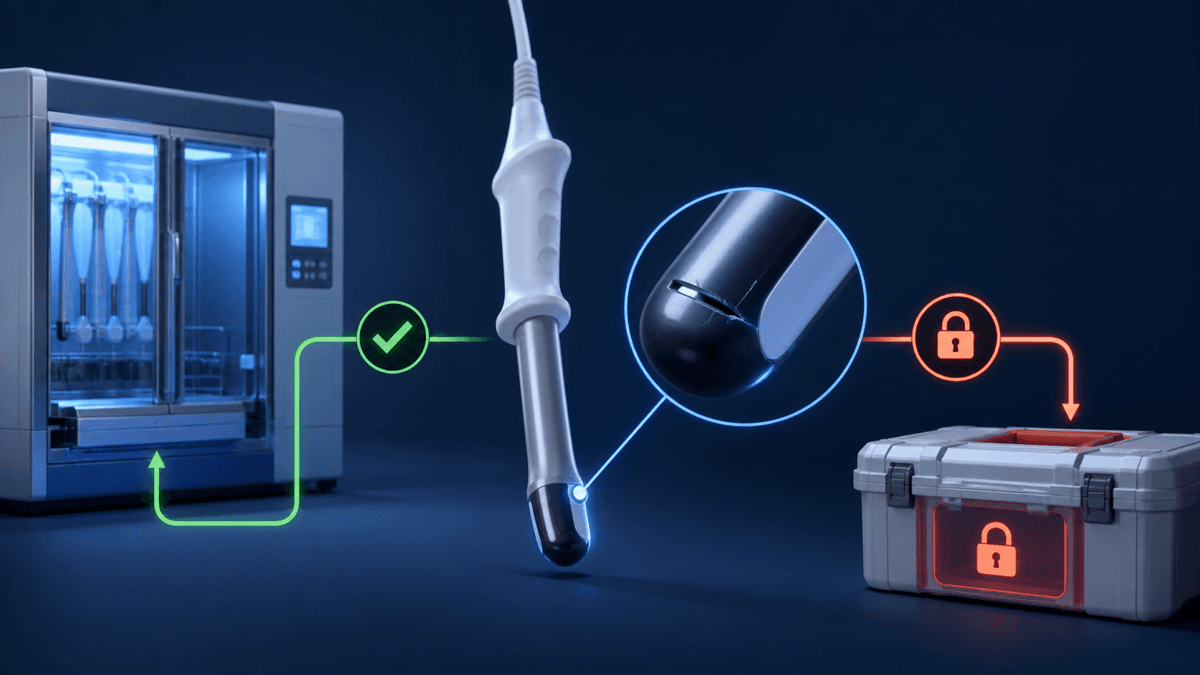
The paper that should hang next to the soak station is Seki 2013. An institutional outbreak of multidrug-resistant Pseudomonas aeruginosa in cardiovascular surgical patients was traced to a transesophageal probe with a 5 mm defect on the insertion tube, 15 cm from the tip. The probe had been cleaned through centralized sterilization. The mechanical defect retained bacteria. No sheath was used 7. AIUM’s 2025 statement cites this outbreak for a reason: HLD chemistry does not disinfect a pocket that should not exist 3.
Seki is not a one-off curiosity. Bancroft and colleagues described an Escherichia coli outbreak associated with a contaminated TEE probe the same year 22. Two papers, two organisms, one mechanical class of failure: a probe that had been through a decontamination process still carried bacteria in or on damaged material. This report does not turn those outbreaks into a US rate. It uses the second paper as independent confirmation of the inspect-before-you-disinfect rule.
That is the service-side half of infection control. A cracked lens, a punctured bending rubber, a swollen cable strain relief or a failed electrical leakage test means the probe must leave clinical use for quarantine, integrity testing and either repair or retirement. Rongtao’s TEE probe damage and repair route maps bite, articulation and chemical-attack modes on TEE specifically; the probe repair-versus-replace report covers the economic fork once the probe is already failed. This section is the gate before that fork: do not send a known breach through another cycle.
| Finding on inspection or after HLD | Action | Why it is a hard stop |
|---|---|---|
| Crack, bite, hole, swelling or delamination of lens, housing or bending rubber | Remove from clinical use; do not HLD-and-reuse | The surface cannot be disinfected; fluid and chemistry enter |
| Failed electrical leakage or insulation test | Remove from clinical use | Patient shock risk; HLD chemicals follow the leak path |
| Chemistry not on the OEM IFU compatible list | Stop; do not improvise | Cleared HLD ≠ compatible with this probe |
| Failed leak test after a cycle | Quarantine; inspect internally | Ingress has already happened |
| Missing cycle log or unknown last chemistry | Do not release | HLD without a record is not HLD |
Seki 2013 traced an MDR Pseudomonas outbreak to a 5 mm defect on a TEE insertion tube that had been through centralized sterilization. A damaged probe is an infection-control device that has already failed.
Source: Seki et al., Journal of Infection and Chemotherapy, 2013; AIUM 2025; IEC 60601 electrical-safety practice as used in probe acceptance testing — accessed August 2026
Chemical compatibility is the other hard stop. FDA’s HLD list is not a probe-compatibility list 9. AIUM: departing from the manufacturer’s cleaning instructions can damage probes and affect diagnostic results; inspect connector, cable, housing and acoustic lens 3. MHRA’s wipe alert is the same idea in the opposite direction: the chemistry can attack the plastic 20. If the HLD, wipe or automated cycle is not on the IFU for that model, the department is choosing between an unvalidated disinfection claim and a shortened probe life — often both.
Leak and electrical-safety testing for TEE and other immersible probes is model-specific. Some IFUs require a check before each examination or before immersion; others define additional post-cleaning or release inspections. Do not impose one universal “after HLD” position. A failed test at any required gate means quarantine, not another cycle. Acceptance testing after repair belongs in the same family: probe acceptance testing is how the service record documents the repaired probe’s condition before the hospital applies its own reprocessing policy.
6. The between-patient cycle
HLD is one box. CDC and AIUM both describe a sequence: remove soil, clean, disinfect at the correct level, rinse as the chemistry requires, dry, and store at the level achieved 1 3. Add inspection and any IFU-required integrity or electrical tests at the points specified for that model. A generic workflow must not move a pre-immersion test to the end of the cycle.
| Step | Owner | Release rule |
|---|---|---|
| Point-of-care wipe of gel and soil | User | Visible soil gone before transport |
| Dirty transport, cover off the clean storage path | User / SPD | No clean/dirty mix |
| Inspect; complete any IFU-required pre-immersion integrity test | HTM / SPD | Any breach → out of clinical use |
| Clean, then HLD or sterilize at the required level | SPD / designated user | Correct chemistry, time, temperature, rinse |
| Rinse and dry; complete any IFU-required release check | HTM | Fail → quarantine, not 'wipe again' |
| Store at the disinfection level achieved | SPD | HLD probes do not hang next to dirty probes |
High-level disinfection is one box in a longer chain. Integrity-test timing is probe-specific: perform each check at the point required by the OEM IFU.
Source: CDC and AIUM cleaning sequences; electrical leak-testing practice in TEE/endocavity IFUs — accessed August 2026
Point-of-care cleaning exists to get gel and soil off before they dry. Dried gel is a disinfection-failure mechanism, not a housekeeping preference. AIUM’s gel section is part of the same cycle: sterile or bacteriostatic gel for endocavitary examinations on intact mucous membranes; no refilling of multidose bottles; no contact between the dispensing tip and the transducer 3. Dirty transport has to stay dirty: a used TEE in an unsealed bag on a clean worktop is a new reservoir. Storage after HLD has to stay at HLD level; AIUM says transducers are stored in accordance with their disinfection level 3. Hanging a processed endocavity probe next to yesterday’s unprocessed linear probe is a reclassification of both.
The physical split is not optional because the department is small. Dirty intake, inspection and pre-cleaning, disinfection or sterilization, rinse/dry, IFU-specified release checks and clean storage are different contamination states. Combining them on one counter is how a logged cycle still delivers a re-contaminated probe. Automated instruments help the middle of that chain — clock, temperature, chemistry lot — and do nothing for the two ends: the dirty bag that arrived open, and the clean hook that shares a pegboard with an unprocessed linear.
Manual versus automated HLD does not change those boxes. Automation can force a clock, a temperature and a log. It cannot see a 5 mm cut. The human inspection step is not legacy workflow. It is the step the outbreak literature says the machine will not do 7.
7. Buying and governing a reprocessor
If the department buys an automated instrument, buy a file, not a brochure. The clearance census in Section 3 is the identity check: liquid versus mist Class II code, 510(k) number, intended use limited to ultrasound transducers 4 13. Then demand the current compatible-probe list by model, including whether TEE, endocavity and surface probes are in or out. Then match chemistry: named HLD, contact conditions from the FDA-cleared label 9, and a line-by-line IFU match for every high-volume probe.
| Gate | Evidence | Fail if |
|---|---|---|
| Regulatory identity | Class II code (liquid vs mist), 510(k), intended-use statement | Code/indication does not match the probes you process |
| Probe compatibility | Current OEM-endorsed list by model, including TEE vs endocavity vs surface | Your highest-volume probes are absent |
| Chemistry | Named HLD, contact conditions, MRC/CI method, probe IFU match | Hospital chemistry is not on both lists |
| Traceability | Cycle log, probe ID, operator, pass/fail, consumable lot | No audit trail a surveyor can read |
| Environment | Ventilation, vapor control, dirty/clean split, storage at HLD level | Soak station in an unventilated alcove |
| Integrity loop | Pre-cycle inspection, any IFU-required pre-immersion test, and any IFU-required release check | HLD is treated as a substitute for inspection |
A 510(k) number is the start of the file, not the end. The probe list and the IFU decide whether the machine can legally and physically process the fleet you actually own.
Source: FDA product classification for ultrasound-transducer HLD instruments (21 CFR 892.1570); FDA-cleared HLD list; OEM transducer IFUs — accessed August 2026
Traceability is the survey-facing half. A cycle that cannot name the probe, the operator, the chemistry lot and a pass/fail is not auditable HLD. Several of the liquid-code clearances in the census name a chemical indicator in the 510(k) device string (QwikCheck on Ethos and on a TD-200 supplement) 4. That is identification of what was cleared, not a recommendation to buy that brand of strip. It is evidence that FDA’s file treats cycle verification as part of the instrument, not as an optional sticker. Environment is the industrial-hygiene half: vapor control for glutaraldehyde and OPA is not optional because a machine exists; it is specified by the chemistry’s label. Dirty/clean split is physical. If the only space is a curtain around a soak bin, the purchase has not solved the process.
The last gate is the integrity loop written into the purchase agreement: pre-cycle inspection, any pre-immersion integrity test the probe IFU requires, any post-cycle release check it requires, and a defined quarantine path. Without that loop, the hospital has bought a faster way to HLD probes that should have been pulled.
Keep a one-page IFU-conflict log next to the instrument: probe model, HLD chemistry, automated-cycle name, compatible-list version and date, who signed. When the probe OEM and the reprocessor OEM disagree, the probe IFU wins for damage and warranty; the hospital’s infection-prevention policy wins for whether that probe may be used at all. “We ran it anyway” is not a documented decision. It is how useful-life and chemical-attack failures get explained after the fact 3 6.
8. Where Rongtao fits — and does not
Rongtao Medical is an independent ultrasound service partner founded in 2013: core-board repair, probe solutions, tested replacement parts, 48-hour real-machine testing, typical 5–8 business-day turnaround, typical 90-day warranty, 3,000+ parts SKUs, 35+ engineers, a 3,000 m² workshop, ISO 13485:2016 and ISO 9001:2015, coverage into 140+ countries and regions. It is not an OEM. It is not a hospital sterile-processing department. It does not provide clinical HLD or on-site reprocessing.
What it can own is the physical half of the cycle this report describes. A probe that fails inspection or leak testing is a repair/replace decision, not an HLD decision. Incoming inspection on the serial — lens, bending rubber, strain relief, connector — is the same family of look as the soak-station gate, done on a bench instead of a dirty utility room. Real-machine testing after repair documents function and integrity within the service scope; it does not validate the hospital’s next HLD cycle or prove compatibility with a chemistry. Parts availability and turnaround matter because a department needs a safe spare rather than pressure to keep a marginal probe in service. A 90-day warranty is a hardware warranty. It is not a disinfection validation.
If a service partner cannot show incoming inspection, a test record tied to the serial, and a warranty that does not pretend to be a reprocessing certificate, it is not closing this loop. Neither is Rongtao if a customer asks it to certify a hospital’s HLD program. That certification is the hospital’s, against the probe IFU, the chemistry label and the log.
9. Ultrasound probe disinfection FAQ
Do transvaginal probes need HLD if we always use a cover? Yes. CDC and AIUM both require HLD plus a new cover. Covers fail, including some unused sterile covers 1 2 3.
Does a surface probe ever need HLD? Yes, when it contacts non-intact skin or is otherwise used as a semi-critical device. Intact-skin survey is LLD. The class follows the examination, not the catalog name 8 3.
Is automated HLD required? No. It is one way to control time, temperature and logs. The requirement is HLD at the correct Spaulding level with a chemistry compatible with the probe IFU 3 9.
Can we use any FDA-listed HLD? No. The FDA list clears chemistries for labeled contact conditions. Probe IFUs subset that list. Off-list use is how probes lose lenses and seals 3 9.
If MAUDE is 89% malfunction, is infection a non-issue? No. MAUDE in this snapshot has no narrative and no denominator. Outbreaks such as Seki 2013 are the infection evidence; they are rare, documented, and mechanical 5 7.
Does a repaired probe come back “HLD-validated”? No. Repair restores a testable physical object. The hospital’s validated cycle, IFU and logs remain the disinfection claim.
Where do gel and wipes fit? Gel can re-contaminate a processed probe; Eco-Med’s 2021 gel recall is in the US file for bacterial contamination 6 17. Wipes can degrade plastics 20. Both are IFU items, not extras.
Does a 2024 jump in MAUDE rows mean HLD is failing? No. 2024 is 989 transducer rows in a 3,848-row file with no denominator and no narrative. Treat it as reporting volume 5.
If the manufacturer has defined a useful life, can we HLD past it? No. Multiple transducer recalls exist specifically because devices were refurbished beyond a labeled life, or because that life had to be defined in the field 6. HLD does not extend a labeled life.
Can we use Tristel Duo ULT on every probe because it is on the FDA HLD list? No. FDA’s table limits that chlorine-dioxide foam to specified transvaginal, transrectal and skin-surface transducers, 2 minutes at 20°C, manual Duo Wipes, single-use foam 9. TEE and any probe not on that row still follow their own IFU.
Is a lumen probe just a surface-HLD problem? No. MHRA’s MDA/2009/080 exists because some transrectal-biopsy transducers have an internal lumen that surface disinfection does not address 21. Follow the OEM IFU for that channel.
Does the fifth disinfection-language recall in the ultrasound-code slice prove HLD machines fail? No. One of those five rows is an endoscope incompatible with an automated endoscope reprocessor, not an ultrasound probe 6. The remaining four are inspection-and-IFU actions.
Who wins if the reprocessor’s compatible-probe list and the probe IFU disagree? The probe IFU wins for damage and warranty. Infection-prevention policy wins for whether that probe may be used at all 3 14.
Conclusion
Semi-critical use requires at least HLD; critical use requires sterilization, with CDC’s HLD-plus-sterile-cover minimum only when surgical-probe sterilization is not feasible. A cover does not buy a downgrade. The FDA automated-HLD instrument file is small — 11 clearances, three applicant families — while the probe file is large. The post-market record sits on probe integrity, gel and useful life, not on a flood of reprocessor injuries. The decision that protects patients is the unglamorous one: inspect, follow the model-specific sequence, and quarantine what fails. Independent probe repair exists after removal from clinical use. It does not replace the hospital’s reprocessing controls.
If a probe has already failed inspection or leak testing, send the serial, model, photos of the breach and the HLD chemistry in use. That is enough to decide whether repair is even eligible before another cycle is wasted on a device that should be out of the cabinet.