
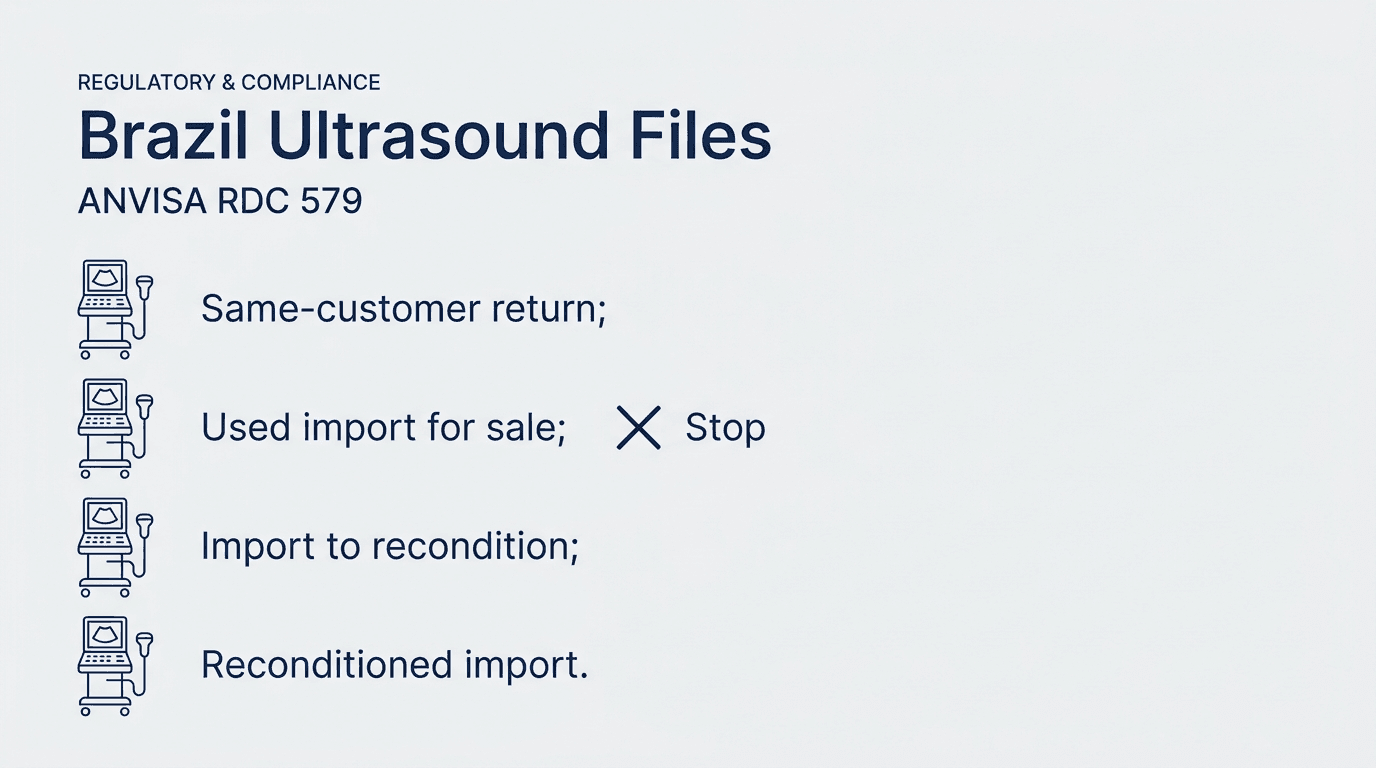
Four shipment files, and why refurbished is not one of them
RDC 579 of 25 November 2021 was published in the Diário Oficial da União on 1 December 2021, edition 225, section 1, page 139. Article 22 puts it into force on 1 January 2022. Article 21 revokes RDC 25 of 15 February 2001. Article 1 defines requirements for import, commercialization, and donation of used or reconditioned medical devices destined for use in Brazil. Article 2 applies the resolution to products regulated by RDC 185 of 22 October 2001 and RDC 36 of 26 August 2015, or by resolutions that replace them. 14
Search overviews often collapse those articles into one sentence: refurbished ultrasound may be imported if registration, an authorized service provider, customs, INMETRO, and UDI are in order. That sentence is the page this guide is written against. RDC 579 does not use the commercial word refurbished as a file type. It separates technical assistance, used equipment, and reconditioned equipment, and it puts the reconditioning rules in Chapter V, Articles 15 to 18, not in the domestic-sale chapter. INMETRO and UDI are not requirements of the articles read here, so they are not added to the table. 1
The quotations below follow the 1 December 2021 DOU text. The 20 August 2024 FAQ still quotes Article 4 and Article 15 in those words. This review did not find an amending resolution in those sources. The FAQ's own introduction says it is a non-regulatory, non-binding clarification and is not intended to expand or restrict technical requirements. Every FAQ sentence below stays labeled as the FAQ. 24
| File | What the text decides | Who the text names | What this file does not do |
|---|---|---|---|
| 1. Same-customer repair return | Outside RDC 579. Article 2, sole paragraph. The non-binding FAQ, question 3, says an export for repair or maintenance that returns to the same customer is not reconditioned equipment for this resolution and follows RDC 81/2008. | The same customer named in Article 3, item II. The activity is maintenance or repair of a finished product so it can be returned to its specifications for that customer. | It does not authorize sale to a new customer. The FAQ says a used return for commercialization is prohibited by Article 4. This page does not recite the RDC 81 petition. |
| 2. Used import for sale or a new customer | Article 4 prohibits import, commercialization, and donation, throughout Brazil, of a used or reconditioned device that does not meet this regulation. Used equipment is Article 3, item XIII: already used, and not submitted to any reconditioning process. | Article 4 does not name a distributor, broker, or clinic that may import an unreconditioned used system for sale. | It does not say that every other Brazilian law is silent, and it does not publish a customs-clearance time. It withholds the sanitary permission in this resolution. |
| 3. Used import only for reconditioning in Brazil | Article 4, sole paragraph: used equipment may be imported when it is destined exclusively for the reconditioning process in Brazil, according to the criteria in RDC 81/2008 or a resolution that replaces it. | The non-binding FAQ, questions 34 and 36, says the notification or registration must be current, as in Article 15, and that the activity is permitted only to the registration holder. That holder sentence is not the text of Article 4. | It is not permission to sell the unit in the state in which it arrived, and it does not turn a repair shop into the reconditioning plant. |
| 4. Import of equipment already reconditioned | Chapter V, Article 15: import, manufacture, and commercialization are permitted when the Anvisa regularization is current. The reconditioning plant must appear on that regularization. | Article 3, item XI: the original manufacturer of the new product, a company in the same corporate group, or a company that manufacturer qualified and authorized specifically for this process. | It does not copy Article 6's recipient list onto the import. A workshop sticker is not the Article 18 marking. Item XIII is the definition of used equipment, not this row. |
| Domestic used sale or donation | Chapters III and IV, Articles 6 to 14. Article 6 permits commercialization and donation of used lay or professional equipment that was regularized at Anvisa, with the indelible label preserved. | For used professional equipment, Article 6, paragraph 2, names companies regularized at Anvisa with a distribution AFE, and health services. The non-binding FAQ, question 1, reads the scope more narrowly. | It does not authorize a foreign used inventory to cross the border. Lease and comodato have a separate waiver in Article 12. |
Source: DOU text of ANVISA RDC 579/2021, 1 December 2021, edition 225, section 1, page 139; ANVISA Perguntas e Respostas, 3rd edition, 20 August 2024
A related split already exists for a different country. The India repair-return versus refurbished-sale split uses Indian documents. It is not the Brazil rule. Packing, invoice wording, and the point that destination clearance remains the buyer's procedure are covered in the guide to cross-border repair shipping and destination clearance. That guide does not parse RDC 579. Commercial words such as used, pulled, tested, and refurbished are explained in commercial condition words on a parts label. Those words are not Article 3.
Is a same-customer board or probe repair a reconditioned import?
No. Article 2, sole paragraph, reads: A atividade de assistência técnica não faz parte do escopo dessa regulamentação. Technical assistance is not part of the scope of this regulation. 14
Article 3, item II, defines it: Assistência Técnica: Manutenção ou reparo de um produto acabado a fim de devolvê-lo às suas especificações para o mesmo cliente. That is maintenance or repair of a finished product in order to return it to its specifications for the same customer. FAQ question 3 is about that finished product going out for repair and coming back to the same customer. A board or probe that is part of the same customer's device, and that returns to that customer, belongs in that repair-return file. A new replacement board, taken from inventory for a different scanner, is FAQ question 10, not a reconditioned console. 12
FAQ question 3, 3rd edition, 20 August 2024, answers the temporary-export case in these words. The FAQ is non-binding and does not amend the resolution. 2
Portanto, esclarecemos que a exportação do produto usado para fins de reparo/manutenção, ao qual será retornado para o próprio cliente, não é considerado equipamento recondicionado para fins desta Resolução. Devendo assim ser retornado conforme as regras estabelecidas pela Resolução - RDC nº 81 de 2008. Caso a intenção seja retornar o produto como usado para comercialização, este é proibido, conforme Art. 4º da Resolução - RDC nº 579 de 2021. Por fim, caso o produto seja retornado para fins de comercialização como “recondicionado” para um novo cliente, deverá seguir as regras estabelecidas neste Regulamento.— ANVISA, Perguntas e Respostas, RDC nº 579/2021, 3ª edição, 20 August 2024, question 3
In English: export of the used product for repair or maintenance, when it will be returned to the same customer, is not reconditioned equipment for this resolution and should return under the rules in RDC 81/2008. A return as used for commercialization is prohibited by Article 4. A return for commercialization as reconditioned, to a new customer, must follow this regulation. Siscomex still lists RDC 81 of 5 November 2008 and records that RDC 599 of 9 February 2022 amends it. This page does not parse those temporary-export articles and does not supply a petition code, an invoice sentence, or an export-declaration number. 25
Keep two facts visible on the repair papers: the same customer, and the serial identity of the article that left. Do not describe that repair as recondicionado. Chapter V is the industrial reconditioning chapter. An independent service repair does not meet Article 3, item XI, merely because the destination is Brazil.
When does RDC 579 still prohibit a used ultrasound import?
Article 4 is the baseline, not a general opening. The DOU text reads: Ficam proibidas em todo o território nacional a importação, comercialização e doação de dispositivo médico usado ou recondicionado que não atender aos critérios estabelecidos neste Regulamento. Import, commercialization, and donation of a used or reconditioned medical device that does not meet the criteria in this regulation are prohibited throughout the national territory. 14
The sole paragraph is the only import exception for used equipment: Pode ser importado o equipamento usado que se destinar exclusivamente ao processo de recondicionamento em território nacional, de acordo com os critérios estabelecidos na Resolução de Diretoria Colegiada - RDC nº 81, de 05 de novembro de 2008, ou em resolução que vier a substituí-la. Used equipment may be imported when it is destined exclusively for the reconditioning process in Brazil, according to the criteria in RDC 81/2008 or a resolution that replaces it. 14
FAQ questions 34 and 36, still non-binding, say import of used equipment remains prohibited except for import exclusively to recondition the product in the country. For that purpose they say the notification or registration must be current, as Article 15 states for reconditioned equipment, and that the activity is permitted only to the registration holder. That holder limit is the FAQ's reading. Article 4 does not contain it. 2
Three further boundaries matter before anyone treats a used console as eligible for that exception.
- Implantable devices, Article 5. Import, commercialization, and donation of a used or reconditioned device that qualifies as an implantable medical device are prohibited. Article 3, item VIII, defines that category, including a device introduced wholly into the body, one that replaces an epithelial or ocular surface by clinical intervention and is intended to remain, and one introduced partly and intended to remain at least 30 days. A diagnostic console is not that definition. This page does not decide whether a probe, catheter, accessory, or marker meets item VIII. 1
- Demonstration units and trade-show units, FAQ questions 15 and 16. The non-binding FAQ says equipment placed with a customer for demonstration, without clinical use, is treated as used, and the same rule applies to accessories and parts whether they are controlled by serial number or lot. Equipment shown at a fair or congress is treated as used even when only functions are shown and no patient is tested. Once the unit is removed from its primary packaging, assembled, and installed, the FAQ says it is no longer new. A demo scanner is not a new import. 2
- Other purposes, including parts harvesting, FAQ question 11. The resolution regulates commercialization and donation of used and reconditioned equipment to be used in health services. The FAQ says it is not intended to regulate commercialization of used equipment for other purposes. That answer does not clear a used console labeled as scrap under Article 4, and it does not say a bare board is unregulated. FAQ question 10 says import of parts, components, and replacement materials used to maintain medical equipment follows RDC 81/2008, because technical assistance is outside this resolution. 2
A foreign broker who buys a pre-owned ultrasound at auction and sells it to a clinic in Brazil as a used system is in row 2 of the table, unless the system is already reconditioned under Article 15 or is entering only for the Article 4 reconditioning process. Row 2 is not a paperwork problem that a different invoice adjective can repair.
What has to be true before a reconditioned ultrasound can be the import file?
Chapter V, Articles 15 to 18, is the reconditioned-equipment chapter. The definition sits earlier, in Article 3, item XI, not item XIII. Item XIII is used equipment: equipment or an IVD instrument that has already been used and has not undergone any reconditioning. Item XI is reconditioned equipment. 1
Item XI requires an industrial process by one of three actors: the original manufacturer of the new product, a company in the same corporate group, or a company the original manufacturer qualified and authorized specifically for that process. When necessary, the process includes repair, rework, replacement of worn parts, and software or hardware updates, and replacement of critical or worn components by new or reconditioned components. The result must have operation, function, and performance equivalent to the original new product, including as to warranty. Do not convert "including as to warranty" into a number of days, and do not apply it to a third-party repair. 1
FAQ question 4 asks whether a company that performs technical assistance, parts repair, and maintenance is a reconditioning factory. The non-binding answer says a company that performs technical assistance is not a reconditioning factory, because technical assistance is not a production process. The FAQ describes reconditioning as an industrial production line: disassembly, replacement of damaged parts, reassembly, in-process and finished-product tests, an updated original product history, labeling, sale as reconditioned, and a warranty equivalent to the original new product. A qualification and authorization from the original manufacturer, for that process, is the statutory gate in item XI. A service relationship is not that authorization. 2
Article 15 then adds two conditions, which the FAQ also quotes: import, manufacture, and commercialization of reconditioned equipment are permitted when the Anvisa regularization is current, and the reconditioning plant must appear on that regularization. Article 15 does not, by itself, name every importer that holds a distribution AFE as the permitted consignee. 12
- Article 17. An initial regularization will not be granted exclusively for reconditioned equipment. A valid registration may be maintained under Article 16. Article 16 concerns a discontinued production line and the compulsory-certification exemption in RDC 549 of 30 August 2021. This page does not parse RDC 549. 1
- Article 18. The plant that performs reconditioning must affix, indelibly, on each equipment, complementary information that the unit was reconditioned, indicating the year. If a physical limitation makes that impossible, the label goes on the primary packaging. The resolution requires that information and the year. It does not set one mandatory sentence. A service sticker from an independent workshop is not this marking. 1
Why is a domestic used sale or donation not an import permission?
Chapter III, Articles 6 to 12, governs commercialization and donation of used equipment. Chapter IV, Articles 13 and 14, is the technical report some of those transfers require. Neither chapter clears a foreign used shipment. 1
Article 6 permits commercialization and donation of used professional or lay equipment that was regularized at Anvisa. The verb is "esteve regularizado": it was regularized. Paragraph 1 requires the indelible label to be preserved so the unit can be traced and its Anvisa regularization number identified. FAQ question 12, non-binding, says the same thing and adds that the label need not state that the equipment is used. 12
Paragraph 2 permits commercialization and donation of used professional equipment only to companies regularized at Anvisa through an Operating Authorization (AFE) for distributing medical devices, and to health services. FAQ question 35, non-binding, says that distribution AFE is required of the companies that will commercialize or donate used equipment, and that it does not apply to health services, which have their own sanitary licenses. This page does not turn that answer into a municipal-license checklist. 12
FAQ question 1, still non-binding, reads the scope more narrowly than paragraph 2's recipient list. It says the resolution deals with commercialization from a health service to a health service, or from a company duly regularized at Anvisa to a health service, and that commercialization between regularized companies, or from a health service to a regularized company, is outside this resolution. The FAQ does not amend Article 6. A buyer who is moving a used scanner from one Brazilian company to another should read paragraph 2 and question 1 together, and should not treat either sentence as an import document. 2
The class of the device comes from its Anvisa regularization, not from a guess that abdominal ultrasound is class II or that an intravascular system is class III. RDC 751 of 15 September 2022 revokes RDC 185 of 22 October 2001 when RDC 751 enters into force on 1 March 2023. That revocation list does not include RDC 579, and the lines read here do not revoke RDC 36/2015. Article 2 already covers resolutions that replace RDC 185 and RDC 36. 13
- Classes I and II, Article 8. The health service or company that commercializes or donates used professional equipment in class I or II is responsible for making it available for use only after evaluation by a qualified higher-education professional with proven technical expertise and an Anotação de Responsabilidade Técnica (ART), so that technical-operational and safety conditions are assured. The ART is waived for transfer between legal entities in the same economic group, or between branches. The resolution does not name a particular class council in Article 8. 1
- Classes III and IV, Article 11. Commercialization and donation require a technical report attesting that the unit meets the manufacturer's technical specifications and conditions of use. Diagnostic or interventional radiology equipment that meets RDC 330 of 20 December 2019, its related normative instructions, or their substitutes, is exempt from that report if a higher-education professional evaluates it with an ART. The FAQ's related-norms list says RDC 611 of 9 March 2022 revoked RDC 330/2019. Diagnostic ultrasound is not named in the Article 11 waiver. Do not use it to skip the report. 12
- Who issues the report, Articles 13 and 14. Where this resolution requires the report, Article 13 requires it from the Brazilian notification or registration holder, a company that holder authorizes, or the responsible manufacturer. Article 14, paragraph 2, waives the report for transfer inside the same economic group or between branches. 1
- Lease and comodato, Article 12. Commercialization in Article 3 includes sale, dação em pagamento, lease, comodato, and leasing. For lease or comodato, Article 12 waives Articles 8 and 11. The lessor or comodante must still keep the distribution record and the record of preventive and corrective maintenance, including part replacement, calibration, and periodicity. 1
- Notice to the holder, Article 9. A health service that receives used professional equipment must formally tell the Brazilian notification or registration holder within 30 days of receipt, even if the regularization is not current. The notice names the receiving service, its CNPJ and address, and the model and serial number, and that record is kept. Article 10 points the receiving service to RDC 509 of 27 May 2021, or a successor, for health-technology management. This page does not parse RDC 509. 1
| Item | What Article 14 requires | What to copy |
|---|---|---|
| I | Dados do equipamento: nome comercial, modelo, número de série/lote, número do registro na Anvisa; | Commercial name, model, serial or lot, and the Anvisa registration number named in this item. Copy the number from the label. Do not assume a digit count. |
| II | Dados do proprietário da unidade avaliada; | Data identifying the owner of the evaluated unit. The CNPJ requirement in this article sits on the issuing company, in item III, not on this line. |
| III | Dados da empresa emissora do laudo técnico: razão social, endereço, CNPJ, telefone, identificação e número de registro do respectivo conselho de classe do profissional responsável pela elaboração do laudo técnico; | Corporate name, address, CNPJ, and telephone of the company issuing the report, plus the identity and class-council number of the professional who prepared it. |
| IV | Data de emissão do laudo técnico; | The date the report was issued. |
| V | Conclusão clara e objetiva do estado geral da unidade avaliada, informando se esta atende ou não as especificações técnicas e condições de uso definidas pelo fabricante; | A clear conclusion on the general state of the unit, stating whether it does or does not meet the manufacturer's technical specifications and conditions of use. |
| VI | Orientações gerais para o correto transporte e instalação, destacando-se requisitos específicos, quando aplicável, definidas pelo fabricante. | General guidance for correct transport and installation, including specific manufacturer requirements when they apply. |
Source: ANVISA RDC 579/2021, Article 14, DOU 1 December 2021
Article 14, paragraph 1, requires at least two copies: one kept by the seller or donor, and one by the company or health service that receives the equipment. Paragraph 2 waives the report for transfers inside the same economic group or between branches, without waiving the other obligations in the regulation. 1
What has to be on the quote before anyone calls the shipment refurbished?
Stop a request that says only "refurbished ultrasound for Brazil." The quote has to say which file it is. Ask for the facts below. Do not invent the RDC 81 form, a customs-broker engagement, or a municipal license from this page.
- Identity. OEM, commercial model, console serial, and, if a transducer is in the shipment, the probe serial and part code. Photograph the nameplate.
- Anvisa number, when the label has one. For a domestic used sale, Article 6 requires the indelible label to remain so the regularization number can be traced. A missing label is a problem for that domestic file. It does not, by itself, pull a same-customer repair back inside RDC 579.
- Which transaction. Same-customer repair return, sale to a new buyer, donation, lease or comodato, or import only for reconditioning in Brazil. Name the city of destination and the quantity.
- Same-customer papers. The same customer and the matching serial. Describe the work as repair or maintenance for that customer. Do not write recondicionado. The return path named by the FAQ is RDC 81/2008. The petition itself is the importer's, not a sentence this page can draft.
- Domestic used transfer. Read the risk class on the regularization before anyone asks for an ART or a laudo. Article 8 and Article 11 are different documents. Article 12 changes both for lease and comodato.
- Condition evidence, if a used system is already in hand. Housing, connectors, and the transducer face still have to be looked at before a technical test. That inspection is the subject of the acceptance gates for a used system already in hand. It is not an import file.
Hard stops for the people using this page: do not relabel a third-party repair as recondicionado; do not treat Article 6 as a border clearance; do not assign an ultrasound, a probe, or a board a Brazilian risk class from a general impression; do not open an energized system or return equipment to clinical use from this article. The ART and the Portuguese laudo are acts for the persons Articles 8 and 13 name.
Where Rongtao Medical fits, and where it does not
Guangzhou Rongtao Medical Technology Co., Ltd. repairs ultrasound boards and probes for distributors, independent service organizations, and hospital engineering teams. That service is not an Anvisa registration, not an OEM reconditioning authorization, and not a Brazilian legal entity.
Where the service fits:
- Component repair of the customer's own article. Board-level and power-supply repair, and probe work such as lens, cable, element, and 3D/4D motor service, on GE Healthcare, Philips, Siemens, Toshiba (Canon), Samsung Medison, and Mindray platforms that Rongtao supports. The Brazil file is still the customer's.
- Published service terms, confirmed on the quote. The published terms include a standard 5–8 business-day turnaround and a typical 90-day warranty, confirmed by item and service. They are not the warranty phrase in Article 3, item XI, and they are not a statement that a Brazil shipment is stocked or cleared.
- Same-customer technical assistance. If a Brazilian hospital or service organization sends its own serialized board or probe for repair and the article returns to that customer, the repair can be documented as technical assistance. The FAQ sends that return to RDC 81/2008. Rongtao does not file the Brazilian petition.
Where it does not fit:
- Not an Article 3, item XI, plant. Rongtao is not the original manufacturer, is not held out here as a member of that manufacturer's corporate group, and does not issue an OEM reconditioning authorization or a factory reconditioning certificate for a console imported into Brazil.
- Not an Anvisa registration holder. Rongtao does not hold the device's Brazilian registration or notification and does not act as a Brazilian registration holder or local legal representative.
- Not the customs file. A repair report and a serial check are not an import license and not an ANVISA petition. Clearance remains with the Brazilian importer.
- Not a China bonded-zone permission. A repair that uses a China bonded zone, and the re-export that zone requires, is a different cycle. It is not Brazilian nationalization. See China bonded repair and the required re-export.
For a board or probe that is already in service, the next pages are the technical services directory and the quote intake. Send the OEM, model, serial, nameplate photo, the Anvisa number if the label has one, whether the article returns to the same customer or moves to a new buyer, the quantity, and the destination city.
Frequently asked questions
Does the 20 August 2024 ANVISA FAQ amend RDC 579?
No. The introduction to the 3rd edition, Brasília, 20 August 2024, says the document is a non-regulatory, non-binding clarification and is not intended to expand or restrict technical requirements. The edition history printed at the back of that PDF records the first edition on 20 April 2022 and the second on 22 November 2022. The cover and the file date are the source for the 3rd edition date. The history table does not, in the copy read here, describe what the third edition changed. 2
Is a third-party repair shop a reconditioning factory?
No. Reconditioning is Article 3, item XI: an industrial process by the original manufacturer, a company in the same corporate group, or a company that manufacturer qualified and authorized specifically for that process. FAQ question 4, non-binding, says a company that performs technical assistance is not a reconditioning factory, because technical assistance is not a production process. Item XIII is the definition of used equipment, not the factory test. 12
May a hospital keep using a unit after its Anvisa regularization expires?
Article 19 permits use of a medical device that was regularly acquired, even after the regularization ends, if sanitary requirements and the manufacturer's specifications and conditions of use are observed. That is continued use. It is not an import permission. Article 15 still requires a current regularization for import, manufacture, or commercialization of reconditioned equipment. Domestic sale and donation are Article 6, which uses "was regularized." FAQ question 137 agrees that continued use differs from a new import. Question 40 says donation of lay equipment whose regularization has expired can be permitted. Question 139 says comodato, rental, and sale are commercialization under Article 3 and follow Article 6, not Article 19. Do not read Article 19 as a ban on every later domestic transaction, and do not read it as permission to import. 12
Does a catalog board become a refurbished ultrasound because the destination is Brazil?
No. FAQ question 10, non-binding, says import of parts, components, and replacement materials used in the maintenance of medical equipment follows RDC 81/2008, because Article 2 leaves technical assistance outside this resolution. Document the board as the replacement part it is. Do not label it as a reconditioned ultrasound, and do not treat that answer as a statement that the part is unregulated. 2