
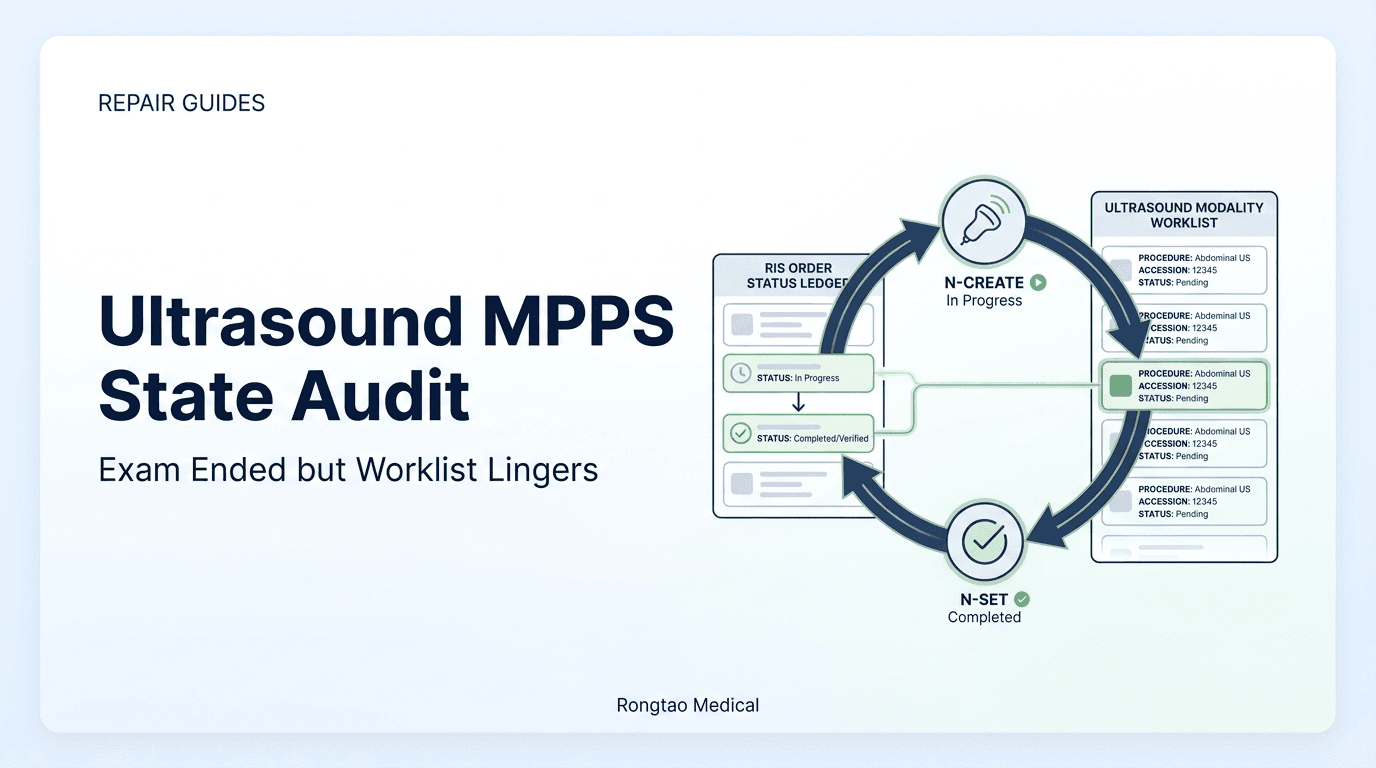
The support ticket trap: hardware fault or integration gap?
Consider a composite, synthetic ticket of the kind integration and clinical-engineering teams describe. A vascular ultrasound room reports that finished exams are not leaving the scanner's worklist. Schedulers see the matching orders still open in the Radiology Information System (RIS) late in the day and start booking around them. A separate audit finds a handful of exams marked 'Discontinued' that the sonographers consider finished—one was a quick assessment in which nothing was stored to that study, another was restarted after a patient ID was corrected. Meanwhile, the PACS team confirms that the room's images are arriving and readable.
A first-pass ticket may blame the scanner's network hardware or main computer and propose a board swap or a software reload. The evidence argues against that. The same cart is completing worklist queries and image sends, so its network path and DICOM software are evidently carrying traffic. Worklist closure depends on a different exchange—Modality Performed Procedure Step (MPPS)—and on how the receiving system uses it. Replacing a board changes neither.
Audit four layers in order: the scanner's MPPS configuration; the event flow the scanner actually produced; whether and how the receiving system (the MPPS Service Class Provider, or SCP) accepted the messages; and the worklist provider's retention policy. The sections below set out the standard's rules, the documented behavior in five ultrasound conformance statements, a decision table, an acceptance test and an escalation record.
What is MPPS and how does the procedure-step lifecycle work?
Two DICOM services connect an ultrasound scanner to scheduling systems, and they run in opposite directions.
Modality Worklist (MWL): acting as a Service Class User (SCU) of the Modality Worklist Information Model – FIND SOP Class (1.2.840.10008.5.1.4.31), the scanner sends a C-FIND query to the worklist provider—typically a RIS, broker or integration engine—and displays the matching Scheduled Procedure Steps. For EPIQ Elite, Philips states that a successful worklist update overwrites the worklist display, that there is no queue management for MWL, and that updates run on operator request, at intervals or at the end of each exam, depending on configuration. 4 The query carries no completion report back to anyone.
Modality Performed Procedure Step (MPPS): under the MPPS SOP Class (1.2.840.10008.3.1.2.3.3), the scanner creates and then updates a record on the MPPS SCP describing what it actually performed: when the step started and ended, which scheduled step it fulfils, who operated, which series and instances it created, and its final status. 9 10 IHE's Scheduled Workflow.b profile requires an Acquisition Modality to support the worklist query and both MPPS transactions (in progress and completed) 11—but support in a product is not the same as configuration at a site.
The standard does not require a worklist entry to vanish when an exam ends. DICOM Supplement 17, which introduced MPPS in 1998, describes worklist management as complete once the scheduled step 'has been removed from the Worklist, possibly in response to the Modality Performed Procedure Step.' 1 The current PS3.3 adds that 'the specification of the workflow itself is beyond the scope of the Standard.' 8 Removal is therefore a behavior of the RIS, broker or worklist provider—something to confirm with its owner—not an automatic consequence of the network exchange.
Three states, one direction: IN PROGRESS, COMPLETED, DISCONTINUED
PS3.4 Chapter F carries the state in Performed Procedure Step Status (0040,0252), with three values: IN PROGRESS, COMPLETED and DISCONTINUED. Because the object represents only the 'performed' part of the real-world procedure step, 'all events are initiated by the modality.' 2 The lifecycle uses two DIMSE-N operations:
- N-CREATE: the scanner creates the MPPS instance with status
IN PROGRESS—the only value an SCP will accept at creation. The scanner specifies the instance UID and supplies the link to the scheduled step (Scheduled Step Attributes Sequence, including accession number and Study Instance UID), the start date and time, and the performing station. 9 - N-SET: the scanner updates the same instance and, when it finishes, sets
COMPLETEDorDISCONTINUED. Before or at that final N-SET it must have sent the list of all image and non-image instances created during the step, and the Performed Series Sequence may not be empty—although a series may contain no instances if none were created. 7 9
Once the scanner has sent a final status, it may no longer modify that MPPS or create new instances under it; a modality that resumes acquisition may create a new MPPS instead. 7 On the receiving side, the SCP accepts an N-SET only while its own copy of the step is still IN PROGRESS. The standard also allows the SCP itself, 'under exceptional circumstances,' to set COMPLETED or DISCONTINUED—for example if the modality has failed—and warns that subsequent N-SETs from the recovered modality may then fail. 7 That exception matters for troubleshooting: it is a documented way for the receiving system and the scanner to disagree about the same step.
| Status value | How it is reached | What the standard says (PS3.4 2026d) | What to check |
|---|---|---|---|
| IN PROGRESS | N-CREATE from the modality (the only value permitted at creation). | 'Modality Performed Procedure Step created and execution in progress' (Table F.1-3). | The SCP should hold a record linked to the scheduled step. Whether the RIS displays 'started' depends on its own mapping. |
| COMPLETED | Final N-SET from the modality (End Exam on the documented systems). | 'The acquisition of Composite SOP Instances has been successfully completed and the SCU has provided all required Attribute Values' (F.1.5). | Final: the scanner may not update it. Compare the referenced-instance list with what was actually stored. |
| DISCONTINUED | Final N-SET from the modality (Cancel Exam on the documented systems; other triggers are vendor-specific). | 'Canceled or unsuccessfully terminated'; the modality 'shall convey this state change' so the information system can reschedule or cancel the related step (F.1.5). | Final. A discontinuation reason code is optional (Type 3), so it may be absent; check what the scanner offers and what the RIS does with it. |
Source: DICOM PS3.4 2026d, Section F.1.5, Table F.1-3, Table F.7.2-1 and Sections F.7.2.2.2–F.7.2.2.3.
The DISCONTINUED rule is the one schedulers feel. The standard requires the modality to convey that state change 'to allow the information system to reschedule or cancel the related Procedure Step.' 2 If the message never arrives, the receiving system has nothing to act on, and the order keeps its last known state.
What does the scanner actually send at exam completion?
Engineers often assume the MPPS exchange starts when a patient is picked from the worklist. On most of the documented systems it does not—but the trigger is vendor-specific, which is why the conformance statement for your exact release matters.
Philips EPIQ Elite Rel 6.0.x and Lumify R5.0 open an association to the configured MPPS SCP 'immediately after the first image is acquired' and send N-CREATE with IN PROGRESS. 4 12 GE's LOGIQ9 and LOGIQ7 statements also send N-CREATE when the first image is acquired. 3 5 Mindray's statement for the ZS3/z.one pro/ZS2 platform differs: 'Starting a new exam or reactivating an exam' creates the MPPS instance. 6 On that platform an IN PROGRESS step can exist before any image does.
At the end of the exam, the documented systems send a final N-SET. On EPIQ and Lumify, the End Exam button produces COMPLETED and Cancel Exam produces DISCONTINUED; the two are mutually exclusive for a given exam. 4 12 The LOGIQ7 and LOGIQ9 statements say the N-SET sent after the exam ends 'will include all acquired images' UIDs and the status of COMPLETED or DISCONTINUED.' 5 3 EPIQ and Mindray draw each message in its own association—open, send, close—so an MPPS failure at exam end can occur even though the N-CREATE at the start succeeded. 4 6
The scanner usually records the outcome somewhere you can inspect. EPIQ lists MPPS message queues alongside image and structured-report queues in its Network status window. 4 Mindray logs the status meaning and any Error Comment and Error ID returned with a failure, and can retry a failed transfer a configured number of times. 6 Where your own system keeps that evidence is a question for its conformance statement and service documentation.
Documented vendor behavior: no-image exams, paused exams, and append cases
Mixed fleets create most of the confusion, because each conformance statement describes only its own product and release. Five documented behaviors change how an RIS status should be read:
- No saved images (GE LOGIQ7): for an ended exam with no images, LOGIQ7 sends the N-CREATE at exam end, and 'For an exam without saved images or results, the N-SET will be sent with status DISCONTINUED.' 5 An exam the sonographer considered complete—an assessment in which nothing was stored to that study—can therefore be reported as discontinued by design. The EPIQ and Lumify statements tie N-CREATE to image acquisition and do not describe an exam ended without images, so do not assume they behave like LOGIQ7, or that they send COMPLETED. 4 12
- Patient identity changed mid-exam (Philips EPIQ): if patient identification is changed while an MPPS is in progress, 'the previous MPPS is discontinued and a new MPPS is created with the changed patient information'; images already sent are regenerated with new UIDs. 4 Correcting a patient ID during an exam can leave a DISCONTINUED step in the RIS alongside a new one.
- Paused exam (Philips EPIQ): 'A "Paused" exam does not initiate an MPPS event.' 4 If images were already acquired, the step created at the first image stays IN PROGRESS on the receiving system until the exam is ended or cancelled.
- Append (Philips EPIQ): an exam sent as COMPLETED 'can no longer be updated', except that re-selecting a scheduled study from the worklist to append images generates a new set of MPPS messages under the same Study Instance UID. Appends made from the Patient Directory or Image Review also receive a new Performed Procedure Step SOP Instance UID. 4 Expect more than one MPPS per accession after an append.
- Reactivated exam (Mindray): reactivating an exam creates a new MPPS instance, and the operator can pick a reason when cancelling. 6
Staged ultrasound protocols such as stress echo add one more pattern. DICOM Supplement 45 recommends that a single MPPS cover an entire staged-protocol exam where possible. If acquisition is halted—its example is patient distress such as angina—the MPPS is still COMPLETED as long as the protocol's conditions were met, and is DISCONTINUED only if the exam ended before meeting the minimum acquisition requirements. Follow-up stages acquired later 'require a separate MPPS' under the same Study Instance UID. 13 A second MPPS on one stress-echo accession can therefore be expected behavior rather than a duplicate.
| Workflow event | GE LOGIQ7 (2316173-100 Rev 4.0, BT04) | GE LOGIQ9 (2325843-100 Rev 1.0) | Philips EPIQ Elite Rel 6.0.x (000737000000163 Rev A) | Philips Lumify R5.0 (HSDP-1299212) | Mindray ZS3 platform (H-046-019409-00 v2.0) |
|---|---|---|---|---|---|
| MPPS enablement | Sent only 'if Modality Performed Procedure Step is configured'. | Sent only 'if Modality Performed Procedure Step is configured'. | DICOM PPS Server must be selected on the DICOM Selection page; one MPPS server active at a time. | Sent to 'the configured MPPS SCP'; setup steps not detailed in the MPPS section. | Sent to the selected remote AE; setup steps not detailed in the MPPS section. |
| N-CREATE (IN PROGRESS) | When the first image is acquired; at exam end if there are no images. | When the first image is acquired. | Immediately after the first image is acquired. | Immediately after the first image is acquired. | When a new exam is started or an exam is reactivated. |
| Ending the exam | N-SET COMPLETED for an exam with saved images or results. | N-SET with all acquired image UIDs and COMPLETED or DISCONTINUED; the trigger for each is not stated. | End Exam → COMPLETED; no further updates. | End Exam → COMPLETED; no further updates. | Operator ends the exam → COMPLETED. |
| Ended with no saved images | N-CREATE, then N-SET DISCONTINUED. | Not stated. | Not stated (N-CREATE is tied to image acquisition). | Not stated. | Not stated (the MPPS already exists from exam start). |
| Cancel Exam | Not stated separately. | Not stated separately. | DISCONTINUED; no further updates. | DISCONTINUED; no further updates. | DISCONTINUED; operator can choose a cancel reason. |
| Pause, ID change, append, reactivation | Not stated. | Not stated. | Pause: no MPPS event. ID change: previous MPPS discontinued, new one created. Worklist append: new MPPS set. | Not stated. | Reactivating an exam creates a new MPPS. |
| Failure response handling | Refused or Error statuses treated as failures; association and operation terminated. | Refused or Error statuses treated as failures; association and operation terminated. | 0110 and other failures: association aborted. 0116H warning: message displayed. | 0110 and other listed failures: association aborted. | 0110 and other failures: A-ABORT, MPPS marked failed, Error Comment/ID logged; configurable retries. |
Source: Compiled by Rongtao Medical on 19 October 2026 from the cited conformance statements. Each statement applies to its named product and release only; check the statement for your installed software before relying on any cell.
Why does the worklist entry linger after the examination ends?
When an ended study is still listed on the scanner or still open in the RIS, there are five broad explanations. None of them requires a hardware fault, and the evidence for each sits in a different place.
- MPPS was never configured on the scanner. The cart has working worklist and storage destinations but no MPPS destination selected. GE's statements make the condition explicit: 'If Modality Performed Procedure Step is configured N-CREATE and N-SET messages will be sent for the exam.' 3 5 An unconfigured cart is silent at exam end, so the RIS has nothing to close the order with. How often this happens has not been measured. In 2005 Noumeir wrote that MPPS deployment had been 'much slower than expected' even though most modality equipment had implemented it, and noted that equipment without MPPS can be integrated by having a RIS terminal or relay station create the step instead. 10 Treat a never-configured cart as a settings and ownership decision, not a repair.
- The message never arrived. The scanner tried to send N-CREATE or N-SET, but the association timed out, was refused or was dropped—for example because the MPPS destination's address, port or AE title changed, or a network rule blocks that destination. Image storage and MPPS use separately configured destinations, often on different systems, so images can flow while MPPS fails. Mindray documents that a timeout, or an association aborted by the SCP or network, marks the MPPS as failed and logs the reason. 6 If the final N-SET never landed, the receiving system can still show the step IN PROGRESS.
- The receiving system refused the update because it had already closed the step. The SCP accepts an N-SET only while its copy of the step is IN PROGRESS; otherwise it returns 0110H 'Processing failure' with the error comment 'Performed Procedure Step Object may no longer be updated' (Error ID A710). 7 Philips EPIQ aborts the association on this status; Mindray aborts it with A-ABORT and marks its MPPS as failed. 4 6 The scanner then shows a failure while the RIS already holds the step as COMPLETED or DISCONTINUED—possibly closed by a person or process on the receiving side, as the standard permits in exceptional circumstances. 7 The question is which final state and which instance list the RIS kept, not why the step is stuck.
- The step closed as DISCONTINUED, not COMPLETED. The scanner reported exactly what its software defines: Cancel Exam on the documented Philips and Mindray systems, an ended LOGIQ7 exam without saved images or results, or a mid-exam patient-ID change on EPIQ. 4 5 6 Whether a DISCONTINUED step leaves the order open, cancels it or queues it for rescheduling is RIS policy.
- The worklist provider does not remove entries on MPPS status. The scanner sent COMPLETED, the receiving system recorded it, and the entry still appears. Because removal happens only 'possibly in response to' MPPS 1, the worklist query may simply return every step scheduled for the day. Some departments want that—for example when a patient moves between rooms or returns for delayed images—while elsewhere nobody configured the filter. Confirm which with the worklist provider's owner before calling it a fault. Any retention window is local policy, not a DICOM value.
The audit order: MPPS configuration, event flow, SCP consumption, then policy
Changing settings at random or ordering parts destroys the evidence you need. Work through the layers in order and record what you see at each one.
| Audit layer | Where to look | What to establish | Interpretation and next step |
|---|---|---|---|
| 1. Scanner configuration | The scanner's DICOM/network setup pages and the conformance statement for the installed release. | Is an MPPS destination defined and selected (AE title, host, port)? Is it the system the RIS owner expects? On EPIQ, the PPS server must be selected on the DICOM Selection page. | If no MPPS destination is selected, the cart is silent by configuration. Agree with the RIS/broker owner whether to enable MPPS, then run the acceptance test. Nothing here points to hardware. |
| 2. Scanner event flow | The scanner's network queue or status view and its DICOM logs for the affected exams. | Was N-CREATE sent (at first image or exam start, per your statement) and N-SET sent at End or Cancel Exam? What came back: 0000 success, 0116H warning, 0110H or another failure, timeout or abort? | No N-SET attempt: check the workflow (exam paused rather than ended) against the documented triggers. Timeout or abort: route reachability to the network team. 0110H: go to layer 3 with the timestamps. |
| 3. Receiving system (MPPS SCP) | The RIS/broker's MPPS records and logs, obtained from its owner. | Did the N-CREATE and N-SET arrive? What final status, end time and instance list does the SCP hold? Was the step closed on the receiving side before the scanner's N-SET? | SCP holds IN PROGRESS and never saw the N-SET: the message was lost—resend if your system documents a way, otherwise reconcile through the RIS owner. SCP had already closed the step: agree with the RIS owner which record is authoritative. |
| 4. Worklist policy | The worklist provider's query/filter configuration and the department's workflow rules. | Does the worklist query exclude steps whose MPPS is COMPLETED, or return all of today's scheduled steps? Is there a deliberate retention window? | COMPLETED recorded but the entry persists: this is worklist-provider behavior. Confirm whether it is intended (for example multi-room or delayed-imaging workflows) before requesting a change. |
Source: Decision framework written for this guide from DICOM PS3.4 2026d Chapter F, Supplement 17 and the cited conformance statements. It is not an OEM or IHE procedure.
Each layer removes a failure domain. If layer 1 shows that MPPS was never selected, stop: there is nothing to trace yet. If the scanner's log shows success responses to both N-CREATE and N-SET, the receiving system accepted the messages, and the remaining questions sit on the receiving side or in worklist policy.
What does MPPS prove—and why is image archiving a separate track?
A COMPLETED MPPS is sometimes treated as proof that the study is safely in PACS. It is not.
DICOM PS3.3 Section 7.3 states: 'The purpose of the Modality Performed Procedure Step is to report what was performed; it does not imply any storage semantics.' 8 MPPS carries references to the instances the scanner says it created. It carries no pixel data and no promise that any archive holds them.
Archive responsibility is a separate exchange: Storage Commitment (Push Model SOP Class 1.2.840.10008.1.20.1), in which the scanner asks the archive to accept responsibility for safekeeping specific instances and receives the result in an N-EVENT-REPORT. IHE SWF.b lists Storage Commitment as its own required transaction for the Acquisition Modality, alongside the MPPS transactions. 11 Our guide to ultrasound DICOM storage commitment and local deletion decisions covers what that result does and does not establish.
Keep the two tracks apart. An MPPS COMPLETED status confirms only that the modality reported the procedure step as finished. Never approve deletion of local studies—before a repair, a drive replacement or a resale—on the strength of MPPS closure or a C-STORE success alone.
Recovery paths: documented resends and what to re-run
When an outage, a reboot or a configuration change drops MPPS messages, the first question is whether your system documents a way to resend them. Where it does not, the usual fallback is reconciliation by the RIS owner rather than a workaround on the scanner.
Philips documents one for EPIQ Elite Rel 6.0.x (Section 4.1.2.2 of document 000737000000163 Rev A): 'If the MPPS messages were not received by the MPPS server, they may be "re-sent" by selecting the study in Review and selecting "Export". In Export, select the MPPS server. The MPPS messages associated with that study will be resent.' 4 The statement does not say how a receiving system that has already closed the step will respond. Under the standard, an N-SET for a step that is no longer IN PROGRESS is refused with 0110H 7—so check the receiving side first, then resend.
Mindray's statement describes automatic retries, a configured number of times, when an exam step transfer fails. 6 For other systems and releases, look for an equivalent in the conformance statement or operator manual before improvising. Do not edit the scanner's database or files to force a state change: that is unsupported, can damage the record and is outside a safe service boundary.
The acceptance test: proving worklist closure before go-live
Before a scanner goes live on a worklist—and after any change that can affect the loop—run a synthetic scheduled case end to end. Use the facility's designated test patient and test orders, created and cleaned up under the RIS owner's procedures. Never use a real patient's order.
| Step | Action | Expected on the scanner | Expected on the RIS/broker | Record to keep |
|---|---|---|---|---|
| 1. Create the test order | Ask the RIS owner to schedule a test order for the scanner's station or AE title (illustrative values: TEST^ROUTING, accession SYN-0001). | Nothing yet. | Order shows as scheduled. | RIS screenshot or export of the test order. |
| 2. Query the worklist | Update the worklist on the scanner. | The test order appears with the expected name, ID, accession and procedure. | The worklist provider logs a matching query. | Photo of the scanner's worklist screen. |
| 3. Start and acquire | Select the test order and store a test image without a patient (for example a phantom or in-air image, following facility rules). | N-CREATE (IN PROGRESS) sent at the point your statement documents—first image or exam start. | The SCP holds an IN PROGRESS step linked to the test order. | Scanner log or queue entry with time and response status. |
| 4. End the exam | Press End Exam (not Pause). | N-SET COMPLETED sent; success response. | The SCP holds COMPLETED with an instance list matching what was stored. | Scanner log entry and the SCP's record. |
| 5. Re-query | Update the worklist again. | The test order is no longer listed—unless the agreed retention policy keeps it. | The order shows the state the RIS owner expects. | Second worklist photo and the RIS order status. |
| 6. Cancel path (optional) | Repeat with a second test order and Cancel Exam, where the system offers it. | N-SET DISCONTINUED after the N-CREATE. | The RIS applies its rule for DISCONTINUED steps. | Same records as above. |
Source: Synthetic sequence written for this guide from the Scheduled Workflow transaction order (worklist query, MPPS in progress, MPPS completed). It is not an OEM, IHE or Rongtao certification test.
Make the test part of routine clinical-engineering practice rather than a response to complaints; our ultrasound preventive maintenance checklist is a natural place to record it. Re-run it whenever:
- A scanner is commissioned: initial go-live of any new or refurbished system.
- Scanner software changes: operating-system patches, application upgrades or DICOM option changes.
- The RIS or broker changes: upgrades, migrations or changes to worklist query filters.
- A scanner is redeployed: moved to another department, network segment or worklist station.
- System-computer service is done: after a motherboard, drive or network interface replacement.
When is an open worklist order a service matter—and when is it not?
Routing the evidence to the right owner prevents misdirected service calls. Use this record to decide who acts next.
| Observed evidence | Likely layer | Owner | Next action |
|---|---|---|---|
| No MPPS destination selected; no N-CREATE or N-SET in the scanner's log. | Scanner configuration. | Modality administrator with the RIS/broker owner. | Decide whether to enable MPPS; configure the agreed destination; run the acceptance test. |
| Timeouts or aborted associations on MPPS only; image sends to PACS succeed. | Network path or destination details for the MPPS SCP. | Network/infrastructure team and broker owner. | Verify the destination address, port, AE title and the route to it; retest. Do not bypass security controls. |
| 0110H 'may no longer be updated' on N-SET. | The receiving system already holds the step as final. | RIS/broker owner. | Compare the SCP's final status, time and instance list with the scanner's log; agree which record is authoritative. |
| N-SET COMPLETED accepted (0000); RIS shows COMPLETED; worklist still lists the order. | Worklist-provider filter or retention policy. | RIS/broker owner and department lead. | Confirm the intended retention rule; change it only through the owner's change process. |
| DISCONTINUED where staff expected COMPLETED. | A documented vendor trigger (cancel, no saved images, ID change) or the operator workflow. | Modality administrator and department lead. | Check the release's conformance statement and the exam history; adjust workflow or RIS handling. |
| The scanner freezes, reboots or logs system errors when End Exam is pressed, or DICOM functions fail generally. | Possible scanner software or system-computer fault, not yet isolated. | Qualified ultrasound service. | Capture error logs and the exact sequence; isolate the cause through OEM or qualified diagnosis before any part is replaced. |
Source: Escalation framework written for this guide; adapt the owners to your facility's support model.
Only the last row points toward the scanner itself, and even then the evidence has to isolate the cause before a part is ordered. If the same cart boots, scans, queries the worklist and sends images to PACS, its network hardware and main computer are demonstrably carrying DICOM traffic. A board replacement will not change an MPPS setting, a broker filter or a step the RIS has already closed.
What this guide cannot tell you
- Behavior is release-specific. The five conformance statements cited here cover particular products and releases—three of them dating from 2001–2004—and do not describe every model or software version in a fleet. 'Not stated' in Table 2 means not described, not absent.
- There is no prevalence data. No current measurement shows how many ultrasound systems run without MPPS or how often each cause occurs. The audit order reflects how cheaply each layer can be checked, not how common each cause is.
- No real configurations were inspected. Every identifier, accession number and scenario in this guide is synthetic, and broker and RIS behavior varies by product and local configuration.
- RIS, broker and HL7 order handling are out of scope. Changes there belong to the system owner and their change-control process.
Where Rongtao fits—and where it does not
Rongtao Medical works on ultrasound hardware: board and assembly repair, probe repair, replacement parts and system-level diagnostics across GE, Philips, Siemens, Mindray, Toshiba (Canon), Samsung Medison and other supported brands. Standard board repair is typically 5–8 business days, repaired boards run for 48 hours in a real ultrasound system before dispatch, and the standard warranty is typically 90 days; final terms are confirmed per item and quote. See Rongtao ultrasound repair services for scope.
Most of this guide's problem sits outside that scope. Rongtao does not configure hospital RIS, PACS or integration brokers, set network policy or change HL7 order handling; those belong to the facility's IT and integration owners. MPPS behavior is defined by each OEM's documentation.
Where we can help is when the audit points back at the scanner: an intermittent network interface, a system computer that crashes at End Exam, or a drive fault behind corrupted logs. For those, our model guides for GE LOGIQ S7/S8 and Philips EPIQ, and the guide to ultrasound DICOM network and I/O board faults, set out the hardware evidence.
For a hardware question, send the OEM, exact model and installed software release, the manufacturer part number with photos of both sides of any suspect board or label, the symptom with timestamps, sanitized log excerpts, the quantity and the destination through our contact page. Remove patient names, IDs and other protected health information first.
Frequently asked questions
Why is a finished ultrasound exam still on the modality worklist?
Usually because the receiving system has not been told about the end of the exam, or does not act on it. MPPS may not be configured on the scanner, the final N-SET may have failed, the RIS may have closed the step already and refused the update, or the worklist provider may keep entries by policy. Check those layers in that order. 3 7 1
What is the difference between Modality Worklist and MPPS?
Modality Worklist is a query (C-FIND) in which the scanner asks for scheduled steps. MPPS is a report (N-CREATE, then N-SET) in which the scanner tells the RIS or broker what it actually performed. The worklist brings orders in; MPPS sends status out. 1 9
Does a COMPLETED MPPS mean the images are archived in PACS?
No. DICOM PS3.3 Section 7.3 states that MPPS reports what was performed and 'does not imply any storage semantics.' Verify archiving separately, through Storage Commitment or by retrieving the study from the archive. 8
Why does the RIS show DISCONTINUED for an exam the sonographer completed?
Because the scanner's software defined the exam that way. LOGIQ7 BT04 sends DISCONTINUED for an ended exam without saved images or results; EPIQ discontinues the in-progress MPPS when patient identification is changed mid-exam; Cancel Exam produces DISCONTINUED on the documented Philips and Mindray systems. 5 4 6
Where do I find what my ultrasound system actually sends for End Exam and Cancel Exam?
In the OEM's DICOM conformance statement for your exact software release. Look for the MPPS activity (titled, for example, 'Acquire Images', 'Image Acquisition/End exam' or 'Send MPPS Request') and its status-handling table. Section numbers differ between documents. 4 5 6
Can lost MPPS messages be re-sent?
Only where the system documents a way. EPIQ Elite Rel 6.0.x lets the user re-send a study's MPPS messages from Review by exporting to the MPPS server; Mindray's ZS3-platform statement describes configurable automatic retries. If the receiving system already closed the step, a resent N-SET will be refused with 0110H. Otherwise, reconcile through the RIS owner. 4 6 7
Is a stuck worklist entry ever a board or hardware fault?
Rarely on its own. If the scanner boots, scans, queries the worklist and sends images, its network hardware is carrying DICOM traffic. Suspect the scanner when the MPPS failure comes with crashes, freezes or wider DICOM failures, and then isolate the cause with qualified service before ordering parts.
What should we record before escalating a worklist-closure problem?
The scanner's OEM, model and software release; a photo of its MPPS destination settings; its DICOM log or queue entries with timestamps and response status codes; the accession number and Study Instance UID of an affected exam; the RIS/broker's record of the same step, obtained from its owner; and the result of the synthetic acceptance test.