
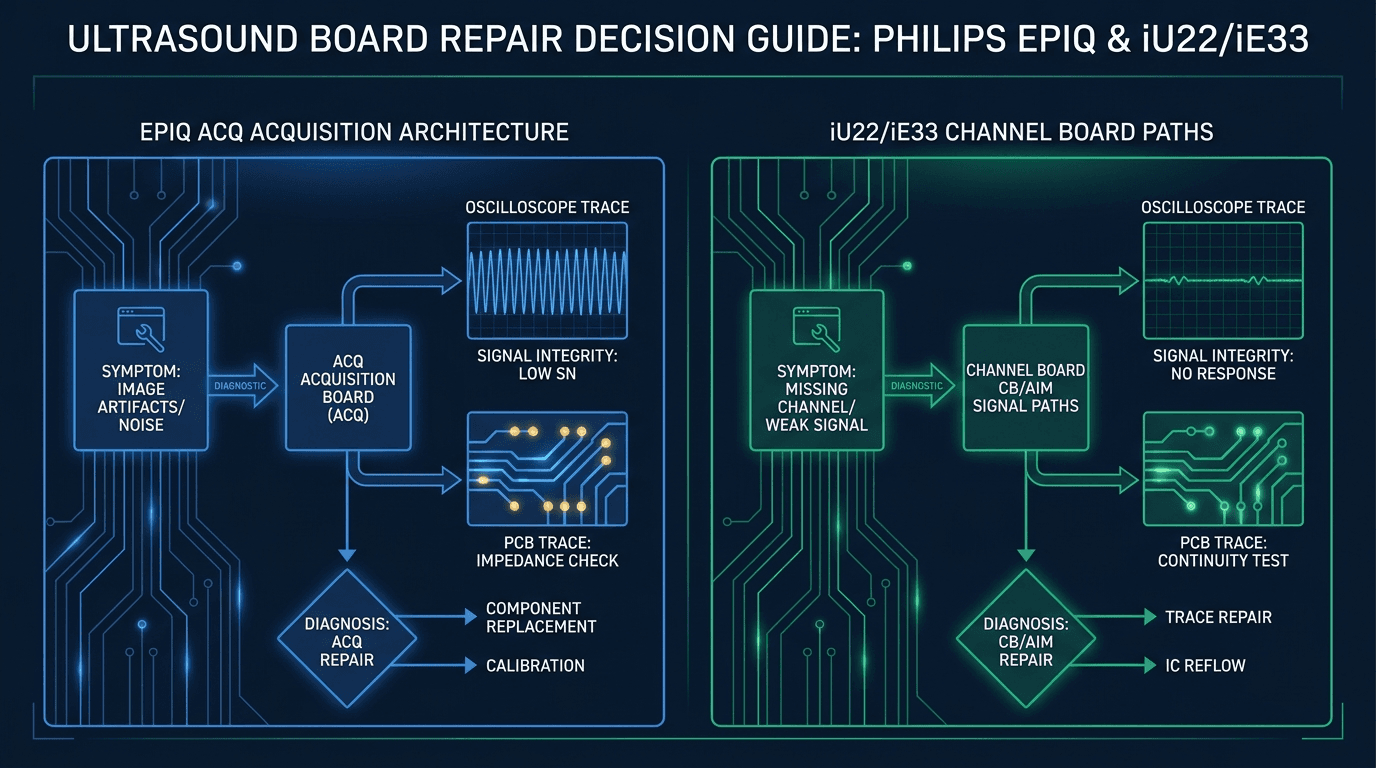
What does the iU22/iE33 versus EPIQ 5/7 platform split mean for parts and repairs?
In hospital biomedical engineering departments and independent service organizations (ISOs), Philips ultrasound systems represent some of the highest-utilization imaging assets in radiology, vascular labs, cardiology, and shared-service suites. While broad multi-brand diagnostics are outlined in our Philips board-level symptoms decision path and cardiovascular fleet patterns are explored in our GE Vivid E9/E80/E90/E95 board decision path, engineers frequently encounter a costly misconception: assuming that Philips modular architectures share interchangeability across eras 1.
In reality, Philips premium consoles sit across a defined generational divide verified by regulatory clearance history and underlying electronic architecture:
- The 2004-Era Legacy Platform (iU22 and iE33): Cleared initially under FDA 510(k) K042540 in October 2004 (with subsequent updates K093563 in 2010 and K130499 in 2013) 1, the iU22 (general imaging) — with its same-generation cardiac sibling, the iE33 (echocardiography) — utilizes a discrete sub-rack card cage architecture. This generation relies on dedicated Acquisition Interface Modules (AIM), Front End Controller (FEC) boards, multiple Channel Boards (CB), Digital Scan Converters (DSC), Advanced Video Input/Output (AVIO) boards, Unified or Excelsior Motherboards (UMB/EMB), and a modular primary power supply (such as 4535611151071 or 453561642151) 13 15.
- The 2013+ Modern Architecture (EPIQ 5, EPIQ 7, Elite, and CVx): Cleared initially under 510(k) K132304 in August 2013 by Philips Ultrasound, Inc., with named EPIQ 5 and EPIQ 7 configurations cleared from K160807 (April 2016) through K182857 (November 2018) 1, the EPIQ platform introduces the nSIGHT proprietary beamforming and processing topology 8. The EPIQ card cage eliminates legacy CB/FEC boards in favor of high-density Acquisition modules (ACQ-A and ACQ-B), dedicated Power Distribution Boards (PRB), Acquisition Control Boards (ACB), specialized Power Boards, and unified host computer cores 13.
Because backplane bus topologies, high-voltage rails, communication protocols, and physical form factors are completely distinct, no internal circuit board or power module crosses the iU22/iE33 to EPIQ platform boundary. However, as established in our inventory and legacy archives, cross-compatibility between the general-imaging iU22 and the cardiac iE33 is extensive within their shared generation 14 15.
| Primary Observed Symptom | Probable Subsystem / Board Family | EPIQ 5/7 Target Part & Revision | iU22 / iE33 Target Part & Revision | Initial Verification Gate |
|---|---|---|---|---|
| Total power blackout; no standby LEDs; system non-responsive to power switch | Main AC/DC Power Supply Unit (PSU) / AC Input | Power Supply 453561879752 / Power Board 453561803892 | Power Supply 4535611151071 / PSU 453561642151 | Verify wall AC outlet, line cord seated, internal breaker switch, and DC standby rail (+5VSB) |
| Standby power present; power button initiates startup but unit shuts down or boot-loops immediately | Power Distribution / PRB / DC Rail Short / Host PC | PRB Board 453561799432 / Power Board 453561803892 | PSU 4535611151071 / Motherboard UMB 453561254492 | Disconnect front-end card cage to isolate bus overload from PSU rail voltage collapse |
| Unexpected automatic reboot during active scanning or idle state | Software Patch / OS Kernel / Power Supply / Host PC | System Software / Host PC (Check Recall Z-1007-2026) | PC F-Version 453561604291 / PC-G 453561620091 | Check system software version against FDA recall Z-1007-2026 before condemning hardware |
| System hangs at startup progress bar; displays error 518 (iU22) or error 511 (EPIQ) dialog | Back-End Host PC / System Storage Drive (documented cases) | Host PC / Host PCBA 453561940503 (archive) | PC F-Version 453561604291 / System drive HDD0 (documented case) | Capture photo of exact error dialog and boot progress percentage; export the system error log; inspect drive cabling |
| No 2D ultrasound image on any probe; black active sector; UI and patient banner normal | Front-End Acquisition / Transmit Pulser / Channel Boards | ACQ-A 453561704246 / ACQ-B 453561798362 | CB F-Version 453561303331 / CB G-Version 453561386051 | Test multiple probe ports; confirm failure persists across convex, linear, and cardiac transducers |
| Vertical dark dropout bands or elevated noise streaks across all probes | Channel Board (CB) / Acquisition Channel Stage | ACQ-A 453561704246 / ACQ-B 453561798362 | Channel Boards (CB) 453561303331 / FEC 453561278267 | Swap probe to alternative port to isolate connector pin wear; verify high-voltage bias supplies |
| System freezes or locks up intermittently when exiting patient exams or QLAB analysis | Host Operating Software / Application Layer / RAM | Software Version (Check Recall Z-2483-2021) / Host PC | Host PC F/G Motherboard / Memory Modules | Verify software patch level (versions 5.0, 5.0.1, 5.0.2 subject to recall Z-2483-2021) |
| Operator control panel non-responsive; dead rotary knobs, trackball failure, or touch panel freeze | Control Panel Assembly / Trackball / USB Interface | Control Panel 453561773636A (catalog: A50/EPIQ B) | F-Version Control Panel 453561304221 / Numeric 453561278687 | Inspect USB harness; verify swivel-lock and panel mechanical fasteners per FDA arm recalls |
Source: Rongtao Medical Technical Service Archive & Documented Bench Repair Records, August 2026
Which board family does my EPIQ 5/7 symptom point to: acquisition (ACQ-A/ACQ-B), power (PSU/PRB), or back-end?
Troubleshooting an EPIQ console requires understanding how the nSIGHT front-end, distributed power architecture, and back-end computer interact. Rather than guessing, clinical engineering teams should route faults systematically through the platform's core functional domains 13.
1. Front-End Acquisition Domain (ACQ-A vs. ACQ-B): In the EPIQ architecture, acoustic beamforming, multi-channel transmission, and digital reception are consolidated into high-density Acquisition (ACQ) modules. As detailed in our comprehensive guide to beamformer and front-end board failure, when an image fault appears on only one probe or follows that probe between connector ports, the transducer or pin cartridge is at fault. When image blackout, vertical dropouts, or acoustic line jitter persist across all connected transducers, the front-end ACQ module has degraded 13.
Crucially, the EPIQ platform employs two distinct acquisition board tiers cataloged in the Rongtao parts system: ACQ-A (part number 453561704246) (catalog item) and ACQ-B (part number 453561798362) (catalog item) 13. The catalog treats these as separate hardware-revision part numbers, and neither the catalog nor the service archive asserts that the two versions are interchangeable. Engineers must read the exact 12-digit 4535 barcode label and match the version to the card-cage configuration before ordering.
2. Power Generation & Distribution Domain (PSU, Power Board, and PRB): Power issues on the EPIQ are distributed across three distinct assemblies rather than a single conventional power box 10 13:
- Main Power Supply Unit (PSU 453561879752): Converts incoming AC mains into regulated bulk DC voltages (catalog item). Total blackout or inability to generate primary DC rails isolates to this module 10 13.
- EPIQ Power Board (453561803892): Regulates intermediate DC rails, manages power sequencing, and communicates power telemetry to the host motherboard (catalog item) 10 13.
- Power Distribution Board (PRB 453561799432): The A-Version PRB routes regulated high-voltage and low-voltage power directly across the card cage backplane to the ACQ modules (catalog item) 13. Failures on the PRB often cause instantaneous shutdown when transitioning into high-power Color Doppler or 3D/4D acquisition modes.
For deeper diagnostic analysis on power topologies, refer to our reference guide on ultrasound power supply failure and boot loops.
EPIQ freezes or reboots by itself: board fault, power fault, or a known FDA-recalled software issue?
One of the most frequent and disruptive service calls on an EPIQ 5 or EPIQ 7 is an intermittent unexpected reboot during a clinical exam or a complete freeze when exiting an exam. Biomedical technicians often spend thousands of dollars replacing power supplies or host motherboards, only to find the intermittent symptom persists. In some instances, the symptom is governed by a documented FDA recall action — a software defect in one case, and a reboot condition associated with a specific transducer in another — rather than by failed hardware 2 3.
Mandatory Recall Diagnostic Gates:
- Unexpected Automatic Reboot Gate (FDA Recall Z-1007-2026): Initiated by Philips on July 14, 2022 (Completed; enforcement report Z-1007-2026 is a retroactive classification), this recall covers Philips EPIQ ultrasound systems used in conjunction with the X5-1c transducer that may experience an unexpected automatic reboot, resulting in damage to the transducer 2. Before ordering a new main power supply (453561879752) or PRB board (453561799432), verify the console's recall and corrective-action status from its service records.
- System Lock-Up on Exam Exit (FDA Recall Z-2483-2021): Initiated August 6, 2021 (Completed), Recall Z-2483-2021 covers EPIQ Diagnostic Ultrasound Systems operating software versions 5.0, 5.0.1, and 5.0.2 due to a software defect that can intermittently cause the system to lock up when exiting Review Mode while performing an exam 3. If the system freezes exclusively when ending exams or exiting Review Mode, this points directly to the software build rather than a physical memory or motherboard failure.
- Delayed-Image Gate on Software 10.0 (FDA Recall Z-0283-2024): Initiated October 9, 2023 (Completed), Recall Z-0283-2024 covers EPIQ 5G, 5W, 7G, 7C, 7W, CVx and Elite systems operating software version 10.0, which may present a delayed image instead of a real-time image 4.
For broader fleet-wide regulatory methodologies, review our FDA ultrasound recall failure-mode analysis and our published MAUDE malfunction database methodology. FDA recall records reflect discrete enforcement actions and regulatory reporting, not device incidence or comparative safety metrics. However, verifying recall status prevents unwarranted hardware swaps on systems requiring software remediation 2 3.
iU22 boot hang with error 518 (or EPIQ error 511): what do these dialogs mean and what evidence should I capture?
Startup error dialogs are among the most common failure presentations documented across the Rongtao legacy service archive. Two prominent error presentations frequently encountered are the iU22 Error 518 and the EPIQ Error 511 dialogs 15.
1. The iU22 Error 518 Boot Hang: In real-world service records, including our documented iU22 boot error 518 repair note and unanswered discussions in the MedWrench service community, the system powers on, reaches the loading scroll-bar screen, remains there for roughly 30 seconds, and then presents a modal dialog stating "Error 518" — the operator can dismiss it or enter settings, but cannot reach the system's operating interface, and restarting does not clear the fault 15 16.
The documented case history matters for routing. In the archived repair note, the service engineer exported the system error log from the settings interface, and analysis with Philips special software traced the fault to a corrupted system file set on the host computer — the console was recovered by rebuilding the system on a replacement system drive (the iU22 carries three drives: HDD0 as the system drive, HDD1/HDD2 for image storage, with a follow-up 602 code if the software and sub-disk codes do not match) 15. So on an iU22 error-518 boot hang, the first evidence gate is the exported error log plus the host PC (PC F-Version 453561604291) and its storage — front-end boards such as the AIM 453561279498 or DSC 453561233805 13 become suspects only if the back-end checks out. Treat this as a documented symptom record with a back-end-first routing, not a universal code-to-board mapping.
2. The EPIQ Error 511 Dialog: Documented in our service archive under EPIQ 7 error 511 analysis, the archived case followed two sudden power cuts during use: on restart, the display stayed on the PHILIPS boot screen for an extended period and the console finished at an error-511 dialog, unusable 15. The documented isolation path is instructive: the BIOS power-on self-test covers the front end, and with the ACQ and power-regulation boards unplugged from the back-end PC (all front-end load removed), the fault persisted — localizing it to the back-end PC section, not the ACQ acquisition modules 15. Related startup-delay notes (our EPIQ 7C slow startup note and EPIQ crash troubleshooting note) similarly point first at peripheral initialization and the PC/storage side rather than the front end 15.
Required Evidence Capture Checklist Before Service Dispatch:
- Photograph the exact error dialog on the main monitor, capturing the complete alphanumeric error code, sub-code numbers, and background UI state.
- Record the exact percentage or visual milestone where the boot progress bar halts (e.g., BIOS screen, OS splash screen, or ultrasound application load).
- Export and back up the system error log file to an external USB drive if the diagnostic service desktop is accessible.
- Check whether all internal cooling fans are spinning and whether any front-end card-cage status LEDs show amber/red fault conditions.
Image dropout across all probes on an iU22: CB or FEC channel boards, probe, or port — and which F/G version?
Image quality degradation on an iU22 or iE33 typically presents as dark vertical acoustic dropouts, weak penetration, or severe image noise. Applying the diagnostic protocol from our framework on probe versus scanner artifact diagnosis, technicians must systematically isolate the failure before ordering boards 13.
Step 1: The Probe vs. Console Isolation Gate: Connect the primary transducer to Port 1 and observe the artifact. Move the transducer to Port 2 and Port 3. If the dropout disappears on alternative ports, the fault is isolated to damaged receptacle pins or multiplexer relays on that specific probe connector board. Connect a completely different transducer family (e.g., linear L12-5 vs. convex C5-2). If the identical vertical dropout pattern persists across all probes and ports, the fault is inside the console's front-end card cage 13.
Step 2: Front-End Architecture (CB vs. FEC vs. AIM): The iU22 card cage distributes acoustic processing across multiple dedicated boards:
- Channel Boards (CB): Multiple Channel Boards operate in parallel to handle analog acoustic transmit pulsing and multi-channel receive amplification. Individual channel component failure on a CB results in dark vertical scan-line dropouts across the 2D sector 13.
- Front End Controller (FEC 453561278267): Coordinates timing, master clocking, and beamformer synchronization across all installed Channel Boards (catalog item) 13.
- Acquisition Interface Module (AIM 453561279498): Provides the high-speed data interface bridging the front-end acquisition card cage to the back-end computer (catalog item) 13.
Step 3: The Critical F-Version vs. G-Version Hardware Gate: On the iU22, Channel Boards and host PC modules exist in major hardware revision tiers that must not be mixed 13:
- F-Version Hardware: Channel Board F-Version 453561303331 (catalog item) pairs with the F-Version host computer 453561604291 (catalog item) and F-Version control panel 453561304221 (catalog item) 13.
- G-Version Hardware: Channel Board G-Version 453561386051 (catalog item) and 453561386053 (catalog item) reflect the updated G-cart revision 13.
The catalog lists F- and G-version Channel Boards as separate part numbers, and no catalog or archive record supports mixing the two tiers within one card cage. Always read the 12-digit 4535 part number and revision letter directly from the board's barcode label, match the tier, and verify against the cart configuration before ordering.
Which iU22 boards cross-fit the iE33 — and which never cross to the EPIQ?
For biomedical engineering teams managing mixed multi-system fleets, understanding shared hardware between the iU22 and iE33 unlocks critical spare-parts flexibility and extends clinical uptime for legacy systems 13 14. Independent training curricula and technical service guides across the biomedical industry treat the iU22 and iE33 as a unified hardware training pair precisely because their core sub-racks share interchangeable components 11.
| Board Designation | Catalog / Archive Part Number | Supported Platform Models | Hardware Role & Architecture | Cross-Platform Compatibility Rule |
|---|---|---|---|---|
| ACQ-A Acquisition Module | 453561704246 | EPIQ (EPIQ 5, EPIQ 7) | High-density front-end acquisition and beamforming module (A-Tier) | EPIQ platform only. Do not interchange with ACQ-B or install into iU22/iE33. |
| ACQ-B Acquisition Module | 453561798362 | EPIQ (EPIQ 5, EPIQ 7) | Updated high-density acquisition and beamforming module (B-Tier) | EPIQ platform only. Must match ACQ card cage revision tier. |
| EPIQ PRB Power Board | 453561799432 | EPIQ A-Version | Power distribution board routing card-cage high/low voltage rails | EPIQ platform only. Catalogued for EPIQ A-Version. |
| EPIQ Main Power Supply | 453561879752 | EPIQ 5, EPIQ 7 | Main AC/DC power supply assembly converting line power | EPIQ platform only. Distinct form factor and voltage rails from legacy PSU. |
| ACB B-Version Board | 453561777664 | EPIQ / A70 (catalog row) | Acquisition Control Board managing backplane communication | Catalog models this row as "EPIQ/A70"; a cross-line candidate to verify by console configuration. |
| Channel Board (CB) F-Version | 453561303331 | iU22 F-Version | Multi-channel transmit pulser and receive amplifier board | iU22 F-tier. Does not fit EPIQ. iE33 CB sharing is documented at family level — verify per label. Do not mix with G-Version CB. |
| Channel Board (CB) G-Version | 453561386051 / 453561386053 | iU22 (G-tier catalog rows) | Updated channel board for G-tier systems | iU22 G-tier. Does not fit EPIQ. iE33 CB sharing is documented at family level (see CB 453561303902) — verify per label. |
| Channel Board Shared Stock | 453561303902 | iU22 / iE33 | Channel board catalogued explicitly under shared model designation | Catalog and inventory verified shared board across iU22 and iE33. |
| Front End Controller (FEC) | 453561278267 | iU22, iE33 | Master front-end timing and beamformer control board | Shared across iU22 and iE33 legacy platforms. Does not fit EPIQ. |
| Acquisition Interface (AIM) | 453561279498 | iU22, iE33 | High-speed bus interface bridging front end to back end | Shared across iU22 and iE33 legacy platforms. Does not fit EPIQ. |
| Digital Scan Converter (DSC) | 453561233805 | iU22, iE33 | Image coordinate scan conversion and raster formatting board | Shared across iU22 and iE33 legacy platforms. Does not fit EPIQ. |
| Advanced Video I/O (AVIO) | 453561278213 | iU22, iE33 | Video distribution and external display interface board | Shared across iU22 and iE33 legacy platforms. Does not fit EPIQ. |
| Host PC F-Version | 453561604291 | iU22 F-Version | Host computer assembly for F-Cart systems | iU22 F-Cart specific. Verify software build and cart revision. |
| Legacy Power Supply Unit | 4535611151071 / 453561642151 | iU22, iE33 | Main system power supply assembly for legacy card cage | Shared across iU22 and iE33 carts. Does not fit EPIQ. |
Source: Rongtao Medical Parts Catalog & Historical Service Archive, August 2026
As established in Table 2, the iU22 and iE33 share nearly their entire front-end card cage (AIM, CB, FEC, DSC) and power supply architecture 11 13 14 15. However, none of these modules cross into the EPIQ platform. One verification rule applies throughout: iU22↔iE33 sharing is documented at board-family level in the service archive and, for CB 453561303902, in a current inventory row — it is not a per-part-number guarantee, so verify every unit by its 4535 label before ordering.
| Major Assembly / Board Group | iU22 Status (2004-2013) | iE33 Shared Status (2004-2013) | EPIQ 5/7 Status (2013-2026+) | Engineering Verification Rule |
|---|---|---|---|---|
| Channel Boards (CB) | F/G-Version CB (453561303331 / 453561386051) | Shared (CB 453561303902) | Incompatible (Replaced by ACQ-A/B) | Shared between iU22/iE33; never crosses to EPIQ |
| Front End Controller (FEC) | FEC 453561278267 | Shared (FEC 453561278261/267) | Incompatible (Integrated into ACQ) | Shared between iU22/iE33; never crosses to EPIQ |
| Acquisition Interface (AIM) | AIM 453561279498 | Shared (AIM 453561210221/241) | Incompatible (absorbed into the EPIQ ACQ/host architecture) | Shared between iU22/iE33; never crosses to EPIQ |
| Scan Converter (DSC) | DSC 453561233805 | Shared (DSC 453561233804/805) | Incompatible (Software scan conversion) | Shared between iU22/iE33; never crosses to EPIQ |
| Video Interface (AVIO) | AVIO 453561278213 | Shared (AVIO family) | Incompatible (Dedicated EPIQ Video I/O) | Shared between iU22/iE33; never crosses to EPIQ |
| Main Power Supply Unit | PSU 4535611151071 | Shared (PSU 453561642151) | Incompatible (PSU 453561879752) | Shared between iU22/iE33; completely distinct from EPIQ |
| Power Distribution (PRB) | Not used (Legacy backplane) | Not used (Legacy backplane) | PRB 453561799432 | EPIQ platform specific; no legacy equivalent |
| Control Panel Assembly | Control Panel 453561304221 | Cart-specific layout | Control Panel 453561773636A (catalog: A50/EPIQ B) | Distinct mechanical and electrical interfaces per platform |
Source: Rongtao Medical Engineering Ground Truth, August 2026
Control panel dead zones, trackball faults and the panel-arm recalls: panel assembly, cable, or CB board?
The ultrasound operator control panel is subject to continuous mechanical wear, transducer gel contamination, and cable flexing. When an operator reports dead keys, intermittent trackball tracking, or frozen TGC slider response, clinical engineers must systematically differentiate between user-interface hardware, internal USB harnesses, and articulating arm safety issues 5 13.
1. Mandatory Physical Safety Gate — EPIQ Control Panel Arm Recalls: Before undertaking electrical troubleshooting or removing plastics on an EPIQ control panel, clinical engineers must verify the physical integrity of the articulating arm assembly under three documented FDA recall actions 5:
- Swivel-Lock Failure Risk (FDA Recall Z-2306-2021): Initiated July 22, 2021 (Completed), covering EPIQ Elite, EPIQ 5G, EPIQ 5C, EPIQ 5W, EPIQ 7G, EPIQ 7C, EPIQ 7W, and CVx/CVxi models due to potential failure of the control panel arm swivel lock, which could allow unexpected arm rotation during transit or positioning 5.
- Missing or Loose Arm Screws (FDA Recall Z-0947-2021): Initiated December 24, 2020 (Terminated), covering EPIQ control panel arm assemblies that could have missing or loose screws 5.
- Panel Fastener Loosening (FDA Recall Z-1380-2016): Initiated March 28, 2016 (Terminated), covering fasteners securing the control panel assembly to the base 5.
Service personnel must verify that all arm structural fasteners and swivel-lock mechanisms are intact and secure before performing bench servicing or releasing the machine to clinical service 5.
2. Electrical & Interface Diagnosis: As a catalog example in the EPIQ family, Rongtao stocks the Control Panel with Gain Keyboard 453561773636A (catalogued for A50/EPIQ B) 13. On the iU22, the user interface includes the F-Version Control Panel 453561304221 and Numeric Keyboard 453561278687 13. If the entire panel loses power, check the 5V/12V DC power harness from the host PC. If individual rotary encoders or trackball axes fail, targeted component rebuild or trackball module exchange preserves the original console calibration at a fraction of full assembly cost.
iU22/iE33 end-of-life: repair the board, buy a tested replacement, or plan migration to EPIQ?
Healthcare facilities and imaging centers operating mature iU22 and iE33 fleets face critical lifecycle decisions when major hardware fails. Service-industry retrospectives document that Philips designated the early A, B, and C cart revisions of the iU22 and iE33 as End of Life on December 31, 2021 12, and Philips public portals host legacy DICOM conformance statements dating back to 2010-2012 9. Meanwhile, the EPIQ platform remains actively cleared with 510(k) clearances continuing through May 2026 (such as K260680 and K260123) 1.
| 510(k) Number | Decision Date | Applicant Name | Listed Platform / Device Name | Platform Architecture Relevance |
|---|---|---|---|---|
| K042540 | 2004-10-04 | Philips Ultrasound, Inc. | Philips iU22 Diagnostic Ultrasound System | Original 510(k) clearance establishing the legacy iU22 sub-rack architecture |
| K093563 | 2010-02-01 | Philips Ultrasound, Inc. | Philips iU22 Ultrasound System | Mid-lifecycle clearance supporting updated F-Cart revisions |
| K130499 | 2013-06-18 | Philips Ultrasound, Inc. | Philips iU22 Ultrasound System | Final recorded iU22 clearance prior to commercial platform transition |
| K132304 | 2013-08-21 | Philips Ultrasound, Inc. | EPIQ Diagnostic Ultrasound System | Original 510(k) clearance establishing the modern EPIQ architecture |
| K160807 | 2016-04-06 | Philips Ultrasound, Inc. | EPIQ 5 and EPIQ 7 Diagnostic Ultrasound Systems | Explicit clearance defining the EPIQ 5 and EPIQ 7 model configurations |
| K163120 | 2017-01-10 | Philips Ultrasound, Inc. | EPIQ Diagnostic Ultrasound System Series | Platform update expanding transducer and feature support |
| K172607 | 2017-10-04 | Philips Health Care | EPIQ 5 and EPIQ 7 Diagnostic Ultrasound Systems | System enhancements across general and cardiovascular imaging |
| K181485 | 2018-07-27 | Philips Ultrasound, Inc. | EPIQ, EPIQ 5, EPIQ 7, Affiniti 30/50/70 Systems | Combined clearance reflecting shared architecture with Affiniti line |
| K182857 | 2018-11-09 | Philips Ultrasound, Inc. | EPIQ, EPIQ 5, EPIQ 7, Affiniti 30/50/70 Systems | Consolidated hardware and software feature clearance |
| K260680 / K260123 | 2026-05-27 | Philips Ultrasound, LLC | EPIQ Series Diagnostic Ultrasound Systems | Demonstrates continuous active regulatory clearance through 2026 |
Source: U.S. FDA 510(k) Database via OpenFDA Records, Computed August 2026
For strategic fleet planning and parts harvesting across mature multi-brand platforms, explore our dedicated framework on ultrasound end-of-service critical spares.
| Recall RES Number | Initiation Date | Recall Status | Recalled Platform / Component | Documented Defect / Failure Mode | Pre-Service Verification Gate |
|---|---|---|---|---|---|
| Z-1007-2026 | 2022-07-14 | Completed | Philips EPIQ Ultrasound Systems used with the X5-1c transducer | Unexpected automatic reboot resulting in damage to the transducer (retroactively classified) | Verify console recall and corrective-action status before diagnosing power supply or board hardware failure |
| Z-2483-2021 | 2021-08-06 | Completed | EPIQ Diagnostic Ultrasound (Software 5.0, 5.0.1, 5.0.2) | Intermittent system lock-up when exiting Review Mode during an exam | Verify software release before condemning host PC motherboard or RAM |
| Z-0283-2024 | 2023-10-09 | Completed | Philips EPIQ 5G/5W, 7G/7C/7W, CVx, Elite (software 10.0) | System may present a delayed image instead of a real-time image | Confirm software 10.0 remediation status on affected model variants |
| Z-2306-2021 | 2021-07-22 | Completed | EPIQ Elite, 5G, 5C, 5W, 7G, 7C, 7W, CVx, CVxi | Control panel arm swivel lock failure risk during transit | Inspect mechanical swivel-lock mechanism before physical console movement |
| Z-0947-2021 | 2020-12-24 | Terminated | Philips EPIQ Diagnostic Systems (Elite, 5G/5C/5W, 7G/7C/7W, CVx, CVxi) | Control panel arm assembly missing or loose screws | Check all articulating arm structural screws during routine preventative maintenance |
| Z-1380-2016 | 2016-03-28 | Terminated | EPIQ 5C, 5G, 5W, 7C, 7GC, 7W Systems | Fasteners securing control panel assembly to base | Verify control panel base mounting bolt torque and integrity |
| Z-0422-2007 | 2006-11-02 | Terminated | Philips iE33 Ultrasound System (with S12-4 transducer, CW mode) | Acoustic output intensity and patient-contact temperature exceeding limits | Historical acoustic-safety calibration gate, not a console-board fault |
| Z-1841..1844-2020 | 2019-08-30 | Terminated | Philips S7-3t and S8-3t TEE Transducers | Distal-tip temperature measurement defect from manufacturing programming | Isolate TEE probe defects from console front-end channel failures |
Source: U.S. FDA Medical Device Recalls Database, Computed August 2026
What safety and recall gates must I check before Philips console or probe servicing?
Clinical engineering protocols require rigorous pre-service safety checks before connecting power, opening sub-racks, or replacing modules on Philips equipment. As detailed in Table 5, regulatory recall records provide essential safety gates that must be cleared prior to service 2 5 6 7.
1. Transducer vs. Console Safety Separation: When troubleshooting image noise or thermal warnings in cardiac studies, technicians must differentiate between console channel degradation and transducer-specific defects. FDA Recalls Z-1841 through Z-1844-2020 (S7-3t and S8-3t TEE transducers with distal-tip temperature-measurement defects) 7 and Recall Z-2517-2023 (3D9-3v transducer bonding) 7 are probe-side actions: the defect sat in the transducer assembly, not the console. Separately, the historical iE33 recall Z-0422-2007 concerns system acoustic-output and patient-contact temperature limits with the S12-4 transducer in CW mode 6 — an acoustic-safety calibration gate rather than a console-board fault. TEE probes exhibiting casing cracks, articulation play, or electrical leakage must be routed immediately to our specialized probe repair facility.
2. Electrical Safety & High-Voltage Discharge: Power supply units (PSU 453561879752 on EPIQ; PSU 4535611151071 on iU22) contain high-capacity filter capacitors that store lethal energy after AC disconnection. Technicians must follow the OEM service manual's stated discharge procedure for the specific supply and verify zero residual voltage before touching internal power terminals or removing modules.
| Catalog Item Link | Platform / Model | Part Description & Label Identifier | Manufacturer Part Number | Typical Service Terms |
|---|---|---|---|---|
| epiq-acq-a-453561704246 | Philips EPIQ | ACQ-A Acquisition Board 453561704246 | 453561704246 | Typical 5-8 business-day repair · typical 90-day warranty |
| epiq-acq-b-453561798362 | Philips EPIQ | ACQ-B Acquisition Board 453561798362 | 453561798362 | Typical 5-8 business-day repair · typical 90-day warranty |
| epiq-power-board-453561803892 | Philips EPIQ | Power Board 453561803892 | 453561803892 | Typical 5-8 business-day repair · typical 90-day warranty |
| epiq-power-supply-453561879752 | Philips EPIQ | Main Power Supply 453561879752 | 453561879752 | Typical 5-8 business-day repair · typical 90-day warranty |
| epiq-a-version-prb-power-distribution-board-453561799432 | Philips EPIQ A-Version PRB | Power Distribution Board 453561799432 | 453561799432 | Typical 5-8 business-day repair · typical 90-day warranty |
| epiq-a70-acb-b-version-453561777664 | Philips EPIQ / A70 | ACB B-Version Board 453561777664 | 453561777664 | Typical 5-8 business-day repair · typical 90-day warranty |
| iu22-aim-453561279498 | Philips iU22 / iE33 | AIM Acquisition Interface Module 453561279498 | 453561279498 | Typical 5-8 business-day repair · typical 90-day warranty |
| iu22-avio-453561278213 | Philips iU22 / iE33 | AVIO Advanced Video I/O Board 453561278213 | 453561278213 | Typical 5-8 business-day repair · typical 90-day warranty |
| iu22-dsc-453561233805 | Philips iU22 / iE33 | DSC Digital Scan Converter 453561233805 | 453561233805 | Typical 5-8 business-day repair · typical 90-day warranty |
| iu22-fec-453561278267 | Philips iU22 / iE33 | FEC Front End Controller Board 453561278267 | 453561278267 | Typical 5-8 business-day repair · typical 90-day warranty |
| iu22-f-version-cb-453561303331 | Philips iU22 F-Version / iE33 | CB Channel Board F-Version 453561303331 | 453561303331 | Typical 5-8 business-day repair · typical 90-day warranty |
| iu22-g-version-cb-453561386051 | Philips iU22 G-Version / iE33 | CB Channel Board G-Version 453561386051 | 453561386051 | Typical 5-8 business-day repair · typical 90-day warranty |
| iu22-g-cb-453561386053 | Philips iU22-G / iE33 | CB Channel Board 453561386053 | 453561386053 | Typical 5-8 business-day repair · typical 90-day warranty |
| iu22-pc-f-version-453561604291 | Philips iU22 F-Version | Host PC F-Version Assembly 453561604291 | 453561604291 | Typical 5-8 business-day repair · typical 90-day warranty |
| iu22-power-supply-4535611151071 | Philips iU22 / iE33 | Power Supply Assembly 4535611151071 | 4535611151071 | Typical 5-8 business-day repair · typical 90-day warranty |
| iu22-f-version-control-panel-453561304221 | Philips iU22 F-Version | F-Version Control Panel 453561304221 | 453561304221 | Typical 5-8 business-day repair · typical 90-day warranty |
Source: Rongtao Medical Verified Inventory and Parts Catalog, August 2026
The service terms in Table 6 reflect typical depot board-repair turnaround (5-8 business days) and standard 90-day warranty coverage for this product line; final terms depend on the specific part and service agreement and must be confirmed per case. Catalog listings establish part identity and platform context — current stock availability routes directly to the live catalog and quote flow 13.
| Decision Pathway | Best Clinical & Operational Fit | Key Advantages | Primary Risks & Limitations | Recommended Action Trigger |
|---|---|---|---|---|
| Component-Level Board Repair | Single-board failures on active EPIQ systems or legacy iU22/iE33 (e.g., ACQ channel faults, PSU rail capacitor degradation, AIM bus timing) | Lower cost than a new OEM assembly (final economics confirmed per board at quote); preserves original system calibration and firmware pairing | Requires 5-8 business-day turnaround time; board substrate must not have severe PCB charring or unrepairable ASIC internal shorts | Select when facility has secondary backup scanners and preserving operational capital is paramount |
| Tested Replacement Board Exchange | Acute clinical downtime on high-volume EPIQ consoles; catastrophic power supply blowout; physical connector trace damage | Fastest restoration when pre-tested inventory is in stock; 100% pre-tested on live ultrasound machines before dispatch | Higher initial part acquisition cost than repair; requires rigorous 12-digit 4535 part number and revision letter matching | Select when clinical exam backlog cannot tolerate depot repair turnaround and matching tested unit is ready to ship |
| Platform Migration (iU22/iE33 to EPIQ) | Aging 15+ year old iU22/iE33 fleets suffering multi-subsystem cascading failures across power, host PC, and front-end card cage | Upgrades facility to modern nSIGHT processing, enhanced frame rates, advanced matrix probes (X5-1, X6-1), and active OEM software support | Substantial capital equipment expenditure; requires clinical staff retraining and replacement of legacy transducer inventory | Select when cumulative annual maintenance and board-replacement spend on an iU22/iE33 approaches the acquisition cost of a pre-owned EPIQ-class system |
Source: Rongtao Medical Strategic Service Consulting Framework, August 2026
Where does Rongtao fit — and where does it not?
Clear boundaries protect clinical engineering integrity and patient safety. Rongtao Medical operates as an independent, certified medical equipment engineering center specializing in component-level PCB repair, tested parts harvesting, and transducer rebuilding 13.
Where Rongtao Fits:
- Component-Level Board Repair: Precision depot diagnostics and micro-soldering rework for Philips EPIQ front-end boards (ACQ-A, ACQ-B), power supplies (453561879752), PRB boards, and legacy iU22/iE33 modules (AIM, CB, FEC, DSC, AVIO, PSU).
- Tested Replacement Assemblies: Pre-tested replacement boards with verified 4535 part numbers and revisions, backed by standard 90-day warranties with extended terms available upon request.
- 48-Hour Live Machine Validation: Every repaired board undergoes a minimum 48-hour continuous stress test inside an actual ultrasound console before release — real-machine validation, not bench-only simulation.
- Transducer & Probe Repair: Comprehensive evaluation and repair for Philips standard sector, convex, linear, and transesophageal (TEE) probes via our dedicated probe repair facility.
Where Rongtao Does Not Fit:
- Authorized OEM Representation: Rongtao Medical is an independent service provider and is not an authorized sales representative or distributor for Philips HealthCare. OEM trademarks are used strictly for equipment identification.
- Proprietary Software Licensing & Option Keys: We do not generate, alter, or transfer proprietary Philips software option keys or QLAB clinical licenses. Software options must be procured through official Philips channels.
- On-Site Hospital Field Troubleshooting: Rongtao operates specialized centralized depot repair centers. We do not dispatch field service engineers for bedside hospital service calls.
What information makes a quote-ready Philips board repair or replacement intake?
To ensure fast turnaround, exact pricing, and unambiguous hardware revision matching, biomedical engineers and procurement teams should provide a complete technical intake package when submitting a repair or replacement request 13.
- Exact Ultrasound Platform & Model: Specify Philips EPIQ 5, EPIQ 7, EPIQ Elite, EPIQ CVx, or legacy iU22 / iE33, including cart hardware revision (e.g., F-Cart or G-Cart) and installed software release level if known.
- Target Board Name & 12-Digit Part Number: Provide the exact part number from the barcode label (e.g., 453561704246 for ACQ-A; 453561798362 for ACQ-B; 453561303331 for iU22 F-Version CB; 453561879752 for EPIQ PSU) along with all revision suffix letters.
- High-Resolution Photographs of Both Sides: Attach clear photos of both the component side and solder side of the circuit board, specifically capturing the barcode label, revision stickers, connector pins, and any visible thermal discoloration or damaged components.
- Detailed Symptom Narrative & Error Screenshots: Describe the exact failure presentation (e.g., total blackout, unexpected reboot, Error 518 on boot, Error 511 on EPIQ, all-probe image dropout, or dead control panel) and include photographs of system error dialogs or log exports.
- Service Type, Quantity & Destination: Indicate whether you require component-level depot repair of your existing board or supply of a tested replacement unit, along with the quantity and destination postal code for shipping calculation.
Before ordering or shipping assemblies, follow our standardized protocols in ultrasound board part-number verification and acceptance. Clinical engineering teams standardizing repair vendor evaluations across multi-vendor fleets should utilize our multi-brand ultrasound board repair RFQ template to define explicit testing, warranty, and turnaround criteria.
Explore our live inventory in the parts catalog, review our certified quality assurance standards, or submit your board details directly through our technical service intake form to receive a rapid quote.
Frequently Asked Questions
Is the Philips EPIQ 5/7 still a supported platform?
Yes. The Philips EPIQ series remains an actively cleared and widely supported premium ultrasound platform. Regulatory records from the openFDA 510(k) database show continuous clearances from K132304 (August 2013) through clearances in May 2026 (such as K260680 and K260123) 1. Both OEM channels and independent engineering facilities like Rongtao Medical maintain comprehensive component-level repair and tested parts support for the EPIQ family.
Are ACQ-A and ACQ-B acquisition boards interchangeable on the EPIQ?
No. ACQ-A (part number 453561704246) and ACQ-B (part number 453561798362) are cataloged as two distinct hardware tiers within the EPIQ front-end architecture, and no catalog or archive record supports cross-version interchange 13. Installing an ACQ-A into a card cage configured for ACQ-B (or vice versa) puts the system into an untested configuration. Always match the exact 12-digit 4535 part number and revision from the barcode label.
What is a PRB board on a Philips EPIQ?
The PRB is the Power Distribution Board (cataloged as A-Version PRB 453561799432) on the Philips EPIQ platform 13. It acts as the intermediate power management and distribution layer between the main AC/DC power supply (453561879752) and the front-end acquisition card cage, regulating and routing high-voltage transducer bias rails and low-voltage digital rails across the system backplane.
What does error 518 mean on a Philips iU22?
On the Philips iU22, Error 518 is a documented startup failure dialog: the console stays on the scroll-bar boot screen, shows the dialog after roughly 30 seconds, and cannot reach the operating interface 15 16. In the archived case, analysis of the exported error log traced the fault to corrupted system files on the host computer, and the console was recovered by rebuilding the system drive — so route this symptom to the back-end host PC (e.g., PC F-Version 453561604291) and its storage first 13 15. It is a documented symptom record, not a guaranteed code-to-board mapping; capture the dialog and the exported log before dispatch.
Can I use an iU22 board in an iE33 (or the reverse)?
Yes, for the majority of front-end and power assemblies. The general-imaging iU22 and cardiovascular iE33 share extensive hardware architecture: Channel Boards (e.g., CB 453561303902 modeled as "IU22/IE33" in inventory), Front End Controllers (FEC 453561278267), Acquisition Interface Modules (AIM 453561279498), Digital Scan Converters (DSC 453561233805), and main power supplies (4535611151071 / 453561642151) are shared 11 13 14 15. However, cart-specific assemblies like operator control panels and host software builds are model-specific.
My EPIQ reboots randomly — should I replace the power supply first?
Not before checking software recall status. Under FDA Recall Z-1007-2026, Philips EPIQ systems were subject to a corrective action addressing an unexpected automatic reboot defect 2. Always verify that your console has received the appropriate software patch before condemning the main power supply (453561879752) or PRB board (453561799432).
What is the difference between iU22 F-version and G-version boards?
F-version and G-version represent major hardware revisions of the iU22 cart architecture. F-Version Channel Boards (453561303331) pair with F-Version host computers (453561604291) and F-Version control panels (453561304221), while G-Version Channel Boards (453561386051 / 453561386053) belong to the updated G-tier architecture 13. The catalog keeps the tiers as separate part numbers and no record supports mixing them within one card cage — match the tier from the label and verify per case before ordering.
What should I send with a Philips board for repair or exchange — and what turnaround and warranty apply?
Submit the exact 12-digit 4535 part number, high-resolution photos of both sides of the board (capturing barcode labels and connector pins), a description of the observed symptom or error code dialog, and your shipping destination 13. Typical board-repair turnaround is 5-8 business days with standard 90-day warranty coverage, with final terms confirmed per case 13 14.