
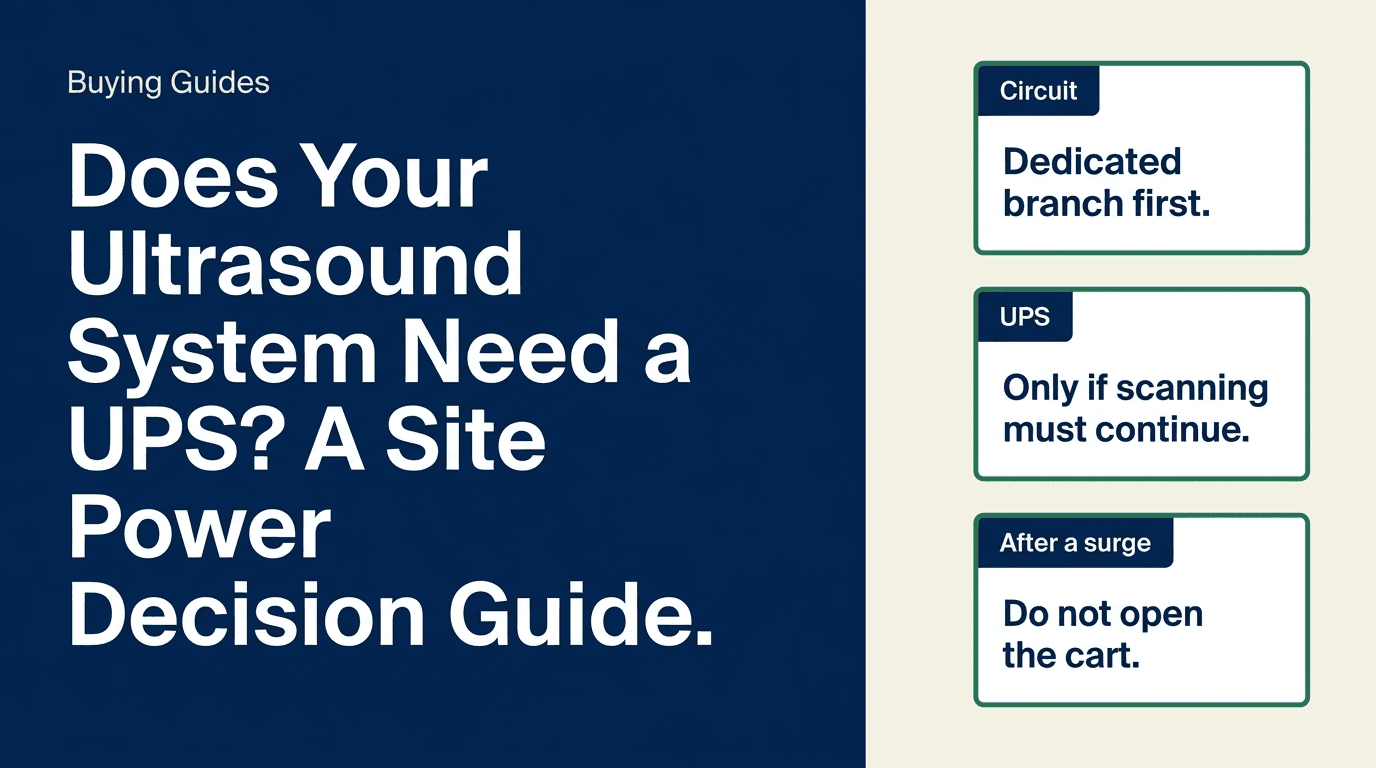
What do ultrasound site-prep documents actually require?
Seller pages for “UPS for ultrasound” usually start with a product topology. The installation documents start somewhere else: the branch circuit, the outlet, and the cord. A battery cabinet downstream of a shared circuit does not satisfy those sentences. Pull the sheet for the serial number you are installing. GE’s site-planning hub is the distribution point for family PDFs, and the two sheets below are not a substitute for a Venue, Versana, or Vivid sheet you have not read. 1
The Voluson E6/E8/E10 US site-preparation PDF, read on 25 September 2026, prints the electrical window as 100–240 VAC ±10% at 50/60 Hz ±2%, and power consumption as 800 VA including all on-board peripherals. It requires a dedicated AC outlet within reach of the unit without extension cords, and a dedicated single branch circuit. The reason on the sheet is circuit overload and possible loss of critical-care equipment: do not run any other equipment on that circuit. The room-layout legend calls for that outlet to be circuit-breaker protected and easily accessible. The same sheet recommends combination dim and bright lighting, and it warns that lighting controls and dimmers can be a source of EMI which could degrade image quality. It does not describe the artifact shape. 2
The LOGIQ S7 US site-preparation PDF uses the same dedicated-outlet and single-branch language, including the breaker-protected outlet and the dimmer warning. Its voltage window is not the Voluson wide-range line. It prints 100–120 VAC ±10% at 7.0–9.0 A, or 220–240 VAC ±10% at 3.7–4.0 A, both at 50/60 Hz ±2%, and 900 VA. On inrush, the sheet says inrush current is not a factor because of the inrush-current-limiting properties of the power supplies. That sentence is about the LOGIQ S7 supplies. It is not a reason to put a different console on an undersized breaker. 3
Philips states the EPIQ 7 rules in the user manual, document 4535 617 25341, not in a GE-style one-page site sheet. The specifications section prints AC voltage 100–240 V~, 50 or 60 Hz, and 600 VA. It does not print a ±10% tolerance or a ±2% frequency window in that section. Power must come from a grounded outlet. In the United States it must be a grounded hospital-grade outlet. A warning says never to connect the system power cord to a power strip or an extension cord, and to plug the cord directly into a grounded wall outlet, because of shock risk. A separate caution says that for optimal performance the system should be on a circuit dedicated solely to it, and that life-support devices should not share that circuit. That is a performance caution plus a life-support separation rule. GE’s site sheets use a stricter “no other equipment” mandate. The table keeps the two wordings apart. 4
The LOGIQ P5/A5/A5 Pro quick guide, Direction 5137113-100 Rev. 3, prints two plug configurations: 100–120 VAC at 950 VA, and 220–240 VAC at 950 VA. It does not print ±10% or ±2% on that figure, and it does not print the dedicated-branch paragraph used on the Voluson and LOGIQ S7 sheets. What it does print is a hospital-grade grounding outlet, a ban on three-prong-to-two-prong adapters because the protective-earth connection will loosen, and a requirement that the supply circuit be adequately rated as specified in Chapter 3 of the Basic User Manual. This page does not have that chapter, so it does not invent the breaker size. 5
| Document | Voltage as printed | Frequency as printed | Apparent power | Branch circuit as printed | Cord and adapter as printed |
|---|---|---|---|---|---|
| GE Voluson E6/E8/E10 site-prep PDF | 100–240 VAC ±10% | 50/60 Hz ±2% | 800 VA, including on-board peripherals | Dedicated single branch. No other equipment on that circuit. Breaker-protected outlet within cord reach. | Extension cords prohibited. |
| GE LOGIQ S7 site-prep PDF | 100–120 VAC ±10% at 7.0–9.0 A, or 220–240 VAC ±10% at 3.7–4.0 A | 50/60 Hz ±2% | 900 VA | Same dedicated single branch and breaker-protected outlet. | Extension cords prohibited. Inrush described as limited by the internal supplies. |
| GE LOGIQ P5/A5/A5 Pro quick guide | 100–120 VAC, and 220–240 VAC. No ±10% printed on the plug figure. | Not printed on the plug figure. | 950 VA on each plug configuration | Adequately rated circuit, with the rating deferred to Chapter 3 of the Basic User Manual. Hospital-grade grounding outlet. | Three-prong-to-two-prong adapters prohibited. |
| Philips EPIQ 7 user manual | 100–240 V~. No ±10% printed in the electrical-parameters section. | 50 or 60 Hz. No ±2% printed there. | 600 VA | Caution: a circuit dedicated solely to the system, and no life-support device on that circuit. US: grounded hospital-grade outlet. | Power strip and extension cord prohibited. Plug directly into a grounded wall outlet. |
Source: GE Voluson E6/E8/E10 and LOGIQ S7 US site-preparation PDFs; Philips EPIQ 7 User Manual 4535 617 25341; GE LOGIQ P5/A5/A5 Pro Quick Guide, Direction 5137113-100 Rev. 3. The Philips row is the EPIQ 7 manual only.
Two consequences follow from the table. First, “about 800 to 950 VA” is not a fleet rule. The EPIQ 7 manual reviewed here prints 600 VA. Second, “dedicated circuit” is doing different work in different documents. On the two GE site sheets it means no other equipment. On the EPIQ 7 manual it is a caution aimed at performance, with an explicit ban on sharing the circuit with life-support devices. On the LOGIQ P5 quick guide the dedicated-branch sentence is simply absent. Specify the circuit from the document that matches the cart.
What power events does the EPIQ 7 declaration actually test?
IEC 60601-2-37:2024 Edition 3.0 is the current particular standard for the basic safety and essential performance of ultrasonic diagnostic and monitoring equipment. The IEC webstore dates that edition 2 July 2024 and says it cancels and replaces the second edition from 2007 and its 2015 amendment. 6 The US FDA recognized that edition in full, as recognition number 12-380, entered 26 May 2025, and included it in the Accreditation Scheme for Conformity Assessment. Recognition is a path for declarations of conformity in premarket submissions. FDA will still accept declarations to Edition 2.1 (2015), recognition number 12-293, until 2 July 2028. An installed scanner cleared against an earlier edition is not retrofitted by this recognition entry. 16
IEC 60601-1-2:2014 plus Amendment 1:2020 is the collateral EMC standard those submissions sit beside. Its webstore abstract says immunity test levels are set from the reasonably foreseeable maximum electromagnetic disturbance in the intended environment, and that some levels are higher than in the previous edition. The abstract is not a license to publish the paid test procedure, and a recognition record is not a measurement of the disturbance in a particular room. 7
The levels a buyer can check without buying the standard are the ones printed in the console’s own declaration. In the EPIQ 7 manual reviewed here, the electromagnetic-immunity table says compliance is the same as the IEC 60601 test level, and it prints these levels:
- Electrostatic discharge, IEC 61000-4-2: ±6 kV contact and ±8 kV air. 4
- Electrical fast transient, IEC 61000-4-4: ±2 kV for power-supply lines and ±1 kV for input/output lines. 4
- Surge, IEC 61000-4-5: ±1 kV differential mode and ±2 kV common mode. The guidance cell says mains power quality should be that of a typical commercial or hospital environment. 4
- Voltage dips, short interruptions, and variations, IEC 61000-4-11: the printed test level is “Drop out <40 msec.” The same guidance cell contains the UPS sentence quoted in the next section. 4
Those four lines are the declaration in this manual. They are not a description of metal-oxide varistors, gas-discharge tubes, or hold-up capacitors, which the manual does not name. They are not a rating for a direct lightning strike, for a sustained voltage outside the 100–240 V~ line, or for a generator that is still hunting. A later EPIQ manual, or another OEM’s declaration, can print different levels. The LOGIQ P5 quick guide has its own immunity table, with columns that do not match the EPIQ 7 numbers one-for-one; this page does not merge the two tables. Use the declaration that shipped with the serial number.
View chart data
| Category | Reports |
|---|---|
| Console hardware | 4480 |
| Transducers and probes | 2017 |
| Other peripherals | 477 |
Counts from the cited Rongtao review, not a new openFDA extract. Console hardware 4,480, transducers and probes 2,017, other peripherals 477. These shares are not a failure rate, not a brand comparison, and not a count of surge events.
Source: Rongtao Medical review of 2020–2025 diagnostic ultrasound MAUDE reports whose device name designated system hardware or a transducer
The same review grouped 4,480 reports (64.2%) as console hardware, 2,017 (28.9%) as transducers and probes, and 477 (6.9%) as other peripherals. The console group is a bucket. It includes power supplies, and it also includes backplanes, beamformers, computers, software exceptions, and control panels. It does not say what share of those reports followed a surge, and passive-surveillance counts do not measure how often consoles fail. The chart is context for why a dead console is a board-level question after the room power has been ruled out. It is not evidence that a UPS would have prevented the reports. 15
Do GE and Philips require a UPS?
The EPIQ 7 manual puts the recommendation in the dip-test guidance cell: “If you require continued operation during power mains interruptions, Philips recommends that the system be powered from an uninterruptible power supply or a battery.” 4 The LOGIQ P5/A5/A5 Pro quick guide says: “Mains power quality should be that of a typical commercial and/or hospital environment. If the user requires continued operation during power mains interruptions, it is recommended that the system be powered from an uninterruptable power source (UPS).” The guide spells it “uninterruptable.” 5
The operative clause in both sentences is the same. The UPS is recommended if continued operation during an interruption is required. The sentences do not say that a UPS is a condition of electrical safety, of regulatory clearance, or of a repair warranty. They also do not say that ordinary hospital mains will wear the console out. The Voluson and LOGIQ S7 site sheets reviewed here do not contain a UPS sentence at all. Their power-outage line is the dedicated-branch instruction, so that an outage on a shared circuit does not take other critical-care equipment with it. 2 3
The practical split is the exam, not the brand. An elective study that stops can be repeated. An image that is guiding a needle, a catheter, or a resuscitation cannot be paused for a cold boot. That is an operational reason to buy runtime. It is not a finding that every outpatient room is out of compliance without a battery. Fix the circuit the document actually requires before you spend the battery budget on a cart that is still on an extension cord.
When is a UPS worth specifying?
Specify a UPS when the cost of an interrupted exam is the problem you are buying down: image-guided procedures, emergency and trauma scanning, a site whose generator does not pick up instantly, or a pattern of full blackouts that have already corrupted an exam database. On a stable outpatient grid, the OEM sentences above leave the UPS optional. The mandatory item is the circuit.
| Situation | What fails if the line drops | What to specify |
|---|---|---|
| Image-guided procedure | The image stops while the procedure is underway | Runtime through the interruption. Ask the UPS vendor which topology they are actually selling. |
| Emergency or trauma scan | The exam stops during resuscitation | The same continuity question, plus the dedicated circuit the console’s own document requires. |
| Hospital with a generator | The gap between utility loss and generator availability | A UPS to bridge that gap. The generator does not make the gap zero. |
| Repeated full blackouts | Abrupt shutdown. One EnVisor post describes database-file corruption after an outage. | Enough runtime for a controlled shutdown, taken from the UPS datasheet, not from a slogan. |
| Stable elective clinic | A scan is rescheduled | The dedicated or adequately rated circuit first. A UPS is optional under the OEM wording reviewed here. |
Source: Decision frame from the OEM continuity sentences and from the CyberPower and EdgeUptime claims cited in the following paragraphs. VA bands are omitted on purpose. Size from the rating plate and the UPS datasheet.
Topology claims belong to the seller. EdgeUptime, an Eaton PowerAdvantage reseller, says an online double-conversion UPS “continuously regenerate[s] clean power,” filtering voltage sags, surges, and harmonic distortion, and that this matters for ultrasound. That is the seller’s description of the product it deploys. The page does not print a transfer time, and this guide does not add one. A line-interactive unit corrects moderate drift with a transformer and moves to battery when the line leaves its window or disappears. A standby unit waits for the failure and then transfers. This page does not assign millisecond ride-through to an ultrasound power supply, because none of the four OEM documents reviewed here prints that claim. Ask the UPS vendor for a sine-wave output specification and for the transfer behavior in writing. 10
Size from the apparent power on the rating plate or the matching site sheet, and then read the UPS datasheet in the same unit. The four documents above print 800 VA, 900 VA, 950 VA, and 600 VA. Peripherals that ride on the UPS output count. A datasheet rated in watts at an assumed power factor is not the same number as the console’s VA line. EdgeUptime’s own FAQ says capacity depends on the machine’s draw, the runtime required, and whether other devices share the output, and that a professional assessment sets the size. Use that assessment. Do not replace it with a percentage added to the OEM figure. 2 3 4 5 10
Batteries age. The same Eaton reseller page says most UPS batteries reach end of life within 3–5 years, depending on use, environment, and chemistry, and that the lithium-ion platforms it sells last longer than valve-regulated lead-acid batteries. Treat the 3–5 year line as that seller’s statement. The interval that binds you is the one in the UPS manual you bought. A pack that can no longer carry the console drops the load during the outage the UPS was installed to cover. 10
What is a UPS bridging on a generator site?
CyberPower’s 16 June 2020 post says that even with backup generators, a UPS is needed to bridge the time those generators take to start, and that during a longer outage a UPS allows a graceful shutdown so the outage does not become damaged files or a crashed system. The post gives no duration for that start. 9 Hospital essential-electrical-system design puts some loads on a short automatic transfer and allows other loads a longer delay or a shed. The facility’s electrical drawings show which branch feeds the ultrasound receptacle.
What the OEM continuity sentence and the CyberPower claim do support is a narrower point. If the console is on when the utility fails, it loses power until something else supplies it. A generator that arrives later still leaves a gap, and the console still has to boot after that gap. For an elective schedule, the gap is inconvenience. For a procedure that needs the image the whole time, the gap is the reason the UPS is on the drawing. An online unit is the topology the Eaton reseller markets for staying on inverter power through that transition. Whether a particular model does so is a datasheet question, not a sentence this page can sign for every brand. 4 9 10
Is a voltage stabilizer a substitute for a UPS?
In markets where the nominal line drifts for hours, distributors often propose a servo stabilizer. The machine is a motor-driven variable transformer that tries to hold the output near a set voltage while the input wanders. It has no battery. When the line disappears, the console goes with it. A UPS has the opposite shape: it is there for the absence of the line, and a narrow-window line-interactive model may treat a long sag as an outage and sit on its battery until the pack is flat.
The OEM window is the test of whether the drift matters, and the windows are not the same. The Voluson sheet prints 100–240 VAC ±10%, so a sag to 170 V is still inside that wide range. The LOGIQ S7 sheet does not. Ten percent below its 220 V high-window floor is 198 V, and ten percent above its 120 V low-window ceiling is 132 V, so 170 V sits outside both printed windows. The EPIQ 7 manual prints 100–240 V~ with no ±10% beside it, so 170 V is inside that line. The LOGIQ P5 quick guide prints separate 100–120 V and 220–240 V plug configurations and no tolerance, so a 220–240 V plug figure does not include 170 V. 2 3 4 5 A stabilizer is the device aimed at a sustained miss of the window that applies to that cart. A UPS is the device aimed at the moment the voltage becomes zero. Using one as the other leaves a hole: a stabilizer does not carry a scan through a blackout, and a UPS that spends every afternoon on battery will not be charged when the blackout comes. Where both problems are real, the usual arrangement is conditioning that holds the UPS input inside the UPS window, and a UPS that holds the console through the outage. Both still sit on the branch circuit the site sheet requires. Neither one authorizes an extension cord.
| Question | Servo voltage stabilizer | UPS |
|---|---|---|
| Sustained drift outside the OEM voltage window | This is the job it is built for | Only if that model’s regulation window actually covers the drift without living on battery |
| Blackout runtime | None | Whatever that model’s battery datasheet states at the console’s load |
| Battery wear on a drifting grid | No battery to wear | A narrow window can cycle the pack all day |
| Replaces the dedicated branch and the grounded outlet | No | No |
Source: Functional contrast only. Input windows, correction speed, and runtime minutes are datasheet values and are not filled in here.
Seller pages in India, Indonesia, and elsewhere advertise both products to clinics. Their percentage-regulation claims and their prices are quotes for those products. They are not a fleet benchmark, and this page does not average them. Match any stabilizer’s output to the voltage window printed for that console before you put it in front of a UPS.
Can the UPS sit next to the patient?
The EPIQ 7 manual draws a distance. “Do not use nonmedical peripherals, such as report printers, within 1.5 m (5 ft) of a patient, unless the nonmedical peripherals receive power from an isolated power outlet on the Philips ultrasound system, or from an isolation transformer that meets medical safety standards, as defined by standard IEC 60601-1.” A UPS that is not one of those two supplies is in the class of device that warning is about. The manual also says that when optional devices are connected, total system earth leakage current must not exceed 500 µA. In this warning, 500 µA is Philips’s limit for that combined system. 4
CyberPower’s 2020 post says medical-grade UPS products are designed for non-critical medical devices in patient-care vicinities, and that plugs used in those vicinities have additional UL requirements beyond ordinary outlets. The post gives no leakage number and no UL standard number. Read it as the seller’s category claim. 9
Two placements stay consistent with the Philips warning without turning this page into a wiring specification. Clinical engineering can accept a UPS that is powered in the way the manual allows inside 1.5 m, and can confirm the combined earth leakage still meets the 500 µA warning. Or the UPS can sit outside that 1.5 m and a licensed electrician can feed the console from a receptacle that still meets the site-prep rules: the right voltage window, the dedicated or adequately rated branch, no extension cord, and a grounding outlet. This page does not specify conduit, breaker amperes, or a leakage budget beyond the 500 µA sentence Philips printed.
What do you check after a surge before the console is re-energized?
The useful checks are outside the covers. The EPIQ 7 manual says not to remove the protective covers because hazardous voltages are inside, and to keep cabinet panels in place while the system is in use. The LOGIQ P5 quick guide says there are no user-serviceable components inside the console, not to remove protective covers, and to refer servicing to qualified personnel. A post-surge inspection that starts by pulling boards is already outside both warnings. 4 5
- Do not rapid-cycle the Voluson E10 breaker. The 2017 Conquest Imaging Voluson E10 training manual says not to cycle the circuit breaker ON-OFF-ON in less than five seconds, to wait until the on/off button is no longer lit, and not to turn the breaker on again until the system is completely de-energized. That note is in a third-party training manual. It is not a sentence in the GE site-preparation PDFs, and it is not a license to invent a failure mechanism for every brand. For any other model, follow that model’s own power-on warning. 8
- Look at the cord, the plug, and the receptacle. Unplug the cart. The EPIQ 7 manual already tells the operator to inspect the power cord and plug for damage. Scorch, melted plastic, pitted pins, or a burning smell from the cart are reasons not to reconnect. They are also reasons to call clinical engineering before anyone experiments with the switch. 4
- Have the receptacle measured before the cart goes back on it. A qualified electrician or biomedical technician confirms that the outlet is inside the voltage window printed on that console’s rating label. This page does not add a neutral-to-ground volt limit the manuals do not print.
- Reset a tripped breaker with the cart unplugged. Facility electrical staff reset the branch, confirm the receptacle, and only then reconnect the ultrasound. Do not hold a breaker in against a trip.
- Do not bypass the breaker. A public video suggests defeating a breaker that trips during scanning by adding another overcurrent device so the breaker no longer opens the circuit. Do not. The Voluson and LOGIQ S7 sheets call for a breaker-protected outlet. Defeating that protection is outside this guide, and this page does not repeat the video’s parts list. 2 3
Which repair path fits the symptom?
Once the receptacle is known to be inside the rating label and the cord is intact, the symptom chooses the repair article. The tests in the table are records, not bench procedures. Nobody should be checking standby rails, pulling card-cage harnesses, or metering a coin cell from this page.
| What you see | What to write down | Do not do this from this page | Next page |
|---|---|---|---|
| No lights and no fans | Whether the event was a blackout, a generator transfer, or a surge, and that the wall outlet was then confirmed | Do not open the mains inlet or check internal fuses | Power-supply and boot-loop path |
| Fans or a light for a moment, then off | How long it stayed up, and whether this started on the day of the outage | Do not disconnect internal harnesses to see what happens | Power-supply and boot-loop path |
| Powers up, then boot-loops or sits on a black screen | The on-screen text, and whether a database error is named | Do not reload an image until the host-versus-disk page has been read | HDD versus motherboard path |
| Application opens, then database errors | The file names in the error. One EnVisor C.1.3 post describes .mdf and .ldf corruption after a sudden outage | Do not treat that post as the failure mode of every Philips cart | HDD versus motherboard path |
| Smoke, or several major assemblies dead together | Which assemblies are dead. The CX50 page treats simultaneous loss of the power supply, e-box, motherboard, and channel boards, including a severe surge, as a platform-replacement case | Do not keep swapping single boards into a chassis that has already destroyed three of them | CX50 multi-assembly case |
Source: Routes point at existing Rongtao decision pages. The EnVisor row is one forum post. The multi-assembly row follows the CX50 decision path’s own replacement example.
The EnVisor citation is one post. On a MedWrench thread updated 14 July 2026, a technician says a sudden power outage on an EnVisor C.1.3 corrupted the database files and asks for installation media. That account shows an abrupt outage can leave a database unreadable on that cart. It is one cart, not a rate. 11
The CX50 decision path uses a severe power surge that destroys the e-box, internal power supply, motherboard, and channel board together as the example of when board-level swap stops being the economic choice.
After a repair, the console goes back to patients only when qualified staff have completed the facility’s electrical-safety test. The preventive-maintenance guide explains IEC 62353 as the recurrent and after-repair standard and does not reprint numeric limits. This page does not reprint them either. Ultrasound preventive-maintenance boundaries.
Where Rongtao fits — and where it does not
Rongtao Medical repairs ultrasound boards and assemblies, including power supplies, for distributors, independent service organizations, and hospital clinical-engineering teams. The process page states that standard board repair runs 5–8 business days from intake to sign-off. 12 The quality page’s Q-02 says every repaired board runs for 48 hours inside an actual ultrasound system before release, not on a bench only, with photo or video evidence where applicable. Q-06 says the standard warranty is typically 90 days, with the term confirmed by product category and service type. 13
The public catalog, as reviewed on 25 September 2026, has 28 photographed entries whose names include “Power Supply,” across GE, Philips, Siemens, Hitachi, Mindray, Aloka, and Toshiba (Canon). That count mixes console supplies and some probe supplies, so a Voluson RSP-series supply is not the cart’s mains supply. Three console examples are the LOGIQ E9 power supply 5205052-10, the LOGIQ S7 CPS assembly power supply 6626600, and the Mindray DC-70 power supply 115-022761. Rows turn over. Confirm the live catalog or the quote before you promise a part to a customer.
Rongtao does not design or install building wiring, does not sell UPS or stabilizer hardware, and is not an authorized representative of GE HealthCare, Philips, Siemens Healthineers, Canon, Samsung, or Mindray. The warranty checklist states the commercial boundary in one sentence: board damage from improper installation, liquid spills, unauthorized soldering, or catastrophic electrical power surges in the customer facility is not covered, and the terms for a specific item are finalized on the quote. A UPS does not rewrite that sentence. 14 The full exclusion is on the warranty and RMA checklist.
For a quote, send the packet through the contact form: OEM and exact model, the assembly part number from the label, photographs of both sides of the label if a qualified person has already removed the assembly, the symptom and whether it followed a blackout, a generator transfer, or a surge, the quantity, and the destination country. Do not remove covers in order to take those photographs.
What this guide does not decide
- It does not size a breaker, specify a wire, or design an essential electrical system. Those decisions stay with the facility’s electrical engineer and the OEM sheet for that serial number.
- It does not apply the Voluson 800 VA line, the LOGIQ S7 900 VA line, the LOGIQ P5 950 VA line, or the EPIQ 7 600 VA line to a model whose document was not opened.
- It does not treat FDA recognition 12-380 as a requirement that every scanner already in service conforms to IEC 60601-2-37:2024. Declarations to the 2015 edition remain acceptable for premarket submissions through 2 July 2028.
- It does not read the MAUDE console share as a surge rate, a brand ranking, or proof that power supplies are the dominant failure inside that share.
- It does not certify any UPS, stabilizer, or “medical-grade” label for a patient vicinity. The Philips 1.5 m warning and the 500 µA system-leakage warning are the limits this page will quote.
- It does not provide a return-to-service pass/fail number. IEC 62353 limits stay in the standard and in the facility’s safety program.
Frequently asked questions
Do ultrasound machines need a UPS?
Not for the electrical-safety sentences in the GE and Philips documents reviewed here. Both the EPIQ 7 manual and the LOGIQ P5 quick guide recommend a UPS only if you need the system to keep scanning through a mains interruption. A dedicated or adequately rated branch, a grounded outlet, and no extension cord come first.
What power does an ultrasound machine require?
Use the document for that model. The four opened here print 800 VA at 100–240 VAC ±10% (Voluson E6/E8/E10), 900 VA on a split 100–120 V or 220–240 V window (LOGIQ S7), 950 VA at 100–120 V or 220–240 V (LOGIQ P5/A5/A5 Pro), and 600 VA at 100–240 V~ (EPIQ 7). Frequency tolerance of ±2% is printed on the two GE site sheets and is not printed in the EPIQ 7 electrical-parameters section or on the LOGIQ P5 plug figure.
Does a surge protector replace a UPS?
No. A surge protector has no battery, so a blackout still removes power. The EPIQ 7 surge line is a test level of ±1 kV differential and ±2 kV common mode in that manual, not a promise that a plug-in strip covers lightning. A UPS adds runtime. It still does not replace the branch circuit.
Can a power cut corrupt the exam database?
It can. A MedWrench post about an EnVisor C.1.3 says a sudden outage corrupted the .mdf and .ldf database files. That is one report. It is a reason to care about a controlled shutdown where blackouts are common. It is not a rate for every Windows-based console.
Should I add a voltage stabilizer?
Add one when the line spends time outside the voltage window printed for that console. A stabilizer does not carry the cart through a blackout. If you need both correction and runtime, the stabilizer has to hold the UPS input inside the UPS window, and the UPS has to be sized to the console. Confirm both against the rating plate.
Is surge damage covered by a repair warranty?
On Rongtao’s published warranty checklist, catastrophic electrical power surges in the customer facility are excluded, together with improper installation, liquid spills, and unauthorized soldering. The quote states the term for that item. This page does not describe any other company’s warranty.