
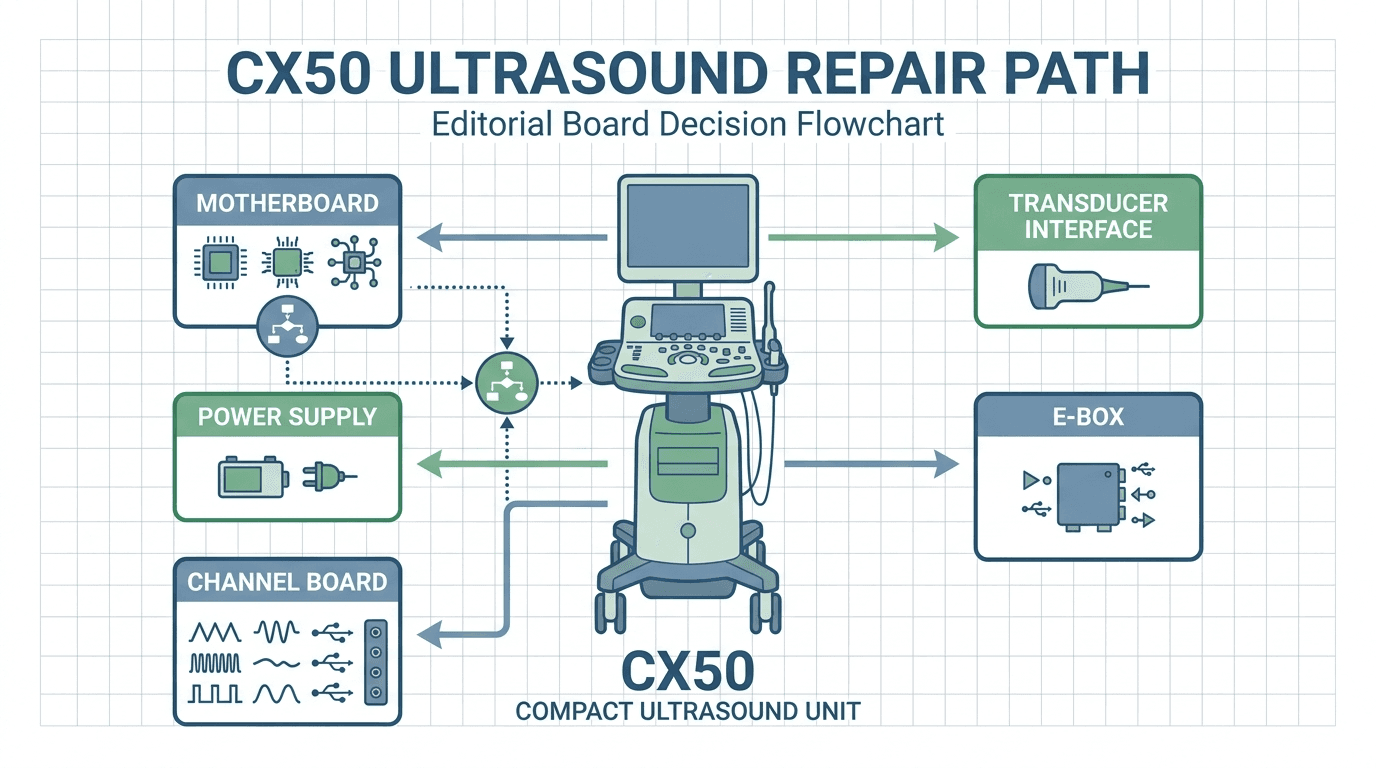
Which CX50 assembly does my symptom point to?
The Philips CX50 CompactXtreme ultrasound system represents one of the most successful high-performance compact ultrasound architectures ever deployed in point-of-care, cardiology, and shared-service imaging. First cleared by the U.S. FDA under 510(k) K081802 in July 2008 1, the CX50 condensed premium cart-based beamforming and Doppler capabilities into a compact laptop-and-cart hybrid form factor. However, this dense mechanical and electronic packaging means that a single functional disruption—such as a boot stall, probe drop-out, or video failure—can originate from tightly coupled, adjacent sub-assemblies.
Unlike full-sized cart consoles such as the Philips EPIQ 5/7 and iU22/iE33 platforms which house modular, isolated card cages (ACQ, AIM, APB, and power distribution boxes), the CX50 integrates its computing, front-end beamforming, power regulation, and transducer interfaces into a dense, multi-board sandwich inside the lower chassis. For broader multi-brand context, consult our brand-level Philips board decision path. Verified CX50 catalog rows live on the Philips CX50 model page and under Philips board repair; match the label before using a motherboard, TI board, or control panel SKU. To accurately triage a defective CX50 without unnecessary board replacements, biomedical engineers must classify observed symptoms across five distinct hardware domains:
- 1. Motherboard & Host Processing Domain (Motherboard 453561239048 / MAIN BOARD 453561495821 / ComEx Module): Houses the primary CPU, system memory, graphics processing, Windows embedded operating system, cine memory, and system controllers. Failures in this domain present as total failure to initiate POST, frozen Philips splash screens, BIOS communication halts, recurring application crashes, or loss of Ethernet/DICOM output 5 6.
- 2. Acoustic Front-End & Channel Board Domain (Channel Boards 453561239066 / 453561473231 / 453561681442 / 453561662431): Contains the digital beamformer circuitry, high-voltage transmit pulsers, low-noise pre-amplifiers, and analog-to-digital converters (ADCs). Failures manifest as uniform 2D image degradation, fixed vertical black lines (channel dropouts) across all transducers, Doppler noise streaks, or front-end bus communication timeouts 5 6.
- 3. Power Conversion & Distribution Domain (Internal Power Supply 453561375144 / AC-DC E-Box 453561769362 / Battery Management): Converts external DC input from the cart/e-box or internal lithium-ion battery into regulated logic voltages and high-voltage transducer bias rails. Failures present as complete dead console, spontaneous shutdown under high-energy color/spectral Doppler load, battery charging failure, or diagnostic Error 0022 during self-test 5 6.
- 4. Transducer Interfacing & Port Switching Domain (TI Board 453561473251): Connects the physical probe connector receptacles to the internal channel boards, handling high-voltage multiplexing, probe EEPROM ID decoding, and micro-coaxial signal routing. Failures present as an unrecognized probe on a specific port, port-specific image noise, or intermittent pin connection dropouts 5.
- 5. User Interface & Operator Console Domain (Control Panels 453561391513 / 453561497353 / Trackball 700299-G017 / Side I/O 453561463021 / 453561275123): Scans rotary encoders, silicon pushbuttons, TGC slide potentiometers, optical trackball movement, and external peripheral ports. Failures manifest as unresponsive gain dials, frozen cursor navigation, stuck key matrix lines, or non-functional USB/video ports 5 6.
| Presenting Symptom / Error Pattern | Primary Suspect Assembly | Key Verified Part Numbers | Mandatory Initial Diagnostic Gate | Recommended Service Action |
|---|---|---|---|---|
| Error 0022 on boot: 'Cannot enter the system' | Power Supply Board (Pwr Sup) or Front-End CB | 453561375144 (PSU), 453561473231 (CB) | Execute background self-check; inspect diagnostic log for 'Pwr Sup' flag (s6) | Replace/repair internal Power Supply board; inspect DC bus voltages before condemning CB |
| Blue Screen STOP 0x000000ED (UNMOUNTABLE_BOOT_VOLUME) | Internal hard disk drive (HDD / storage) | SATA HDD / SSD Image Assembly | Image or test the internal HDD on a diagnostic bench; look for bad sectors before condemning the motherboard (s6) | Repair or replace the HDD/image; do NOT start with Motherboard 453561239048 |
| Probe port 1 dead or unrecognized; probe works on Port 2 | Transducer Interface (TI) Board | 453561473251 (TI Board) | Cross-test probe on secondary port; inspect receptacle pins for bent/recessed contacts (s5) | Replace/repair TI Board 453561473251; do NOT order Channel Board 453561473231 |
| Complete no-power; power LED unlit on AC and battery | External E-Box Power Module or Internal PSU | 453561769362 (E-Box), 453561375144 (PSU) | Confirm E-Box/adapter output against the rating printed on that unit's label; try known-good external power if available | Replace external E-Box if labeled output is missing; service internal Power Board 453561375144 if DC input is valid |
| Vertical black lines / dropouts across ALL connected probes | Channel Board (CB / Beamformer) | 453561239066, 453561473231, 453561681442 | Test with at least two known-good transducers across different frequencies | Component-level repair of Channel Board pulser/ADC section or tested exchange assembly |
| Trackball cursor frozen or erratic; keys functional | Optical Trackball Assembly | 700299-G017 (Trackball X38) | Clean optical sensor and mechanical rollers; check internal USB/serial ribbon harness | Replace Trackball 700299-G017 (Caution: remove power board first to prevent motherboard fracture) (s8) |
| TGC sliders non-responsive or intermittent gain jumps | Control Panel Assembly | 453561391513, 453561497353 | Run diagnostic service test mode for potentiometer resistance sweeps | Replace TGC slide potentiometers or exchange full Control Panel assembly |
| S7-3t TEE probe tip temperature error on CX50 display | S7-3t Transducer (Programming / Sensor) | REF 989605406772 (S7-3t TEE) | Check transducer serial number against FDA Recall Z-1841-2020 (s2) | Send S7-3t probe for manufacturer reprogramming/repair; do NOT condemn CX50 console boards |
Source: Rongtao Medical Technical Service Archive (s5, s6), FDA 510(k)/Recall Data (s1, s2), and MedWrench Biomedical Practice (s8)
Error 0022 cannot enter the system: power board first, not the channel board — a documented case
Among the most common catastrophic failure prompts encountered on the Philips CX50 is Error 0022: 'Can not enter the system'. When this error occurs, the machine completes initial hardware power-up but halts abruptly during diagnostic initialization, refusing to load the clinical imaging interface. In informal online forums and unverified repair guides, Error 0022 is frequently attributed to a damaged acoustic channel board or a corrupt software installation, leading technicians to order expensive front-end exchange boards prematurely.
Documented bench service records at Rongtao Medical (Philips CX50 Report Error 0022 Case Narrative) 6 demonstrate a completely different diagnostic resolution. In an audited CX50 repair case exhibiting Error 0022, senior biomedical engineers initiated the system's background self-check diagnostic utility rather than immediately tearing down the card cage. The diagnostic test log returned a specific hardware failure flag: Pwr Sup (Power Supply).
The archive case does not publish a measured rail log. It does record that background self-check named Pwr Sup and that replacing the power supply restored function. Treat that outcome as one documented path, not a universal map: Error 0022 can still be a channel-board or software problem on another unit. The CX30/CX50 power board documented in the product-note registry is 453561375144; match the label on the board in hand rather than assuming the case used that exact 12NC 6.
Diagnostic Takeaway: When confronting CX50 Error 0022, always query the background self-check error log and isolate power before condemning expensive channel boards. For systemic power isolation principles, see our comprehensive guide to ultrasound power supply failure and boot loops.
Blue screen 0x000000ED: HDD bad sectors, not motherboard 453561239048 — a documented case that corrects the parent matrix
In high-level brand repair summaries—including the initial brand-level Philips board decision path—general CX50 blue-screen and boot-loop symptoms are often mapped directly to the primary motherboard (catalog part number 453561239048) 5. While catastrophic CPU or chipset failures on the motherboard do cause system crashes, treating every blue-screen event as a motherboard condemnation is a costly error that overlooks storage drive physics.
A specific documented technical case in the Rongtao archive (Repair Blue Screen Fault for Philips CX50) 6 details a CX50 unit presenting with a Windows Blue Screen of Death (BSOD) displaying STOP code 0x000000ED (UNMOUNTABLE_BOOT_VOLUME). In Windows, STOP 0x000000ED (UNMOUNTABLE_BOOT_VOLUME) means the boot volume could not be mounted because of uncorrectable storage read errors.
Rather than swapping motherboard 453561239048, engineers tested the internal hard disk, found bad sectors, and restored the unit by repairing HDD data. The archive does not specify drive size, cloning, or a file-table rebuild procedure; do not treat those shop details as part of the public case record. The machine restarted normally after HDD repair, with no motherboard replacement 6.
Parent Matrix Correction: When a CX50 blue-screens, the exact STOP code must be recorded. If the screen displays 0x000000ED or references file-system corruption, the mandatory first action is storage drive verification, not motherboard replacement. Reserve motherboard replacement (453561239048 or 453561495821) 5 for verified POST halts, memory bus parity errors, or hardware freeze conditions where the drive passes integrity testing.
Probe port dead after a probe swap: TI 453561473251 versus channel board 453561473231
A frequent clinical complaint on the CX50 involves transducer recognition failure or severe signal drop-out isolated to one specific probe port. For example, a cardiac probe plugged into Port 1 is not recognized or displays heavy background noise, but when transferred to Port 2, it initializes and scans perfectly. When this occurs, technicians frequently search for replacement boards and stumble upon adjacent part numbers in commercial marketplaces.
A critical risk identified in SERP and marketplace analyses 7 is the confusion between the Transducer Interface (TI) Board and the Channel Board (CB). These two assemblies share closely related part numbers separated by only a single digit:
- Transducer Interface (TI) Board (Catalog 453561473251): This board sits directly behind the physical probe locking receptacles. It manages connector pin routing, high-voltage multiplexing relays, and probe EEPROM ID lines. When a single port fails while others function, 453561473251 is the correct assembly to inspect and replace 5.
- Channel Board / CB Assembly (Inventory 453561473231 / 453561239066): This is the core digital beamformer and analog front-end processing board. It processes signals from all ports after multiplexing. If the channel board fails, image artifacts and channel dropouts appear across all connected transducers regardless of which port is used 5 7.
Ordering part number 453561473231 (Channel Board) to fix a single dead probe port will not resolve the problem and wastes budget on an unneeded beamformer. Always verify whether the dropout is port-isolated (TI Board 453561473251) or universal across all ports (Channel Board 453561473231). For deeper front-end physics, see our guide on ultrasound beamformer and front-end board failure.
No boot or power-related shutdown: PSU 453561375144 (CX30/CX50 shared), e-box 453561769362, or motherboard?
The power architecture of the Philips CX50 combines external AC-DC conversion, an internal power regulation and distribution board, an internal smart lithium-ion battery, and power-management circuitry on the motherboard. When a CX50 experiences total power failure, spontaneous rebooting, or failure to charge batteries, isolating the root assembly requires an orderly, multi-step measurement protocol:
- Step 1 — External E-Box & AC Adapter Isolation (E-Box 453561769362): The CX50 relies on an external power supply module (commonly termed the E-Box or cart power brick, part number 453561769362) 6. Confirm output against the voltage printed on that E-Box or adapter. If the module is dark, or labeled DC is missing or collapsing when the power button is pressed, the fault lies in the external supply path, not automatically in the console boards.
- Step 2 — Internal Battery Pack Test: Remove the internal battery pack and attempt to power the unit exclusively from the verified E-Box. Defective or deeply discharged lithium-ion battery cells can drag down the internal charging bus, triggering over-current protection and preventing startup.
- Step 3 — Internal Power Board (PSU 453561375144): The internal power supply board converts the labeled external DC input into the logic and pulser rails the compact chassis needs. If standby is present but main power will not latch when the front-panel button is toggled, the internal power board (453561375144 in the CX30/CX50 registry) is the next qualified-service suspect 6.
- Step 4 — Motherboard Power Management (Motherboard 453561239048): If labeled power is present at the internal board but the system still will not complete POST or generate video, motherboard power-management on 453561239048 (or the MAIN BOARD PN actually on the label) becomes the remaining host-side suspect 5.
Dead trackball or panel: control panel 453561391513 / 453561497353, trackball 700299-G017, and why MedWrench says the power board comes out first
Physical user interface components on the CX50—including the primary Control Panel Assemblies (453561391513 and 453561497353) and the Optical Trackball (part number 700299-G017 / X38) 5—experience heavy mechanical wear in point-of-care emergency and ICU environments. Fluid spills, acoustic gel ingress, and mechanical impact frequently cause unresponsive pushbuttons, jumpy trackball tracking, or broken encoder knobs. For cross-brand console troubleshooting, review our guide on ultrasound control panel and touch display failure.
However, servicing the CX50 control panel or replacing a defective trackball carries severe mechanical risks that every clinical engineer must understand. Biomedical engineering service discussions on MedWrench and field maintenance bulletins 7 8 issue an explicit warning regarding CX50 chassis teardowns:
Public MedWrench CX50 CompactXtreme threads, and the motherboard AI Overview that cites them, warn that the compact chassis is densely packed: field replacement of the main board or channel board has damaged adjacent SMT assemblies even in experienced hands, and trackball jobs that do not first free the power board have cracked main boards. Mixed-length screws are part of that warning. Use this as a qualified-service hard stop, not as a screw-count teardown recipe and not as a Rongtao case 8.
Depot service rule: Do not treat CX50 trackball or control-panel work as a top-cover shortcut. Public MedWrench threads warn that the power board should come out first and that mixed-length screws in the compact chassis have damaged adjacent boards, including main boards. That is a qualified-depot hard stop, not a field teardown sequence, and not a Rongtao documented case 8.
Which part number is my board? Motherboard 453561239048 versus MAIN BOARD 453561495821 versus legacy 453561368033 / 453561622163 / 453561495832
Over its multi-year production lifecycle from 2008 through the late 2010s, Philips manufactured several hardware revisions of CX50 sub-assemblies. In the global replacement parts market, multiple distinct 12-digit part numbers (12NC) circulate for overlapping functional roles. Sourcing parts solely by machine model name or generic descriptions ('CX50 motherboard') frequently results in incompatible hardware deliveries.
To avoid ordering errors, service teams must match the exact 12-digit barcode on the physical board against verified repository ground truth (how to verify ultrasound board part numbers):
- Motherboard Variants in Circulation: The primary photo-verified catalog SKU is 453561239048 5. In active inventory, a distinct revision exists under 453561495821 (labeled MAIN BOARD) 5. Additionally, legacy technical archive records document three further mainboard part numbers in circulation: 453561368033, 453561622163, and 453561495832 6. These part numbers represent documented production variants circulating in the field; they must not be assumed to follow a numeric revision sequence or permit silent interchange.
- AI Overview Hyphenation Traps: Search engine AI Overviews frequently display hyphenated part numbers such as
4535-612-39104or4535-614-732517. These strings represent web-scraped marketplace typos or unverified third-party numbers. Sourcing teams must rely exclusively on physical barcode labels matching genuine 12NC formats. - Channel Board (CB) Variants: Documented channel boards include catalog/inventory numbers 453561239066, 453561473231 (labeled CB Sparq/CX50), 453561681442, and legacy archive number 453561662431 5 6. Always match the exact part number and firmware revision when replacing front-end assemblies.
- Control Panel & Peripherals: Verified control panels include 453561391513 and 453561497353; side I/O boards include 453561275123 and legacy 453561463021; trackball assembly is 700299-G017 (X38) 5 6.
| Hardware Assembly Domain | Part Name & Description | Primary 12NC Part Number | Alternate / Documented Circulation PNs | Source & Ground Truth Reference |
|---|---|---|---|---|
| Motherboard / Processing | CX50 Motherboard / Ultrasonic Mainboard | 453561239048 | 453561495821, 453561368033, 453561622163, 453561495832 | Catalog SKU cx50-motherboard-453561239048 (s5), inventory snapshot (s5), legacy notes (s6) |
| Front-End / Beamformer | CX50 Channel Board (CB) | 453561239066 | 453561473231 (Sparq/CX50), 453561681442, 453561662431 | Inventory stock rows (s5) & Technical archive records (s6) |
| Transducer Interface | Transducer Interface (TI) Board | 453561473251 | None (Do not substitute with CB 453561473231) | Catalog SKU cx50-ti-board-453561473251 (s5) |
| Power Supply | Internal Power Board (CX30/CX50 Shared) | 453561375144 | Documented shared PSU across CX30 and CX50 | Technical archive record /blog/philips-cx50-report-error-0022 (s6) |
| External Power / AC-DC | CX50 E-Box Power Adapter Module | 453561769362 | External AC-DC converter brick / cart dock | Technical archive specification body (s6) |
| Control Panel | CX50 Operator Control Panel | 453561391513 | 453561497353 | cx50-control-panel-453561391513 / 453561497353 (s5) |
| User Interface | CX50 Optical Trackball Assembly | 700299-G017 | X38 Trackball Module | Catalog SKU cx50-trackball-x38-700299-g017 (s5) |
| Peripheral I/O | CX50 Side I/O Interconnect Board | 453561275123 | 453561463021 | Inventory stock row (s5) & Technical archive record (s6) |
Source: Rongtao Medical Parts Catalog (s5), Inventory Ground Truth (s5), and Migrated Technical Archive (s6)
View chart data
| Category | Verified Part Numbers in Circulation |
|---|---|
| Motherboards & Mainboards | 5 |
| Channel Boards (CB / Front-End) | 4 |
| Control Panels & Trackballs | 3 |
| Power Supplies & E-Boxes | 2 |
| Side I/O Interconnects | 2 |
| Transducer Interface (TI) | 1 |
Breakdown of 17 verified CX50 electronic part numbers across catalog, inventory, and technical archive records (snapshot 2026-08-24).
Source: Rongtao Medical Parts Catalog & Inventory Ground Truth (s5, s6)
Could it be a probe or a recall instead? S7-3t Z-1841-2020 as a host-system rule-out, not a board condemnation
Before condemning expensive internal circuit boards or sending a CX50 console to depot repair for front-end artifacts or temperature error prompts, biomedical engineers must rule out probe-specific failures and mandatory regulatory recalls. Transducer acoustic lens delamination, crystal element micro-fractures, cable strain relief breakage, and internal EEPROM calibration corruption frequently create symptoms that mimic channel board or power supply failures.
A critical regulatory case that directly impacts CX50 service diagnosis is FDA Recall Z-1841-2020 (FDA Event ID 84902, initiated 2019-08-30, Class 2, Terminated) 2. Under this action, Philips Ultrasound recalled specific lots of the S7-3t Transesophageal (TEE) Transducer (UDI 00884838061439, REF 989605406772) used on CX50, EPIQ 7, Affiniti 50, and Affiniti 70 systems. The FDA determined root cause was a manufacturing process-control defect: affected TEE transducers were improperly programmed during assembly, causing the host CX50 system to incorrectly measure or fail to read distal-tip temperature.
When an S7-3t probe triggers a temperature error or halts scanning on a CX50, technicians must not replace the console's TI Board (453561473251) or Channel Board. The failure resides entirely within the transducer's internal programming and thermal sensing circuit. The probe must be serviced through qualified ultrasound probe repair or replaced, leaving the console hardware untouched.
| Regulatory Identifier / Action | Status & Key Dates | Affected Product & Scope | Observed Failure Symptom | Root Cause vs Misdiagnosed Board Defect |
|---|---|---|---|---|
| FDA Recall Z-1841-2020 (Event 84902) | Terminated (Initiated 2019-08-30) | Transducer S7-3t (REF 989605406772) on CX50 / EPIQ / Affiniti | Distal-tip temperature measurement failure or error prompt | Transducer EEPROM programming defect (s2); do NOT replace CX50 TI or Channel boards |
| MAUDE Adverse Event Surveillance (n=37 total, 36 Philips) | Reviewed August 2026 | Philips CX50 Diagnostic Ultrasound System | Intermittent imaging freeze, power restart, or transducer communication loss | Passive surveillance reports; sample rows reflect isolated clinical malfunctions, not systemic board epidemiology (s3) |
Source: U.S. FDA Medical Device Recalls Database (s2) & MAUDE Adverse Event Database (s3)
An audit of the FDA MAUDE database conducted on 2026-08-24 revealed 37 total adverse event reports matching brand name CX50, with 36 explicitly identifying Philips as the manufacturer 3. Sampled records (e.g., 3019216-2021-00018, 3019216-2022-00023, 3019216-2023-00010) describe individual clinical malfunctions such as intermittent scanning freezes or probe recognition timeouts. In accordance with FDA guidelines, MAUDE data represents passive surveillance; report counts do not reflect failure incidence, establish device causality, or prove comparative board reliability.
CX30 is not a silent donor, and Wide CX50N is not this scanner
Two major cross-model and naming pitfalls frequently lead to ruined parts and wasted procurement expenditure during CX50 maintenance operations:
- 1. CX30 vs CX50 Board Sharing vs Functional Incompatibility: The Philips CX30 and CX50 share an identical external chassis, control console ergonomics, and the internal power supply board (part number 453561375144) 6. However, CX50 is the higher-capability compact cardiac platform and CX30 is a reduced-capability sibling. The product-note body documents shared power board 453561375144 for System CX30, CX50; that is not a license to swap channel boards, motherboards, or software storage. Unverified donor swaps can disable clinical modes and create software mismatches — stop and match the 12NC on the board.
- 2. FDA Search Collision: Wide Corporation CX50N Diagnostic Displays: When querying FDA regulatory databases or general medical search engines for 'CX50', multiple 510(k) clearances appear under applicant Wide Corporation (K170783, K222719, K160351). These filings correspond to the CX50N diagnostic medical display (product code PGY) and have zero relationship to the Philips CX50 diagnostic ultrasound system (product codes ITX/IYN) 1. Sourcing teams must filter out display monitor filings when compiling compliance histories.
Repair, tested replacement, or platform move: 2008 first clearance, 2016 last CX50-named hardware-adjacent 510(k), 2020 labeling-only K201012
Healthcare facility directors and clinical engineering managers managing CX50 fleets face an important strategic lifecycle decision: when a major board fails, should the facility invest in component-level PCB repair, procure a tested exchange board, or retire the platform in favor of newer systems such as the Philips Compact 5000 Series?
To make an evidence-based financial decision, service planners must evaluate the regulatory and engineering timeline of the CX50 platform:
- 2008 — Initial FDA Clearance (K081802, July 11, 2008): Established the CX50 as a premium compact ultrasound platform with ITX/IYN product codes 1.
- 2009–2012 — Hardware & Software Evolutions (K091804, K111513, K123754): Introduced CX50 Version 2.0 and 3.0, expanding transducer support and processing power 1.
- 2016 — Final CX50-Named Hardware-Adjacent Clearance (K162329, September 14, 2016): Cleared shared architectural enhancements across CX50 and Sparq platforms 1 4.
- 2020 — Emergency COVID-19 Labeling Expansion (K201012, May 1, 2020): Expanded clinical indication labeling for lung and cardiac triage during the pandemic across EPIQ, Affiniti, Lumify, CX50, and Sparq 1 4. This was an indication/labeling update, not a new hardware chassis or board redesign.
View chart data
| Category | 510(k) Premarket Clearances |
|---|---|
| 2008 (K081802 — Initial CX50) | 1 |
| 2009 (K091804 — CX50 v2.0) | 1 |
| 2011 (K111513 — CX50) | 1 |
| 2012 (K123754 — CX50 3.0) | 1 |
| 2016 (K162329 — CX50 & Sparq) | 1 |
| 2020 (K201012 — COVID Labeling Expansion) | 1 |
Chronological distribution of 6 FDA 510(k) clearances for the Philips CX50 ultrasound platform. Note that K201012 represents labeling expansion across existing platforms.
Source: U.S. FDA 510(k) Premarket Notification Database (s1, s4)
With the last CX50-named hardware-adjacent clearance occurring in September 2016 (K162329) 1, installed CX50 systems are currently 10 to 18 years past initial clearance. When an isolated assembly fails, clinical engineering teams have three clear pathways (board repair vs replacement decision guide):
- Option 1 — Component-Level Board Repair (Recommended Primary Route): For high-value assemblies such as Motherboard (453561239048), Channel Boards (453561473231), or Power Supplies (453561375144), depot-level component repair restores the identified assembly instead of forcing a platform move. Rongtao's standard service terms are a 5–8 business-day turnaround, typically 90-day warranty, and 48-hour real-machine testing, with finals confirmed at quote 5.
- Option 2 — Tested Exchange Assembly: When a PCB has suffered severe multi-layer substrate charring, liquid corrosion, or damaged BGA pads, an outright exchange with a photo-verified, pre-tested donor board is the fastest recovery path. Exchange boards must be validated on an actual CX50 host, backed by a real-machine test evidence pack.
- Option 3 — Platform Move / Replacement: If multiple major assemblies fail simultaneously (e.g., severe power surge destroying E-Box, internal PSU, motherboard, and channel board simultaneously) or if clinical demand requires newer AI workflow features, migrating to next-generation systems is economically indicated.
Where Rongtao fits — and where it does not
To establish clear, transparent expectations with hospital clinical engineering teams, ISOs, and medical equipment distributors, Rongtao Medical explicitly delineates its technical capabilities and service boundaries:
- Where Rongtao Fits:
• Component-Level PCB Repair: In-house depot diagnosis and repair for Philips CX50 motherboards, channel boards, TI boards, internal power supplies, and control panels.
• Photo-Verified Parts Inventory: 5 photo-backed CX50 catalog SKUs and 5 inventory rows in the 2026-08-24 snapshot, with availability confirmed on the live catalog or a quote, and typically 90-day warranty terms 5.
• 48-Hour Real-Machine Testing: Every repaired board and exchange module undergoes 48 hours of continuous operational stress testing inside an authentic CX50 ultrasound chassis before dispatch.
• Transducer Repair: Acoustic lens replacement, cable de-pinning, strain relief repair, and TEE probe servicing via our dedicated ultrasound probe repair laboratory. - Where Rongtao Does Not Fit:
• No OEM Representation: Rongtao Medical is an independent service organization and replacement parts supplier. We are not an authorized agent, distributor, or representative of Philips Healthcare. OEM brand names and part numbers are referenced solely for technical identification and compatibility.
• No On-Site Hospital Field Service: We operate centralized high-tech repair depots and global parts logistics; we do not dispatch field engineers for on-site hospital emergency repairs.
• No Unqualified DIY Instructions: We strictly decline to provide instructions that encourage untrained individuals to service energized high-voltage power supplies or bypass electrical safety interlocks.
Quote-ready handoff: photos, labels, error text, HDD already checked, quantity, destination
To receive an accurate, rapid technical evaluation and quote for Philips CX50 board repair or parts replacement, service engineers should compile the following six items before submitting a request via our contact and quote portal:
- 1. System Serial & Software Badge: Clear photograph of the CX50 rear identification badge showing system model, serial number, and installed software version (e.g., v3.0, v4.0).
- 2. Physical Board Barcode Photographs (Both Sides): High-resolution photographs of both component and solder sides of the suspected board, capturing the 12-digit 12NC part number label (e.g.,
453561239048,453561473251) and barcode revisions. - 3. Exact Error Code & Screen Capture: Photograph of the diagnostic error prompt (e.g., Error 0022, Blue Screen STOP 0x000000ED) and any background self-check log output (such as
Pwr Sup). - 4. Storage & Probe Pre-Check Status: Confirmation of whether the internal HDD has already been scanned for bad sectors, and whether the fault persists across multiple probes and both transducer ports.
- 5. Transducer Details (If Probe-Related): Transducer model (e.g., S7-3t, S5-1, L12-3), serial number, and connector condition.
- 6. Order Quantity & Destination: Required quantity, service preference (depot repair vs tested exchange assembly), and shipping destination for customs and logistics calculation.
Frequently Asked Questions
Q1: Will a Philips CX30 board work in my CX50 (or the reverse)?
The archive documents a shared internal power board (453561375144) for CX30 and CX50 6. That shared PSU PN is not a silent-donor license for channel boards or motherboards. Do not install a CX30 front-end or host board into a CX50 (or the reverse) without matching the 12NC on the metal and confirming the software image.
Q2: My CX50 shows Error 0022 and will not enter the system — is that the channel board or the power supply?
Error 0022 is not automatically a channel board. In the documented archive case, background self-check named Pwr Sup and power-supply replacement restored function 6. Run that self-check first; if the log names the power supply, repair or replace the power board before ordering a channel board. Other units can still fail 0022 for non-PSU reasons.
Q3: Blue Screen 0x000000ED on CX50: should I replace Motherboard 453561239048 first?
No. STOP code 0x000000ED corresponds to UNMOUNTABLE_BOOT_VOLUME and, in the documented CX50 case, tracked to HDD bad sectors. HDD/data repair restored the unit; the motherboard was not replaced 6. Consider motherboard replacement only after storage integrity is verified.
Q4: Is TI Board 453561473251 the same as Channel Board 453561473231?
No. Despite their nearly identical 12-digit part numbers, these are completely different functional assemblies. 453561473251 is the Transducer Interface (TI) Board responsible for probe connector pin routing and port selection 5. 453561473231 is the core Channel Board (CB) containing the acoustic beamformer DSPs and pulsers 5. If only one probe port fails, replace the TI board; if dropouts occur across all ports, inspect the channel board.
Q5: Is the S7-3t temperature recall a reason to replace my CX50 boards?
No. FDA Recall Z-1841-2020 2 was caused by an internal EEPROM programming error inside specific S7-3t TEE transducers, which prevented the CX50 host system from correctly measuring distal-tip temperature. This is a probe-specific defect, not a defect in the CX50 console or its circuit boards.
Q6: Did the 2020 FDA clearance mean the CX50 chassis was redesigned?
No. FDA 510(k) K201012 (cleared May 1, 2020) was an emergency clinical indication and labeling expansion for COVID-19-related lung and cardiac management across existing Philips platforms (EPIQ, Affiniti, Lumify, CX50, and Sparq) 1 4. The last CX50-named hardware-adjacent clearance occurred under K162329 in September 2016.
Q7: Is the Philips CX50 still worth repairing in 2026?
Yes. The CX50 remains one of the most reliable and clinically capable premium compact ultrasound systems in global service, particularly for point-of-care cardiac, vascular, and ICU imaging. Component-level board repair (standard 5–8 business-day turnaround, typically 90-day warranty 5) restores systems to full performance at a fraction of the cost of procuring a new cart.
Q8: What photos and information should I provide to receive an accurate CX50 repair quote?
Provide high-resolution photos of the system identification badge, clear photos of the suspected board's 12-digit barcode label (both sides), the exact error text or diagnostic self-test code, confirmation of HDD and probe testing status, and your shipping destination.