
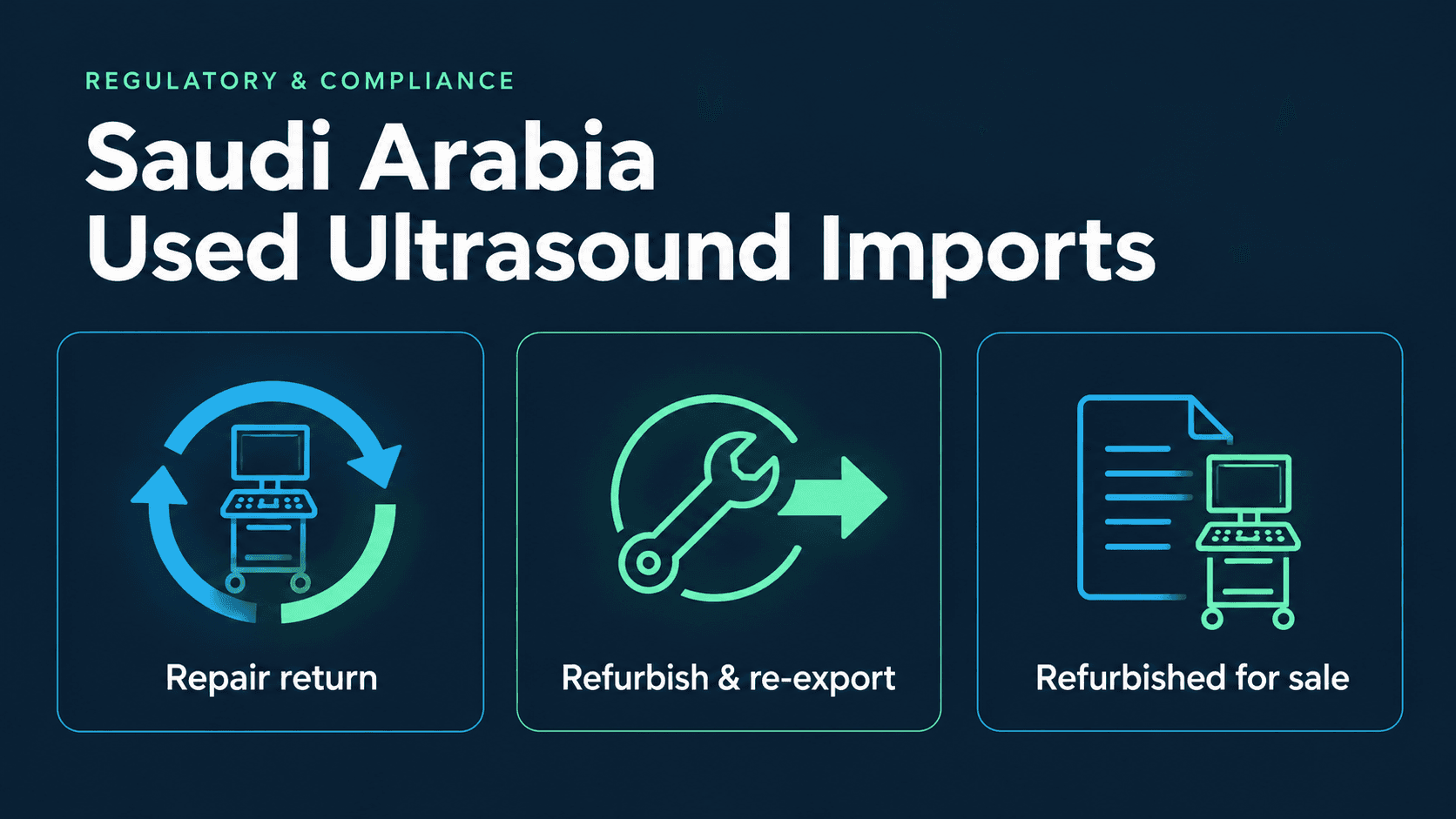
Start with the shipped article and its intended use
A hospital sending its own console abroad for service faces a different question from a distributor buying a decommissioned console for a new Saudi customer. A workshop importing equipment only to service it and send it back out has a third purpose. Using the same description—“used ultrasound equipment”—for all three hides the facts that the importer must establish.
Article 11.8 restricts imports of used medical devices for circulation, with the exceptions cross-referenced to Articles 11.4 and 11.5. Refurbished circulation is addressed separately: Article 20.3 treats refurbished devices as new for compliance purposes, and Article 20.4 sets conditions. This does not turn a cleaned, repaired or cosmetically restored console into an authorized refurbished import. 2
The source basis reviewed on 28 October 2026 is MDS-REQ 5 version 6.0, dated 19 July 2023, and the Implementing Regulation issued by Board Decision (3-29-1443), dated 19/02/1443 AH. SFDA’s regulation landing page links an October 2023-hosted English copy of MDS-REQ 5 carrying that same version/date. The used-device provisions are on page 5 and the electrical prohibitions are in Annex 7. 127
Scope comes before route selection. Page 3 excludes spare parts while covering medical devices and accessories. A console, a detached power board, and a separately supplied transducer cannot be assigned the same customs treatment from their shared ultrasound use. Ask the importer to resolve the product classification, with SFDA clarification where needed. Exclusion from this particular document does not mean exemption from every Saudi requirement. 1
- Record the exact article: console, probe/accessory, or spare part; manufacturer, model, serial or part number, quantity and current location.
- State what will happen after arrival: return to its owner, work followed by re-export, or supply for Saudi clinical use.
- Identify who will obtain the regulatory permissions, prepare the customs entry and accept the financial consequences if clearance is refused.
- Keep any exchange unit separate from the identity record of the item exported for repair. A different serial needs its own assessment; describe the transaction accurately.
Compare the three shipment files
| Shipment purpose | Main source | Evidence to resolve before dispatch | Timing / destination |
|---|---|---|---|
| Return after overseas work | MDS-REQ 5 p.5, A; Article 11.5 | Export declaration linkage; prior SFDA export permission and re-entry import permit addressed by Article 11.5; same-article records | Clearance within six months of export under Clause A |
| Import for maintenance/refurbishment in KSA and re-export | MDS-REQ 5 p.5, B; Articles 11.4 and 11.6 | GHAD import permission; pre-arrival release approval; suitable licensed activity; re-export approval | Permission valid three months; separate six-month re-export clearance condition; no domestic circulation under this permission |
| Refurbished device for Saudi circulation | MDS-REQ 5 p.4; Articles 20.3–20.4 | Prior MDMA plus MDMA after refurbishment; Manufacturer responsibility, labeling and technical compliance; importer/AR and shipment release evidence | Check actual authorization validity and scope; not a universal three-year term |
| Ordinary foreign used console offered for domestic resale | Article 11.8; MDS-REQ 5 Annex 7 | A seller’s “tested” or “refurbished” label does not supply the missing authorization | Do not ship while eligibility is unresolved |
Source: SFDA MDS-REQ 5 pp.4–5 and Annex 7; Implementing Regulation Articles 11 and 20. [1, 2]
Route 1: The repair return and the six-month clock
Clause A covers return to Saudi Arabia after maintenance, calibration, marketing-sample display, correction required by a safety warning, or testing abroad. It ties clearance to the export customs declaration within six months of exportation. Read this alongside Article 11.5: the Regulation refers to devices exported with prior SFDA permission and requires an import permit before re-entry. An outbound customs declaration is not a substitute for those SFDA permissions. 12
For a hospital console, assemble the identity and permission record before booking collection. Keep the outbound declaration, permit references, serial-label photographs, service order and the intended return destination together. Ask the overseas depot to preserve identity and document any replacement assemblies. If repair becomes an exchange or a different device is supplied, stop and have the importer reassess the entry rather than reuse the original return description.
Six months is the wording of the instrument; it is not a fixed 180-day rule. Have the broker confirm the applicable calendar calculation and clearance deadline from the export record. Arrival at the airport is not the same milestone as completed clearance. The timeline must include outbound transport, intake, diagnosis, parts availability, agreed testing, customer sign-off, return transport and destination processing. 1
- Before export: establish scope, permissions, the export reference and the deadline owner. Resolve whether the shipment is a regulated device/accessory or an excluded spare part.
- At depot intake: reconcile the received serial with the outbound record and confirm the repair scope. Request an updated schedule if diagnosis changes the work.
- Before return dispatch: reconcile serials, work performed, repair invoice, shipping documents and the required re-entry approval with the importer.
- If delay threatens the window: contact SFDA and the broker before moving the goods. The cited texts do not establish an automatic extension or an inevitable seizure outcome. Keep any case-specific written direction in the file.
Rongtao publishes a typical 5–8 business-day board-repair turnaround and a typical 90-day warranty, with scope and final terms confirmed on the quotation. Those terms do not describe the entire transport-and-clearance cycle, establish a universal probe turnaround, or guarantee compliance with a Saudi deadline. Use the cross-border repair shipping guide to plan the physical journey once the destination entry has been resolved.
A whole console or storage assembly may contain patient information. The facility should arrange authorized backup, retention and sanitization before release to a carrier, preserving what it must lawfully retain. Our patient-data export and erasure guide covers the technical evidence to collect; it does not replace Saudi privacy requirements or the facility’s own approval process.
Route 2: Import to refurbish in KSA, then re-export
Article 11.4 allows used devices to enter for maintenance or refurbishment in Saudi Arabia with an import permit and requires re-export; domestic circulation is prohibited under this arrangement. MDS-REQ 5 Clause B implements this with an application through GHAD, the importer declaration and required documents, plus approval for shipment release before arrival through the specified Faseh/FASAH systems. 12
The clocks need separate entries in the work plan. Clause B says the import license/permission is valid for three months. Its re-export note separately specifies customs clearance against that permission within six months. Do not infer that an open-ended workshop job is allowed, or copy the repair-return export date into this different file. Confirm the re-export deadline and its starting reference against the issued permission with SFDA and customs. 1
Article 11.6 also requires SFDA approval for re-export. A maintenance work order and an outbound freight booking are therefore incomplete exit evidence. Before accepting the job, identify who obtains approval, who maintains serial-level custody records, and what happens commercially if work cannot be completed on schedule. These are recommended contract controls; this report does not declare that every such shipment must use a particular bonded zone or customs-bond structure. 2
Verify the Saudi establishment’s licensed activity for the work it actually performs. MDS-REQ 9 version 2.0, dated 15 January 2025, has distinct provisions for importers/distributors, warehouses and maintenance providers. Maintenance-provider provisions address trained technical staff, suitable test equipment and maintenance records. A warehouse license alone does not demonstrate the scope needed to refurbish a device. 3
Route 3: Refurbished under the Manufacturer, with two MDMA records
For a refurbished console offered for Saudi clinical use, the decisive question is not whether an overseas seller calls it “factory quality.” MDS-REQ 5 page 4 requires a Marketing Authorization after refurbishment in addition to the previous MDMA. Obtain both records and ask the manufacturer or its Saudi authorized representative to show how they cover the offered model/configuration and refurbished status. Check validity rather than assuming a standard authorization period. 1
Article 20.4 lists eight conditions. In practical terms, the evidence must establish the following; the list is a paraphrase of the Regulation rather than a new certification scheme. 2
- The device had SFDA Marketing Authorization before refurbishment.
- Refurbishment was implemented under the responsibility of the Manufacturer.
- The primary intended use of the device or its accessories has not changed.
- The device is not intended for single use.
- Circulation after refurbishment meets the marketing-authorization technical requirements and SFDA-approved technical regulations and standards.
- Labeling clearly and non-removably identifies refurbished status and the refurbishment date, while retaining the basic label.
- Post-market surveillance requirements are met.
- Any additional requirements determined and published by SFDA are met.
Manufacturer does not automatically mean original OEM. The Regulation’s definition includes national or foreign establishments designing or manufacturing devices offered in their own name, and manufacturing includes refurbishment. Responsibility, licensing and authorization must be established on the facts. An independent dealer’s inspection report alone does not prove those obligations, but the definition also does not justify a categorical claim that only the original OEM can ever qualify. 2
Keep the evidence tied to the offered unit. Request photographs of the original identification and refurbished label, the responsible entity’s details, the two authorization records, the service history and the proposed configuration. An OEM refurbishment-program name is not proof that a particular system has Saudi authorization. This guide does not verify any GoldSeal, Diamond Select or other branded unit for entry.
Import eligibility and clinical acceptance remain separate decisions. Once the regulatory file is established, apply the used ultrasound buying guide to configuration, licenses, each included probe, measured performance, data state and future support. A device’s compliance status does not demonstrate that it is a sound purchase or ready for patients.
Check the electrical evidence before paying
MDS-REQ 5 Annex 7 lists prohibited electrical configurations: operation on AC supplies other than 230 or 400 volts, frequency other than 60 Hz, and a connector incompatible with SBC Part 401 or SASO 2203. It is an import gate as well as a site-planning question. Review the exact console and any mains-powered peripherals against the applicable requirements before dispatch. 1
| Evidence presented | What it shows | Action before shipment |
|---|---|---|
| 100–240 V, 50/60 Hz plate | The stated range includes 230 V and 60 Hz; it does not prove full shipment compliance | Check exact-unit OEM documentation, cord/connector and importer assessment |
| 120 V only | Does not document operation at the required Saudi voltage | Hold procurement; obtain manufacturer-supported suitability evidence rather than assuming a transformer solves entry |
| 230 V, 50 Hz only | Does not document 60 Hz operation | Hold dispatch; request exact-configuration documentation and an SFDA/importer determination |
| Suitable voltage/frequency but unclear connector | The electrical evidence remains incomplete | Identify the fitted assembly and verify its compatibility with the referenced requirements |
| Unreadable plate or seller’s generic brochure | Cannot establish the offered unit’s electrical configuration | Request clear plate photographs and configuration-specific records |
Source: SFDA MDS-REQ 5 Annex 7, p.37; application to hypothetical labels is editorial triage. [1]
This table does not authorize rewiring, transformer-tap changes or substitution of a cord. Any equipment change needs qualified personnel, manufacturer instructions and the appropriate verification before use. Do not infer compliance for an entire GE, Philips, Siemens or Mindray model family from a generic brochure. The ultrasound power-protection guide explains the wider site-evidence task.
Build a document register with a named owner
Separate official application requirements from useful commercial evidence. MDS-REQ 5 has a used-device import-permission document list on page 15 and shipment-clearance documents on pages 21–22. The latter lists invoice, bill of lading and customs declaration, with purpose-specific authorization, license and conformity records. Check the applicable rows and footnotes with the importer rather than presenting every document below as mandatory for every route. 1
| Record | Return after work abroad | Work in KSA for re-export | Refurbished circulation |
|---|---|---|---|
| Regulatory basis and approvals | Article 11.5 permissions plus export-declaration link; confirm scope | GHAD permission, pre-arrival release and SFDA re-export approval | Previous and post-refurbishment MDMA; importer/AR and release evidence |
| Article identity — recommended reconciliation | Outbound and returning identifiers, photos and any changed assemblies | Incoming and outgoing serial inventory | Offered-unit identity, configuration and refurbished label |
| Commercial and transport documents | Truthful repair/return description; invoice, freight and declaration records as applicable | Purpose and permission references; transport and customs records | Invoice/packing-list identifiers, bill of lading and customs declaration |
| Technical evidence — request before dispatch | Service findings, work performed and agreed test results | Work scope, custody record, completion and exit plan | Manufacturer-responsibility evidence, labels and technical compliance |
| Dates — assign an owner | Export date, broker-confirmed six-month clearance deadline, expected return | Permission expiry, confirmed re-export deadline and approval status | Authorization validity, release status and agreed acceptance dates |
Source: Official gates: MDS-REQ 5 and Implementing Regulation. Identity reconciliation, technical packets and date ownership are editorial recommendations. [1, 2]
For circulation, verify the distinct importer and authorized-representative roles and the shipment Declaration of Conformity. The clearance-document table distinguishes that shipment declaration from the declaration submitted for MDMA. Establishment licensing and product authorization are different records; a valid license does not establish that the offered refurbished configuration is authorized. 13
Resolve pre-arrival timing and tax treatment separately
Do not rely on a universal 48-hour filing rule. ZATCA’s general Import Instructions page still states at least 48 hours before arrival, while its dated 26 November 2024 announcement specifies 72 hours. This is a visible official-source inconsistency. Plan early enough for the 72-hour instruction and have the broker confirm the current applicable requirement for the shipment and port; also complete the required SFDA approvals before movement. 45
Do not budget a universal 15% VAT charge or assert a verified zero customs-duty rate from a generic authority homepage. ZATCA’s May 2026 Imports and Exports VAT Guideline includes qualified medicines and medical equipment among exempt imports. Qualification must be established for the actual goods; a medical-equipment description alone does not establish the exemption. The exact classification, qualification, customs value and treatment of a repair return need a current case-specific determination. Ask the broker for the exact tariff item and dated duty/VAT basis; a console’s classification does not automatically classify a loose board or probe. 6
Boundary cases and stop decisions
Personal import is not a substitute for a clinic’s procurement file. The Regulation limits it to defined circumstances including home devices for lay use and custom-made devices, without business use. Demonstration and clinical-study imports have their own permissions and purposes. An exhibition label does not establish eligibility for subsequent commercial patient use, and an MDMA exemption does not by itself cancel the used-device restrictions. 12
Domestic resale is also a separate question. Article 20.5 sets conditions for resale, loan and donation, including authorization, notifications, supporting technical documents and records. That provision does not clear a foreign used-device shipment. Likewise, transit through a neighboring Gulf state does not establish Saudi eligibility. Other destinations need their own review; our Brazil import-purpose guide illustrates why the same equipment description can produce a different regulatory file. 2
- Board-only repair: a Riyadh hospital has an isolated failed board. First resolve the spare-part scope exclusion and its applicable entry requirements; do not promise Clause A solely because the board came from a Saudi console.
- Dealer-refurbished console: the seller supplies a test sheet and the original MDMA but no post-refurbishment authorization. Keep the purchase on hold until the responsible entity and missing authorization evidence are resolved.
- Saudi workshop job: a foreign owner wants the machine back after servicing. Agree the import-permission, release, custody and SFDA-approved re-export plan before intake; local resale is not the outcome allowed by that permission.
These examples are document-triage scenarios, not rulings on named devices. When the evidence fails, pause the transaction and resolve the missing record with the responsible importer or SFDA. The reviewed documents do not support predicting routine confiscation, automatic blacklisting or a specific penalty for every deficient file.
Where Rongtao fits—and where it does not
Rongtao Medical provides independent ultrasound board repair, probe service and replacement-parts support. Its technical contribution is identifying the article, assessing repair scope, agreeing the required test evidence and documenting the work. A repair quotation is not a Saudi regulatory authorization. The service offered here does not include obtaining MDMA, acting as the Saudi importer of record, providing an authorized-representative mandate or issuing customs clearance.
For a probe, request a case-specific assessment through probe repair services; quote and acceptance requirements depend on the actual probe and defect. Do not extend the board turnaround to every probe or assume repair is possible before assessment. OEM names identify equipment; they do not imply OEM affiliation, authorization or endorsement.
For an actionable technical quote request, provide the OEM, exact model, manufacturer part number, serial number, clear label photos and both sides of a board where safely available, symptom/error code, quantity, current location and destination. Add the proposed shipment purpose and relevant export/permit references after review by the importer. Exclude patient information. Ask for repair scope, expected schedule, test deliverables and final warranty terms, and have the importer settle the destination entry before shipment.
Frequently asked questions
Why does SFDA’s English FAQ say used-device imports are not allowed?
The English FAQ dated 20 February 2024 states the prohibition without explaining the conditional exceptions. Its Arabic counterpart adds a note for devices previously used in the Kingdom returning after specified work abroad, with prior SFDA export permission and an import permit before re-entry. Read both summaries alongside MDS-REQ 5 pages 4–5 and Articles 11 and 20 of the Implementing Regulation. Those detailed provisions distinguish used-device returns and work for re-export from refurbished circulation. They do not grant ordinary used consoles a general resale route. If the proposed shipment’s status is unclear, obtain SFDA clarification before dispatch. 8912
Does the original MDMA alone cover a refurbished import?
No. MDS-REQ 5 expressly calls for an MDMA after refurbishment in addition to the previous MDMA. Check coverage of the actual refurbished device with the responsible manufacturer/AR. 1
Does a five-day bench repair guarantee the return deadline?
No. The relevant milestone is clearance, with transport and processing on both sides of the repair. Confirm the deadline and all permissions; a typical service time is not a clearance promise.
Can every repaired board use the device-return exception?
That cannot be concluded from MDS-REQ 5. Its scope excludes medical-device spare parts. Establish the shipped article’s classification and applicable requirements first. 1
Does Article 20.4 require original-OEM involvement in every case?
It says Manufacturer responsibility. Read that with the Regulation’s definition, which includes refurbishment within manufacturing. Do not replace that definition with an unverified OEM-only rule, or treat an independent dealer’s claim as proof of compliance. 2
Limits and recheck triggers
This is regulatory information for procurement and service planning, based on the public English instruments actually reviewed on 28 October 2026. The SFDA documents are marked “Translated Copy”; resolve interpretation against the official Arabic text with SFDA or a qualified adviser. No shipment-level permit, authorization record, enforcement-frequency dataset or exact-unit OEM electrical file was examined for this guide.
The official landing-page download and targeted version searches support the identified source versions; absence of a newer result is not proof that no amendment or circular exists. Recheck before dispatch whenever the shipped article, responsible manufacturer, refurbished status, destination or purpose changes, and on a new SFDA requirement, authorization change, customs timing notice or tax ruling. Regulatory eligibility, safe transport and clinical return-to-service testing remain separate gates.