
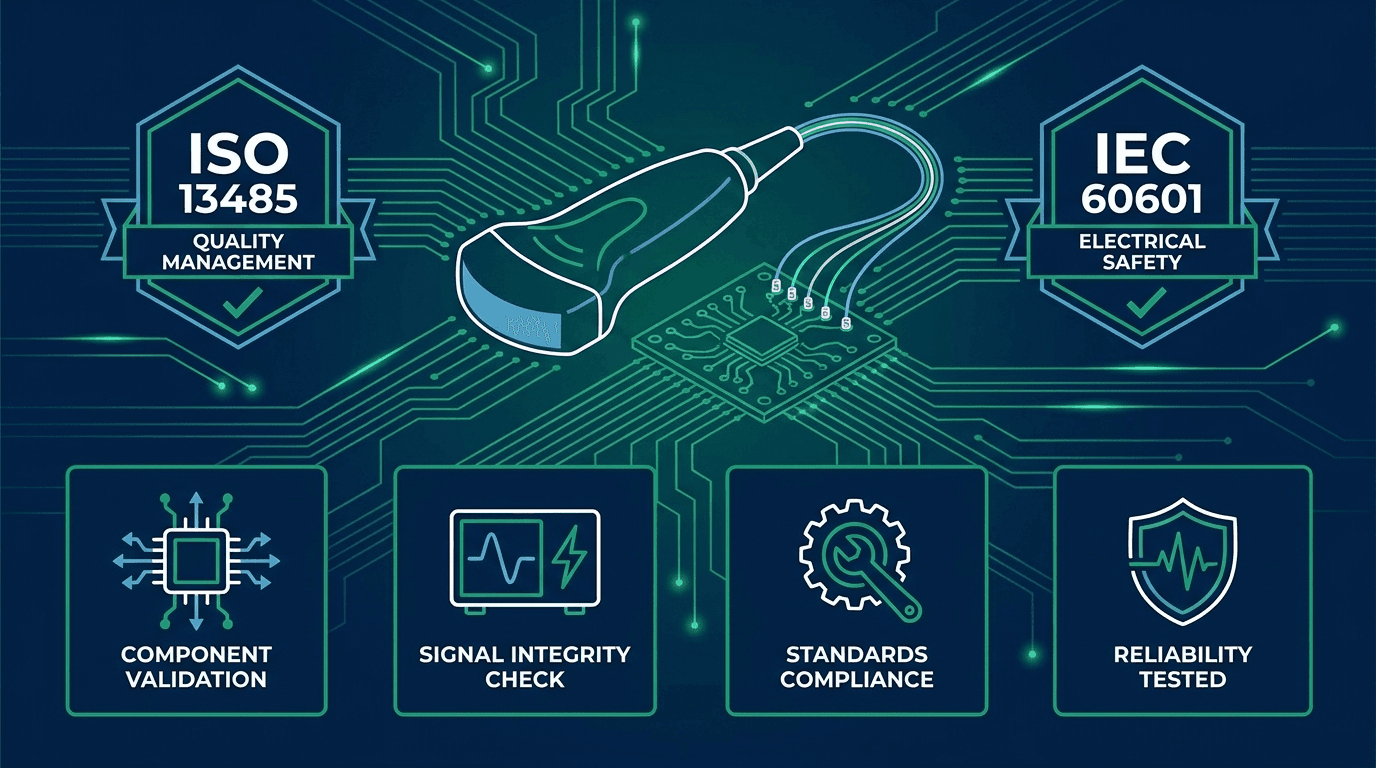
Which standards and QMS claims actually apply to ultrasound replacement parts?
In the medical imaging secondary market, line-item quotations and supplier websites frequently present logos for ISO 9001, ISO 13485, IEC 60601, and FDA registration side by side. For clinical engineering leads, biomedical equipment technicians (BMETs), and procurement managers, distinguishing between what an organizational standard covers and what product-level evidence proves is essential to protecting patient safety and asset uptime.
A common point of confusion is treating standard badges as product approvals. Standards fall into three distinct tiers: organizational Quality Management System (QMS) frameworks, equipment safety and performance standards, and refurbishment process standards. Understanding how these tiers interlock enables buyers to request the exact evidence documents required for safe clinical integration.
| Standard / Claim | Target Entity | What it Proves | What it Does NOT Prove | Evidence Document to Request |
|---|---|---|---|---|
| ISO 13485:2016 | Organization / Facility QMS | The facility operates a documented quality system specific to medical devices (purchasing, trace-back, nonconforming product controls). | Does NOT certify that a specific replacement board or probe is defect-free or clinically functional. | Official ISO 13485 certificate showing scope statement, accredited registrar, and valid expiry date. |
| ISO 9001:2015 | Organization / Facility QMS | General industrial quality management (customer satisfaction, process consistency). | Does NOT include medical-device-specific risk controls, trace-back, or regulatory complaint handling. | ISO 9001 certificate scope disclosure. |
| IEC 62353:2014 | Repaired / Serviced Assembly | Post-repair electrical safety (chassis leakage, touch current, protective earth resistance) for medical equipment. | Does NOT prove acoustic beam profile or diagnostic image resolution on a specific probe. | Serial-number-linked IEC 62353 electrical safety test report. |
| IEC 60601-2-37 | Transducer / Beamformer | Compliance of ultrasonic diagnostic equipment with acoustic output safety and thermal index limits. | Does NOT grant OEM authorization or validate non-OEM replacement crystal materials without testing. | Acoustic output and element sensitivity test data (First-Pass / Doppler array report). |
| IEC 63077:2019 | Refurbished Imaging System | Standardized process for whole-system imaging equipment refurbishment, software reset, and risk assessment. | Does NOT apply directly to isolated component repairs unless part of a certified system refurbishment workflow. | Refurbishment process sign-off sheet and system audit log. |
| FDA Registration (21 CFR Part 807) | Establishment / Facility | Administrative listing of facility location and active device categories with the US FDA. | Does NOT constitute FDA approval, clearance, safety endorsement, or quality verification (21 CFR 807.39). | FDA Establishment Registration Number (FEI) and listed product codes. |
What does 'ISO 13485 certified' prove about a supplier — and what does it not prove about a part?
ISO 13485:2016 specifies requirements for a quality management system where an organization needs to demonstrate its ability to provide medical devices and related services that consistently meet customer and applicable regulatory requirements 2. However, an ISO 13485 certificate is issued to a business facility for a specific certified scope—such as 'the repair, refurbishment, and distribution of multi-brand ultrasound transducers and circuit assemblies.'
Crucially, there is no technical framework under ISO 13485 for certifying a spare power supply, transmit board, or beamformer PCB as an individual 'ISO-certified part.' Claiming an individual spare part is 'ISO-certified' is a marketing misrepresentation that conflates organizational QMS oversight with product-level design clearance.
What an ISO 13485 certification does prove about a parts supplier is that their facility is audited by an independent accredited registrar (such as TÜV, SGS, BSI, or NQA) to verify critical operational clauses:
- Clause 7.4 (Purchasing & Supplier Control): Establishes strict criteria for qualifying component suppliers, evaluating donor systems, and inspecting raw materials before use.
- Clause 7.5.1 (Control of Production & Service Provision): Mandates documented work instructions, calibrated test equipment, and controlled ambient environments for circuit board soldering and transducer acoustic rebuilding.
- Clause 7.5.9 (Traceability): Requires complete trace-back records linking every shipped replacement part to its original donor system, batch serial number, and test technician.
- Clause 8.3 (Control of Nonconforming Product): Governs the quarantine, isolation, and root-cause failure analysis of any component failing QA inspections.
To evaluate these capabilities thoroughly during supplier onboarding, review our supplier-qualification evidence checklist.
How do receiving technicians verify standards compliance and prevent counterfeit parts?
Even when a supplier provides valid QMS certificates, receiving technicians must verify physical parts against documented quality standards upon delivery. Counterfeit circuit components, relabeled low-spec power modules, and improperly harvested PCBs present severe operational risks.
Execute these four physical receiving verification controls:
- Verify Registrar Certificate Validity: Cross-check the supplier's ISO 13485 certificate registration number directly on the official accredited registrar portal (e.g., IAF CertSearch or registrar validation portal). Confirm that the facility address and certified scope match the vendor's physical operating location.
- Inspect Anti-Tamper Seals and ESD Packaging: Confirm that circuit boards arrive sealed inside un-damaged anti-static shielding bags with unbroken tamper-evident security labels.
- Cross-Check Barcode Serial Tags: Match OEM part number tags and barcode stickers on the physical board against the supplier's serial-numbered QA test execution report.
- Verify Solder Joints and Component Revision: Inspect the PCB for unauthorized jumper wires, re-soldered surface-mount components, or mis-matched hardware revision letters.
What electrical-safety and test evidence should a buyer request for a replacement board or probe?
When a high-voltage transmit board or TEE transducer is installed into a clinical ultrasound system, patient and operator safety depend directly on electrical insulation and signal integrity. Receiving a part stamped with 'Passed QA' without accompanying test metrics exposes the health system to unquantified clinical and operational risk.
For circuit assemblies (such as power supplies, high-voltage boards, and front-end processing cards), buyers should require proof of real-machine testing under load. Bench testing with an oscilloscope demonstrates basic signal response, but only continuous operation in a matching ultrasound system chassis validates thermal stability and bus communication under multi-channel scanning modes.
For transducers and probes, the return-to-service test method should follow the device manufacturer's instructions and the applicable equipment/applied-part safety procedure; IEC 62353 is one relevant framework for recurrent and post-repair testing 3. The evidence pack should identify the method used and may include:
- Chassis and Patient Leakage Current: Measurement of micro-ampere leakage across applied parts (probe lens and housing) under normal and single-fault conditions to prevent patient micro-shock, particularly for TEE and surgical probes.
- Acoustic Element & Array Integrity: FirstCall or equivalent acoustic matrix testing quantifying capacitance, pulse width, sensitivity, and dead element count across every individual piezo-electric channel.
- In-Air & Phantom Resolution QA: High-resolution phantom image captures verifying axial/lateral resolution, penetration depth, and color Doppler sensitivity on standard tissue-mimicking phantoms.
Before placing a returned probe into clinical rotation, engineering teams should follow the probe acceptance protocol and cross-reference physical board revisions against the board acceptance protocol.
How do FDA QMSR (21 CFR 820), IEC 63077 and IEC 62353 fit together?
On February 2, 2024, the U.S. FDA issued its final rule amending the Device Quality System Regulation (21 CFR Part 820) to form the Quality Management System Regulation (QMSR) 1. Effective February 2, 2026, the QMSR explicitly incorporates ISO 13485:2016 by reference, harmonizing US medical device quality management expectations with international standards.
These sources address different questions and do not automatically apply to every independent servicer or spare-part transaction:
- FDA QMSR (21 CFR Part 820): Establishes quality-management requirements for device manufacturers and other entities whose activities bring them within the regulation, including remanufacturers. It should not be described as a blanket purchasing rule for hospitals or ordinary third-party servicing 1.
- IEC 63077:2019: Specifies a process for refurbishment of used medical imaging equipment and systems. Buyers can use its scope to ask about identity, restoration, updates, verification, records, and release, but should not treat it as a self-proving grade for every loose part 5.
- IEC 62353:2014: Provides methods for recurrent and post-repair safety testing of medical electrical equipment, systems, or relevant parts. Applicability and the test setup depend on the finished equipment, the repair, its applied-part classification, and the manufacturer's instructions 3.
- ISO 14971:2019: Governs medical device risk management. It is important to note that while FDA QMSR incorporates ISO 13485:2016, the FDA explicitly chose not to incorporate ISO 14971 by reference in the final rule text, although risk management principles remain embedded within ISO 13485 Clause 7 requirements 1.
Furthermore, FDA establishment registration under 21 CFR Part 807 remains an administrative requirement; as stated in 21 CFR 807.39, registration does not constitute FDA approval or clearance 6. Suppliers must maintain a clear boundary along the FDA servicing-vs-remanufacturing line.
What is a standards-and-evidence checklist I can send a supplier?
To streamline procurement and eliminate ambiguous quality claims, biomedical and procurement departments can attach this standardized evidence disclosure request to all replacement parts and repair RFQs.
| Verification Gate | Required Supplier Submission | Pass / Fail Criteria | Reference Baseline |
|---|---|---|---|
| 1. QMS Organizational Scope | Official ISO 13485:2016 Certificate with accredited IAF registrar mark and explicit scope text. | Scope must cover 'repair, service, or distribution of medical imaging components or transducers.' | ISO 13485 Clause 4.1 / 7.4 |
| 2. Part / Assembly Identity | High-resolution photographic evidence of OEM part number label, revision code, and serial number tag. | Exact match to system revision and hardware matrix; clear evidence of anti-counterfeiting seal. | the provenance scorecard |
| 3. Electrical Safety Record | Serial-number-matched IEC 62353 test report showing chassis/patient leakage current values. | Leakage current strictly within specified micro-ampere limits for applied parts. | IEC 62353 Clause 5 |
| 4. Functional & Real-Machine QA | For repaired boards, a signed QA record describing Rongtao's 48-hour real-machine test; for probes and replacement parts, a record of the applicable live-system or functional verification. | Recorded acceptance criteria and results for the relevant functions, with exceptions or limitations disclosed. | ISO 13485 Clause 7.5.1 |
| 5. Probe Acoustic Integrity | Acoustic element test report (FirstCall or equivalent) measuring dead elements and array sensitivity. | Zero adjacent dead elements; total dead channel count strictly within clinical tolerance. | IEC 60601-2-37 |
| 6. Decontamination & Hygiene | Documented cleaning disclosure confirming high-level disinfection/sanitation upon intake/release. | Signed decontamination certificate for all returned or exchanged transducers. | CDC / OEM IFU Hygiene Standards |
Frequently Asked Questions
Can an ultrasound replacement part be ISO-certified?
No. ISO 13485 certifies an organization's quality management system, not individual physical components or spare parts. A supplier operating an ISO 13485-certified facility applies audited quality controls to their processes, but the part itself should be evaluated by its traceable identity, revision match, and test reports.
Is ISO 9001 enough for medical-device parts, or do I need ISO 13485?
ISO 9001 is a general industrial quality management standard focused on customer satisfaction. ISO 13485 is tailored specifically to medical devices, incorporating stringent requirements for traceability, risk management, regulatory reporting, and nonconforming product control. While ISO 9001 is positive, ISO 13485 provides the specific framework necessary for clinical asset reliability.
What is the difference between IEC 60601-1, IEC 60601-2-37 and IEC 62353?
IEC 60601-1 is the general safety standard for new medical electrical equipment; IEC 60601-2-37 adds particular requirements for acoustic output and thermal safety in ultrasound diagnostic devices. IEC 62353 is designed specifically for in-service testing and test-after-repair of medical equipment, establishing practical electrical safety testing protocols after maintenance.
Does FDA registration prove a replacement part is safe or compliant?
No. FDA establishment registration (21 CFR Part 807) is an administrative requirement notifying the FDA of facility operations. Under 21 CFR 807.39, registration does not denote FDA approval, clearance, or quality endorsement. Safety and performance must be verified through technical test documentation.
How can buyers verify that an ISO certificate is authentic?
Ask for the certificate's unique registration number and registrar name. Visit the registrar's official online verification database (or IAF CertSearch) to verify that the certificate is currently active, accredited, and that the certified facility address matches the supplier's actual operating location.
Where Rongtao Medical Fits — Ground Truth & Quality Assurance
At Rongtao Medical, quality claims are backed by verifiable operational ground truth. Rongtao holds dual certification for ISO 13485:2016 (Medical Devices Quality Management System) and ISO 9001:2015, with official certificates maintained on file and publicly accessible on our Quality Assurance page.
Rongtao's ISO certifications apply to the organization's quality management system, facility workflows, and service processes—not as a product-level seal on individual spare parts. Rongtao publishes a 48-hour real-machine QA step for every repaired board; repaired probes are verified on a live compatible system, while replacement parts receive the functional checks applicable to their category. Buyers should confirm the exact evidence package for the quoted item.
To learn more about our documented 10-step service flow, visit our Service Process page, or submit your exact OEM model, part number, and symptom details directly on our Contact Page for an actionable, evidence-backed quotation.