
What Does the 527 FDA Ultrasound Recall Record Actually Cover?
When a medical equipment manager or biomedical engineer evaluates ultrasound fleet safety, relying on sporadic recall alerts or manufacturer headlines provides a fragmented view of risk. To establish an empirical baseline for fleet maintenance, acceptance testing, and third-party supplier evaluation, we analyzed the U.S. Food and Drug Administration (FDA) Medical Device Recall database via openFDA 2. This dataset originates directly from the FDA Recall Enterprise System (RES), recording field safety corrective actions (FSCAs), removals, and labeling updates initiated by medical device manufacturers.
Our analysis focuses on three primary FDA product codes that encompass diagnostic ultrasound imaging across clinical specialties 1:
- Product Code IYO (21 CFR 892.1560): System, Diagnostic Ultrasound. Covers main console hardware, beamformer backplanes, backend image processing engines, and display architecture for general imaging, cardiac, and OB/GYN systems.
- Product Code IYN (21 CFR 892.1550): System, Signal Processing / Ultrasonic Pulsed Doppler Diagnostic. Encompasses spectral Doppler processing modules, color flow mapping hardware, and advanced Doppler calculation firmware.
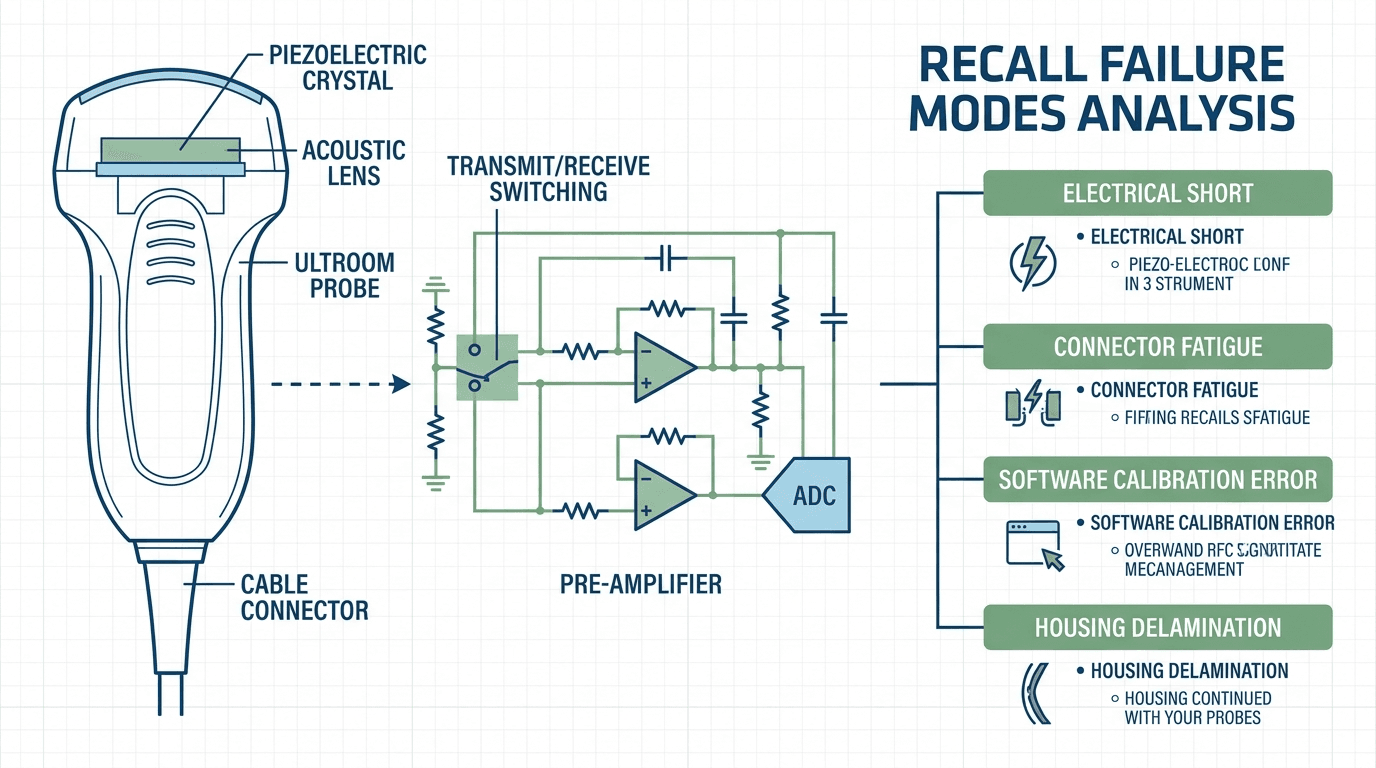
- Product Code ITX (21 CFR 892.1570): Transducer, Ultrasonic, Diagnostic. Encompasses all piezoelectric and capacitive micromachined ultrasonic transducer (CMUT) arrays, probe cables, acoustic lenses, strain reliefs, and connector housings across linear, convex, phased array, endocavity, and transesophageal (TEE) probes.
Between January 2000 and July 2026, a total of 527 distinct medical device recalls were logged across these three product codes in the FDA database. Product code IYN accounts for 298 recalls (56.6%), product code ITX accounts for 147 recalls (27.9%), and product code IYO accounts for 82 recalls (15.6%).
| Product Code | Regulation Number | Device Category Description | Total FDA Recalls | Share of Dataset |
|---|---|---|---|---|
| IYN | 21 CFR 892.1550 | Ultrasonic Pulsed Doppler Diagnostic System | 298 | 56.6% |
| ITX | 21 CFR 892.1570 | Diagnostic Ultrasound Transducer | 147 | 27.9% |
| IYO | 21 CFR 892.1560 | Diagnostic Ultrasound System Console | 82 | 15.6% |
| Total | — | Combined Diagnostic Ultrasound Scope | 527 | 100.0% |
Source: Source: openFDA Device Recall Database (IYO, IYN, ITX 2000–2026 analysis)
Understanding these denominators is critical for biomedical engineering leadership. The recall record is not a list of catastrophic equipment failures; rather, it reflects formal regulatory submissions when a manufacturer identifies a design defect, software anomaly, labeling contradiction, or manufacturing variance that requires field mitigation 1. By categorizing the root causes across these 527 actions, fleet managers can transition from reactive alert management to proactive, data-driven inspection protocols.
Which Failure Modes Dominate 527 Ultrasound Recalls, and What Do They Mean for a Buyer?
To transform raw recall entries into actionable intelligence, we categorized the free-text reason-for-recall descriptions and root-cause statements across all 527 records into eight distinct operational failure-mode buckets. The results demonstrate a striking concentration of risk in specific sub-assemblies.
| Failure Mode Category | Primary Root Causes & Defect Types | Recalls | % Share | Key Operational Risk for Fleet Buyers |
|---|---|---|---|---|
| Transducer / Probe-Related (all causes) | Hardware faults (lens delamination, element dropout, fluid ingress), useful-life labeling actions, coupling-gel and accessory recalls, and disinfection-compatibility recalls that name a transducer or probe | 238 | 45.2% | Broadest bucket: spans hardware defects, useful-life enforcement and accessory/gel recalls — see note below |
| Software & Firmware | Image freeze during live scans, Doppler depth calculation errors, boot loop lockups, OS compatibility bugs | 154 | 29.2% | Diagnostic inaccuracy during Doppler studies; unannounced system freezes in OR/ICU |
| Labeling & Instructions for Use | Unclear reprocessing IFU, missing useful-life warnings, symbol translation errors, incompatible chemical guidance | 38 | 7.2% | Improper disinfection degrading probe housing; premature retirement of functional probes |
| Electrical & Power Supply | PSU overheating, transformer short circuit, ground line noise leakage, battery backplane failure | 31 | 5.9% | Complete system boot failure; electrical safety test failure (IEC 62353) |
| Other / Administrative | Component supplier revisions, packaging seal integrity, administrative labeling corrections | 27 | 5.1% | Low direct clinical impact; requires tracking during routine PM checks |
| Infection Control & Disinfection | Chemical degradation of probe sealants by automated reprocessors (Trophon/CIDEX), disinfection residue | 24 | 4.6% | Cross-contamination risks; acoustic lens clouding from unapproved wipe chemicals |
| Quality / Manufacturing | Batch soldering flaws, non-conforming electronic components, assembly line tolerance drift | 9 | 1.7% | Intermittent board communication errors; shortened mean time between failures (MTBF) |
| Mechanical & Hardware | Cart caster brake release failure, monitor articulation arm latch failure, physical enclosure cracks | 6 | 1.1% | Ergonomic hazards; physical damage to control panel and display assemblies |
Source: Source: openFDA Device Recall Dataset; first-match keyword bucketing of reason_for_recall, root_cause_description and product_description for IYO/IYN/ITX. Shares are approximate and shift with the keyword method; a single recall can plausibly fit more than one bucket.
Together, transducer/probe-related recalls (about 45%) and software/firmware glitches (about 29%) account for roughly three-quarters (74%) of all ultrasound recalls over the past two decades. This finding directly refutes the common assumption among BioMed teams that main console power supplies or front-end beamformer boards represent the primary safety liability.
Reading this table correctly: the failure-mode shares come from keyword bucketing of free-text recall reasons, not a coded FDA field. A recall that names both a transducer and a software fix is counted once, in the first bucket it matches, so the exact percentages shift depending on how the keywords are drawn. The ranking, however, is robust under every reasonable keyword set we tested: transducers and probes are always the plurality category, software and firmware always second, with labeling, electrical and infection-control recalls trailing in single digits. Treat the figures as a distribution of reported recall reasons, not as device defect rates. One important nuance: the top bucket is “transducer / probe-–related,” not “hardware defects.” Most of its volume — and almost all of the 2025 spike — is useful-life labeling and accessory actions, not acoustic hardware faults. A deeper ITX-only decomposition finds that discrete transducer-hardware faults are only a minority of probe recalls while disposable gel and accessories account for a large share; see our ultrasound probe repair-vs-replace analysis for that device-level breakdown. The practical implication is that probe acceptance must cover hardware inspection, useful-life tracking and disinfection compatibility together — not hardware alone.
Transducer failures in the recall record predominantly involve physical wear vulnerabilities—such as acoustic lens delamination, strain relief sleeve tearing, and fluid ingress into the probe handle—that compromise electrical isolation or create acoustic signal attenuation. When evaluating pre-owned probes or accepting repaired units, BioMed teams must execute rigorous probe acceptance testing using acoustic phantom arrays and electrical safety analyzers rather than relying on simple visual inspection.
For complex transesophageal echocardiography (TEE) probes, where bending mechanism lockups and gastroscope shaft sheath punctures carry severe clinical consequences, understanding specific failure pathways is even more critical. Fleet managers dealing with specialized probes should reference our dedicated guide on TEE probe damage repair routes to determine whether a probe requires acoustic re-lensing, strain relief replacement, or complete insertion tube rebuild.
What Signals Does the 2025 Transducer Recall Spike Send for Probe Acceptance and Useful Life?
The historical baseline of ultrasound recalls remained relatively steady for years, averaging 15 to 25 recall initiations annually. However, data from 2025 reveals a dramatic regulatory shift: 119 recalls were initiated in 2025 alone—an increase of nearly 700% compared to 2024 (15 recalls) and 2022 (17 recalls).
A detailed examination of the 2025 recall records reveals that 105 out of the 119 recalls (88.2%) were transducer-related field safety actions initiated primarily by Philips Healthcare 4 5. These actions stemmed from extensive regulatory reviews concerning transducer useful-life boundaries, labeling clarifications regarding refurbished probe compliance, and software compatibility updates for live-imaging platforms.
In September 2025, the FDA issued a Warning Letter to Royal Philips (CMS #709948) specifically highlighting ultrasound transducer correction and removal obligations, useful-life definitions, and post-market surveillance for probe re-lensing and refurbishment 4.— U.S. Food and Drug Administration, Warning Letter CMS #709948 (Sept 9, 2025)
This enforcement surge highlights a critical compliance intersection for hospital equipment managers: the distinction between routine maintenance and remanufacturing under federal law. When an independent service organization (ISO) repairs or refurbishes an ultrasound probe—replacing acoustic crystal arrays, modifying strain reliefs, or re-potting acoustic lenses—the activity must strictly maintain original device specifications. Equipment buyers and ISO partners must understand servicing versus remanufacturing under FDA guidance to ensure that repaired probes remain fully compliant with 21 CFR Part 820 quality standards.
Furthermore, the 2025 transducer spike demonstrates that probe longevity cannot be treated as indefinite. As transducers age, acoustic potting compounds degrade, lens glues soften under repeated disinfectant exposure, and piezoelectric elements suffer acoustic depolarization. Procurement departments sourcing replacement probes must insist on documented parts provenance and quality evidence to verify that replacement transducers have undergone complete acoustic calibration and real-machine validation before clinical use.
Where Do Software Glitches and Labeling Recalls Change Fleet Acceptance Checks?
While physical hardware defects generate visible symptoms, software and labeling recalls present silent operational hazards. In our 527-recall dataset, software and firmware glitches accounted for 154 recalls (about 29%), while labeling and IFU errors comprised 38 recalls (about 7%).
Software recalls in diagnostic ultrasound typically manifest in three high-risk clinical scenarios:
- Live Image Freezing during Critical Procedures: Glitches in backend image acquisition software where the ultrasound display freezes during cardiac output measurement or vascular needle guidance while the status bar indicates active scanning.
- Doppler Calculation and Caliper Scaling Errors: Firmware bugs in signal processing software (product code IYN) that introduce mathematical scaling offsets in peak systolic velocity (PSV) or velocity time integral (VTI) calculations under specific display zoom modes.
- Operating System & DICOM Connectivity Faults: Incompatibilities following commercial operating system updates (such as mobile live-imaging app updates for iOS 18) or DICOM header corruptions that prevent patient study archiving.
| Initiation Year | Total Recalls Initiated | Probe / Transducer-Related |
|---|---|---|
| 2018 | 39 | 21 |
| 2019 | 15 | 12 |
| 2020 | 13 | 4 |
| 2021 | 61 | 27 |
| 2022 | 17 | 3 |
| 2023 | 14 | 3 |
| 2024 | 15 | 2 |
| 2025 | 119 | 105 |
Source: Source: openFDA Device Recall Dataset (IYO, IYN, ITX). Total is an exact count of recall initiations by year; the probe/transducer column is a keyword-bucketed subset and is approximate.
For biomedical engineers accepting pre-owned systems or replacing backend CPU/DSP boards, software patch verification is essential. Simply plugging in a replacement board and verifying that an image appears is insufficient. BioMed teams must confirm that the installed software revision matches approved OEM field safety revision levels, particularly when managing end-of-service critical spares planning for legacy ultrasound platforms where OEM software patches may no longer be actively pushed.
How Can Fleet Managers Turn Recall Patterns into Acceptance and Supplier Scorecards?
Data analysis is valuable only when it informs operational workflows. Based on the root causes identified across 527 FDA recalls, BioMed departments and hospital procurement teams should implement a structured, 3-phase quality check for all incoming ultrasound systems, replacement circuit boards, and transducers.
Phase 1: Transducer Physical & Acoustic Acceptance Protocol
- Visual & Tactile Inspection: Inspect acoustic lens under magnification for micro-delamination, pinholes, or edge lifting. Flex strain relief sleeve 90 degrees in four directions to verify rubber seal integrity and prevent fluid ingress.
- Electrical Safety & Leakage Testing: Conduct chassis and probe surface leakage current testing per IEC 62353 / IEC 60601-2-37 using a dedicated probe isolation test module before clinical connection.
- Acoustic Element Dropout Audit: Scan a multi-purpose tissue-mimicking phantom (e.g., CIRS or Gammex phantom). Perform a dead-element channel check across all array elements to verify zero acoustic shadow lines or element dropout.
Phase 2: Console & Electronic Board Verification
- Software Release Audit: Verify installed system software build against FDA field safety notices. Confirm firmware checksums on DSP, beamformer, and power management modules.
- Power Supply Voltage Stability Test: Measure DC output rail voltages under full acoustic load (high-PRF color Doppler mode) to ensure voltage ripple stays within ±2% tolerance.
- Thermal & Stress Burn-In: Run continuous stress testing for 4 hours on replacement beamformer (TX/RX) or backend image processing boards to detect thermal drift or intermittent solder joints.
Phase 3: Supplier Qualification & Documentation Audit
When evaluating independent parts suppliers or probe repair providers, procurement managers should apply an empirical scorecard. Do not rely on generic marketing statements. Utilize a standardized ultrasound supplier qualification scorecard to evaluate vendor ISO 13485 certification, FDA facility registration, real-machine test capability, and warranty terms.
When deciding whether to send damaged probes to an OEM or an independent repair facility, review our comparative analysis of OEM versus independent probe repair to balance turnaround speed, repair depth, and component provenance.
What Can FDA Recall Data Tell You—and What Can It Not?
A critical duty of medical device analysts is ensuring data is not misused. High recall volume for a specific manufacturer or product line does not prove that the brand's equipment is inherently unsafe or inferior to competitors.
Across the 527 recalls in our dataset, the distribution of recall entries by normalized recalling firm is led by Philips Healthcare (~130 recall rows), Siemens Healthineers (78 recalls), GE Healthcare (~38 recalls), Civco Medical Solutions (~36 recalls), Toshiba/Canon Medical (23 recalls), and Exact Medical (18 recalls).
To correctly interpret these numbers, BioMed leadership must account for three critical confounding variables:
- Installed Base Size & Market Share: Manufacturers with tens of thousands of ultrasound systems active in global clinical service naturally generate more field safety notices than smaller niche manufacturers.
- Granularity of Regulatory Reporting: Under FDA regulations, a single corrective action involving 20 different transducer models may be logged in openFDA as 20 individual recall entries (one per model number) or as a single master record, depending on how the manufacturer structures its RES submission.
- Corporate Quality Culture & Proactive Post-Market Surveillance: A high volume of voluntary Class III recall corrections often reflects a rigorous internal post-market quality management system that proactively catches minor labeling or software bugs before clinical incidents occur.
Furthermore, BioMed engineers must distinguish between FDA Recalls (firm-initiated corrective actions logged in the RES database 1) and FDA MAUDE Adverse Event Reports (passive surveillance reports filed by clinicians, patients, and manufacturers under 21 CFR Part 803). MAUDE reports contain unverified claims, anecdotal observations, and voluntary submissions that cannot be used to calculate incidence rates or establish medical device causality. Recall data reflects confirmed manufacturer corrections; neither dataset should ever be used to rank brand safety.
Where Rongtao Medical fits—and where it does not
Navigating ultrasound parts sourcing, probe repairs, and fleet maintenance requires absolute transparency regarding technical capabilities and service boundaries.
Where Rongtao Medical Fits:
- Component-Level Ultrasound Board Repair: We provide expert, component-level circuit board repair for GE, Philips, Siemens, Mindray, Toshiba/Canon, Hitachi/Fujifilm, and Samsung Medison systems—fixing power supplies, front-end beamformers, processing backplanes, and control panels.
- Tested Replacement Probes & Modules: We supply fully tested, pre-owned original transducers and replacement circuit modules, verified on actual OEM ultrasound consoles prior to shipment.
- Real-Machine Test Evidence: Every repaired board or probe is shipped with complete real-machine test documentation, acoustic image verification, and a standard 90-day warranty with typical 5–8 business-day turnaround.
- Multi-Brand Inventory & EOSL Support: We maintain extensive inventory for current and end-of-service (EOSL) ultrasound systems to keep hospital fleets operational.
Where Rongtao Medical Does Not Fit:
- No OEM Authorization or Affiliation: Rongtao Medical is an independent service provider. We do not represent ourselves as an authorized OEM service center or affiliated distributor.
- No Software Binary Modifications: We do not modify OEM operating system binaries, bypass software licensing, or alter clinical diagnostic calculation algorithms.
- No Clinical Reprocessing Services: We do not provide hospital-site high-level disinfection (HLD) or clinical reprocessing services.
Quote-ready buyer checklist: What to prepare before sourcing ultrasound probes or boards
When a clinical unit reports an ultrasound fault or a probe fails acceptance testing, rapid resolution depends on clear technical communication. Sourcing replacement parts or board repair services without complete data causes delays.
Before requesting a technical quote or sending a board/probe for repair, prepare the following 5-point evidence package:
- 1. System Identification: Exact OEM brand, system model name, and installed software/hardware revision (e.g., GE Logiq E9 Revision 5.0.2, Philips EPIQ 7 Software v4.0.1).
- 2. Part or Transducer Identification: Complete manufacturer part number, assembly part number, and serial number (e.g., GE C1-5-D Probe Part #5393900; Philips Power Supply Part #453561412341).
- 3. Visual Label Documentation: High-resolution photographs showing both sides of the circuit board, component labels, PCB revision markings, and barcode stickers.
- 4. Detailed Symptom & Error Code Description: Exact clinical failure behavior (e.g., 'System powers on but displays Error Code 004 on beamformer initialization', 'Vertical dark line on acoustic image during linear probe scanning').
- 5. Operational Handoff Details: Required turnaround timeframe, quantity, and destination delivery address.
Frequently Asked Questions
Q1: Does a high recall count mean one ultrasound brand is less safe than another?
No. FDA recall volume reflects manufacturer reporting activity, total installed equipment base size, and corporate corrective action policies. A high number of voluntary Class III labeling or software recalls often indicates proactive post-market surveillance rather than poor product safety. Recall metrics should never be used as a brand safety ranking.
Q2: How do I check whether a specific ultrasound system or probe is currently recalled?
You can search the public openFDA Medical Device Recall database or the FDA Medical Device Recalls RES portal using the specific device model name, 510(k) number, product code (IYO, IYN, ITX), or manufacturer recall number (e.g., Z-number). Biomedical departments should also subscribe to official FDA MedWatch alerts.
Q3: Should the recall pattern change how I accept a used ultrasound system or replacement probe?
Yes. Because about 45% of historical recalls are transducer- or probe-related and about 29% involve software/firmware, BioMed acceptance testing must extend beyond basic cosmetic checks. Incoming probes should undergo acoustic phantom scan testing, acoustic element dropout analysis, and electrical leakage testing. Systems should undergo software release verification against known field safety bulletins.
Q4: What is the difference between an FDA recall and a MAUDE adverse-event report?
An FDA Recall (logged in RES) represents a confirmed field correction, removal, or labeling action initiated by the device manufacturer or mandated by the FDA. An FDA MAUDE report (under 21 CFR Part 803) is a passive surveillance submission detailing an alleged device malfunction, injury, or death. MAUDE reports are unverified, self-reported, and cannot establish device defect rates or causality.
Q5: Do these recall patterns apply to probes and boards from an independent service organization too?
Yes. Independent service organizations (ISOs) repairing or supplying replacement probes and circuit boards must meet identical functional and safety standards. Repaired probes must maintain original acoustic design specifications, and replacement boards must be verified for software and hardware compatibility prior to clinical deployment.