
Summary
When a hospital clinical engineering department, an independent service organization (ISO), or an international diagnostic imaging parts distributor evaluates a repaired ultrasound transducer or a replacement console subassembly—such as a transmit/receive (TX/RX) beamformer board, a high-voltage power supply module, an operator control panel, or an organic light-emitting diode (OLED) monitor—the transaction is frequently accompanied by a bundle of standards references. Vendor certificates of conformance and repair bench sheets routinely invoke IEC 60601-1, IEC 60601-2-37, IEC 62353, IEC 63077, and ISO 13485:2016 as if those five designations were interchangeable badges of "FDA-recognized compliance." They are not 1 4 6 7.
Each standard addresses a different engineering question and stage of the device lifecycle. A scoped post-repair electrical test under IEC 62353 can provide evidence about the electrical characteristics tested; it does not establish complete acoustic, thermal, biological, or essential-performance conformity. Those questions require evidence appropriate to the changed component, device configuration, applicable standard edition, and manufacturer instructions. A supplier should identify what its testing covers and any exclusions. Competent outsourced testing may be appropriate; ownership of a particular analyzer, hydrophone, or water tank is not a universal prerequisite for an acceptable supplier 4 5 8 16.
In 2026, three convergent regulatory milestones make technical precision around these standards essential for every organization that repairs ultrasound probes or supplies replacement imaging parts:
- Full Enforcement of the Quality Management System Regulation (
QMSR,21 CFR Part 820): Under the Food and Drug Administration's (FDA) February 2, 2024 Final Rule (Medical Devices; Quality System Regulation Amendments,89 FR 7496, Document2024-01709), which took legal effect on February 2, 2026, FDA incorporatedISO 13485:2016(Medical devices — Quality management systems — Requirements for regulatory purposes) and Clause 3 ofISO 9000:2015directly by reference into21 CFR § 820.76. While21 CFR § 820.1(a)explicitly binds original equipment manufacturers (OEMs) and remanufacturers (21 CFR § 820.3(a)),21 CFR § 820.1(a)(2)retains the component-and-parts exemption ("The provisions of this part do not apply to manufacturers of components or parts of finished devices, but such manufacturers are encouraged to consider provisions of this regulation as appropriate"), and FDA has continued to distinguish routine third-party servicing from regulated remanufacturing 1 3 6. - Implementation of FDA's May 10, 2024 Final Remanufacturing Guidance (
GUI00017048): In Remanufacturing of Medical Devices: Guidance for Industry, Entities That Perform Servicing or Remanufacturing, and Food and Drug Administration Staff (GUI00017048, DocketFDA-2018-N-3741-0098, printed pp. 1–37), FDA formalized six guiding principles, a three-node hardware decision flowchart (Figure 1:Node A1/A1.1patient-contacting materials,Node A2/A2.1component addition/removal or dimensional/performance specification changes, andNode A3/A3.1cumulative risk and performance/safety specification changes), software maintenance criteria (Section VII), and explicit expectations for demonstrating continued conformity to applicable FDA-recognized consensus standards (Section VI.B, p. 14) 1. As FDA notes in the document header, guidance documents state the Agency's current thinking and nonbinding policy recommendations unless specific statutory or regulatory requirements—such as21 CFR § 820.3(a)or21 CFR § 807.81(a)(3)—are cited 1 6 10. - FDA Recognition List Number
064(90 FR 27312, June 26, 2025) and the2028Ultrasound Standards Transition: In Recognition List064(Federal Register Document2025-11792), FDA recognizedIEC 60601-2-37 Edition 3.0 2024-07(Recognition#12-380),IEC 62127-2 Edition 2.0 2025-01(Recognition#12-379), andIEC 62127-3 Edition 2.0 2022-12(Recognition#12-377), while assigning a07/02/2028transition expiration date to their superseded editions (IEC 60601-2-37 Edition 2.1 2015[#12-293],IEC 62127-2 Edition 1.2[#12-291], andIEC 62127-3 Edition 1.1[#12-279]) 4 5.
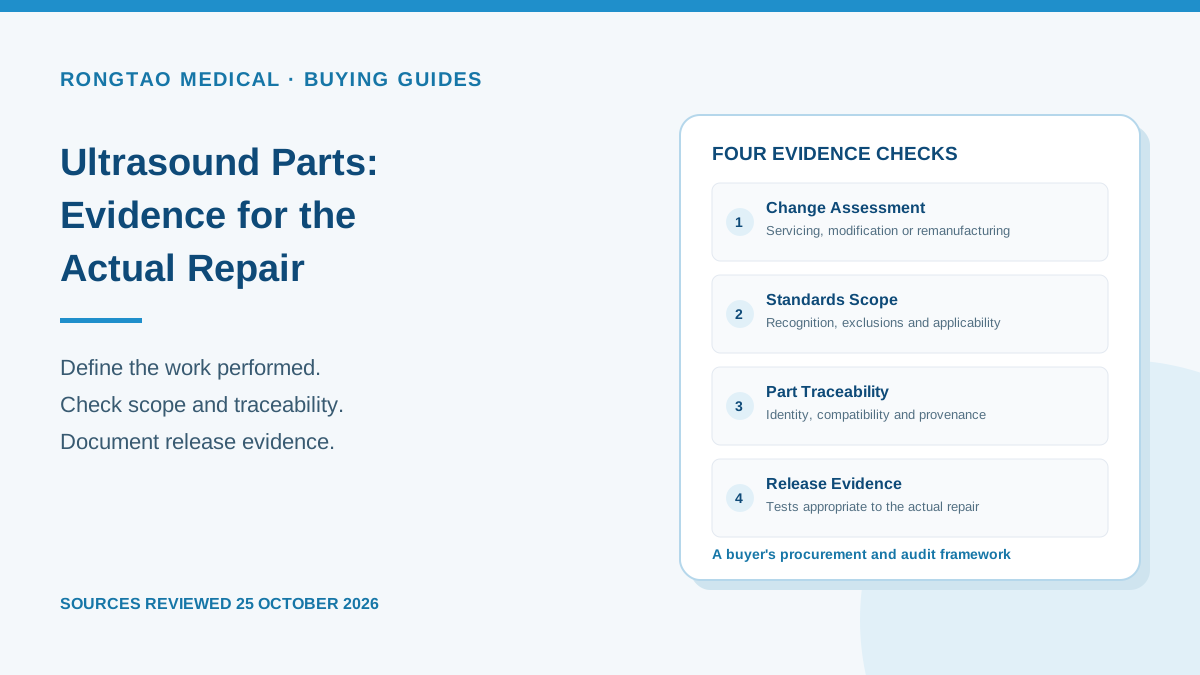
This report is a US-focused procurement and evidence-assessment guide for hospital engineering teams, independent service organizations, and parts buyers. It is not a repair procedure or a substitute for device-specific instructions and competent engineering assessment. Its central question is whether the evidence offered for a replacement part actually covers the changed component and the finished-device configuration. Recognition of a standard, a supplier certificate, a bench test, and FDA clearance each answer a different question. Buyers need to connect them without treating one as proof of all the others.
1. The Regulatory and Market Context for Diagnostic Ultrasound Parts and Probe Servicing
1.1 How FDA Classifies Diagnostic Ultrasound Consoles, Transducers, and Image Processing Subsystems
Under 21 CFR Part 892 Subpart B (Diagnostic Devices), diagnostic ultrasound systems and transducers are regulated as Class II medical devices subject to premarket notification (510(k)) clearance and general and special controls 8 9. Rather than requiring a separate 510(k) for every routine field repair or replacement component, FDA clears the finished console and its compatible transducer portfolio under a harmonized product-code architecture and evaluates post-distribution modifications under the remanufacturing definition in 21 CFR § 820.3(a) and the 510(k) modification trigger in 21 CFR § 807.81(a)(3) 1 6 9 10.
To establish the regulatory baseline for ultrasound equipment in service across U.S. healthcare facilities, Table 1 summarizes the five core diagnostic ultrasound and radiological image-processing product codes extracted from the 7,093-record openFDA Device Classification dataset (vayomed/openfda-device-classification, snapshot 2026-09-21) 9.
Methodological Scope Note on openFDA Classification Array Counts: In FDA's harmonizeddevice/classificationendpoint,openfda.k_numberarray lengths record the number of510(k)clearance identifiers linked to that product code in the openFDA harmonization table (not a census of active commercial models or market volume), andopenfda.registration_numberarray lengths record the number of linked establishment registration identifiers (not a count of active device listings or third-party service depots, since non-remanufacturing servicers are not required to register under21 CFR § 807.20) 1 9 10.
| Product Code | Official FDA Device Name | 21 CFR Regulation Citation | Device Class | Premarket Submission Type | 3P510k Eligible (third_party_flag) | Linked K-Number Identifiers (k_number_count) | Linked Establishment Registration Identifiers (registration_number_count) | Primary Hardware / Subassembly Scope in Field Servicing |
|---|---|---|---|---|---|---|---|---|
IYN | System, Imaging, Pulsed Doppler, Ultrasonic | 21 CFR § 892.1550 | Class 2 | 510(k) (Type 1) | Y | 1,183 | 223 | Mainframe consoles, transmit/receive (TX/RX) beamformer boards, Doppler signal processors, high-voltage power supplies (HVPS), trackballs/control panels, and cooling fans 8 9. |
IYO | System, Imaging, Pulsed Echo, Ultrasonic | 21 CFR § 892.1560 | Class 2 | 510(k) (Type 1) | Y | 894 | 355 | B-mode/M-mode/3D/4D consoles, front-end multiplexer (MUX) boards, back-end motherboards, internal batteries, and primary diagnostic displays 8 9. |
ITX | Transducer, Ultrasonic, Diagnostic | 21 CFR § 892.1570 | Class 2 | 510(k) (Type 1) | Y | 414 | 401 | Linear, curved, phased-array, 3D/4D mechanical volume, endocavitary, and transesophageal (TEE) probes: acoustic lenses, matching layers, PZT/single-crystal arrays, housings, bending rubbers, strain reliefs, coaxial cable harnesses, and system connectors 2 8 9. |
LLZ | System, Image Processing, Radiological | 21 CFR § 892.2050 | Class 2 | 510(k) (Type 1) | Y | 2,287 | 636 | PACS workstations, DICOM review displays, cine-loop storage modules, and image post-processing hardware 9. |
QIH | Automated Radiological Image Processing Software | 21 CFR § 892.2050 | Class 2 | 510(k) (Type 1) | N | 326 | 237 | Automated contour, Doppler envelope measurement, and quantitative image-analysis software modules (ineligible for 3P510k review) 9. |
Table 1: Diagnostic ultrasound and radiological image-processing product classifications in the openFDA Device Classification snapshot (2026-09-21, 7,093 total product codes) 9.
The three acoustic codes have linked-identifier array lengths of 1,183 (IYN), 894 (IYO), and 414 (ITX), summing to 2,491 entries. That sum is not a deduplicated count of unique clearances across codes. A system or submission can appear in more than one harmonized relationship. The arrays do not establish current installed units, active suppliers, sales, or an explanation for differences in identifier ratios. Use the records to find the actual device and its authorized configuration, not to estimate a replacement-parts market from a linkage count 9.
1.2 Empirical Scale of the U.S. Servicing Ecosystem and Federal Ultrasound Repair Spending
Why does FDA treat component replacement and probe repair under a dedicated servicing-versus-remanufacturing framework rather than requiring every repair depot to register as a finished-device manufacturer? In its May 2018 report to Congress mandated by Section 710 of the FDA Reauthorization Act of 2017 (FDARA)—FDA Report on the Quality, Safety, and Effectiveness of Servicing of Medical Devices (printed pp. i–iii, 1–28)—FDA documented both the vast scale of the medical device servicing ecosystem and the empirical safety record of routine servicing versus unauthorized remanufacturing 3:
- Estimated Size of the U.S. Servicing Industry (
16,520 to 20,830Firms): Because non-remanufacturing third-party servicers and hospital biomedical engineering departments are not required to register with FDA under21 CFR Part 807, FDA queried Dun & Bradstreet (D&B) commercial records by Standard Industrial Classification (SIC) codes and identified4,791firms (Section 5.1, p. 19) 3. When FDA cross-checked those4,791records against a convenience sample of130known third-party medical device servicers, only34(26%) appeared in theD&BSIC query (p. 19). Extrapolating from that26%capture rate, FDA estimated that between16,520and20,830firms perform medical device servicing in the United States (Section 5.1, p. 19) 3. - Multi-Source Safety Evidence (
Section 5.2–5.5, pp. 19–22): - Peer-Reviewed Literature (
Section 5.2, pp. 19–20): Screening502candidate articles yielded26full-text papers and only1comparative empirical study of OEM versus third-party servicing quality 3. - ECRI Institute Multi-Database Review (
Section 5.3, pp. 20–21): Across2,114,303Medical Device Reporting (MAUDE) records,528Health Devices Alerts (HDA) Tracker records, and692ECRI accident investigations, ECRI identified just86MAUDE reports (0.004%),4HDA reports (0.8%), and6accident investigations (0.9%) linked to device servicing or maintenance 3. - FDA Internal MAUDE Analysis Through June 30, 2017 (
Section 5.4, pp. 21–22): FDA identified4,301MDRs mentioning third-party servicers (40deaths,294serious injuries,3,791malfunctions, and176other reports). Manual review of the40death reports showed that only3deaths had a clear causal link to servicing activities, while1additional death resulted from an unapproved remanufactured nuclear medicine imaging camera detaching from its gantry and falling onto a patient (p. 21) 3. - CDRH Trade Complaints Since 2009 (
Section 5.5, p. 22): Among68relevant trade complaints submitted to CDRH since 2009 alleging unsafe servicing or unauthorized device alterations,28(41.18%) actually involved remanufacturing (such as substituting unvalidated materials, reverse-engineering safety-critical parts to different specifications, or altering device software/hardware outside OEM parameters), whereas40(58.82%) involved inadequate servicing—and of those40servicing complaints,29(72.50%) involved OEMs,10(25.00%) involved ISOs, and1(2.50%) involved user neglect (p. 22) 3.
FDA's 2018 report found insufficient objective evidence of a widespread public-health concern from servicing to justify the additional regulation discussed there. It also identified the importance of distinguishing servicing from remanufacturing. The complaint and MDR counts are not exposure-adjusted rates: they lack denominators for service events, device use, provider activity, and reporting completeness. They cannot establish that OEM or independent servicing is comparatively safer, nor that an individual repair is acceptable. That historical policy assessment is context for the current framework, not a substitute for evaluating the work being purchased 3.
The preserved USAspending extract provides a bounded procurement context: it selects the 10,000 awards with the highest obligated values in each of J065 and J066, broad medical and laboratory equipment repair categories. Recorded obligations total $6,576,249,940.06 and $4,405,053,039.35 respectively in those selected sets. A case-insensitive OR screen of J065 top-level award descriptions uses 17 terms: ultrasound, sonograph, echocardiograph, transducer, probe, vivid, logiq, voluson, epiq, affiniti, acuson, xcelera, ie33, iu22, cx50, bk medical, and sonosite. It produces the candidate subset below; broad terms such as probe do not establish that every selected award concerns ultrasound. These are selected award records, not a census of service transactions or a measure of the entire ultrasound repair market 12.
| Dataset Stratum / Fiscal Year (USAspending.gov Snapshot 2026-08-26) | Award Count (n) | Total Obligated Amount (USD) | Median Award Value (USD) | Mean Award Value (USD) | Award Value Range (Min – Max USD) | Scope & Agency Concentration Notes |
|---|---|---|---|---|---|---|
PSC J065 Top-10,000 Sample (All Years, FY1999–FY2026) | 10,000 | $6,576,249,940.06 | $309,940.00 | $657,624.99 | $161,012.70 – $55,650,956.83 | Medical, dental, and veterinary equipment maintenance, repair, and rebuilding (top-10,000 awards by obligated dollars) 12. |
PSC J066 Top-10,000 Sample (All Years, FY1999–FY2026) | 10,000 | $4,405,053,039.35 | $219,009.10 | $440,505.30 | $112,265.17 – $98,872,304.90 | Laboratory and scientific instrument maintenance, repair, and rebuilding (top-10,000 awards by obligated dollars) 12. |
PSC J065 — FY2023 Cohort | 615 | $424,047,876.96 | $358,480.00 | $689,508.74 | $161,093.02 – $19,356,645.24 | Full fiscal year within the top-10,000 J065 sample 12. |
PSC J065 — FY2024 Cohort | 716 | $510,634,065.42 | $365,272.67 | $713,176.07 | $161,100.00 – $13,195,902.50 | Peak recent annual award volume in the J065 sample 12. |
PSC J065 — FY2025 Cohort | 520 | $301,136,447.67 | $336,617.34 | $579,108.55 | $161,012.70 – $10,598,083.39 | Full fiscal year within the top-10,000 J065 sample 12. |
PSC J065 — FY2026 Cohort (Partial Year through 2026-08-26) | 234 | $115,023,110.60 | $313,651.68 | $491,551.75 | $161,401.20 – $5,418,756.39 | Partial fiscal year through August 26, 2026 snapshot cutoff 12. |
PSC J065 — 17-Term Keyword-Selected Candidate Subset | 81 | $45,047,778.93 | $340,276.21 | $556,145.42 | $164,445.86 – $3,830,239.30 | Awards matching at least one of the 17 stated terms in description; not individually verified as ultrasound contracts: 72 VA (88.89%), 6 DoD (7.41%), 3 HHS (3.70%) 12. |
Table 2: Federal medical and laboratory equipment maintenance and repair contract benchmarks from the USAspending.gov top-10,000 per-PSC dataset (snapshot 2026-08-26) 12.
The 81 broad keyword-selected candidate awards total $45,047,778.93 in whole-award obligations, with a median of $340,276.21; 72 of the 81 are associated with Veterans Affairs. A contract may cover multiple modalities or services, so its full obligation is not necessarily ultrasound-specific spending. A description without the keyword can still cover ultrasound work. Selection of the largest awards omits smaller purchases, and award obligations are not unit prices or annual market revenue. Fiscal-year groupings follow the extract's recorded award-year field; they should not be treated as fiscal-year transaction spending. No per-probe repair-price estimate is derived from this dataset 12.
2. Inside FDA's Recognized Consensus Standards Database (2026-08-26 Snapshot): What Is Recognized under Section 514(c) and Why IEC 62353, IEC 63077, and ISO 13485 Are Absent
2.1 How Section 514(c) Consensus Standards Recognition Works
Under Section 514(c) of the FD&C Act (21 U.S.C. § 360d(c)), as explained in FDA's September 14, 2018 final guidance Appropriate Use of Voluntary Consensus Standards in Premarket Submissions for Medical Devices (83 FR 46738, Document 2018-19989), FDA publishes notices in the Federal Register recognizing all or part of national and international voluntary consensus standards developed by standards development organizations (SDOs) such as the International Electrotechnical Commission (IEC), the International Organization for Standardization (ISO), the Association for the Advancement of Medical Instrumentation (AAMI), and the National Electrical Manufacturers Association (NEMA) 4 5 7.
When a standard is listed in FDA's Recognized Consensus Standards database with an active Recognition Number and a corresponding Supplemental Information Sheet (SIS), a sponsor submitting a 510(k), De Novo request, IDE, or PMA may submit a formal Declaration of Conformity (DOC) under Section 514(c)(1)(B) certifying that its device conforms to the recognized standard (or the recognized clauses of a partially recognized standard), reducing the volume of raw test reports that must be reviewed from scratch 7. Crucially, however, Section 514(c) recognition is engineered specifically for premarket review of finished medical devices 7.
In our preserved snapshot of the FDA Recognized Consensus Standards database (the preserved source extract, snapshot 2026-08-26), there are 1,898 normalized recognition rows spanning 1,740 unique FDA recognition numbers (the 158-row difference reflects dual-designated international and U.S. national adoptions—such as IEC and ANSI/AAMI—that share a single FDA recognition number in the normalized table) 4:
1,722rows (90.73%) carryCompleterecognition, whereas176rows (9.27%) carryPartialrecognition (meaning specific clauses, notes, or annexes are excluded from FDA's recognition as detailed in the standard'sSIS) 4 7.267rows (14.07%) carry an activetransition_expiration_date, indicating that a newer edition of the standard has been recognized in a Federal Register Modification List (such as Recognition List064,90 FR 27312, June 26, 2025) and that the older edition remains acceptable in premarket submissions only through the stated transition cutoff 4 5.- Across FDA's
18Specialty Task Group Areas,Radiologyaccounts for150rows (7.90%)—ranking fourth behindDental/ENT(238,12.54%),Materials(230,12.12%), andSterility(164,8.64%), and ahead ofOrthopedic(146,7.69%),InVitro Diagnostics(138,7.27%),General Plastic Surgery/General Hospital(134,7.06%),Software/Informatics(129,6.80%),Cardiovascular(90,4.74%),Anesthesiology(85,4.48%),Biocompatibility(72,3.79%),General I (QS/RM)(47,2.48%), andGeneral II (ES/EMC)(41,2.16%) 4.
2.2 Master Matrix of FDA-Recognized vs. Non-514(c) Standards Governing Ultrasound Parts and Probe Repair
When we query all 1,898 rows (1,740 unique recognition numbers) of the FDA Recognized Consensus Standards snapshot (2026-08-26) alongside FDA's June 26, 2025 Federal Register Notice for Recognition List 064 (90 FR 27312, Document 2025-11792) and the QMSR Final Rule (89 FR 7496), a striking structural pattern emerges: the acoustic and electrical design standards (IEC 60601-2-37, IEC 60601-1, IEC 60601-1-2, IEC 62127-1/-2/-3, IEC 62359, IEC 61391-1/-2, IEC 61161, ISO 14971, ISO 10993-1, and IEC 62304) are all formally recognized in the Section 514(c) database, whereas IEC 62353, IEC 63077, and ISO 13485 have exactly 0 rows in the Section 514(c) CSV 4 5 6. Table 3 documents the exact recognition status, transition deadlines, and technical scope of each standard.
| Standard or framework | Relevant question | Evidence boundary |
|---|---|---|
| IEC 60601-2-37:2024, FDA recognition 12-380 | Ultrasound basic safety and essential performance | Read the applicable edition and recognition sheet; recognition is not a certificate for a repaired unit 4 5 |
| IEC 60601-2-37:2015, recognition 12-293 | Earlier-edition declarations during transition | The July 2, 2028 date concerns acceptance of declarations for premarket submissions; it does not automatically revoke installed-device clearance 4 5 |
| IEC 60601-1, recognition 19-49 | General electrical safety and essential performance | FDA's sheet calls for applicable US national differences; an international-edition claim alone may be incomplete 14 |
| IEC 60601-1-2, recognition 19-36 | Electromagnetic disturbances | Evaluate the relevant configuration and impact of the change, rather than substituting a basic leakage test 4 |
| IEC 62127 series; IEC 62359 | Acoustic measurement and index determination | Measurement methods and models do not by themselves prove all-device conformity 4 8 |
| ISO 14971:2019, recognition 5-125 | Lifecycle risk management | Risk analysis connects the change to hazards and verification; a template alone does not establish acceptability 1 4 |
| ISO 10993-1:2025, recognition 2-313 | Biological evaluation within risk management | Partial recognition, including exclusions stated in the recognition sheet; evaluate the finished device and contact context 15 |
| ISO 10993-1:2018, recognition 2-258 | Earlier biological-evaluation edition | Transition through July 1, 2029; read the sheet's limits, including the treatment of Annex A Table A.1 15 |
| IEC 62304, recognition 13-79 | Software lifecycle processes | A component replacement does not confer authorization to alter software or its clinical function 4 |
| IEC 62353:2014 | Recurrent and post-repair testing | Select methods and limits for actual equipment classification, instructions and configuration; not complete type testing 16 |
| IEC 63077:2019 | Refurbishment process for medical imaging equipment | Process conformity does not decide FDA servicing versus remanufacturing status 17 |
| ISO 13485:2016 / QMSR | Quality-system obligations for entities within scope | Regulatory incorporation and third-party certification are different; neither alone authorizes marketing a device 6 |
Table 3. Standards and regulatory frameworks answer different evidence questions; exact recognition scope must be checked in the applicable FDA sheet.
2.3 Absence from a recognition snapshot is not an FDA explanation
The inspected recognition snapshot has no rows for IEC 62353, IEC 63077, or ISO 13485. This is a bounded observation about that dataset, not evidence of FDA's motives or a conclusion that the standards are irrelevant. FDA's voluntary consensus-standards program is one route for supporting premarket submissions; operational standards can have other roles. ISO 13485 has a separate legal role through incorporation in QMSR 4 6 7.
Using a recognized standard is generally voluntary, subject to any separately applicable legal requirement. Recognition helps define when a declaration of conformity can support a submission; it does not make the complete standard a universal legal obligation for every repair. Conversely, not appearing in a snapshot does not prohibit appropriate use of an operational standard. A supplier should state the applicable standard, edition, scope, methods, exclusions, and configuration rather than advertise “FDA standards compliance” without those details 7.
IEC 62353 addresses testing before service, during maintenance or inspection, after repair, and recurrent testing within its scope. IEC 63077 addresses refurbishment practices. These scopes explain why they may be useful to a service organization, but they do not prove why FDA did or did not list them. A buyer's contract can specify justified evidence expectations without falsely presenting every contractual requirement as federal law 16 17.
3. What a test report can establish about a repaired ultrasound device
A test report is most useful when its claim is narrow enough to be checked. The buyer should be able to identify the tested unit or representative configuration, the work performed, the method and edition, the acceptance basis, the result, and the limits of the conclusion. “Passed” without those elements does not explain whether the relevant consequences of the repair were assessed. A useful acceptance record connects the change to a risk assessment and then to the selected verification evidence. This is a recommended purchasing approach, not a claim that FDA mandates one report template 1.
3.1 Acoustic performance and configuration coverage
FDA's diagnostic ultrasound guidance distinguishes the evidence needed for systems and transducers, including acoustic output and display-related matters. A probe is used with a console, software, operating mode, and accessories. A repair claim therefore needs a defined configuration. A report from one probe model on one system cannot be assumed to cover every connector-compatible platform or every software release. The appropriate breadth of evidence depends on the changed component and the potential effect on the finished device 8.
For a cable, connector, array, lens, or related component, ask what engineering characteristic changed and why the selected evidence addresses it. Electrical continuity and element-response checks may identify particular faults. Phantom imaging may address particular imaging characteristics. Acoustic output measurements address another set of questions. None should be marketed as an automatic substitute for the others. The absence of an obvious image artifact is not, by itself, proof of acoustic output, thermal behavior, electrical insulation, biological compatibility, or complete essential-performance conformity.
Thermal and mechanical indices are conditional, model-based indicators. They should not be represented as direct guarantees of temperature rise or patient safety, and their implementation should not be assumed to reside in the same memory component across every device. A change affecting output or its displayed indication needs a device-specific assessment. A buyer does not need to prescribe an improvised test protocol; the buyer needs the supplier to explain the applicable method, configuration coverage, and justified acceptance criteria 8.
The 2024 edition of IEC 60601-2-37 should not be characterized by copying temperature numbers from an earlier amendment. The full current clause has not been independently established for every configuration considered here, so this article does not supply universal temperature limits, immersion procedures, test voltages, or acceptance thresholds. Those belong in the applicable standard, manufacturer instructions, and a competent laboratory's controlled method. This limitation prevents a procurement article from becoming an unreliable operating procedure 4 5.
A laboratory report should identify calibration and measurement uncertainty where relevant, distinguish measured quantities from calculated indices, and explain representative or worst-case selection. It should also identify exclusions. If only a subset of configurations was examined, the supplier should provide a rationale for the claimed coverage rather than leaving the customer to assume that all combinations are equivalent. Outsourced competent testing can be appropriate; ownership of an in-house tank or analyzer is not a universal prerequisite for an acceptable supplier.
For a buyer, the practical distinction is between a unit-release check and design or component qualification. The first asks whether the repaired unit meets the specified release criteria. The second asks why the replacement design or material is suitable for the covered configurations. A passing unit check cannot automatically resolve an unsupported design change, and a qualification report cannot substitute for identifying and inspecting the actual returned unit. Both may be needed, but their extent should follow the repair's risks rather than a fixed document count.
3.2 Electrical safety, biological evaluation, and reprocessing are separate questions
IEC 60601-1 and the ultrasound particular standard address basic safety and essential performance; IEC 60601-1-2 addresses electromagnetic disturbances. IEC 62353 has a recurrent/post-repair scope. A field electrical test does not establish full conformity to every type-test requirement. Equally, repeating a development-stage stress test on an installed device without a justified procedure is not automatically the correct release method. The actual device labeling, protection class, applied-part type, construction, instructions, and repair scope determine which method and limit are appropriate 14 16.
| Evidence category | Buyer should establish | Claim that does not follow automatically |
|---|---|---|
| Post-repair electrical test | Device classification, selected method, applicable limit, equipment identification, result | Complete IEC 60601 conformity |
| EMC impact assessment | Changed shielding, grounding, components, configuration and justified verification | All electromagnetic immunity from a leakage-current result |
| Biological evaluation | Finished-device materials/processes, contact nature and duration, existing evidence and remaining gaps | Suitability from raw-material certification alone |
| Reprocessing compatibility | Relevant OEM process, material compatibility and validated use conditions | High-level disinfection from a wipe-compatibility test |
| Imaging or array assessment | Measured characteristic, configuration and acceptance basis | Complete acoustic, thermal or clinical-performance equivalence |
Biological evaluation is a risk-management process, not a universal three-test package based only on a short contact duration. Patient-contact nature, duration, finished-device materials, manufacturing and repair residues, processing history, and available evidence all matter. ISO 10993-23 concerns irritation; it should not be cited as a sensitization standard. Substitution of a lens, adhesive, coating, or housing material may require a different assessment from replacing an internal part that does not contact the patient. The assessment should establish which endpoints and evidence are relevant rather than automatically demanding or omitting a fixed list 15 18.
Material compatibility with a disinfectant is also different from validation of microbial effectiveness. A quaternary-ammonium wipe should not be described generically as high-level disinfection. Probe contact category and the OEM's validated processing instructions matter, and a wet bench test or workshop handling may mean that appropriate reprocessing remains necessary before clinical use. The buyer should ask how the device is returned, what processing has been completed, and what the receiving facility must still do. This article does not prescribe concentrations, immersion times, or a substitute infection-control protocol 19.
3.3 Refurbishment process evidence and finished-device claims
IEC 63077 describes good refurbishment practices for medical imaging equipment. A refurbishment system can help organize selection, restoration, installation, and support. Its scope does not remove the need to assess the actual work against FDA's servicing/remanufacturing distinction. A company can have a documented refurbishment process and still perform a particular activity that significantly changes a finished device. Conversely, cosmetic or maintenance activity should not be called remanufacturing solely because it is performed by a third party 17 1.
The same distinction applies to an ISO 13485 certificate. Confirm the certificate's entity, site, scope, and status, but do not treat it as FDA clearance, approval of a replacement probe, or proof that every supplied part is appropriate for a particular system. Quality-system controls describe how work is managed. Device authorization and configuration-specific evidence address what may be marketed and what the particular product can support. A purchasing decision should resolve both without conflating them 6 10.
4. Apply the current remanufacturing framework to the actual work
4.1 Significant change requires an assessment, not a label
FDA's 2024 final guidance explains how to evaluate activities against the definition of remanufacturing: work that significantly changes a finished device's performance or safety specifications or intended use. The guidance is nonbinding except where it cites existing requirements. Calling work “repair,” “refurbishment,” or “OEM-equivalent” does not decide the regulatory question. The assessment should examine the device after the activity, including interactions and cumulative changes, not only whether the replacement part fits mechanically 1.
The guiding principles include examining changes to intended use, evaluating risk, considering cumulative effects, and assessing the finished device rather than assuming that a non-OEM part is categorically unacceptable. Incomplete specifications create an evidence problem that must be resolved; their absence does not itself prove that the activity is remanufacturing. Similarly, use of a non-OEM component is not automatically the manufacture of a new finished device. The nature and significance of the resulting change are the central questions 1.
Use FDA's complete Figure 1 and accompanying explanations for the hardware assessment. Do not simplify the flowchart into “any new risk means remanufacturing.” Its patient-contacting-material, component/specification, and risk questions have follow-up significance assessments. In particular, the A3 branch includes A3.1; a positive answer about a new risk or modified risk control must not skip the subsequent assessment of significant change. When available evidence cannot support a conclusion, record the uncertainty and obtain the missing information or appropriate FDA input rather than manufacture a categorical answer 1.
A practical internal record can state: the device and baseline configuration; the reason for work; the component, material, software, or specification affected; the identified hazards and controls; the evidence used to evaluate significance; cumulative prior changes; and the resulting conclusion with limitations. This is an author-proposed record structure. It does not replace the FDA flowchart or create a new legal exemption. If the conclusion is remanufacturing, evaluate the applicable manufacturer obligations and separately determine whether a new premarket submission is required under the relevant rules 1 10.
For software, an authorized service activity and the right to purchase a board or software copy are different matters. Identify the software version and what the activity changes; assess functionality, specifications, intended use, cybersecurity and other relevant risks under the applicable framework. Do not infer authorization to activate a new clinical function from a hardware purchase or a successful boot test. Likewise, replacing a component in an existing device and marketing a newly supplied complete probe may raise different finished-device questions 1.
4.2 Keep historical discussion examples separate from final policy
FDA's 2018 white paper was a public-workshop discussion document. Its ultrasound and circuit-board scenarios help illustrate questions raised during policy development; they should not be cited as final FDA determinations that a particular replacement is servicing or remanufacturing. The operative 2024 final guidance supplies the current framework. Similar-sounding examples from the two documents should not be merged or assigned each other's example numbers 2 1.
The final guidance's Appendix B includes a Pump ABC example involving an identical OEM door, not the invented third-party battery-door qualification scenario sometimes inferred from it. Its illustrative documentation is not an ultrasound-specific test plan. Examples E.3–E.6 concern an MR coil, heater pads, tubing, and a water bath; they should not be relabeled as board or battery examples. A buyer can learn how FDA structures an assessment without pretending that FDA evaluated the buyer's particular probe model 1.
For an illustrative ultrasound case, suppose a supplier replaces an acoustic lens with a different formulation. The assessment would consider patient contact, acoustic transmission, sealing, processing compatibility, and relevant finished-device specifications. This is a hypothetical engineering question, not an FDA determination. If a supplier instead replaces a non-patient-contacting board with the specified part and configuration, the relevant questions may differ. Neither scenario can be concluded from component appearance or price alone. The record must explain the actual change and evidence.
4.3 Match the purchased deliverable to the evidence
Three common purchasing situations require different questions. For repair of an identified customer-owned unit, ask what was changed and how that unit was assessed before return. For a replacement component, ask which configurations it is intended to support and what component qualification evidence is available to the party doing the installation. For a complete replacement transducer, determine whether it is a finished device and verify its own regulatory and compatibility status. A single “parts supplier” label does not resolve these distinctions.
| Purchased item or activity | Core evidence question | Avoid assuming |
|---|---|---|
| Lens, coating or adhesive replacement | What changed in finished-device contact, acoustic, thermal, sealing and processing characteristics? | Raw-material identity establishes all finished-device performance |
| Cable or connector repair | What design and configuration are restored, and which relevant electrical/mechanical functions were verified? | Continuity alone proves complete safety |
| Board or power component | What specifications, software/configuration dependencies and risk controls are affected? | A successful startup establishes full equivalence |
| Complete replacement probe | What is the actual device identity, authorization and supported system scope? | The console's clearance automatically covers every compatible probe |
| Refurbished system | What work and cumulative changes occurred, and how was the finished configuration assessed? | A refurbishment certificate decides FDA status |
Table 5. Illustrative buyer questions; conclusions require device-specific assessment and are not predetermined by this table.
5. How the 2026 Quality Management System Regulation (QMSR, 21 CFR Part 820) and ISO 13485:2016 Apply to OEMs, Remanufacturers, Parts Suppliers, and Third-Party Servicers
5.1 What Changed on February 2, 2026 Under 89 FR 7496 (21 CFR Part 820)
On February 2, 2024, FDA published the Quality Management System Regulation (QMSR) Final Rule (Medical Devices; Quality System Regulation Amendments, 89 FR 7496, Federal Register Document 2024-01709), which took full legal effect on February 2, 2026 following a two-year transition period 6. Replacing the legacy 1996 Quality System Regulation (QS Regulation), the revised 21 CFR Part 820 incorporates ISO 13485:2016(E) (Medical devices — Quality management systems — Requirements for regulatory purposes, Third Edition, 2016-03-01) and Clause 3 of ISO 9000:2015 directly by reference in 21 CFR § 820.7 (89 FR 7496 at 7524) 6.
To understand exactly who is legally bound by the QMSR—and what records an ultrasound parts supplier or service organization must maintain—we examine the exact codified text of 21 CFR §§ 820.1, 820.3, 820.10, 820.35, and 820.45 (89 FR 7496 at 7523–7525) and FDA's preamble response to public comments on servicing (89 FR 7496 at 7501–7502) 6:
- Applicability to Finished-Device Manufacturers and Remanufacturers (
21 CFR § 820.1(a)):
21 CFR § 820.1(a) states that the QMSR governs "the methods used in, and the facilities and controls used for, the design, manufacture, packaging, labeling, storage, installation, and servicing of all finished devices intended for human use" and explicitly enumerates that "Manufacturers subject to this part include, but are not limited to, manufacturers that perform the functions of contract sterilization, installation, relabeling, remanufacturing, repacking, or specification development, as well as initial distributors of foreign entities that perform these functions" (89 FR 7496 at 7523) 6.
- Retained Exemption for Component and Replacement Parts Manufacturers (
21 CFR § 820.1(a)(2)):
21 CFR § 820.1(a)(2) preserves the component exemption verbatim:
"Components or parts. The provisions of this part do not apply to manufacturers of components or parts of finished devices, but such manufacturers are encouraged to consider provisions of this regulation as appropriate." (89 FR 7496 at 7523) 6.However, if a finished-device manufacturer or remanufacturer purchases components or replacement subassemblies (such as acoustic lenses, cables, or circuit boards), that finished-device manufacturer or remanufacturer is legally bound by ISO 13485:2016 Clause 7.4 (Purchasing) via 21 CFR § 820.10 to qualify, monitor, and verify its component suppliers based on risk 6.
- Status of Non-Remanufacturing Third-Party Servicers (
89 FR 7496, Comment 3):
During the QMSR rulemaking, commenters asked whether incorporating ISO 13485:2016 Clause 7.5.4 (Servicing activities) into 21 CFR Part 820 newly subjected third-party Independent Service Organizations (ISOs) and hospital clinical engineering departments to FDA QMSR inspections. In the preamble (89 FR 7496), FDA clarified that the QMSR does not expand the scope of entities regulated as manufacturers: 21 CFR Part 820 applies to finished-device manufacturers (including remanufacturers as defined in 21 CFR § 820.3(a)), whereas third-party entities performing true servicing (returning a device to original OEM safety and performance specifications without significantly changing them) remain outside mandatory Part 820 scope 1 3 6.
- Servicing Record Fields Under
21 CFR § 820.35(b)(Binding on Regulated Manufacturers/Remanufacturers; Voluntary Benchmark for Independent Servicers):
For regulated finished-device manufacturers and remanufacturers performing servicing (§ 820.1(a))—and as a voluntary best-practice reference benchmark for non-remanufacturing independent service organizations (ISOs), hospital clinical engineering departments, and component/parts depots (§ 820.1(a)(2))—21 CFR § 820.35(b) (Records of servicing activities, supplementing ISO 13485 Clause 7.5.4, 89 FR 7496 at 7525) requires recording six minimum data elements for servicing activities 6:
(1)The name of the device serviced;(2)Any Unique Device Identifier (UDI) or Universal Product Code (UPC), and any other device identification(s) (such as console or transducer serial number and part number);(3)The date of service;(4)The individual(s) who serviced the device;(5)The service performed (including components replaced and procedures executed); and(6)Any test and inspection data (such asIEC 62353leakage test printouts, FirstCall array capacitance profiles, andIEC 61391-1phantom verification logs) 6.- Device Labeling and Packaging Controls (
21 CFR § 820.45):
Supplementing ISO 13485 Clause 7.5.1, 21 CFR § 820.45 (89 FR 7496 at 7525) requires documented procedures to examine labeling and packaging for accuracy prior to release—including correct UDI/UPC or other device identifications, expiration date, storage instructions, handling instructions, and processing instructions—with documented release under ISO 13485 Clause 4.2.5 6.
5.2 Public consultation is context, not proof of stakeholder intent
The public docket documents development of the servicing/remanufacturing policy. Its index is useful for locating submitted material, but an index title or organization name cannot establish the full position taken in an attachment. This article does not attribute a particular technical position to a trade association or infer that a comment caused a provision in the final guidance without inspecting the actual content and supporting record 13.
For operational decisions, cite the final guidance's own explanation and the applicable regulation. FDA recommends useful servicing information in labeling; it does not prescribe the invented eight-category list sometimes assembled from several documents. A purchaser may request detailed instructions and specifications as part of a contract, but should distinguish that request from a universal federal requirement. Similarly, Appendix B provides examples of documentation, not a requirement that every supplier use the same named report or attach every internal record to each shipment 1.
6. A proportionate evidence package for parts purchasing and repair release
6.1 Separate qualification from unit release
A useful purchasing structure has two connected levels: qualification evidence for a component or repair approach, and a record for the actual unit supplied or serviced. This is a practical recommendation, not an additional FDA-mandated architecture. Its value is traceability. A buyer should be able to connect the delivered item to the relevant qualification scope without requiring the supplier to disclose unrelated confidential information or mistaking a generic certificate for unit-specific evidence.
At the qualification level, identify the part number and revision, intended compatible configurations, relevant specifications, change assessment, and the evidence supporting the claimed scope. If the qualification relies on representative testing, document why the selected sample or configuration is representative and what remains outside the claim. Do not impose arbitrary universal dimensional tolerances, a universal “zero dead elements” rule, or a fixed number of electrical channels without a justified device-specific basis. Those numbers can look rigorous while failing to address the actual risk.
The qualification record should also explain how new information is handled. A supplier may learn that an OEM software revision changes compatibility, that a material formulation has changed, or that a previously unseen failure affects a repair method. A maintained configuration list and controlled change process are therefore more useful than an undated statement that a part works with an entire brand. The buyer can ask which changes trigger reassessment and how affected customers are informed. This is a contractual quality expectation; its legal basis depends on the supplier's actual role and applicable requirements 6.
For patient-contacting components, distinguish the assessment of materials and processing from the proof needed for electrical or acoustic performance. A single “biocompatible” label should identify the scope it supports. Finished-device exposure can differ from raw material, and the repaired assembly's processing history can matter. If evidence is unavailable, record the gap and determine how to resolve it before release rather than assuming either automatic acceptability or automatic remanufacturing 15 18.
At the unit level, identify the device, serial or other relevant identifier, service date, person or organization performing the work, actual work performed, and applicable test or inspection results. For manufacturers within QMSR's scope, section 820.35(b) specifies servicing records. For an independent servicer outside that scope, comparable fields can be a voluntary quality and purchasing practice. A statutory record-retention duty is different from a requirement to send every internal traveler to the customer; agree the release documentation and access arrangements explicitly 6.
A release record should identify unresolved limitations. If the supplier verified only specified functions, the conclusion should say so. If the receiving facility must perform installation checks or reprocessing before clinical use, that handoff should be clear. The record should not substitute “tested” for a description of what was tested, or “compliant” for a statement of the applicable scope. Customers should retain the documentation in a form that can be linked to future service, complaints, or configuration changes.
6.2 Evaluate discrepancies before accepting broad claims
The following questions help distinguish a missing document from a material evidence gap. They are not allegations about the prevalence of deficient vendors. A supplier may have a legitimate, proportionate alternative method; the task is to determine whether its evidence supports the specific claim and to resolve inconsistencies before acceptance.
| Claim or discrepancy | Follow-up question |
|---|---|
| “FDA standard certified” with no device scope | Which standard, edition, recognition scope, tested configuration and entity does the document cover? |
| Electrical pass offered as complete probe validation | Which relevant acoustic, imaging, thermal, biological or processing questions were considered separately? |
| Replacement described as identical without a baseline | What specifications and evidence establish the claimed equivalence, and what uncertainty remains? |
| ISO 13485 certificate offered as marketing authorization | What is the actual device regulatory status and authorization for the supplied finished product? |
| One report used for all models | What configuration coverage or representative-selection rationale supports that extension? |
A buyer can make this process efficient by requesting a small, consistent evidence index with the quotation: device or part identity, supported configurations, work scope, assessment basis, testing summary, exclusions, warranty, and return conditions. That index should point to controlled records rather than reproduce every report. During qualification, examine a representative complete file and verify that the delivered-unit documentation can be traced back to it. This approach creates a reviewable purchasing decision without pretending that a checklist alone establishes regulatory compliance.
Rongtao Medical's ultrasound parts and repair offering can be discussed using the same evidence-first brief: the system and probe model, part number and revision, fault description, requested work, and required supporting documentation. The scope and availability of compatibility evidence, testing, warranty, and release records should be confirmed for the actual order. No article, sales promise, or general certificate substitutes for the receiving organization's assessment of the finished configuration and intended clinical use.
7. Limits and practical implications
The main conclusion is that evidence should follow the actual change. Standards recognition, type testing, post-repair checks, risk management, biological evaluation, reprocessing validation, and quality-system controls have complementary roles. An acceptable purchasing decision explains which roles are relevant and which records support them. It does not collapse them into one certificate or treat a recognition transition as an automatic withdrawal of existing equipment from service.
The data in this report are descriptive. Classification arrays are not unique installed-device counts; recognition rows are not a population of compliant products; selected procurement obligations are not ultrasound market size; and complaint counts are not comparative safety rates. Full copyrighted standards were not available for every detailed clause, so no universal test limits or operating procedures are supplied. Device-specific requirements must be taken from the applicable documents and competent assessment. These limits preserve the report's intended use: evaluating supplier claims and evidence, not instructing unqualified personnel to perform repairs.