
What Is Inside a Shipping Shock Indicator, and What Triggers It?
When a crate or carton holding an ultrasound console, a probe or a replacement board reaches the dock, the small indicator near one edge is often the first piece of evidence anyone sees. Several product families are in use and they do not all behave alike, so the first job is to identify which device you are looking at. 1 2 5
- Original ShockWatch label (glass tube): The distributor’s implementation guide calls it a “non-mechanical device” with “no moveable parts.” A sealed glass tube holds a small amount of red liquid at one end and a white coating at the other. Surface tension holds the liquid in place until an impact above the rated level disturbs it; the liquid then “dissipates into the white coating, thus turning the label RED.” The guide states that normal handling and vibration will not activate it. 2
- ShockWatch 2: SpotSee describes these as tamperproof, serialized, field-armable, mechanically activated devices that turn bright red, with a 5–75G sensitivity range, a 0.5–50 ms impact-duration range and ±15% tolerance at 20 °C and 1 atm. The sales sheet does not describe the internal mechanism, and neither does this article. 1
- Resettable and other formats: LPS Industries describes Drop N Tell labels as showing a blue arrow when a shock exceeds a specified G range and as resettable up to 50 times, and DropSpot indicators as serialized, field-armable and bi-directional. A device that can be reset carries different evidential weight from a single-use, serialized one, so record exactly which device you have. 5
The implementation guide makes one point that governs interpretation: the device “is designed to take on the weight and mass properties of the object to which it is attached” and “will react differently if simply held in your hand.” Once attached, it registers impact as experienced at that point on the package—not at the scanner chassis inside its foam, and not at a probe inside its case. 2
None of these labels is a data logger. A single-threshold indicator records one fact—rated level reached or not—with no timestamp, peak value, direction or count. Knowing when and where an event happened requires an electronic recorder or the carrier’s own scan and handling records, not a label.
Some shipments also carry tilt indicators. LPS describes the TiltWatch XTR as turning red if the container tips on its side or is completely upended, as not activating under normal handling or during aircraft take-offs, and as carrying a unique serial number. A tilt activation is a separate fact from a shock activation and should be recorded separately. 5
What Does a Red Indicator Prove — And What Does It Not Prove?
Indicator vendors market hard. SpotSee’s sales sheet says its indicators “have been shown to reduce damage by 40-60%” and lists “indisputable evidence of mishandling” among the benefits; the Australian distributor’s guide calls the label “immediate proof of unacceptable handling”; WAN-YO says the right procedure can reduce cargo damage by 70%. These are vendor claims, not independent study results, and none of them says the contents were damaged. 1 2 4
The same distributor guide, in its sample letter to receivers, draws the line a receiving team needs: “An activated (RED) indicator on the label does not mean that damage has occurred. It only indicates that the carton received an impact or was handled above a normally anticipated level. Only an inspection can determine if any damage has occurred.” SpotSee’s medical-equipment article likewise says the colour change alerts recipients that the equipment “might have been subjected to potentially damaging impacts.” 2 3
- What red establishes: at the point where it was attached, the package experienced an impact the device registered as above its rated level, at some time after it was armed. For ShockWatch 2 the rating carries a stated ±15% tolerance at 20 °C/1 atm and applies to impacts of 0.5–50 ms. 1
- What red does not establish: whether anything inside is damaged. Packaging exists to reduce the shock that reaches the product, so the label’s reading is not the load the console, board or probe experienced. Only inspection and testing answer that question. 2
- Where, and by whom: the distributor guide says the devices detect mishandling “during shipping, operation and storage.” On a multi-leg move—pickup, consolidation, line haul or air, final delivery—red does not identify the leg, the handler or the terminal. 2
- What kind of event: red does not say whether the cause was a drop, a forklift strike or a hard set-down.
The reverse matters as much. A clear indicator is not proof of gentle handling.
- Threshold choice: shippers choose a rating from shipment weight and volume, and SpotSee notes that robust packaging may justify a less sensitive (higher-G) device. An impact below that rating leaves the label clear even if it mattered to the contents. 1
- Event type: these devices are built to ignore normal handling and vibration. Sustained vibration that loosens a fastener or connector will not, by design, turn the label red. 2
- Mounting and adhesion: the mounting instructions call for a structurally sound location away from the centre of the package and for pressing firmly on the centre of the device, warning that failing to do so increases “the risk of it falling off the package.” A poorly placed or loosely attached device is a weaker witness. 2
Our guide to ultrasound parts condition grades and acceptance evidence treats an intact indicator as one receiving-inspection item among many; this article covers what to do when it is not intact. In both cases the indicator witnesses the package, not the equipment.
| Observed state | What it establishes | What it does not establish | Receiving action |
|---|---|---|---|
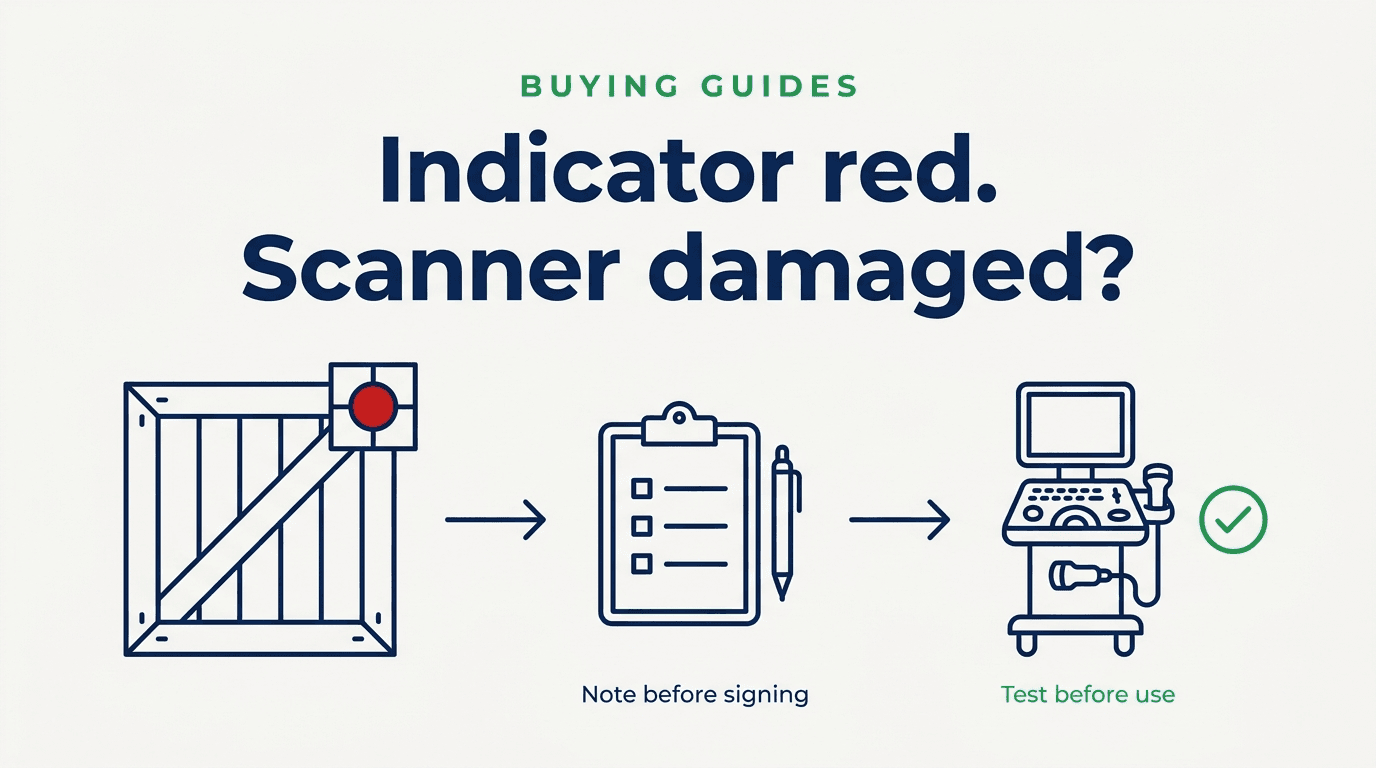
| Shock indicator activated (red) | An impact above the device’s rated level reached its mounting point at some time after arming. | Damage to the contents; which leg, handler or type of event caused it. | Accept custody. Before signing, note device type, rating, serial number, state, date/time and observer. Photograph, keep all packaging, quarantine. |
| Shock indicator clear | No impact above the rated level registered at that mounting point. | Gentle handling; absence of lower impacts, vibration effects or damage. | Inspect the exterior and follow normal incoming inspection. If damage appears later, stop, keep the packaging and notify promptly. |
| Indicator missing, detached or unreadable | Only that the monitoring record is incomplete. | Damage, or that anyone removed it deliberately. | Note it on the delivery receipt—especially if an alert sticker on the paperwork says one was applied—and photograph the mounting location. |
| Tilt indicator activated | The package tipped past the device’s activation condition (for TiltWatch XTR: on its side or upended). | Damage to the contents. | Record tilt separately from shock. Check orientation-sensitive items such as the cart, monitor arm and casters during inspection. |
Source: SpotSee ShockWatch 2 sales sheet (Rev 11/2023); ShockWatch Australia implementation guide (Mar 2020); LPS Industries product descriptions.
Before the Driver Leaves: The Dockside Sequence
The most useful evidence is created in the few minutes before the delivery receipt is signed. Once the driver leaves, a missing notation cannot be added with the same weight. The sequence below is a synthesis of the indicator makers’ receiver instructions and the claims guidance cited here. It is not a carrier’s or insurer’s official procedure, and your contract, the carrier’s tariff or your policy may require more.
- Photograph before anything moves. Photograph the package on the vehicle or dock from several sides, then take close-ups of each indicator showing its state and serial number. Falvey also suggests recording details such as the trailer number. 1 3 6
- Do not refuse the shipment. SpotSee’s companion label says “Do not refuse shipment”; the distributor’s sample customer letter says “Please do not refuse shipment”; WAN-YO tells consignees “DO NOT reject the cargo.” Revcon notes that a refused shipment is returned to the carrier’s delivery terminal, so refusal adds handling and takes the evidence out of your hands. Rejecting goods for commercial reasons, such as the wrong item, is a separate matter under your contract with the seller and is not something an indicator decides. 1 2 4 7
- Write a specific notation before signing. The distributor’s customer letter asks for a notation “on the bill of lading or delivery receipt,” and its carrier letter asks for the “date/time, label colour and signature of individual observing the activated label.” Revcon cautions that “Subject to Inspection” alone “does not serve as sufficient evidence that any specific damage has occurred”; Falvey notes that when the driver will not wait, a “pending further inspection” notation gives some protection. Practical wording that records what you actually saw:
Shock indicator [type / rating], serial [no.], ACTIVATED (red) at delivery [date, time]; observed by [name]. Exterior: [describe, or “no visible damage”]. Received pending inspection for concealed damage.Ask the driver to sign or initial it, and keep your copy. 2 6 7 - Open promptly—and stop if you find damage. The distributor guide says to “examine contents immediately for possible damage and take photos.” SpotSee’s companion label adds the instruction that matters once damage is found: “leave item in original container and packaging, and request immediate inspection from carrier.” Unpack in stages with photographs; if you find damage, stop and keep everything—crate, foam, bags and straps—for the carrier or insurer. 1 2
- Give written notice the same day where you can. The distributor guide says to inform the carrier immediately if damage is discovered; WAN-YO says to notify the shipper and the insurer before checking the goods; Redwood advises filing directly with the carrier rather than relying on the driver to pass it on. Send the photographs and your copy of the delivery receipt to the carrier, the seller or repair supplier, and your insurer or broker. 2 4 9
There is one real difference between the sources: WAN-YO puts notifying the shipper and insurer before checking the goods, while the distributor guide says to examine the contents immediately. An email or phone notice from the dock takes minutes and satisfies both. If your cargo policy specifies an order, follow the policy. 2 4
Our used ultrasound machine buying guide treats delivery as a new evidence point in the purchase, with arrival photographs and acclimatization before power-up. This sequence is what that evidence point looks like when an indicator is red.
| Stage | Action | Evidence to keep | Common mistake |
|---|---|---|---|
| On arrival, before unloading | Check every indicator and the package with the driver present. | Wide photographs of the package; close-ups of each indicator and serial number. | Letting the shipment be unloaded and staged before anyone looks at the indicator. |
| Before signing | Write the specific notation; have the driver sign or initial it. | Your copy of the delivery receipt or proof of delivery with the notation. | Signing clean, or writing only “Subject to Inspection.” |
| After signing | Accept custody and tag the package for quarantine. | Receiving-log entry; quarantine tag. | Refusing the shipment and sending the evidence back to the terminal. |
| Unpacking | Unpack in stages; stop if damage is found and notify in writing. | Staged photo series; packaging inventory; copies of written notices. | Discarding the crate, foam or straps before any inspection. |
Source: Synthesis of SpotSee and ShockWatch Australia receiver instructions, WAN-YO receiver guidance, and Falvey, Revcon and Redwood claims guidance.
Which Indicator Model Was on Your Crate, and Why Threshold Selection Matters
The device and its rating tell you how much the colour can mean. A red low-G label on a heavy crate and a red high-G label on a small carton are different signals, and a clear high-G label on a heavy crate says little. 1
View chart data
| Category | Rated level (G) |
|---|---|
| 45000K | 5 |
| 46000K | 10 |
| 47000K | 15 |
| 48000K | 25 |
| 49000K | 37 |
| 50000K | 50 |
| 51000K | 75 |
Rated activation level for the seven ShockWatch 2 part numbers. A lower G rating means a more sensitive device. Ratings apply to impacts of 0.5–50 ms with ±15% tolerance at 20 °C/1 atm.
Source: SpotSee ShockWatch 2 sales sheet, technical data (Rev 11/2023).
SpotSee lists seven ShockWatch 2 ratings: 5G (45000K), 10G (46000K), 15G (47000K), 25G (48000K), 37G (49000K), 50G (50000K) and 75G (51000K). The sales sheet does not say how the rating is marked on each device, so record the rating and part number from the device itself, or ask the shipper for it from their packing record if it cannot be read. 1
For the older glass-tube labels, the distributor guide identifies five models by colour: L-30 100G (green), L-35 75G (orange), L-47 50G (red), L-55 37G (purple) and L-65 25G (yellow). Activation turns the indicator red, so the model colour—not the activation colour—tells you the rating. 2
SpotSee’s selection guide starts from shipment weight and volume and then adjusts: “More fragile products may require a more sensitive (lower G) indicator while products with more robust packaging may need a less sensitive (higher G) indicator.” The excerpt below covers the weight bands most relevant to ultrasound boards, probes, portable systems and crated consoles. Use it to judge whether the rating on your crate is roughly in line with the vendor’s starting point, not to second-guess a shipper’s validated packaging. 1
| Shipment weight | 5–15 ft³ | 15–50 ft³ | 50–100 ft³ | 100–250 ft³ | 250–500 ft³ | 500–1,000 ft³ | 1,000+ ft³ |
|---|---|---|---|---|---|---|---|
| 0–10 lb (0–5 kg) | 75G | 75G | 50G | 37G | — | — | — |
| 10–25 lb (5–11 kg) | 75G | 50G | 50G | 37G | 25G | — | — |
| 25–50 lb (11–23 kg) | 50G | 50G | 37G | 25G | 25G | 15G | — |
| 50–100 lb (23–45 kg) | 50G | 37G | 37G | 25G | 15G | 15G | 10G |
| 100–250 lb (45–113 kg) | 37G | 37G | 25G | 25G | 15G | 15G | 10G |
| 250–1,000 lb (113–454 kg) | 37G | 25G | 25G | 15G | 15G | 10G | 10G |
| 1,000–2,000 lb (454–907 kg) | 25G | 25G | 25G | 15G | 15G | 10G | 5G |
Source: SpotSee ShockWatch 2 sales sheet, selection guide (Rev 11/2023). Heavier bands (2,000 to 30,000+ lb) omitted; “—” means no rating is listed. A vendor starting point: the guide says product fragility and packaging should adjust the choice.
Mounting also changes what the label can tell you. For the original label, the distributor guide says to place it near the right-hand edge and on the longest side, never in the middle or on a flexible surface, and lower on the package as shipment weight rises. For ShockWatch 2, it says to mount the device in the lower third of the package or pallet, as close to the edge as possible. When a package is twice as long as it is wide, the guide calls for a second indicator in the same position on the opposite side, and it says the alert sticker belongs on the bill of lading so receivers know to check. If the paperwork carries an alert sticker but the package has no indicator, that mismatch belongs in your notation. 2
If you are the shipper—sending a board or probe out for repair—our guide to shipping ultrasound boards and probes for repair covers packing and paperwork on the outbound side.
How an Activated Indicator Interacts With Claims, Warranties, and the Clock
Three different clocks start at delivery. They come from different sources, carry different consequences and should not be merged into one deadline. What follows summarizes U.S. domestic motor-carrier practice and the federal rules behind it. It is general information, not legal advice, and your bill of lading, the carrier’s tariff, your sale contract or your insurance policy may set different terms.
- Clock 1 — the label instruction (5 days; 3 days international): SpotSee’s companion label reads: “If damage is discovered, leave item in original container and packaging, and request immediate inspection from carrier within 5 days of delivery date (int’l 3 days).” This is the indicator maker’s instruction to the receiver, not a statute or a carrier rule. 1
- Clock 2 — concealed-damage notice (about 5 days): claims guidance describes a short window for reporting concealed damage to the carrier. Falvey says it is “usually 5 days,” Revcon says most carriers only allow five days, and Redwood attributes a five-day requirement to the National Motor Freight Traffic Association. Missing it does not end the claim, but Falvey notes you will “need additional proof that the damage didn’t occur at the destination.” Revcon and Redwood both describe one-third settlements as a common outcome when responsibility for concealed damage cannot be shown. 6 7 9
- Clock 3 — the statutory floors: under 49 U.S.C. § 14706(e), a carrier “may not provide by rule, contract, or otherwise, a period of less than 9 months for filing a claim” or less than 2 years for bringing a civil action, counted from the carrier’s written notice disallowing the claim. Under 49 CFR § 370.5(a), a carrier must acknowledge a proper written claim within 30 days unless it has already paid or declined it; under § 370.9(a), it must pay, decline or make a firm compromise offer within 120 days, or send status notices after that. The filing period that actually applies is the one in your bill of lading, which cannot be shorter than these floors. 12 8 11
Two practical consequences follow. First, the nine-month floor is not a reason to wait: evidence quality, the label instruction and the concealed-damage window all reward action within days. Second, the claim amount is not automatically the replacement price. Revcon notes that NMFC guidelines expect the claimant to mitigate the loss—for example by repairing rather than replacing, in which case the repair cost is what is claimed. It also reports that carrier liability is usually limited per pound, with used goods typically capped at $0.10 to $0.50 per pound. For a used ultrasound system, that can make declared value or cargo insurance more important than the carrier claim. 7
| Recovery route | What it rests on | Evidence to assemble | Limits to check |
|---|---|---|---|
| Carrier claim (U.S. domestic motor freight) | Carrier liability under 49 U.S.C. § 14706 and the bill of lading. | Delivery receipt with notation; package and indicator photographs; written notice; repair quote or invoice; proof of value. | Per-pound released-value limits; the concealed-damage notice practice; the filing period in the bill of lading. |
| Seller or supplier remedy | The purchase or service contract, including who bore transit risk and the acceptance terms. | Acceptance-test record showing the nonconformity; transit photographs and notation. | Risk may have passed to the buyer at shipment under the agreed delivery terms. Check before assuming the seller owes a remedy. |
| Cargo insurance | The policy—for example, an all-risk shipper’s-interest cover. | Notation, photographs, packaging inventory, engineering findings, repair invoice. | Deductibles, exclusions and notice conditions in the policy. |
| International air carriage | The Montreal Convention, where it applies. | Written complaint, air waybill, photographs. | Article 31 limits: written complaint within 14 days of receipt for cargo damage. |
Source: 49 U.S.C. § 14706; Revcon Logistics; Falvey Insurance Group; Montreal Convention 1999, Article 31. General information, not legal advice.
International consignments follow different rules. Where the 1999 Montreal Convention governs the air carriage, Article 31 makes receipt of cargo “without complaint” prima facie evidence that it was delivered in good condition, and requires a written complaint about damage “forthwith after the discovery of the damage, and, at the latest, within … fourteen days from the date of receipt in the case of cargo.” Road carriage, sea freight and multimodal moves follow other conventions and contract terms; confirm them with your forwarder or insurer rather than applying U.S. deadlines. 13
Gating Ultrasound Acceptance: Quarantine, Probe Inspection, and Return to Service
Once custody and notice are handled, the decision moves to clinical engineering. An activated indicator is a reason to hold the equipment out of service until a qualified acceptance process is complete—not a reason to condemn it. SpotSee’s own medical-equipment article says that where there is an indication of mishandling, technicians can inspect and recalibrate the equipment before it is put into operation. In practice, red should move the shipment from routine incoming inspection to a documented, targeted one. 3
The stages below describe what that targeted inspection should cover. The binding requirements are the OEM’s installation and service documentation and your facility’s incoming-inspection and electrical-safety procedures. This list does not replace them, and work inside the covers belongs to qualified service personnel.
- Stage 1 — Acclimatize before power-up: equipment that arrives cold from air freight or winter trucking can collect condensation when it is moved into a warm room. Follow the OEM installation instructions for acclimatization before applying power.
- Stage 2 — Mechanical inspection before energizing: look for impact evidence on the cart frame, casters and brakes, the monitor arm and its locks, the control panel, probe holders and connectors, and the power inlet. Compare against the arrival photographs. A bent frame, a damaged power inlet or loose parts heard when the cart is moved are reasons not to power up.
- Stage 3 — Internal checks by qualified personnel: where the service manual calls for it, a qualified engineer confirms that boards, cables and connectors are seated and nothing has shifted, then runs the system’s built-in diagnostics and reviews power-on and error logs. Do not open covers or work on an energized system without the training and procedures the OEM specifies.
- Stage 4 — Probes: probes travel in their own cases but are among the most impact-sensitive items in any shipment, and lens, housing, cable or element damage may not be visible. Route every probe that travelled in an activated shipment through our ultrasound probe acceptance testing protocol: physical inspection, electrical-leakage testing, in-air reverberation checks for element dropout, and phantom image checks.
- Stage 5 — Extended functional run: some impact damage, such as a cracked solder joint or a marginal connector, shows only once the system reaches operating temperature or is moved. Exercise every imaging mode and probe port for a period your facility sets, and record the results. For repaired boards, Rongtao runs a 48-hour test inside a working ultrasound system; our guide to 48-hour real-machine testing evidence for ultrasound boards explains what a run like that can and cannot prove. 10
Electrical-safety testing under your facility’s procedure—commonly based on IEC 62353—belongs in the release record whatever the indicator showed. An activated indicator is a reason to make sure that testing is done and recorded, not a reason to change its limits.
| Check | What to look for | Reference for pass/fail | If it fails |
|---|---|---|---|
| Mechanical, before power-up | Frame, casters and brakes, monitor arm and locks, control panel, probe holders, power inlet. | OEM installation and service documentation; arrival photographs. | Do not energize. Photograph, keep the packaging and notify the carrier, seller and insurer. |
| Internal seating and diagnostics (qualified personnel) | Shifted boards or cables; diagnostic and power-on error logs. | OEM service manual and built-in diagnostics. | Record error codes; escalate to qualified board-level diagnosis. |
| Electrical safety | Protective-earth and leakage results. | Facility procedure (commonly based on IEC 62353) and the manufacturer’s limits. | Keep out of service; do not release. |
| Probes | Lens, housing, cable and connector; leakage; element dropout; phantom image. | Probe acceptance protocol and OEM probe documentation. | Quarantine the probe; route it to probe repair or include it in the claim. |
| Extended functional run | All imaging modes and probe ports; crashes, freezes, artifacts, thermal warnings. | Facility acceptance criteria. | Log errors and capture diagnostic data for the warranty or carrier claim. |
Source: Rongtao Medical synthesis. OEM installation and service documentation and facility procedures set the actual pass/fail limits.
Red but Passes, or Clear but Fails: Managing Edge Cases
Two situations do not fit the simple story that red means damage and clear means safe.
Red, but every check passes. The equipment can be released—on the strength of the acceptance record, not the indicator. The distributor guide is explicit that red does not mean damage and that only inspection decides. Keep the arrival photographs, the delivery-receipt notation and the acceptance results in the equipment’s service record (CMMS). If a fault appears weeks later, that file shows what was known at delivery, though it will not on its own prove that the fault came from transit. 2
Clear, but damaged on unpacking. A clear label does not prevent a concealed-damage claim. Stop unpacking and leave the item in its packaging, as SpotSee’s companion label instructs. Photograph the damage alongside the clear indicator and any exterior marks such as crushed corners or fork punctures, and notify the carrier in writing within the concealed-damage window. Describe what you found and leave the cause to the inspection. 1 6 9
Where Rongtao Medical Fits — And Where It Does Not
Rongtao Medical is an independent ultrasound repair and parts company. It is not a carrier, an insurer, a claims adjuster or a law firm, and it is not an OEM’s authorized representative.
Where Rongtao fits:
- Board-level repair: component-level diagnosis and repair of ultrasound power supplies, channel and beamformer boards, front-end and back-end boards, control panels and interface boards across the supported OEM brands.
- 48-hour real-machine test: every repaired board runs for 48 hours inside an actual ultrasound system before release, with photo or video evidence where applicable. 10
- Probe repair: fault diagnosis and element-level repair of linear, convex, phased-array, endocavitary, TEE and volumetric (4D) probes through the Rongtao probe repair service.
- Turnaround and warranty: standard board-repair turnaround is 5–8 business days and warranty is typically 90 days; final terms depend on the item and service and are confirmed in the quotation. 10
- Documented intake: photo evidence is captured at intake, QC and packaging, and a written repair quotation can support the repair-cost figure in a claim file. 10
Where Rongtao does not fit:
- Not a carrier or forwarder: Rongtao does not operate transport or manage your carrier relationship.
- Not an insurer, adjuster or legal adviser: we cannot tell you whether a claim will succeed or how a notation will be treated under your contract or jurisdiction.
- Not a remote verdict: a photograph of a red indicator cannot show whether a system is damaged. That takes inspection and testing on the equipment itself.
Quote-ready handoff. When a console, probe or board fails acceptance after an activated delivery, send this pack so the first reply can be specific:
- System: OEM, model and software version.
- Part: manufacturer part number and clear photographs of both sides of the board or the probe label.
- Symptoms: error codes, screenshots of image artifacts, and which modes or probe ports are affected.
- Transit evidence: package and indicator photographs, the delivery-receipt notation and the relevant dates.
- Request: quantity, the service wanted (repair of the original, an exchange unit or a replacement part) and the destination.
Send it through our contact page for case-specific diagnosis and a quotation.
Frequently Asked Questions
Q: The ShockWatch indicator is red, but the ultrasound machine looks undamaged. Can we accept it and put it into clinical service?
A: Accept the delivery, but do not sign clean and do not release the machine yet. The indicator shows the package took an impact above its rating; only inspection and testing show whether the equipment was affected. Note the activation on the delivery receipt, keep the packaging, quarantine the unit, and release it only after your acceptance process—mechanical inspection, diagnostics, electrical safety, probe checks and a functional run—is complete and recorded.
Q: The indicator is clear, but the system is damaged on unpacking. Do we still have a claim?
A: Usually yes, as a concealed-damage claim. A clear indicator shows only that no impact above its rating registered at its mounting point. Stop unpacking, keep the packaging, photograph the damage together with the clear indicator, and notify the carrier in writing as soon as possible. Claims guidance describes a window of about five days, after which you need stronger proof that the damage did not happen at your site.
Q: Should we refuse the delivery when the shock indicator is red?
A: Generally no. SpotSee, its Australian distributor and WAN-YO all tell receivers not to refuse a shipment because an indicator is red. A refused shipment goes back to the carrier’s terminal, adding handling and taking the evidence out of your hands. Rejecting goods for commercial reasons, such as the wrong item, is a matter for your contract with the seller.
Q: What exactly should we write on the delivery receipt?
A: Be specific: the indicator type and rating, its serial number and state, the date and time, who observed it, and what the exterior looks like. For example: “Shock indicator [type / rating], serial [no.], ACTIVATED (red) at delivery [date, time]; observed by [name]. Exterior: [describe, or “no visible damage”]. Received pending inspection for concealed damage.” Have the driver sign or initial it. “Subject to Inspection” on its own is weak evidence. This is practical wording, not legal advice.
Q: How long do we have to report damage after delivery?
A: Keep three clocks apart. If damage is found, SpotSee’s label asks for a carrier inspection request within 5 days of delivery (3 days international). Carriers commonly expect concealed-damage notice within about five days. U.S. federal law prevents a carrier from setting less than 9 months to file a claim or less than 2 years to sue after a written disallowance, and requires carriers to acknowledge a claim within 30 days and to pay, decline or make a firm offer within 120 days (or send status updates). Where the Montreal Convention governs international air cargo, a written complaint is due within 14 days of receipt. Act within days, not months.
Q: Does a red indicator prove that the carrier dropped the shipment?
A: No. It shows that an impact above the rated level reached its mounting point at some time after it was armed. It does not show whether the event was a drop, a forklift strike or a hard set-down, and on a multi-leg move it cannot identify which carrier, terminal or handler was involved. That takes carrier scan and handoff records.
Q: What about probes shipped with indicators—is anything different?
A: Probes deserve the most caution. Lens, housing, cable or element damage may not be visible, and a probe case can hide what happened to the probe inside. When a probe arrives in an activated shipment, do not clear it on a visual check alone: run it through physical inspection, electrical-leakage testing, element-dropout checks and phantom image checks before clinical use.