
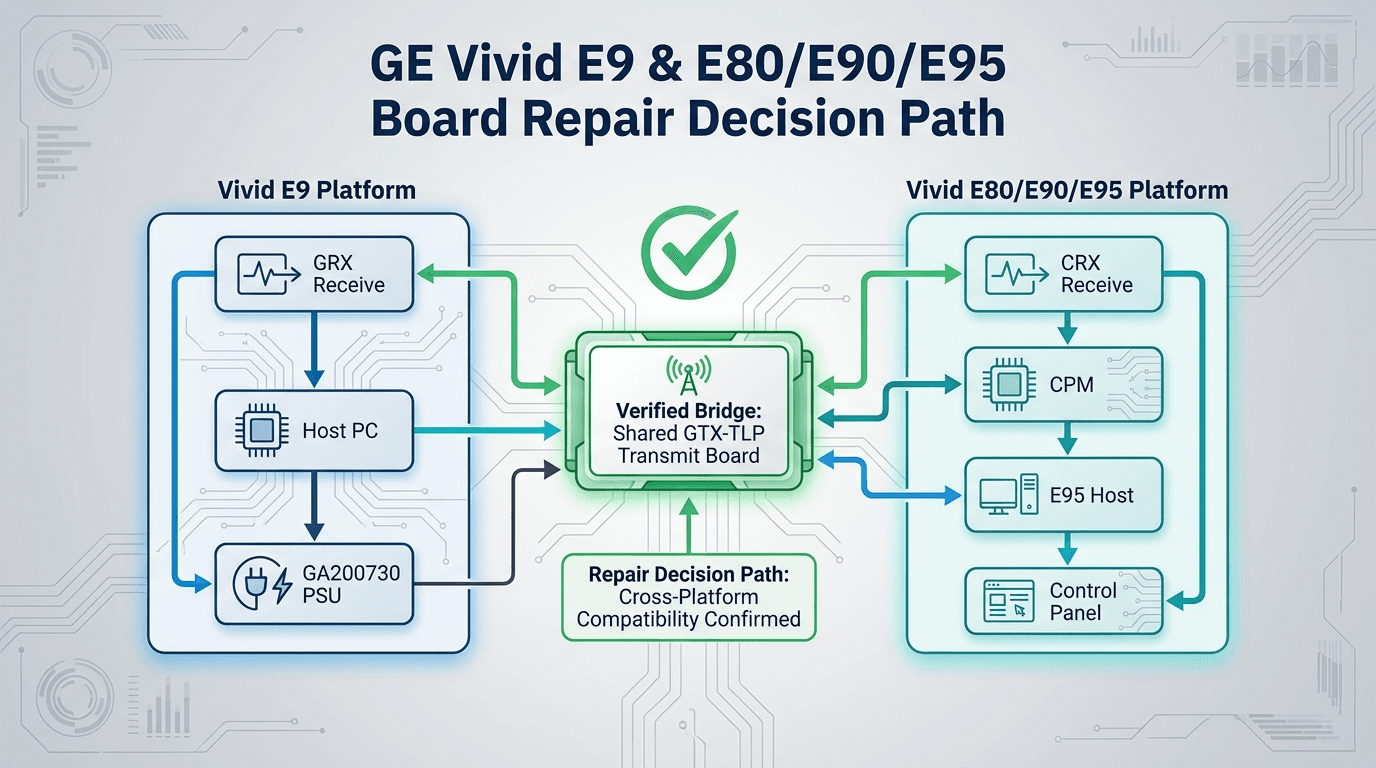
What does the Vivid E9 versus E80/E90/E95 platform split mean for parts and repairs?
In clinical cardiology and vascular ultrasound environments, the GE Vivid line is a mainstay of high-frame-rate 2D, 4D, and transesophageal echocardiography (TEE). While broader brand-level diagnostics are outlined in our GE board-level symptoms decision path and model-specific BT levels are detailed in our Voluson E8 BT-level decision path, biomedical engineers and independent service organizations (ISOs) frequently make an expensive mistake: treating the 'Vivid E-Series' as a single continuous hardware architecture. In reality, the systems sit across a defined generational divide verified by regulatory clearance records and hardware design 1.
The original GE Vivid E9 platform was introduced under FDA 510(k) clearance K081921 in August 2008 and evolved through subsequent clearances (K101149 in 2010, K120201 in 2012, and K131514 in 2013, the final recorded E9-series filing) 1. The E9 architecture is built around a discrete card cage housing dedicated transmit pulser boards (GTX-TLP family), multiple receive channel boards (GRX64 and GRX128 variants), a dedicated host PC processing core (GB200001 / part number 5380000), and a high-capacity main power supply assembly (GA200730) 11.
In 2015, GE HealthCare introduced the next-generation cardiovascular platform comprising the Vivid E80, Vivid E90, and Vivid E95 (originally cleared under K150087 by GE Vingmed Ultrasound AS, and updated through K170823, K173341, K181685, K200743, K202658, and K220882) 1. GE positions this generation around its cSound software beamformer 8, and it carries its own board set in the parts catalog: receive processing (CRX GC200002), the CPM module (GC200019-4), a redesigned host PC platform (GC200018), and new control-panel assemblies (5776030-S / 5769157) 11.
Because the backplane, internal communication buses, power distribution rails, and thermal designs differ materially between the 2008-era E9 and the 2015-era E80/E90/E95 systems, parts cannot be casually interchanged. Sourcing replacement boards or initiating component-level repair requires establishing the exact platform generation and reading the complete alphanumeric part number and revision suffix directly from the board's barcode label 11.
Which board family does my Vivid E9 symptom point to: receive (GRX), transmit (GTX-TLP), or front-end TR?
When troubleshooting image artifacts or total signal loss on a GE Vivid system, clinical engineers must systematically isolate the failure to either the acoustic probe, the connector interface, or the console beamformer. As detailed in our comprehensive guide to beamformer and front-end board failures, a failure that appears on only one probe or follows a specific probe when swapped between ports points directly to the transducer or its pin connector. Conversely, when image defects persist across all connected transducers, the fault resides within the console's front-end card cage 10.
The front-end signal path in a Vivid E9 separates high-voltage acoustic pulse transmission from low-noise multi-channel echo reception across dedicated circuit assemblies:
- Transmit Signal Generation (GTX-TLP): The GTX-TLP board (such as GA200726 / GA200726-2) generates the precision high-voltage excitation pulses delivered to the transducer elements. When the GTX-TLP degrades, symptoms include weak acoustic penetration across all probes, dark vertical acoustic dropouts in Color Doppler mode, or total failure to generate acoustic output despite the system reporting active scanning.
- Acoustic Echo Reception (GRX Family): The GRX board family handles multi-channel analog amplification, time-gain compensation (TGC), anti-aliasing filtering, and analog-to-digital conversion. Failures in the receive path manifest as persistent vertical dark bands, elevated background noise floors, missing scan lines in B-mode, or complete loss of echo reception while Doppler audio remains active.
- Front-End TR Stage Decoupling: The Transmit/Receive (TR) switching circuitry protects sensitive preamplifiers from high-voltage transmit pulses. As demonstrated in documented service cases, breakdown in TR isolation or ground-plane decoupling causes dynamic flicker artifacts across the near-field and mid-field echo regions during live 2D scanning.
| Primary Observed Symptom | Probable Subsystem / Board Family | Vivid E9 Target Part | Vivid E80/E90/E95 Target Part | Initial Verification Gate |
|---|---|---|---|---|
| Total power blackout; no standby LEDs; unit completely non-responsive | Main AC/DC Power Supply Unit (PSU) | GA200730 / GA200730-5 | GA200730-5 (E80/E90) / Platform PSU | Check wall AC receptacle, circuit breaker, and inspect power-cord entry for 2018 recall compliance |
| Power LED turns on, cooling fans spin, but system enters continuous boot loop before OS loads | Host PC Power Module / Motherboard / PSU DC Rails | PC GB200001 (5380000) / GA200730 | PC GC200018 / CPM GC200019-4 | Disconnect external USB peripherals; reseat RAM and internal DC power harness |
| No 2D ultrasound image on any probe; black screen in active imaging area; UI graphics normal | Front-End Transmit (GTX) or Receive (GRX/CRX) | GTX-TLP GA200726-2 / GRX128 GA200295-5 | GTX-TLP GA200726-2 / CRX GC200002 | Test multiple probe ports; verify high-voltage DC rails entering beamformer backplane |
| Flicker artifact or pulsating noise bands in the B-mode echo region during live scanning | Front-End TR Switching / Ground-Plane Decoupling | GRX64 GA200300-5 / GRX128 GA200295-5 | Front-End TR Stage / CRX GC200002 | Verify symptom is console-side by swapping probe to known-good port; review Case 015 workflow |
| Primary display flickers, shows horizontal sync tearing, or blacks out from power-on | Video Interface Board / GPU / Display Cable | IO board 5433408-1 (service archive) | Display Video Interface Board / Host PC GC200018 | Connect external monitor to DVI/DisplayPort output; verify EDID handshake (review Case 016) |
| System freezes or locks up during DICOM patient worklist query or cardiac measurements | Host Operating System / DICOM Software / PC Core | PC GB200001 (5380000) | PC GC200018 / DICOM Worklist Software | Verify software patch level against open FDA recall Z-2316-2024 before replacing PC hardware |
| Operator keyboard non-responsive; rotary knobs, TGC sliders, or touch screen unresponsive | Operator Control Panel / USB Interface Controller | Control Panel GB2000300-1 | Control Panel 5776030-S / 5769157 | Inspect USB communication cable and control panel DC power harness from host PC |
Source: Rongtao Medical Technical Service Archive & Documented Bench Repair Cases, August 2026
How do I diagnose Vivid power and boot failures across the GA200730 family and the 2018 power-cord recall gate?
Power supply failures represent one of the most frequent service events encountered on aging Vivid systems. The primary power module converts incoming AC mains into regulated low-voltage DC rails for the digital processing logic and high-voltage rails required by the beamformer pulsers 11.
On the GE Vivid E9, the primary power module is designated as the GA200730 family (catalog item vivid-e9-main-power-supply-ga200730). In subsequent revisions and the Vivid E80/E90 configurations, GE updated this assembly to the GA200730-5 (catalog item vivid-e9-e80-e90-power-supply-ga200730-5) 11. As analyzed in our guide on ultrasound power-supply failure and boot-loop diagnosis, a degraded power supply can cause intermittent thermal shutdowns (ranking as a leading search symptom in our legacy GE Vivid E9 automatic shutdown repair note 13), failure to assert power-good logic to the host PC, or elevated ripple voltage that induces noise streaks into the ultrasound image.
Mandatory Safety Gate — The 2018 Power-Cord Recall: Before undertaking any internal power supply diagnostics, component repair, or module replacement on a Vivid E9, E80, E90, or E95 system, clinical engineering teams must verify the physical integrity of the AC power cord assembly. Under FDA Recall Enforcement Reports Z-2985-2018, Z-2986-2018, Z-2987-2018, and Z-2988-2018 (initiated March 22, 2018, classified under component design/selection), GE recalled power cords across the Vivid E9, E80, E90, and E95 fleets because the system side of the power cord may break and expose the electrical conductors, creating a risk of shock 2. Service personnel must confirm that the recalled power-cord corrective action has been applied and that the cord assembly passes physical inspection before connecting the system to line power for testing.
Echo-region flicker and channel dropouts: is it the front-end TR board, probe, or probe port?
One of the most challenging diagnostic presentations in clinical echocardiography is an intermittent flicker or pulsating noise band within the ultrasound image sector. Applying the diagnostic protocol from our framework on probe versus scanner artifact diagnosis, technicians must systematically differentiate between probe element failure, cartridge connector wear, and console-side beamformer breakdown 10.
Isolation Protocol:
- Multi-Port Transducer Swap: Connect the active cardiac probe (e.g., M5Sc-D or 4V-D) to Port 1 and record the sector noise pattern. Move the probe to Port 2 and Port 3. If the flicker disappears on alternative ports, the fault is isolated to the mechanical connector pins or relay switching on that specific probe receptacle board.
- Cross-Transducer Evaluation: Connect a linear vascular probe (e.g., 9L-D or 11L-D) or convex probe. If the flicker persists across completely different transducer types and frequencies, the probe is exonerated, confirming a console-side front-end defect.
- Air Scan vs. Tissue Phantom Test: Perform an air-scan gain test to visualize the baseline channel noise floor. In a healthy system, channel noise is uniform. Discrete flashing vertical bands indicate individual receive channel breakdown or failed clamping diodes in the TR switching stage.
Documented Bench Repair Evidence — Case 015: In documented repair Case 015 (Vivid E95 Front-End TR Board), a customer system presented with persistent flicker artifacts across the 2D echo sector in B-mode scanning 12. Rongtao's engineering center isolated the failure to the front-end TR board, reworked the affected channels, and rebuilt the ground-plane decoupling. A reference-phantom retest cleared the fault, completing the documented restoration in 7 days with before/after video on file 12.
Display flickers from boot: how do I isolate the video interface board, panel, or cable?
Display instability on a Vivid system can range from subtle high-frequency backlight flicker to total video tearing, horizontal rolling, or blank screens. Because the operator relies on the primary articulating OLED/LCD monitor and the integrated touch command screen, isolating video faults requires distinguishing between the GPU graphics engine, video distribution board, articulating arm cable harness, and the display panel itself 10.
Diagnostic Isolation Tree:
- External Secondary Monitor Test: Connect a standard clinical display to the auxiliary DVI or DisplayPort video output on the rear I/O panel. If the external monitor displays a rock-solid image while the primary monitor flickers, the host PC graphics processor and software rendering engine are operating correctly. The fault is downstream in the video distribution board, arm cabling, or display panel.
- Articulating Arm Mechanical Stress Check: Gently articulate and swivel the monitor arm through its full range of motion. If video flicker coincides with physical movement or cable flexing, the failure is caused by conductor fatigue inside the internal cable harness.
- Continuous Boot-Time Flicker: If the display flickers immediately upon system power-on during BIOS initialization — before the ultrasound application software loads — the problem is hardware-level video signal generation or EDID communication failure.
Documented Bench Repair Evidence — Case 016: In documented repair Case 016 (Vivid E95 Display / Video Subsystem), an echo system exhibited severe screen flicker immediately from cold boot 12. Bench diagnostics confirmed the graphics core was intact and pointed to the internal video interface board. Rongtao engineers replaced the video interface board, renegotiated the EDID handshake between the host PC and display controller, and validated display stability across all supported resolutions within a 6-day turnaround 12.
When does a host PC or control path fault point to GB200001, GC200018, CPM, or control panels?
The back-end computer subsystem controls the user interface, patient database management, measurement packages, DICOM connectivity, and digital scan conversion. Failures in the back-end host architecture typically present as failure to boot past the GE splash screen, application freezes during image acquisition, database corruption errors, or an unresponsive operator console 13.
Vivid E9 Host Computer Architecture: The Vivid E9 uses a dedicated industrial PC core assembly cataloged as PC GB200001 (part number 5380000, catalog item vivid-e9-pc-gb200001-5380000) 11. This assembly integrates the host processor, system memory, high-speed interface bridges to the beamformer backplane, and peripheral connectivity. When the E9 host PC fails, the system may hang during hardware enumeration or display low-level communication errors with the acquisition sub-rack.
Vivid E95 Host Computer & CPM Modules: On the Vivid E80/E90/E95 generation, back-end processing is handled by the updated PC GC200018 assembly (catalog item vivid-e95-pc-gc200018) working in conjunction with the CPM module (GC200019-4) (catalog item vivid-e95-cpm-gc200019-4) 11. Sourcing replacements requires matching these exact part numbers: E9 and E80/E90/E95 host and processing assemblies are not catalog-listed as interchangeable, and the service archive documents each under its own platform.
Operator Control Panels: The operator console interface includes tactile rotary encoders, motorized TGC sliders, trackball assembly, and capacitive touch screens. On the Vivid E80/E90/E95 platforms, the upper operating panel and control interface is represented by catalog item vivid-e95-e80-e90-control-panel-5776030-s-5769157 (part numbers 5776030-S / 5769157) 11. Typical failures involve worn rotary encoders, liquid ingress across slider pots, or damaged USB communication boards, all of which are repairable through targeted rebuild rather than full console replacement.
Which boards cross the E9 to E80/E90/E95 boundary — and which never do?
A critical objective for hospital clinical engineering departments and independent service organizations is managing spare parts inventory efficiently across mixed fleets. Understanding exactly which board assemblies can cross the Vivid E9 to Vivid E80/E90/E95 boundary prevents costly mis-orders and equipment downtime 11.
| Board Designation | Catalog Part Number | Supported Platform Models | Hardware Role & Architecture | Cross-Platform Compatibility |
|---|---|---|---|---|
| GRX (Base) | GA200105 | Vivid E9 | Multi-channel receive board; base designation in the service archive | Vivid E9 only. Do not confuse with the separately archived Logiq E9 GRX board GA200105-7 — a different system line |
| GRX64 | GA200300-5 / GB200025-1 | Vivid E9 | 64-channel receive board | Vivid E9 only; must verify revision suffix on label |
| GRX128 | GA200295-5 | Vivid E9 | 128-channel receive board | Vivid E9 only; does not fit E80/E90/E95 |
| GRX128CW | GB200020 / GB200020-1 | Vivid E9 | Receive board variant, separately numbered from GRX128 | Vivid E9 only; distinct from GA200295-5 |
| GTX-TLP | GA200726-2 | Vivid E9, Vivid E80, Vivid E95 | Multi-channel high-voltage acoustic transmit pulser | Catalog-verified cross-generation part; also shared with Logiq E9 |
| CRX Board | GC200002 | Vivid E80, Vivid E90, Vivid E95 | Receive processing board for the E80/E90/E95 platform | Vivid E80/E90/E95 platform only; does not fit Vivid E9 |
| CPM Module | GC200019-4 | Vivid E95 (catalog row); also archived under E80/E90 | Catalogued as the E95 CPM board; the same part number is archived for the E80/E90 as an Aurora Power Module R01-R02 | One part number, two designations across the platform — read the board's own label and confirm the system model before ordering |
Source: Rongtao Medical Parts Catalog & Historical Service Archive, August 2026
As established in Table 2, the vast majority of front-end and back-end assemblies are generation-locked. Sourcing teams must strictly respect the hardware boundary: do not attempt to install GRX receive boards into an E80/E95 system, and do not attempt to substitute an E95 CRX board or CPM module into a legacy E9 chassis 11.
Is the GTX-TLP.192 GA200726 board shared across Logiq E9 and Vivid E9 — and how do I verify before ordering?
In multi-modality ultrasound fleets comprising both general-imaging and cardiovascular systems, the GTX-TLP.192 GA200726 board represents a unique and highly valuable cross-system asset. As documented from the general-imaging side in our Logiq E9/E10/E11 board decision path, this board is catalog-listed under both the LOGIQ E9 (logiq-e9-gtx-tlp-192-ga200726) and the Vivid E9 / E80 / E95 (vivid-e9-e80-e95-gtx-tlp-ga200726-2) lines 11.
| Major Assembly / Board Group | Vivid E9 (2008-2013) | Vivid E80/E90/E95 (2015-2022) | Logiq E9 Shared Status | Engineering Verification Rule |
|---|---|---|---|---|
| Transmit Pulser (GTX-TLP) | GA200726-2 | GA200726-2 | Shared (GA200726) | Catalog-verified shared board across Vivid E9/E80/E95 and Logiq E9 |
| Receive Processing (GRX / CRX) | GRX64 / GRX128 | CRX GC200002 | Incompatible (Logiq uses DRX) | Platform-locked; not catalog-listed as shared across platforms |
| Main Power Supply (PSU) | GA200730 / GA200730-5 | GA200730-5 (E80/E90) | Incompatible (Logiq uses 5205052/5433408) | GA200730-5 crosses E9 to E80/E90; Logiq PSU revisions do not cross |
| Host PC Core | GB200001 (5380000) | PC GC200018 | Incompatible (Logiq uses AIMB-563 / PC 5380000-2) | Host motherboards, backplane bridges, and OS images are model-specific |
| Operating Control Panel | GB2000300-1 | 5776030-S / 5769157 | Incompatible (Logiq uses 5207000 series) | 5776030-S group is catalog-verified across Vivid E95, E80, and E90 |
Source: Rongtao Medical Technical Engineering Ground Truth, August 2026
Third-party commercial listings in the European and North American repair market independently corroborate that the GTX GA200726 board functions across both Logiq and Vivid platforms 10. However, clinical engineering teams must verify the revision suffix on the physical label before installation. While the base pulser architecture is shared, certain firmware configurations and calibration parameters stored in onboard EEPROMs require matching the system's software release.
What safety recall gates must I check before Vivid power, DICOM worklist, or probe servicing?
Medical device safety surveillance databases maintained by the U.S. FDA provide vital context for biomedical service engineers. Understanding official recall histories prevents technicians from misdiagnosing documented software bugs as hardware board failures and ensures clinical safety compliance 1.
| 510(k) Number | Clearance Date | Applicant Organization | Cleared Device Description | Platform Generation Context |
|---|---|---|---|---|
| K081921 | 2008-08-06 | General Electric Co. | GE Vivid E9 Ultrasound | Original platform clearance for the Vivid E9 cardiovascular scanner |
| K101149 | 2010-10-13 | GE Vingmed Ultrasound AS | GE Vivid E9 Diagnostic Ultrasound Imaging System | E9-family update filing |
| K120201 | 2012-04-19 | GE Vingmed Ultrasound AS | GE Vivid E9 Diagnostic Ultrasound Imaging System | E9-family update filing |
| K131514 | 2013-07-12 | GE Vingmed Ultrasound AS | GE Vivid E9 Diagnostic Ultrasound Imaging System | Final recorded E9-series clearance in this dataset |
| K150087 | 2015-03-04 | GE Vingmed Ultrasound AS | Vivid E80 / Vivid E90 / Vivid E95 Diagnostic Ultrasound Imaging Systems | Foundational clearance listing all three E80/E90/E95 models |
| K170823 | 2017-06-12 | GE Medical Systems Ultrasound | Vivid E80, Vivid E90, Vivid E95 | Platform update filing (all three models listed) |
| K173341 | 2017-11-02 | GE Medical Systems | Vivid E80, Vivid E90, Vivid E95 | Platform update filing (all three models listed) |
| K181685 | 2018-10-25 | GE Medical Systems Ultrasound | Vivid E80, Vivid E90, Vivid E95 | Platform update filing (all three models listed) |
| K200743 | 2020-07-23 | GE Medical Systems Ultrasound | Vivid E80 / Vivid E90 / Vivid E95 | Platform update filing (all three models listed) |
| K202658 | 2021-03-05 | GE Medical Systems Ultrasound | Vivid E80 / Vivid E90 / Vivid E95 | Platform update filing (all three models listed) |
| K220882 | 2022-07-22 | GE Medical Systems Ultrasound | Vivid E80, Vivid E90, Vivid E95 | Latest recorded filing for the family in this dataset |
Source: Computed from U.S. FDA 510(k) Premarket Notification Database records (openFDA), August 2026. Applicant names as recorded; GE entity variants shown as filed.
As shown in Table 4, the regulatory record clearly demonstrates that the Vivid E9 never appears in any E80/E90/E95 510(k) filing from 2015 onward, reinforcing the strict two-generation architectural separation 1.
| Recall RES Number | Initiated Date | Current Status (as of Aug 2026) | Affected Vivid Models | Reported Root Cause & Safety Risk Description |
|---|---|---|---|---|
| Z-0373-2014 | 2013-10-11 | Terminated | Vivid E9 | Software-associated system slow-down and lock-up during critical procedures (recorded root cause: component change control) |
| Z-1488-2014 | 2014-03-27 | Terminated | Vivid E9 | Software design issue causing incorrect probe power surveillance for C1-5-D, C2-9-D, IC5-9-D, and M5Sc-D probes, potential overheating |
| Z-2985 / 2986 / 2987 / 2988-2018 | 2018-03-22 | Terminated | Vivid E9, E80, E90, E95 | System side of the AC power cord may break and expose the electrical conductors, creating a risk of shock |
| Z-1779-2017 | 2017-03-10 | Terminated | Vivid E95, E90, E80 | Slow DICOM Worklist response leading to potential display of incorrect patient demographics |
| Z-2316-2024 | 2024-05-02 | Open (Verified Aug 2026) | Vivid E90 (H45581LB) & Vivid E95 (H45581DA) | Slow DICOM Worklist response time can cause incorrect patient name and demographics to be displayed on the scanner screen rather than the intended patient selected by the user; FDA Determined Cause recorded as Device Design; 510(k) K150087 |
Source: U.S. FDA recall enforcement records (openFDA); open-recall status live-verified August 2026
Crucial Clinical Workflow Gate — Recall Z-2316-2024: Service engineers troubleshooting an echo lab complaint where 'patient data drops,' 'wrong patient names appear,' or 'DICOM queries freeze the system' on a Vivid E90 or E95 must not replace the host PC GC200018 or hard drive before verifying this open recall. Under FDA Recall Enforcement Report Z-2316-2024 (status Open, Classified on FDA accessdata as verified August 2026), a slow DICOM Worklist response time can cause incorrect patient name and demographics to be displayed on the scanner screen rather than the intended patient the user selected 3. FDA records the determined cause as Device Design, and GE HealthCare issued an Urgent Medical Device Correction to consignees on 2024-05-02 instructing users to review and confirm on-screen patient demographics during the exam 3. Treat this as a documented, manufacturer-addressed recall condition to rule out before attributing the symptom to failed back-end hardware — not as evidence that the host board is faulty.
Two terminated actions round out the E9 diagnostic history. Recall Z-1488-2014 (initiated 2014-03-27) corrected probe-power surveillance settings for the C1-5-D, C2-9-D, IC5-9-D and M5Sc-D cardiac probes — if an E9 still carries these probes, confirm the corrective software is in place before assuming a probe-side fault is hardware 4. Recall Z-0373-2014 (initiated 2013-10-11) documented system slow-down and lock-up during critical procedures — a reminder that freeze or hang symptoms in this family have a documented software dimension and should be checked against the current GE software level before board replacement is ordered 5. Both records are historical context from the FDA enforcement database; recall records establish neither failure frequency nor causality.
Should I repair the board, buy a tested replacement, or plan migration off the E9?
When a mission-critical cardiovascular ultrasound machine experiences a hardware failure, clinical engineering leadership must evaluate three viable pathways: component-level board repair, purchasing a tested replacement board, or initiating full system platform migration. Making the optimal financial and operational decision requires evaluating system age, clinical utilization, parts availability, and turnaround time 11.
| Catalog Item ID | Model Designation | Part Description & Label Identifier | Manufacturer Part Number | Typical Service Terms |
|---|---|---|---|---|
| vivid-e9-grx128-ga200295-5 | Vivid E9 | GRX128 Receive Board GA200295-5 | GA200295-5 | Typical 5-8 business-day repair · typical 90-day warranty |
| vivid-e9-grx64-ga200300-5 | Vivid E9 | GRX64 Receive Board GA200300-5 | GA200300-5 | Typical 5-8 business-day repair · typical 90-day warranty |
| vivid-e9-main-power-supply-ga200730 | Vivid E9 | Main Power Supply GA200730 | GA200730 | Typical 5-8 business-day repair · typical 90-day warranty |
| vivid-e9-pc-gb200001-5380000 | Vivid E9 | Host PC Assembly GB200001 | 5380000 | Typical 5-8 business-day repair · typical 90-day warranty |
| vivid-e9-e80-e90-power-supply-ga200730-5 | Vivid E9 / E80 / E90 | Power Supply GA200730-5 | GA200730-5 | Typical 5-8 business-day repair · typical 90-day warranty |
| vivid-e9-e80-e95-gtx-tlp-ga200726-2 | Vivid E9 / E80 / E95 | GTX-TLP Transmit Board GA200726-2 | GA200726-2 | Typical 5-8 business-day repair · typical 90-day warranty |
| vivid-e80-crx-board-gc200002 | Vivid E80 | CRX Receive Board GC200002 | GC200002 | Typical 5-8 business-day repair · typical 90-day warranty |
| vivid-e95-cpm-gc200019-4 | Vivid E95 | CPM Processing Module GC200019-4 | GC200019-4 | Typical 5-8 business-day repair · typical 90-day warranty |
| vivid-e95-pc-gc200018 | Vivid E95 | Host PC Assembly GC200018 | GC200018 | Typical 5-8 business-day repair · typical 90-day warranty |
| vivid-e95-e80-e90-control-panel-5776030-s-5769157 | Vivid E95 / E80 / E90 | Control Panel Assembly 5776030-S / 5769157 | 5776030-S | Typical 5-8 business-day repair · typical 90-day warranty |
Source: Rongtao Medical Verified Inventory and Parts Catalog, August 2026
The terms above are the typical board-repair turnaround and warranty for this service line; final turnaround and warranty depend on the specific item and service type and must be confirmed per case. Catalog rows establish part identity and listed model context only — current availability routes to the live catalog and quote flow, not to any listed status.
OEM Availability vs. Third-Party Maintenance: As of August 2026, GE HealthCare continues to maintain active parts categories on its official Service Shop portal for both the Vivid E9 (listing 423 items including new, refurbished, and used parts 6) and the Vivid E95 (listing 279 items 7). Furthermore, cross-generation accessories such as the FC200389 ECG stress-cable kit remain officially listed spanning Vivid 7, Vivid E9, and Vivid E95 6. While OEM replacement remains an available route, independent component-level repair and tested replacement parts give hospitals a budget-preserving alternative with rapid turnaround for mature platforms approaching end-of-support horizons 11. For official service documentation and definitive lifecycle status, GE HealthCare's ultrasound service portal is the authoritative channel 9.
| Decision Pathway | Best Clinical & Operational Fit | Key Advantages | Primary Risks & Limitations | Recommended Action Trigger |
|---|---|---|---|---|
| Component-Level Board Repair | Single-board failures (e.g., TR stage flicker, power supply rail capacitor failure, control panel encoders) | Maximizes cost savings; preserves original board calibration; avoids software re-installation | Requires 5-8 business-day turnaround; board must not have severe PCB substrate charring | Select when downtime can be buffered by back-up echo machines and budget preservation is paramount |
| Tested Replacement Board Exchange | Acute clinical downtime; catastrophic board burnout; physical trace damage | Shorter lead time than repair when a tested unit is available; tested before dispatch | Higher initial component outlay than repair; requires exact label part number and revision matching | Select when echo lab throughput cannot tolerate repair turnaround and spare is immediately available |
| Platform Migration (to E90/E95) | Aging Vivid E9 fleets experiencing multi-subsystem degradation; expanding 4D TEE demands | Upgrades to modern cSound processing; full OEM software support; enhanced frame rate and resolution | Substantial capital expenditure; requires retraining clinical staff and updating probe inventory | Select when 10+ year old E9 chassis incurs recurring failures across power, host PC, and beamformer |
Source: Rongtao Medical Strategic Service Consulting Framework, August 2026
Where does Rongtao fit — and where does it not?
Clear boundaries protect clinical engineering integrity. Rongtao Medical operates as a certified independent ultrasound engineering center specializing in component-level PCB repair, parts harvesting and testing, and transducer rebuilding 11.
Where Rongtao Fits:
- Component-Level Board Repair: Precision diagnosis and micro-component replacement for GE Vivid front-end boards (GRX64, GRX128, GTX-TLP), power supplies (GA200730 family), host PCs, and video interface modules.
- Tested Replacement Assemblies: Pre-tested replacement boards with verified part numbers and revisions, backed by standard 90-day warranties with extended coverage options upon request.
- Live Ultrasound System Validation: Every repaired board runs for 48 hours inside an actual ultrasound system before release — real-machine validation, not bench-only.
- Transducer & Probe Repair: Comprehensive repair services for standard cardiac sector probes (e.g., M5Sc-D) and 4D / TEE transducers via our dedicated probe repair facility.
Where Rongtao Does Not Fit:
- Authorized OEM Representation: Rongtao Medical is an independent service organization and is not an authorized sales representative for GE HealthCare. OEM trademarks are used strictly for equipment identification.
- Proprietary Software Licensing & Options: We do not issue, crack, or transfer proprietary GE software option keys. Clinical features requiring OEM licenses must be procured through official GE channels.
- On-Site Clinical Field Service: Rongtao operates centralized depot repair centers. We do not dispatch field service engineers to hospital sites for bedside troubleshooting.
What information should I provide for a quote-ready Vivid board repair or replacement intake?
To ensure fast, accurate pricing and verify hardware compatibility without delay, clinical engineers and procurement teams should submit a complete intake package when initiating a repair or replacement request 11.
- Exact Ultrasound Model: Specify GE Vivid E9, Vivid E80, Vivid E90, or Vivid E95, including software release level (e.g., BT revision or XDclear package) if visible.
- Target Board Description & Part Number: Provide the exact alphanumeric part number and revision suffix (e.g., GA200726-2, GA200295-5, GA200730-5, 5380000).
- High-Resolution Photographs: Attach clear photos of both sides of the circuit board, specifically capturing the barcode label, revision sticker, and connector pins.
- Detailed Symptom & Error Log: Describe the failure mode (e.g., no power, boot loop, echo-region flicker, display tearing, system lock-up) and attach system error log exports or screen captures.
- Service Type, Quantity & Shipping Destination: Indicate whether you require component-level depot repair, a tested replacement board, or probe service, along with the quantity and destination postal code for logistics calculation.
Before ordering or dispatching assemblies, follow our verification protocols in ultrasound board part-number verification and acceptance. For clinical engineering teams standardizing vendor evaluations across multi-brand fleets, utilize our multi-brand ultrasound board repair RFQ template to define clear testing, warranty, and turnaround criteria.
Explore our live inventory in the parts catalog, review our certified quality assurance standards, or submit your board details directly through our technical service intake form to receive a quote.