
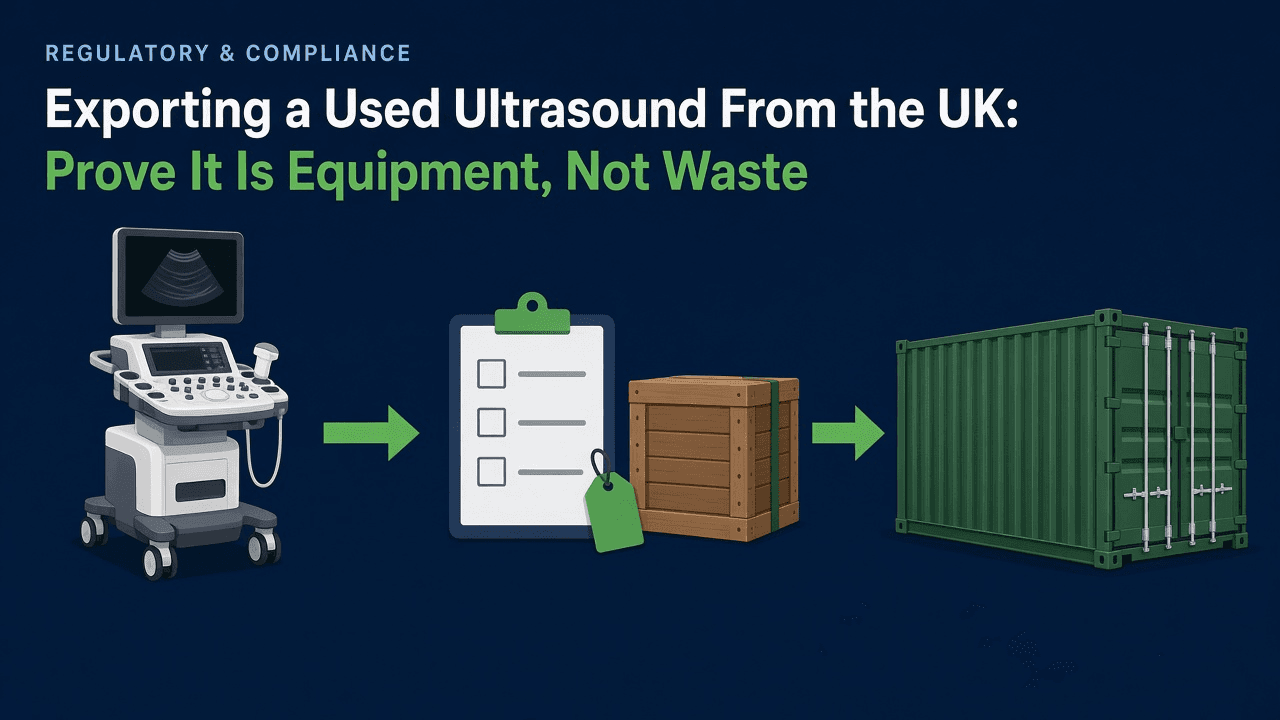
Is the ultrasound still equipment, or has it become waste?
When a hospital clinical engineering department, an independent service organization (ISO), or a medical equipment broker in the United Kingdom prepares to export a decommissioned cart-based or portable ultrasound system to an overseas buyer, the first legal question is binary: is the asset non-waste used electrical and electronic equipment (used EEE), or has it become waste electrical and electronic equipment (WEEE)? Under the waste definition UK law takes from the Waste Framework Directive, an object becomes waste when the holder discards it, intends to discard it, or is required to discard it. The Environment Agency adds that only the courts can finally decide whether something is waste. 3 8
For equipment passed to a new holder for reuse in the UK, the Environment Agency (EA) in England applies Conditions A to F. Under those conditions, the previous holder's actions must show an intention for the whole item to be reused (A). The item must need no more than minor repair (B), and that must be identified before it leaves the holder's premises (C). There must be evidence that any necessary minor repair will be done (D) and a market for lawful reuse (E). Finally, the item must not be transported, stored or mixed with waste in a way that treats it as waste (F). EA states that Conditions A to F apply only to transfers for reuse in the UK; equipment intended for shipment must also be assessed against the export rules discussed below. 3
A common point of friction arises when a UK National Health Service (NHS) trust or private hospital de-installs an older ultrasound console to make room for a new fleet. If the machine is put into a recycling collection or handed to a waste contractor, EA treats it as WEEE because that act shows no intention to reuse it. A later bill of sale does not simply reverse that status. Once an item is WEEE, it must pass an end-of-waste test before it can be treated as EEE again, and that test includes preparation-for-reuse checks and a POPs assessment. Conversely, under EA's asset-replacement scenario, a company collecting working business assets can treat them as EEE until it assesses them. That requires the holder to confirm the item was in use and in good working order until collection, the holder to intend reuse, and the collector to handle it without risk of damage and check it visually. 3
Domestic status is not the end of the analysis. EA guidance states that even if items are classed as used EEE in the UK, they must be assessed against export rules because they may be classed as WEEE for export purposes. 3 Before international transit begins, a buyer and exporter should also agree the serial-specific acceptance gates a buyer should demand, so that clinical capability, software licensing and transducer health are documented once, for both the commercial and the waste-status file.
What does Schedule 9 require for a used ultrasound shipment?
Schedule 9 of the Waste Electrical and Electronic Equipment Regulations 2013 (SI 2013/3113) sets minimum requirements for shipments of used EEE suspected to be WEEE. It was carried over from the EU WEEE Directive to stop electronic scrap being shipped as second-hand goods. Where the holder claims to be shipping used EEE and not WEEE, the holder must have the Schedule 9 documentation available to substantiate that claim, and paragraph 5 places the documentation and packaging obligations on the holder who arranges the transport. Regulation 54 adds that an approved exporter that exports used EEE must comply with Schedule 9 and keep the records for at least four years. 1 11
Paragraph 1 lists four things the holder must have available. First, a copy of the invoice and contract for the sale or transfer of ownership stating that the equipment is destined for direct reuse and is fully functional. Second, evidence of evaluation or testing: a copy of the records (certificate of testing, proof of functionality) for every item in the consignment, and a protocol containing all the record information required by paragraph 3. Third, a declaration by the holder who arranges the transport that none of the material or equipment in the consignment is waste. Fourth, appropriate protection against damage during transport, loading and unloading, in particular through sufficient packaging and appropriate stacking of the load. 1
Paragraph 3 sets two steps. Step 1: functionality must be tested and the presence of hazardous substances evaluated, and the results recorded. The tests depend on the kind of EEE, and for most used EEE a functionality test of the key functions is sufficient. 1 The statute does not define the key functions of an ultrasound. A defensible protocol would normally record boot to imaging, recognition of each transducer on each port, real-time B-mode and every Doppler mode in the configuration, measurement calipers, image storage and export, and the electrical-safety test method used. That list is editorial guidance drawn from ordinary acceptance practice, not statutory text. Step 2: the record must be fixed securely but not permanently to the equipment (if unpacked) or to its packaging, so that it can be read without unpacking. 1
| Pack Item | Clause | What the Clause Requires | Ultrasound Practice |
|---|---|---|---|
| 1. Invoice and contract | Schedule 9, para 1(a) | Copy of the invoice and contract for the sale or transfer of ownership, stating the equipment is destined for direct reuse and is fully functional. | Practical: match chassis and probe serial numbers; a contract that disclaims function ('as is', 'for parts') contradicts the 'fully functional' statement. |
| 2. Item-level test record | Para 1(b); para 3, Step 2 | Name of item and category, identification (type) number where applicable, year of production if available, name and address of the company responsible for evidence of functionality, test results with date, and kind of tests performed. | Fixed securely but not permanently to the unit or its packaging, readable without unpacking. Practical: add console and transducer serial numbers so each record ties to one physical item. |
| 3. Protocol | Para 1(b); para 3, Step 1 | A protocol containing all record information according to paragraph 3; functionality tested and results recorded. | Practical: describe the key-function tests (boot to imaging, probe recognition per port, B-mode and configured Doppler modes, measurement, storage and export) and the electrical-safety method. |
| 4. Holder declaration | Para 1(c) | Declaration by the holder who arranges the transport that none of the material or equipment in the consignment is waste. | Practical: signed by someone with authority, and consistent with internal records showing the unit was never put into a scrap or WEEE collection. |
| 5. Packaging and stacking | Para 1(d); para 5 | Appropriate protection against damage during transport, loading and unloading, in particular sufficient packaging and appropriate stacking of the load. | Practical: crated or cased consoles with internal blocking and separately protected transducers; avoid loose shrink-wrapped pallets that look like bulk scrap. |
| 6. Transport document | Para 4(a) | A relevant transport document, for example a CMR or waybill, accompanying every load (container, lorry). | Practical: cross-reference invoice numbers and test-record numbers. |
| 7. Liable-person declaration | Para 4(b) | A declaration by the liable person on its responsibility. | Practical: name the legal entity taking responsibility for the load and agree in writing who bears return costs if the load is stopped. |
| 8. Hazardous-substance evaluation | Para 3, Step 1(a) | Presence of hazardous substances evaluated and the results recorded. | Practical: batteries, mercury-containing backlights on older displays, and brominated flame retardants (POPs) in boards, cables and plastics. |
| 9. Decontamination record | Not a Schedule 9 item (practical addition) | Record that the console and transducers have been cleaned and disinfected before handling and transport. | Follow the exact system and probe IFU and facility policy; record who decontaminated which item, how, and when. |
Source: WEEE Regulations 2013 (SI 2013/3113), Schedule 9, paragraphs 1, 3 and 4; 'Practical' entries are editorial recommendations, not statutory text. Verified 9 November 2026.
Paragraph 5 sets the consequence. Without proof that an item is used EEE through the documentation in paragraphs 1 to 4, and without appropriate protection against damage, the appropriate authority 'shall consider that an item is WEEE and presume that the load comprises an illegal shipment'. The load is then dealt with under Articles 24 and 25 of Regulation (EC) No 1013/2006, the take-back and cost provisions for illegal shipments. 1 Separately, EA guidance warns that failing to comply with the WEEE Regulations can lead to criminal prosecution, with fines reflecting the severity of the offence. 5
When can a business-to-business repair or refurbishment contract use the exception?
Not every used ultrasound exported from the UK is ready to deploy. Some need board-level repair, transducer relensing or refurbishment that the owner plans to have done abroad. Schedule 9, paragraph 2 recognises legitimate business-to-business repair supply chains with a derogation from some of the testing and invoicing rules. Exporters often misread its scope and assume that calling a shipment 'repair' excuses all of the paperwork. 1 2
The derogation applies only where it is documented by conclusive proof that the shipment takes place under a business-to-business transfer agreement and fits one of three cases. (a) The EEE is sent back as defective for repair under warranty, with the intention of reuse, to the producer or a third party acting on its behalf. Since 12 August 2025, regulation 23 of SI 2025/910 has added the non-UK supplier supplying the EEE on an online marketplace, or a third party acting for that supplier. (b) Used EEE for professional use is sent for refurbishment or repair under a valid contract, with the intention of reuse, to the producer, a third party acting on its behalf, or a third-party facility in a country to which OECD Council Decision C(2001)107/Final applies. (c) Defective professional used EEE, such as medical devices or their parts, is sent to the producer or a third party acting on its behalf for root-cause analysis under a valid contract, where only the producer or its agents can do that analysis. 1 2
The critical distinction is which duties are waived and which survive. Paragraph 2 waives only paragraph 1(a) (the invoice statement of direct reuse and full functionality), paragraph 1(b) (the item-level test records and protocol) and paragraph 3 (the testing and record-labelling steps). It does not waive paragraph 1(c) (the holder's declaration that nothing in the consignment is waste), paragraph 1(d) (protection against damage) or paragraph 4 (the transport document and liable-person declaration). 1 Even under a valid repair contract, unprotected consoles on open pallets fail the packaging duty, and paragraph 5 ties that failure directly to the WEEE presumption.
Geography matters. Under paragraph 2(b), an independent repair facility qualifies only if it is in a country to which the OECD Council Decision applies; otherwise the recipient must be the producer or a third party acting on the producer's behalf. An independent workshop outside the OECD, for example in China, which is not an OECD member, does not fit that limb, so a UK holder cannot use paragraph 2(b) to skip the paragraph 1(a), 1(b) and 3 evidence for a defective unit shipped there. EA export guidance also codes waste printed circuit boards as A1181 hazardous WEEE, which must not be shipped to non-OECD countries. EA notes that EEE sent out for repair and returned to the same person for reuse generally stays EEE, but whether a particular board or console is still EEE depends on the facts. Get a legal or regulator view before relying on that for a non-OECD shipment. 1 3 4
Medical-device questions run in parallel and are separate from waste status. If the overseas work changes performance specifications or intended use, a regulator may treat it as remanufacturing rather than servicing; see where servicing ends and remanufacturing begins for the repair scope. For logistics, coordinate with shipping and customs planning for a repair or return, including how the return leg is documented.
| Decision Branch | Physical Equipment Condition | Governing Legal Framework | Mandatory Documentation Pack | Permitted Export Destinations |
|---|---|---|---|---|
| Branch 1: Non-waste used EEE (direct reuse) | Fully functional and tested; needs no repair; decontaminated. | Schedule 9, paragraphs 1, 3 and 4 (an express duty for approved exporters under regulation 54); EA export reassessment of UK used-EEE status. | Invoice and contract stating direct reuse and full functionality; item-level test records fixed to unit or packaging; protocol; holder declaration; protective packaging; transport document and liable-person declaration. | Possible to any destination that accepts second-hand equipment, subject to that country's import controls on used medical devices. |
| Branch 2: Business-to-business repair or refurbishment derogation | Defective with an identified fault (board, power supply, probe relensing) under a valid repair or refurbishment contract. | Schedule 9, paragraph 2(b), or 2(c) for root-cause analysis; paragraph 2(a) for warranty returns (amended by SI 2025/910). | Conclusive proof of the business-to-business agreement and repair scope; holder declaration; protective packaging; transport document and liable-person declaration. | Producer or a third party acting on its behalf; independent third-party facilities only in OECD-Decision countries. A non-OECD independent workshop does not fit 2(b). |
| Branch 3: WEEE shipment for recovery | Waste: discarded, beyond minor repair, stripped or for parts recovery. | Waste Shipments Regulation as it applies in the UK; EA WEEE export guidance (codes from 1 January 2025). | Notification through IWS online under Y49 (non-hazardous) or A1181 (hazardous, including printed circuit boards). | Recovery only, never disposal. Y49: notify for EU/OECD; notify and obtain consent for non-OECD. A1181: EU, EFTA or OECD only; never non-OECD. |
| Branch 4: Obligated WEEE through an approved exporter | WEEE received from or on behalf of a producer compliance scheme (PCS), or WEEE-derived material from an approved authorised treatment facility (AATF). | WEEE Regulations 2013, Part 8; EA approved-exporter guidance (updated 1 September 2026). | Annual approval; sampling and inspection plan; overseas-site details; quarterly returns with data kept for four years; evidence notes issued through WEEE Online. | Overseas reuse or treatment sites; sites outside the EEA must operate to standards equivalent to a UK treatment facility. |
Source: WEEE Regulations 2013 (SI 2013/3113), regulation 54 and Schedule 9; Environment Agency WEEE export, reuse and approved-exporter guidance; verified 9 November 2026.
How do POPs and the January 2009 date change the answer?
POPs matter in two ways. First, Schedule 9, Step 1 requires the presence of hazardous substances to be evaluated for every used-EEE shipment. Second, if the unit has already become WEEE (for example, it went into a recycling collection before a buyer recovered it), EA guidance says WEEE may be exported as EEE only if the item is not POPs waste. The exporter must show that the whole device does not contain POPs above the concentration limits. POPs waste cannot be reused or recycled; it must be treated so that the POPs are destroyed or irreversibly transformed. 1 3 6
The POPs of most concern in electronics are brominated flame retardants, especially polybrominated diphenyl ethers (PBDEs). EA lists printed circuit boards, cables and internal wiring, and plastic components as places they may be found. On an ultrasound system, that means the board set, internal harnesses, probe and power cables, and moulded console panels. 4 6 Under the POPs Regulation as it applies in Great Britain, waste in which the summed concentration of tetra-, penta-, hexa-, hepta- and decabromodiphenyl ether exceeds 500 mg/kg is POPs waste. 12
EA says EEE manufactured after 1 January 2009 is much less likely to contain PBDEs, but POPs have been found in some equipment made years after that date. For WEEE, the post-2009 date is an exception only for reuse within the UK. For export, EA requires the whole-device demonstration regardless of manufacture date. 3 6 For medical equipment the date is weaker still, because EU RoHS substance restrictions, which include PBDEs, applied to medical devices only from 22 July 2014. 13
For an ultrasound that has a WEEE history and was placed on the market before mid-2014, plan for an affirmative evaluation: OEM material declarations where they exist, and laboratory analysis where they do not. Handheld X-ray fluorescence screening detects bromine, not PBDEs specifically. A high bromine reading should trigger laboratory confirmation; it is not a result in itself. EA's export guidance also limits recovery of POPs waste to techniques that destroy the POPs, and it advises checking whether destination or transit countries apply lower POPs limits than the UK. 4 12
Does BS EN 50614 cover a medical ultrasound?
Section 12 of EA's WEEE evidence and national protocols guidance, updated in July 2026 and written for approved authorised treatment facilities (AATFs) and approved exporters, names BS EN 50614:2020 as the BSI standard for repair and refurbishment of WEEE, supported by WRAP reuse protocols. The same section tells exporters of used EEE to follow Schedule 9. Refurbishers sometimes cite BS EN 50614 for used ultrasound systems, but the published scope shows why that does not work. 5 9
According to the British Standards Institution (BSI) public abstract, BS EN 50614:2020 applies to preparing-for-re-use operators only and does not cover activities connected with used or second-hand equipment that has not become waste. More decisively for healthcare technology managers, it lists medical devices, in vitro diagnostic medical devices and active implantable devices as outside its scope. The abstract also notes that such devices can harbour pathogens and that clinically proven decontamination is essential. 9
An ultrasound exporter therefore cannot rely on BS EN 50614 certification to support a Schedule 9 file for a medical imaging system. Build the key-function protocol from the OEM service documentation and recognised electrical-safety testing practice for medical electrical equipment. A consumer-appliance reuse checklist will not show that the imaging, transducer and measurement functions of an ultrasound actually work.
Data protection is a separate duty. Before a system leaves a UK clinic, patient personal data on it (names, hospital numbers, stored images and cine loops, and reports) must be exported where needed and then securely erased under the UK GDPR and the Data Protection Act 2018. Audit the storage against what patient data must be exported or erased before the unit ships.
When is an approved exporter or WEEE evidence note actually required?
Medical equipment traders often confuse an ordinary exporter of used EEE with an Environment Agency approved exporter (AE). Some ask whether they must become an AE before selling surplus ultrasound systems to overseas clinics. Others assume that AE approval lets them ship second-hand equipment without the Schedule 9 evidence. Neither is correct. 7 11
Under Part 8 of the WEEE Regulations 2013 and EA guidance updated on 1 September 2026, an exporter needs approval if it wants to issue evidence notes on whole appliances for reuse overseas received from or on behalf of a producer compliance scheme (PCS), or to export WEEE-derived materials received from an approved authorised treatment facility (AATF), where the AATF issues the evidence. EA calls this 'obligated' WEEE. An applicant submits a sampling and inspection plan with each annual application and gives details of its overseas sites, including evidence of equivalent standards for sites outside the EEA. Once approved, it files quarterly returns and keeps the data for four years. 7
If an independent service organization, hospital or trader buys a working ultrasound from a UK hospital's surplus and sells it to an overseas healthcare provider as non-waste used EEE, the transaction generates no WEEE evidence notes, and the seller does not need AE approval. What it needs is a complete Schedule 9 file. Conversely, an ultrasound that has entered a PCS collection is WEEE. AE approval governs whether evidence notes can be issued when it is exported for reuse; it does not by itself turn waste back into used EEE, and the end-of-waste, POPs and waste-shipment rules still apply. An AE that exports used EEE must also comply with Schedule 9 and keep those records for at least four years. 3 7 11
Where equipment has become waste and is shipped abroad for recovery or parts harvesting, the waste-shipment rules apply instead. Since 1 January 2025, WEEE shipped for recovery to EU or OECD countries must be notified, under code Y49 for non-hazardous WEEE or A1181 for hazardous WEEE. Y49 WEEE going to a non-OECD country needs notification and consent, and hazardous WEEE must not be shipped to non-OECD countries at all. EA states that printed circuit boards are coded A1181, and waste may be exported only for recovery, never for disposal. 4
| Regulatory Instrument / Source | Effective / Revision Date | Issuer or Regulator | Direct Impact on Used Ultrasound Exporters |
|---|---|---|---|
| WEEE Regulations 2013 (SI 2013/3113), regulation 54 and Schedule 9 | In force 1 January 2014 (revised text) | Regulated by EA (England), SEPA (Scotland), NRW (Wales), NIEA (Northern Ireland) | Sets the documentation, testing, packaging and transport evidence used to rebut the presumption of WEEE; approved exporters must comply and keep records for four years. |
| WEEE (Amendment, etc.) Regulations 2025 (SI 2025/910), regulation 23 | 12 August 2025 | UK statutory instrument | Adds non-UK online-marketplace suppliers to the Schedule 9, paragraph 2(a) warranty-repair derogation. |
| EA guidance: When EEE becomes WEEE | 30 December 2024 | Environment Agency | Conditions A to F for reuse transfers within the UK, the asset-replacement scenario, end-of-waste for WEEE, and the warning that UK used EEE must be reassessed for export. |
| EA guidance: Importing and exporting WEEE | 30 September 2024 (codes from 1 January 2025) | Environment Agency | Y49 and A1181 notification codes for WEEE shipped for recovery; Y49 to non-OECD needs consent; no hazardous WEEE to non-OECD; printed circuit boards coded A1181. |
| EA guidance: WEEE evidence and national protocols (Sections 10 to 12) | 15 July 2026 | Environment Agency | Written for AATFs and approved exporters: names BS EN 50614 for repair and refurbishment of WEEE, points used-EEE exporters to Schedule 9, and sets four-year record keeping for AATFs and AEs. |
| EA guidance: Reusing WEEE and components removed from WEEE | 19 December 2022 | Environment Agency | WEEE may be exported as EEE only if not POPs waste (whole-device demonstration); the post-2009 date helps only for reuse within the UK. |
| EA guidance: How to be an approved exporter | 1 September 2026 | Environment Agency | Annual approval, sampling and inspection plan, equivalent-standard evidence for non-EEA sites, and quarterly returns for obligated WEEE. |
| BSI BS EN 50614:2020 abstract | 29 February 2020 | British Standards Institution | Scope excludes used equipment that has not become waste, and excludes medical devices, IVDs and active implantable devices. |
Source: Compiled from UK Statutory Instruments and Environment Agency guidance releases; verified 9 November 2026.
What must be checked in the destination country before freight?
Meeting the UK side of Schedule 9 is only half of the cross-border check. A shipment that leaves the UK with complete documentation can still be refused at the destination if that country restricts or prohibits used medical electrical equipment. EA guidance states that some countries do not accept second-hand EEE and that exporters must check the destination country's requirements before exporting. 3 4
Requirements vary. Some jurisdictions require a pre-shipment inspection certificate, set an age limit for imported used medical equipment, or require an import permit from the national health or device regulator. Treat these as items to confirm for the specific destination, not as general rules. Where the destination is in the European Union, coordinate with local economic operators on what the EU importer must register before the unit arrives under the EU Medical Device Regulation (EU) 2017/745.
Before booking freight, get written confirmation from the consignee or its licensed customs broker on four points. First, used ultrasound consoles and transducers can be imported under the national tariff line (ultrasonic scanning apparatus falls under HS subheading 9018.12; confirm the national code, including for separately shipped transducers). Second, the buyer holds any required device establishment or import licence. Third, the local supply voltage, frequency and plug configuration match the system's rating. Fourth, the destination does not classify second-hand electronics as waste under its own environmental law.
| Failure Mode | Rule Engaged | Consequence the Rules Provide For | Mitigation |
|---|---|---|---|
| Missing item-level test record | Schedule 9, para 1(b) and para 3, Step 2 | Paragraph 5: the item is considered WEEE and the load presumed an illegal shipment, handled under the take-back provisions. | Fix a durable, serialized record to each console and probe package before loading, readable without unpacking. |
| No holder declaration | Schedule 9, para 1(c) | Missing paragraph 1 documentation; the paragraph 5 presumption applies even under a repair derogation. | Include a signed non-waste declaration in the shipping pack with the CMR, waybill or bill of lading. |
| Inadequate or damaged packaging | Schedule 9, para 1(d) and para 5; EA Condition F | Paragraph 5 ties inadequate protection directly to the WEEE presumption; damage-prone handling indicates treatment as waste. | Crate or case consoles with internal blocking; protect transducers separately; avoid loose shrink-wrap. |
| Unit with WEEE history contains POPs above the limit | GB POPs Regulation, Annex IV; EA reuse guidance | It is POPs waste: it cannot be exported as EEE, and the POPs must be destroyed or irreversibly transformed. | Obtain material declarations or laboratory analysis for pre-2014 units with WEEE history; treat bromine XRF as a screen only. |
| EEE mixed with waste | EA guidance (Condition F) | Mixing EEE for reuse with waste without a clear distinction causes all of it to be classified as waste. | Never place cracked probe shells, dead batteries or failed boards in a crate with functioning equipment. |
| Destination import ban or no licence | Destination import law | Refusal at the destination, with return or other handling at the cost of the party that accepted responsibility. | Confirm importability and licences with the consignee and its customs broker before booking. |
Source: Editorial synthesis from Schedule 9 and the Environment Agency guidance cited above; consequences describe what the rules provide for, not observed enforcement statistics. November 2026.
Where Rongtao fits—and where it does not
Guangzhou Rongtao Medical Technology Co., Ltd. (Rongtao Medical) is an independent technical services company in Guangzhou, China, specializing in ultrasound parts supply, multi-brand transducer repair and board-level repair. The boundary between that technical support and a holder's statutory waste-status decision needs to be explicit. 10
Rongtao can add technical evidence to a holder's file. That includes board-level diagnosis and repair, probe repair, and replacement boards or probes supplied into the UK so a unit can be repaired and tested before export. Every repaired board runs for 48 hours inside an actual ultrasound system before release, with photo or video evidence where applicable. Typical board-repair turnaround is 5 to 8 business days and the warranty is typically 90 days; final terms depend on the item and service and are confirmed in the quotation. 10
Geography is part of the answer. Rongtao's workshop is in China, which is not an OECD member, and Rongtao is not a producer or a party acting on a producer's behalf. Sending a defective UK console or board to Rongtao is therefore not covered by the Schedule 9, paragraph 2(b) third-party-facility derogation, and printed circuit boards that are waste are A1181 hazardous WEEE, which cannot be shipped to a non-OECD country at all. A UK holder considering that route needs its own legal or regulator view before shipping. Where the answer is unfavourable, repairing in the UK with parts supplied by Rongtao keeps the export decision tied to a fully functional, tested unit. 1 4 10
Where Rongtao does not fit is equally clear. Rongtao Medical is not an environmental regulator, not an Environment Agency Approved Exporter, not a licensed waste carrier, not a hazardous waste disposal contractor, and not a licensed customs clearance brokerage. Rongtao does not make legal determinations regarding whether a client's asset constitutes waste, does not issue statutory transfrontier waste shipment notifications (Y49 or A1181), and does not guarantee that a destination customs authority will admit a specific second-hand consignment. Furthermore, OEM brand names (including GE HealthCare, Philips, Siemens Healthineers, Canon/Toshiba, Samsung Medison, Mindray, and Sonosite) are cited only to identify the equipment concerned; Rongtao is not an authorized representative, agent, or affiliated entity of these manufacturers. 10
| Intake Field | Technical Data Required | How It Supports the Holder's File |
|---|---|---|
| System identity | OEM, model, console serial number and installed software version. | Ties test records and repair reports to one physical unit and its configuration. |
| Defective subsystem | OEM part number, hardware revision and component description (for example motherboard, beamformer, power supply). | Documents the identified repair scope, which matters to whether only minor repair is needed and to any repair contract. |
| Photographic record | Photographs of the serial nameplate, both sides of each board, and transducer connectors. | Gives a visual record of condition and labels before and after service. |
| Diagnostic fault logs | Error codes, boot-failure logs, image-artifact screenshots and the conditions under which the fault appears. | Shows what is wrong and supports a case-by-case judgement on repair scope; it does not decide waste status. |
| Decontamination | Signed facility declaration that the equipment was cleaned and disinfected according to the IFU and facility policy. | Protects handlers and supports a safe repair intake; it is not a waste classification. |
| Commercial scope | Required service (board repair or replacement module), quantity, destination country and timeframe. | Allows a formal quotation and aligns parts delivery with the export schedule. |
Source: Rongtao Medical quote-intake fields; November 2026. The right-hand column describes how the information can support a holder's own file; it does not settle waste status.
For a UK repair-before-export plan, see Rongtao's ultrasound repair services or contact Rongtao with the OEM, model and console serial number, the manufacturer part number and photographs of both sides of each board or the probe label, the symptom or error code, quantity, and the destination country.
Frequently asked questions
Does an invoice saying 'fully functional' prove the unit is not waste?
No. An invoice and contract stating direct reuse and full functionality satisfy only paragraph 1(a) of Schedule 9. Paragraph 1(b) and paragraph 3 also call for item-level test records, fixed to the unit or its packaging, and a protocol. Without the documentation and adequate packaging, paragraph 5 says the authority shall consider the item WEEE and presume the load is an illegal shipment. 1
Can I use the repair or refurbishment exception for any used ultrasound?
No. Paragraph 2 of Schedule 9 covers only three documented business-to-business cases: warranty repair returns, professional equipment sent for repair or refurbishment under a valid contract with the intention of reuse, and defective professional equipment sent for root-cause analysis. Under paragraph 2(b), the recipient must be the producer, a third party acting on its behalf, or an independent facility in an OECD-Decision country, so a workshop in a non-OECD country such as China does not qualify. The derogation waives only the invoice statement, test records and testing steps. The holder declaration, packaging and transport documents remain mandatory. 1 2
Is a unit made after 1 January 2009 automatically free of POPs?
No. EA says EEE made after that date is much less likely to contain PBDEs, but POPs have been found in later equipment. For WEEE, the date helps only for reuse within the UK, not for export. Medical devices also came under EU RoHS substance restrictions only from 22 July 2014. If an ultrasound that has become WEEE contains PBDEs above the 500 mg/kg summed limit, it is POPs waste and cannot be exported as EEE. 3 6 12 13
Do I need to be an approved exporter to sell my own used ultrasound abroad?
No. Approved-exporter approval under Part 8 of the WEEE Regulations is needed only to issue evidence notes on whole appliances received from or on behalf of a producer compliance scheme (PCS) and exported for reuse, or to export WEEE-derived materials received from an approved authorised treatment facility (AATF). A hospital, clinical engineering group or trader selling working second-hand equipment does not issue evidence notes. It still needs the Schedule 9 evidence to show the machine is not waste. 7 11
Does BS EN 50614 certification cover an ultrasound?
No. The BSI abstract states that medical devices, in vitro diagnostic medical devices and active implantable devices are outside the scope of BS EN 50614:2020. It also applies only to preparing-for-re-use operators handling WEEE, not to used equipment that has never become waste. Base ultrasound testing on OEM service documentation and medical electrical-safety testing practice instead. 9
What records should be kept, and for how long?
Regulation 54 requires approved exporters to keep Schedule 9 records for at least four years and to produce them on demand, and EA guidance sets the same four-year minimum for AATF and AE records. Schedule 9 sets no separate period for other exporters. Even so, keeping the full pack (contract, invoice, item-level test records, protocol, declarations, transport documents and photographs) for at least four years is a sensible default, because the holder carries the burden of proving the equipment is not waste. 1 5 11