
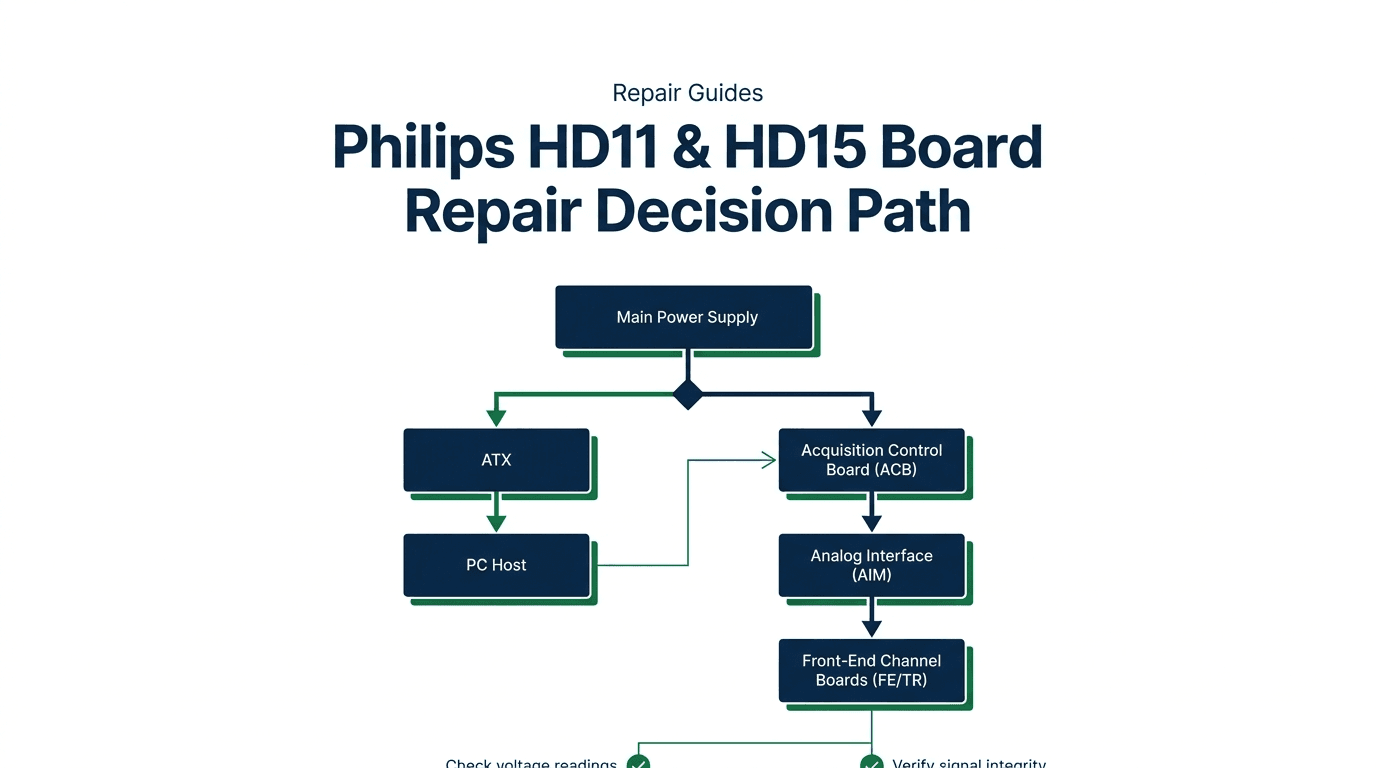
In this decision path
- Which assembly does the symptom point to?
- Start-then-stop blank display: main PSU capacitor, not automatic ACB 453561197145
- Documented HD15 power-on handshake (AC → ATX → PC → ACB trigger)
- Probe-port or vertical dropout: HD15 FE vs HD11 TR
- Unresponsive panel: control panel vs PC USB vs ACB
- AIM 305/306 vs ACB 145/144
- HD11 vs HD11XE vs HD15 vs EnVisor HD7
- Probe and recall rule-outs
- Repair vs replacement vs platform move
- Quote-ready handoff
Which HD15 or HD11 assembly does my symptom point to?
The Philips HD cart generation—anchored by the workhorse HD11 / HD11 XE (first cleared under U.S. FDA 510(k) K043535 in January 2005 and K062247 in August 2006) and the high-definition HD15 (cleared under K081661 in June 2008) 1 8—remains a widely installed shared-service ultrasound platform. Built around a modular lower card-cage and an integrated backplane bus, these systems combine cart-based acoustic front-ends, dedicated host computer modules, multi-rail power supplies, and analog interface conditioning.
Unlike compact hybrid carts such as the Philips CX50 compact cart which integrate computing and beamforming onto dense multi-layer sandwiches, and unlike premium matrix carts such as the Philips EPIQ 5/7 and iU22/iE33 platforms which use complex multi-chassis ACQ/AIM architecture, the HD generation utilizes a centralized card cage with distinct, serviceable functional assemblies. For broad multi-brand context, consult our brand-level Philips board decision path. Verified HD15 and HD11 catalog rows live on the Philips HD15 model page, the Philips HD11 model page, and under Philips board repair; match the physical label before ordering an ACB, FE channel board, HD15 PC, or HD11 PC SKU. To accurately triage a down or degraded HD cart without unnecessary board replacements, biomedical engineers must classify observed symptoms across six distinct hardware domains:
- 1. Main Power Conversion & ATX Distribution Domain (Main PSU 453561382671 / HD11XE PSU 453561382672 / ATX Power Supply): Converts facility AC mains into the intermediate DC buses used by the cart. Archive records describe AC entering the main power supply, then the rear ATX supply, then the PC, then the ACB, with an ACB trigger returning to the main supply before the display and front end come up. Failures manifest as total failure to power on, or start-then-stop cycles where the host starts briefly and then shuts down with a blank screen 4 5.
- 2. Host Computing & System Processing Domain (HD15 PC 453561317224 / HD11 PC 453561674461 / APIO Board 453561183003): Contains the host computer assembly and related interconnects. Failures in this domain can present as boot or storage problems, software/internal-error prompts, loss of DICOM connectivity (a common field complaint, not a documented Rongtao isolation), or unresponsive operator controls caused by a poor PC-to-panel USB connection 3 4 5.
- 3. Acquisition Control & System Coordination Domain (ACB 453561197145 / 453561197144): The Acquisition Control Board (ACB) is the documented HD15 acquisition-control assembly. In the archive handshake it sits downstream of the PC and returns the trigger that brings up the main power supply, display, and front end. Do not treat every blank display as an ACB failure. Catalog 453561197145 is photo-verified; 453561197144 circulates as a legacy/marketplace variant 4 5.
- 4. AIM & Transducer Management Domain (AIM 453561197305 / 453561197306): Archive product notes label both 453561197305 and 453561197306 as HD15 AIM assemblies (compatible with Philips HD15). Marketplace pages also call 305 an analogue interface board and 306 an “AIM/ACB” hybrid. Treat those as labeling collisions, not interchange licenses. After a probe swap, a single dead port or probe-not-recognized complaint points here before ACB 5 7.
- 5. Acoustic Front-End & Beamformer Domain (HD15 FE Channel Board 453561182933 / HD11 TR Transceiver M2540-60240E / M2540-60040 / 453561342481 / SP Boards 453561210152): On HD15 systems this domain is documented as Front-End (FE) Channel Board 453561182933; on HD11 systems as Transceiver (TR) and Signal Processing (SP) boards. Failures that persist across multiple known-good probes create fixed vertical black bands (channel dropouts) or weak acoustic performance 4 5.
- 6. Operator Interface & Console Domain (Control Panels 453561360225 / 453561690381 / HD11 Panel 453563495542 / Keyboard 452561660941): Houses the operator console assemblies documented in the catalog and archive. Failures manifest as an unresponsive panel or worn controls. A 2017 MAUDE inspection isolated one HD15 dead-panel event to a poor USB connection on the PC, not to the ACB 3 4 5.
| Presenting Symptom / Error Pattern | Primary Suspect Assembly | Key Verified Part Numbers | Mandatory Initial Diagnostic Gate | Recommended Service Action |
|---|---|---|---|---|
| Starts then stops with blank display; cooling fans spin briefly then stop | Main Power Supply (PSU) or Filter Capacitors | 453561382671 (Shared PSU), 453561382672 (HD11XE) | Verify wall AC voltage; observe whether the rear ATX supply starts before shutdown; inspect the main PSU for bulging capacitors (s5). Do not treat catalog PSU 453561382671 as the serial identified in that case. | Rebuild/repair Main PSU capacitor section; do NOT immediately order ACB 453561197145 |
| Total dead system; no standby LED, no fan spin on power toggle | Main PSU or Auxiliary ATX Supply | 453561382671 (shared HD11/HD15 PSU label), rear ATX supply | Confirm inlet power; observe whether the rear ATX starts at all | Repair/replace defective ATX supply or primary AC-DC stage on Main PSU |
| Vertical black lines / channel dropouts across ALL connected transducers | FE Channel Board (HD15) or TR Board (HD11) | 453561182933 (HD15 FE), M2540-60240E / 453561342481 (HD11 TR) | Test with at least two known-good probes across different connector ports (s4, s5) | Depot repair of front-end pulser/ADC channels or replace tested FE/TR assembly |
| Single probe port unrecognized; probe works perfectly on adjacent port | AIM or probe connector | 453561197305 (Analogue Interface), 453561197306 (AIM) | Inspect receptacle connector pins for bent/recessed contacts; clean probe mating pins | Replace/repair AIM board 453561197306; do NOT order ACB 453561197145 |
| Control panel completely unresponsive; system boots and displays ultrasound image | PC Host USB Controller or Control Panel Assembly | 453561317224 (HD15 PC), 453561360225 / 453561690381 (HD15 Panel) | Check internal USB cable connecting PC host to control panel; test external USB mouse (s3) | Inspect/repair PC USB port circuit (s3) or service Control Panel assembly; do NOT condemn ACB |
| Continuous Doppler background hiss, audio squeal, or CW initialization error | AIM or HD11 SP — after probe swap | 453561197306 (AIM), 453561210152 (HD11 SP) | Confirm the complaint persists after a known-good probe swap; match the AIM/SP label on the board | Depot inspection/repair of the labeled AIM or SP assembly; do not order ACB from a Doppler complaint alone |
| 3D9-3v probe housing loose or separating on an HD15 host | 3D9-3v Transducer Housing (Chassis Bonding) | 3D9-3v Transducer Assembly | Check transducer serial number against FDA Recall Z-2517-2023 (s2) | Send 3D9-3v probe for laboratory re-shelling/repair; do NOT condemn HD15 console boards |
| S7-3t TEE probe tip temperature error or refusal to scan on HD11 | S7-3t TEE transducer (manufacturing programming) | S7-3t TEE Transducer Assembly | Check transducer serial against FDA Recall Z-1842-2020 (s2) | Route the S7-3t for qualified probe service; do NOT replace HD11 TR boards |
Source: Rongtao Medical Technical Service Archive (s4, s5), FDA 510(k)/Recall Data (s1, s2), and Field Practice Records (s6, s7)
Start-then-stop with blank display: main PSU capacitor first, not ACB 453561197145 — a documented HD15 case that corrects the parent matrix
One documented HD15 failure mode is a start-then-stop power failure with a blank display. In the archive record, after the power button is pressed the host starts and then stops, and the display remains blank 5. That presentation is easy to misread as a dead ACB.
In high-level brand repair summaries—including the brand-level Philips board decision path—HD15 “boots but video remains black” is mapped to the Acquisition Control Board (catalog part number 453561197145), including an unverified “status LED 3 lit” cue that is not in this case body 4. Because the ACB sits in the documented power handshake, technicians often assume a failure to initialize video implies a dead ACB. Ordering a replacement ACB without validating the power path can leave the actual fault untouched.
A documented bench service record in the Rongtao Medical technical archive (Fault Case: Philips HD15 Ultrasound System Cannot Start; the troubleshooting URL is the same case, not a second event) 5 records this isolation:
- Input power: Wall socket voltage was normal, and voltage entering the main power supply was also normal, so the fault was inside the HD15 5.
- Handshake observation: The rear ATX power supply started after boot, then the system stopped and the display stayed black. The record judged that ATX itself and the trigger switch were not the remaining fault 5.
- What was checked next: Interface board and wiring were normal. Remaining suspects were a front-end path that could not return the trigger to the main supply, or the main supply itself 5.
- Outcome: Inspection of the main power supply found a slightly bulging capacitor with abnormal charge/discharge on a meter. Replacing that capacitor with the same specification restored function. The case does not identify a 12NC on that supply and does not record ACB replacement 5. Shared HD11/HD15 PSU 453561382671 is the documented registry label for this family, not the serial from this unit.
Parent matrix correction: When an HD15 or HD11 cart exhibits start-then-stop with a blank display, isolate the main power supply and capacitor condition before condemning ACB 453561197145. This is one historical record without a denominator—not proof that every blank display is a capacitor. For broader power troubleshooting principles, review our guide to ultrasound power supply failure and boot loops.
How the HD15 power-on handshake actually runs: AC main PSU, ATX, PC, ACB trigger — without DIY jumper instructions
The documented HD15 power-on sequence in that technical record is a staged handshake, not a simultaneous turn-on of every rail. Treat it as depot context from one write-up, not as an OEM service-manual schematic 5:
- Stage 1 — AC through the main supply into the rear ATX: Facility AC passes through the main power supply of the equipment and then enters the ATX power supply at the back end 5. Shared HD11/HD15 PSU 453561382671 is the registry label for this family 5.
- Stage 2 — ATX to the PC: After the ATX supply receives the power-on signal, it passes power to the PC motherboard 5.
- Stage 3 — PC to ACB: The PC motherboard passes power to the back-end ACB through the front and rear interface boards and cables 5.
- Stage 4 — ACB trigger back to the main supply: The ACB transmits a trigger signal back to the main power supply. After the main supply receives that trigger, the display and the front end activate and the system can operate normally 5.
Qualified depot safety hard stop: The archive case includes energized diagnostic work that is out of scope for unqualified readers. This article does not republish those steps. Do not force a supply on with chassis jumpers, and do not service energized HD cart hardware without qualified controls. The main power supply contains high-energy capacitors. Power-path isolation belongs in a controlled depot.
Probe-port or vertical dropout: HD15 FE 453561182933 versus HD11 TR variants, after a probe swap
Image quality degradation—specifically fixed vertical black lines, missing acoustic vectors (dropouts), or severe near-field noise—represents a frequent reason for clinical service calls. Because acoustic dropouts can originate either from damaged piezo-electric crystals inside the transducer or from blown pulser/ADC channels on the internal beamformer boards, engineers must execute a structured isolation procedure.
- Mandatory Initial Diagnostic Gate — Transducer Substitution: Connect a known-good secondary transducer (preferably of a different model and frequency band) to the suspect connector port. If the vertical dropout shifts position, alters width, or disappears entirely, the defect resides inside the primary probe's crystal array or micro-coaxial cable harness (ultrasound probe repair). If the identical vertical black line persists in the exact same screen coordinate across multiple known-good probes, the failure is definitively located inside the console acoustic front-end 4 5.
Once a front-end console defect is confirmed, service teams must understand the fundamental architectural differences between the HD15 and HD11 beamformer architectures:
- Philips HD15 Front-End (FE) Channel Board (Catalog 453561182933): On the HD15 platform, the acoustic front-end is documented as Front-End (FE) Channel Board 453561182933 4. When identical vertical dropouts persist across multiple known-good probes on an HD15, route the complaint to this assembly rather than ACB.
- Philips HD11 / HD11 XE Transceiver (TR) Board Variants: On the HD11 platform, acoustic transmit and receive functions are handled by Transceiver (TR) boards. In the global service market, several distinct part numbers circulate for the HD11 TR assembly: inventory records M2540-60240E 4; legacy archive specification bodies document M2540-60040 and 12NC 453561342481 5; and marketplace listings include M2540-20240 7. These numbers represent documented production variants circulating in the field; they must not be assumed to follow a numeric revision sequence or permit silent interchange without matching the physical board label.
For deeper physical insights into acoustic beamforming channels, consult our detailed analysis of ultrasound beamformer and front-end board failure.
Unresponsive panel: control-panel SKUs versus PC USB versus ACB — a MAUDE isolation, not a board condemnation
When an operator reports that the ultrasound keyboard, rotary dials, or trackball are completely unresponsive while live imaging continues to display, technicians frequently face an ambiguous diagnostic choice between replacing the physical control panel, replacing the host computer, or replacing the Acquisition Control Board (ACB).
A critical insight into this failure mode comes from an official U.S. FDA MAUDE record. In report 3019216-2017-00023 (Philips HD 15 ULTRASOUND SYSTEM, model 795066) 3, the control panel was unresponsive. The manufacturer isolated the issue to a poor USB connection on the PC that leads to the control panel. The manufacturer narrative states:
The Philips field service engineer went onsite to perform a thorough inspection of the HD15 ultrasound system and isolated the issue to a poor USB connection on the PC that leads to the control panel. Evaluation of the device verified the poor connection caused the system control panel to be unresponsive. It has been concluded that the ultrasound system did not cause or contribute to the death of this patient. Once a secure connection was established, the system operated properly and was returned to use.— U.S. FDA MAUDE Database, additional manufacturer narrative, report 3019216-2017-00023 (s3)
Two service rules follow: first, an unresponsive control panel can be a PC-to-panel USB connection (catalog HD15 PC 453561317224 or HD11 PC 453561674461) 4 rather than an ACB failure—and this record describes restoring a secure connection, not a documented PC-board swap; second, death codes in passive-surveillance databases must be read against the manufacturer finding, not sensationalized. Other MAUDE records—a lift-assembly drop (1218950-2013-02733) and an unplugged fire with no failure analysis (3019216-2017-00037)—are isolated mechanical or facility events, not board epidemiology 3.
When isolating control panel faults, service personnel should match verified physical console SKUs: HD15 control panels include 453561360225 and 453561690381; HD11 control panels include 453563495542 4. For broader console diagnostic methods, see our guide on ultrasound control panel and touch display failure.
AIM 453561197305 versus 453561197306 versus ACB 453561197145/197144 — and why IndiaMart's AIM/ACB label is not a swap license
A common procurement error is conflating the HD15 AIM with the Acquisition Control Board (ACB). On secondary parts platforms such as IndiaMart, part number 453561197306 is listed under the hybrid title "Philips HD15 AIM/ACB Board" 7. That marketplace label is not a license to treat AIM and ACB as the same assembly.
Biomedical engineers must maintain strict distinction between these assemblies (how to verify ultrasound board part numbers):
- Acquisition Control Board (ACB — Catalog 453561197145 / Marketplace 453561197144): Catalog 453561197145 is the photo-verified HD15 ACB SKU; 453561197144 is a documented legacy/marketplace variant in circulation. Match the 12-digit label; do not infer interchange from one digit 4 5 7.
- AIM (Legacy Archive 453561197305 / 453561197306): Archive product-note bodies label both 453561197305 and 453561197306 as HD15 AIM assemblies compatible with Philips HD15. DotMed lists 305 as an analogue interface board; IndiaMart lists 306 as AIM/ACB. Those are circulation labels, not proof that 305 and 306 are different functions or that either is an ACB 5 7.
AIM and ACB are different part-number families. Do not order one from the other's marketplace title. Always cross-check the exact 12-digit barcode printed on the physical PCB. This site does not have an OEM revision matrix showing interchange.
HD11 versus HD11XE versus HD15: shared PSU 453561382671, HD11XE 453561382672, and why HD7/EnVisor is a different family
The Philips HD cart generation spans multiple model designations across a decade of production. Sourcing teams frequently question whether internal parts can be freely exchanged between an HD11, an HD11XE, an HD15, or an EnVisor HD7. Sourcing errors can be avoided by understanding three critical platform boundaries:
- 1. Shared HD11 / HD15 Power Supply (453561382671) vs HD11XE PSU (453561382672): Technical archive records document that the primary Main Power Supply 453561382671 is shared across standard HD11 and HD15 platforms 5. However, the HD11 XE revision utilizes a dedicated power supply assembly under part number 453561382672 5. While search engine AI Overviews and marketplace listings frequently display unverified hyphenated numbers like
4535-612-227726, procurement teams must verify the physical 12NC label on the existing power supply before ordering. - 2. HD11 vs HD15 Front-End Architecture: HD11 systems utilize separate Transceiver (TR) boards (such as M2540-60240E or 453561342481) and Signal Processing (SP) boards (453561210152) 4 5. HD15 systems utilize consolidated high-density Front-End Channel Boards (453561182933) and an Acquisition Control Board (453561197145) 4. Do not cross-install HD11 TR/SP assemblies into an HD15 FE slot from the family name; they are different labeled part families.
- 3. EnVisor HD7 / HD7XE Family Separation: Online document repositories (such as Scribd service guides) frequently bundle EnVisor HD7, HD11, and HD15 under combined titles 7. EnVisor HD7/HD11/HD15 bundled service-guide titles are a family collision, not a donor map. Do not harvest EnVisor HD7 boards to repair an HD11 or HD15 cart.
| Hardware Assembly Domain | Part Name & Description | Primary 12NC Part Number | Alternate / Documented Circulation PNs | Source & Ground Truth Reference |
|---|---|---|---|---|
| Acquisition & Control | HD15 Acquisition Control Board (ACB) | 453561197145 | 453561197144 | Catalog SKU hd15-acb-453561197145 (s4), legacy notes (s5), Heart Medical (s7) |
| Front-End / Beamformer | HD15 Front-End Channel Board (FE) | 453561182933 | None (Dedicated HD15 beamformer) | Catalog SKU hd15-fe-channel-board-453561182933 (s4) |
| Host Computing / PC | HD15 Host Computer Assembly (PC) | 453561317224 | 453561450161 (DotMed listing) | Catalog SKU hd15-pc-453561317224 (s4), DotMed (s7) |
| Host Computing / PC | HD11 Host Computer Assembly (PC) | 453561674461 | None (Dedicated HD11 host) | Catalog SKU hd11-pc-453561674461 (s4) |
| Operator Control Panel | HD15 Operator Control Panel | 453561360225 | 453561690381 | hd15-control-panel-453561360225 / 453561690381 (s4) |
| Operator Control Panel | HD11 Operator Control Panel | 453563495542 | 453561210412 (archive HD11 control-panel note) | Catalog SKU hd11-control-panel-453563495542 (s4) |
| Front-End / Transceiver | HD11 Transceiver Board (TR) | M2540-60240E | M2540-60040, M2540-20240, 453561342481 | Inventory row (s4), legacy notes (s5), eBay listing (s7) |
| Analog Interface | HD15 AIM | 453561197306 | 453561197305 (archive AIM; DotMed analogue-interface listing) | Legacy archive specification bodies (s5); IndiaMart AIM/ACB listing (s7) is a collision, not interchange |
| Power Supply / Main | HD11 / HD15 Main Power Supply (PSU) | 453561382671 | 4535-612-22772 (Hyphenated string in circulation) | Technical archive case & registry (s5), AI Overview (s6) |
| Power Supply / Main | HD11 XE Main Power Supply (PSU) | 453561382672 | Dedicated HD11 XE supply | Technical archive specification body (s5) |
| Peripheral I/O | HD11 IO Board Assembly | 453561254771 | 453561249883 | Inventory stock rows (s4) |
| Signal Processing | HD11 Signal Processing Board (SP) | 453561210152 | 453561210154, 453561343282, 453561343281 | Legacy technical archive records (s5) |
| Interconnect / Backplane | HD11 APIO / Front Backplane | 453561183003 | 453561235651 (APIO), 453561247581 (Backplane) | Legacy technical archive records (s5) |
Source: Rongtao Medical Parts Catalog (s4), Inventory Ground Truth (s4), and Migrated Technical Archive Records (s5)
View chart data
| Category | Verified Part Numbers in Circulation |
|---|---|
| Signal Processing (SP) & APIO | 6 |
| Front-End Beamformers (FE & TR) | 4 |
| Control Panels | 3 |
| Host Computer Assemblies (PC) | 2 |
| Power Supply Modules (PSU) | 2 |
| Acquisition Control (ACB) | 2 |
| AIM | 2 |
| Backplane & Peripheral I/O | 3 |
Breakdown of 24 documented HD11, HD11XE, and HD15 electronic part numbers from the catalog, inventory, and archive specification bodies (snapshot 2026-08-25). Excludes hyphenated PSU folklore (4535-612-22772), eBay-only TR M2540-20240, and DotMed PC 453561450161, which remain circulation strings in the registry table.
Source: Rongtao Medical parts catalog, inventory snapshot, and technical archive labels (s4, s5)
Could it be a probe or a recall instead? 3D9-3v Z-2517-2023 on HD15 and S7-3t Z-1842-2020 on HD11
Before condemning internal circuit boards or sending an HD console to depot repair for transducer communication errors or physical probe faults, clinical engineering teams must rule out official regulatory recalls and transducer-specific defects.
Two major U.S. FDA Class II recall actions directly impact the Philips HD cart family and must be cleared during triage:
- FDA Recall Z-2517-2023 (Class II Completed, openFDA event 92761, initiated 2023-06-30): Philips Ultrasound recalled specific lots of the 3D9-3v transducer (product code ITX) used on host systems including EPIQ Elite, Affiniti 30/50/70, ClearVue 850, HD15, iU22, and Compact 5000 2. The FDA described a chassis bonding issue in which two bonded parts of the transducer may come apart. When a 3D9-3v probe exhibits a loose or separating housing on an HD15, route the probe for qualified ultrasound probe repair; this recall does not condemn HD15 console boards.
- FDA Recall Z-1842-2020 (Class II Terminated, openFDA event 84902, initiated 2019-08-30): Philips recalled lots of the S7-3t transesophageal (TEE) transducer used as an accessory with iE33 and HD11 2. Affected transducers were not properly programmed during manufacturing, so the host cannot correctly measure distal-tip temperature. When an S7-3t triggers a tip-temperature error on an HD11, do not replace the HD11 TR or SP boards on the strength of that recall.
- FDA Recall Z-0987-2007 (Terminated, initiated 2007-04-25): A historical HD11XE Diagnostic Ultrasound System recall for potential erroneous measurements if the user exits an imaging mode while Active Annotation is in use. Treat it as a software/measurement-state rule-out, not a board condemnation 2.
| Regulatory Identifier / Action | Status & Key Dates | Affected Product & Scope | Observed Failure Symptom | Root Cause vs Misdiagnosed Board Defect |
|---|---|---|---|---|
| FDA Recall Z-2517-2023 (Event 92761) | Completed (Initiated 2023-06-30, Posted 2023-09-06) | 3D9-3v transducer on hosts including HD15 | Probe outer housing loose or separating during clinical use | Transducer chassis bonding (s2); do NOT condemn HD15 FE Channel Boards |
| FDA Recall Z-1842-2020 (Event 84902) | Terminated (Initiated 2019-08-30) | S7-3t TEE Transducer on HD11 / iE33 hosts | Distal-tip temperature measurement error or scanning halt | Transducer not properly programmed during manufacturing (s2); do NOT replace HD11 TR or SP boards |
| FDA Recall Z-0987-2007 | Terminated (Initiated 2007-04-25, Posted 2007-07-03) | HD11XE Diagnostic Ultrasound System | Potential erroneous measurements / Active Annotation state | Historical software/measurement recall (s2); not a board condemnation |
| MAUDE Report 3019216-2017-00023 | Investigated 2017 (Reviewed August 2026) | Philips HD 15 Ultrasound System (Model 795066) | Control panel completely unresponsive during procedure | Isolated to poor USB connection on PC Host (s3); manufacturer explicitly confirmed system did not cause/contribute to death |
| MAUDE Adverse Event Surveillance (n=3 for HD15, n=4 for HD11) | Reviewed August 2026 | Philips HD15 and HD11/HD11 XE Ultrasound Systems | Isolated lift drop (2013), unplugged fire (2017), TEE blank screen, power smoke | Passive surveillance reports; isolated clinical malfunctions, not systemic board failure epidemiology (s3) |
Source: U.S. FDA Medical Device Recalls Database (s2), Enforcement Database (s2), and MAUDE Database (s3)
HD15 AIM is not iU22 AIM, and HD15 PC 453561317224 is not HD11 PC 453561674461
Cross-generation part swapping between different Philips ultrasound platforms carries severe technical risks. Sourcing personnel frequently encounter three specific compatibility pitfalls:
- 1. HD15 AIM (453561197305 / 453561197306) vs iU22 / iE33 AIM (453561279498): They share the acronym AIM but not the part number. HD15 AIM labels in the archive are 453561197305 and 453561197306; the iU22/iE33 catalog AIM is the Acquisition Interface Module 453561279498 5. Do not order an HD15 AIM into an iU22 AIM slot from the family name.
- 2. HD15 PC Host (453561317224) vs HD11 PC Host (453561674461): These are distinct catalog SKUs (453561317224 vs 453561674461) 4. Match the label on the installed host; do not assume HD11/HD15 PC interchange.
- 3. HD15 / EPIQ alphanumeric keyboard (452561660941): A legacy product note is titled Philips HD15/EPIQ alphanumeric keyboard 452561660941 and lists additional keyboard PNs in the same note 5. Shared labeling is not proof that the underlying controller board can be swapped. Match the 12NC on the assembly you have.
Repair, tested replacement, or platform move: 2005/2006 HD11 clearances, 2008 HD15 clearance, and why K201012 is not this chassis
Clinical engineering directors, hospital procurement committees, and ISO managers responsible for ultrasound fleets face a crucial financial and operational decision when an HD11, HD11XE, or HD15 experiences a major board failure: should the facility invest in component-level PCB repair, procure a tested exchange board, or retire the platform entirely in favor of modern systems such as the Philips Affiniti or EPIQ series?
To establish an evidence-based capital strategy, service managers must examine the regulatory and engineering lifecycle of the HD platform:
- 2005 — Initial HD11 FDA Clearance (K043535, January 6, 2005): Established the HD11 as a versatile shared-service cart platform under product code IYN (subsequent codes ITX/IYO) 1 8.
- 2006 — HD11 Special 510(k) Clearance (K062247, August 18, 2006): Cleared system software and hardware modifications under Philips Medical Systems (Andover, MA) 1 8.
- 2008 — HD15 Clearance (K081661, June 24, 2008): Cleared the HD15 Diagnostic Ultrasound System (IYN, Traditional, Substantially Equivalent) with applicant state WA 1 8.
- 2020 — COVID-19 Labeling Expansion (K201012, May 1, 2020): Expanded emergency labeling for cardiac and lung triage during the pandemic across EPIQ, Affiniti, CX50, Sparq, and Lumify platforms 1. K201012 did not include the HD11 or HD15 platform; the HD generation remained in its mature, established clinical configuration.
View chart data
| Category | 510(k) Clearances |
|---|---|
| 2005 (K043535 — HD11 Initial) | 1 |
| 2006 (K062247 — HD11 Special) | 1 |
| 2008 (K081661 — HD15 Initial) | 1 |
Chronological distribution of 3 primary FDA 510(k) clearances for the Philips HD11 and HD15 platforms. Note that K201012 (2020) covered newer platforms and excluded HD11/HD15.
Source: U.S. FDA 510(k) Premarket Notification Database (s1, s8)
With the HD cart generation operating 16 to 21 years post-clearance, clinical engineering teams have three clear operational pathways (board repair vs replacement decision guide):
- Option 1 — Component-Level PCB & PSU Repair (Recommended Primary Route): For core assemblies such as Main Power Supplies (453561382671), Acquisition Control Boards (453561197145), or FE Channel Boards (453561182933), component-level depot repair restores the failed module without requiring full assembly replacement. Standard service terms provide a 5–8 business-day turnaround, typically 90-day warranty, and 48-hour real-machine stress testing, with finals confirmed at quote 4.
- Option 2 — Tested Exchange Assembly: When a printed circuit board has suffered severe multi-layer substrate delamination, liquid ingress corrosion, or cracked BGA pads, an outright exchange with a photo-verified, pre-tested module is the fastest recovery path. Exchange boards must be backed by an authentic real-machine test evidence pack.
- Option 3 — Platform Retirement / Capital Upgrade: If a cart has suffered widespread simultaneous damage across multiple core subsystems (e.g., high-voltage lightning surge destroying main PSU, ATX, PC host, ACB, and front-end channel boards simultaneously), or if clinical workflows demand modern shear-wave elastography and automated cardiac quantification, retiring the unit in favor of an Affiniti or EPIQ system is economically justified.
Where Rongtao fits — and where it does not
To establish clear, transparent expectations with hospital clinical engineering teams, ISOs, and medical equipment distributors, Rongtao Medical explicitly delineates its technical capabilities and service boundaries:
- Where Rongtao Fits:
• Component-level PCB and PSU repair: Depot diagnosis and repair for Philips HD11, HD11XE, and HD15 power supplies, ACB, AIM, FE, TR, and host-computer assemblies that match a verified label.
• Photo-verified catalog rows: 5 photo-backed HD15 catalog SKUs and 2 HD11 catalog SKUs, plus 2 HD11 inventory rows in the 2026-08-25 snapshot, with availability confirmed on the live catalog or a quote, and typically 90-day warranty terms 4.
• 48-hour real-machine testing: Every repaired board runs for 48 hours inside an actual ultrasound system before release 4.
• Transducer repair: Probe service through the dedicated ultrasound probe repair laboratory, including 3D9-3v and S7-3t complaints after recall rule-out. - Where Rongtao Does Not Fit:
• No OEM Representation: Rongtao Medical is an independent service organization and replacement parts supplier. We are not an authorized agent, distributor, or representative of Philips Healthcare. OEM brand names and part numbers are referenced solely for technical identification and compatibility.
• No On-Site Hospital Field Service: We operate centralized high-tech repair depots and global parts logistics; we do not dispatch field engineers for on-site hospital emergency repairs.
• No Dangerous DIY Jumper Instructions: We strictly decline to provide instructions that encourage untrained individuals to short chassis jumpers or service energized high-voltage power supplies.
Quote-ready handoff: HD15 versus HD11/HD11XE, both-sides photos, label PN, symptom text, probe types including any TEE or 3D9-3v, quantity, destination
To receive an accurate, rapid technical evaluation and quote for Philips HD11, HD11XE, or HD15 board repair or parts replacement, service engineers should compile the following six items before submitting a request via our contact and quote portal:
- 1. Exact System Model & Cart Badge: Clear photograph of the rear system serial badge confirming whether the machine is an HD15, HD11, or HD11 XE, along with installed software revision.
- 2. Physical Board Barcode Photographs (Both Sides): High-resolution photographs of both component and solder sides of the suspected board, clearly capturing the 12-digit 12NC barcode label (e.g.,
453561197145,453561182933,453561382671) and PCB revision markings. - 3. Detailed Symptom & Handshake Behavior: Specific description of observed failure behavior: whether the machine exhibits start-then-stop, total dead power, vertical image dropouts, a blank display after ATX start, or internal software error prompts.
- 4. Transducer & Port Pre-Check Status: Confirmation of whether vertical dropouts or noise persist across multiple probes and connector ports, including probe model (e.g., 3D9-3v, S7-3t, C5-2, L12-3).
- 5. Storage & Peripheral Status: Confirmation of whether the PC Host USB connections have been inspected and whether the hard drive boots on bench diagnostics.
- 6. Required Quantity, Service Mode & Destination: Number of boards required, preference for depot repair versus tested exchange assembly, and shipping destination for customs and logistics calculation.
Frequently Asked Questions
Q1: Will an HD11 board work in my HD15, or an HD11XE PSU in an HD11?
No. The HD15 uses Front-End (FE) Channel Board 453561182933 and ACB 453561197145, whereas the HD11 uses Transceiver (TR) and Signal Processing (SP) boards 4 5. Do not assume those assemblies interchange. Standard HD11 and HD15 share Main PSU label 453561382671; HD11XE uses 453561382672 5. Always match the 12NC on the board label.
Q2: My HD15 starts then stops and the display is blank — should I replace ACB 453561197145 first?
No. In a documented HD15 record, start-then-stop with a blank display recovered after a bulging capacitor on the main power supply was replaced; the rear ATX had already started 5. That is one historical outcome, not a reason to skip ACB when the power path is healthy—and not a reason to order ACB 453561197145 first.
Q3: Is AIM 453561197306 the same as ACB 453561197145?
No. Despite third-party listings of 453561197306 as 'AIM/ACB' 7, archive notes treat 453561197306 as an HD15 AIM assembly, while catalog 453561197145 is the HD15 ACB 4 5. Match the label on the board you have.
Q4: Is the 3D9-3v bonding recall a reason to replace my HD15 boards?
No. FDA Recall Z-2517-2023 2 is a 3D9-3v transducer chassis-bonding action on hosts including HD15. It is a probe housing failure, not a reason to condemn HD15 console boards. Send the probe for laboratory repair.
Q5: Did the 2020 Philips COVID labeling clearance cover the HD15 chassis?
No. FDA 510(k) K201012 (cleared May 1, 2020) was an emergency clinical indication and labeling expansion covering EPIQ, Affiniti, CX50, Sparq, and Lumify systems 1. It did not cover the HD11 or HD15 chassis, whose primary 510(k) clearances date from 2005 (K043535), 2006 (K062247), and 2008 (K081661) 1 8.
Q6: Is the HD15 still worth repairing in 2026 after the 2008 510(k)?
For many installed-base carts, yes: component-level board and power-supply repair (standard 5–8 business-day turnaround, typically 90-day warranty, 48-hour real-machine testing 4) remains a rational alternative to buying a new cart, provided the failed assembly is identified first. Final terms depend on the item and are confirmed at quote.
Q7: What photos and information should I send to get a quote for an HD11 or HD15 board or PSU repair?
Provide clear photographs of the rear machine serial badge, high-resolution photographs of both sides of the suspected circuit board showing the 12-digit barcode label, a detailed description of observed power handshake or imaging symptoms, and confirmation of probe testing status.