
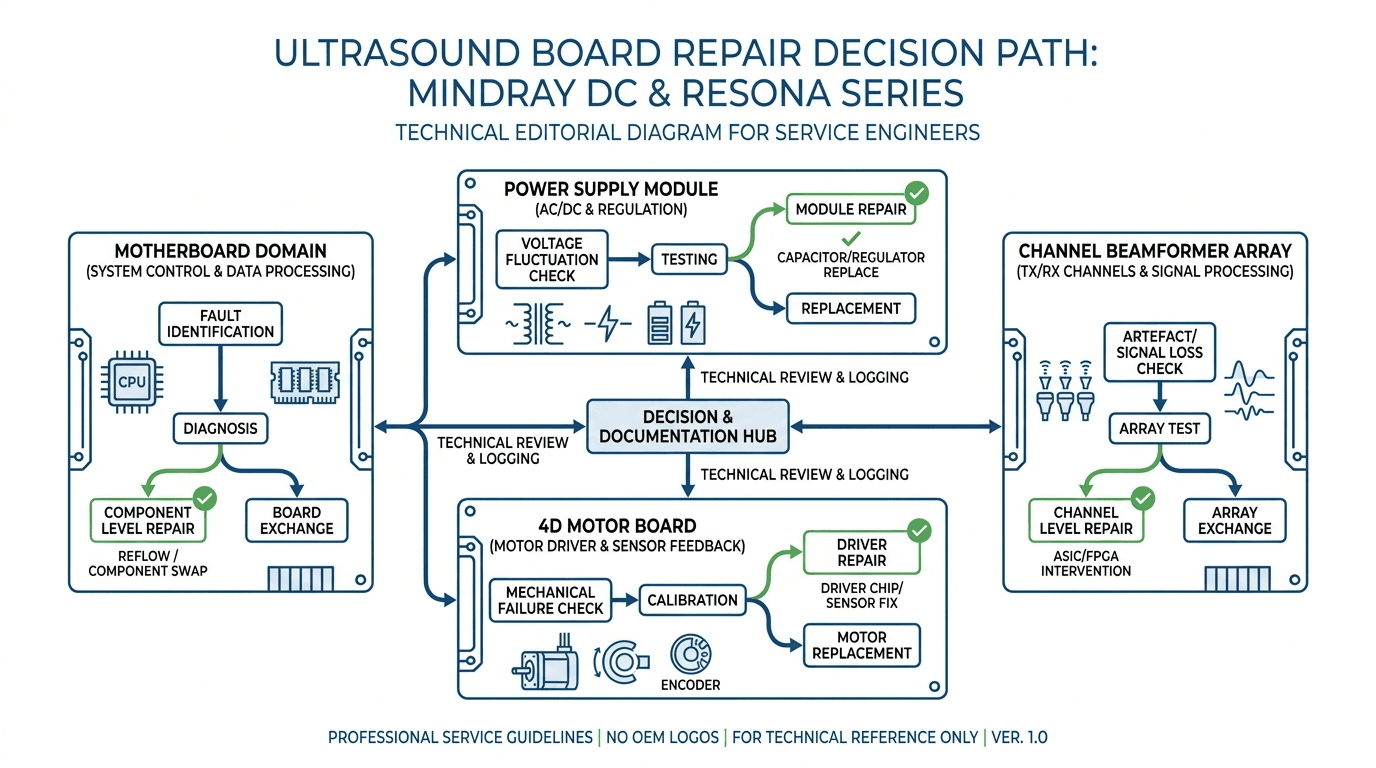
Introduction: Structured Board Isolation for Mindray DC and Resona Ultrasound Platforms
Mindray Bio-Medical Electronics has established an extensive global installed base in diagnostic ultrasound across hospital departments, outpatient imaging centers, and independent clinical facilities. Key console lines range from versatile mid-tier cart systems like the DC-70, DC-75, DC-78, DC-80, and DC-85, to established workhorses such as the DC-8, DC-60, and DC-6, flagship premium platforms like the Resona 7, and high-performance portable consoles including the M7, M7T, and M9.
When a Mindray ultrasound console exhibits electronic failure, hospital biomedical engineering teams, independent service organizations (ISOs), and medical equipment refurbishers need a structured, objective method for isolating symptoms to specific circuit board assemblies. Searching public search engines often directs technicians to surface-level consumer stubs or parts marketplace listings that lack diagnostic logic, electrical safety boundaries, or OEM part-number verification rules.
Component-level board repair and advance board exchange provide clinical facilities with a highly cost-effective path to restore system operation without incurring full console replacement expenses. By mastering Mindray's 051-series, 115-series, and 023-series part numbering scheme, verifying exact hardware revision letters, and cross-referencing system FDA 510(k) clearances, service engineers can eliminate guesswork, shorten downtime, and ensure compliance with medical device servicing regulations.
For technical diagnostic guides covering other major multi-brand ultrasound platforms, service engineers can consult our sibling decision-path reports for GE ultrasound board symptom isolation, Philips iU22/EPIQ board fault diagnosis, Siemens Acuson board symptom paths, Hitachi / Fujifilm Aloka board repair guidance, and Toshiba / Canon Aplio board symptom isolation.
Which Mindray board causes no image, probe-not-detected, channel dropout, a 4D motor error, or no-boot on a DC-70/DC-80/DC-8/Resona 7?
Diagnostic troubleshooting on Mindray systems begins by categorizing observed failure symptoms into functional hardware sub-systems: (1) Front-End Transmit / Receive & Signal Interface, (2) Main Power Conversion & Voltage Distribution, (3) Back-End Motherboard & Central Processing Unit, (4) Volumetric 4D Transducer Motor Drive, or (5) User Interface Control Panel & Trackball Interconnect.
Different board modules experience distinct thermal and electrical stresses. Transmit interface (TI) and receive channel (TR) boards house high-voltage pulser ICs and sensitive low-noise pre-amplifiers that operate under continuous RF pulsing during Doppler modes. Power supply modules house switching transistors and filter capacitors subjected to ongoing thermal cycles. 4D motor driver boards handle inductive motor current loads, making them susceptible to driver FET breakdown.
Table 1 correlates observed clinical and hardware failure modes across Mindray DC-70, DC-80, DC-8, Resona 7, M7, and M9 systems directly to primary candidate board assemblies, manufacturer part numbers, and catalog IDs verified from Rongtao Medical's ground truth 6:
| System Model / Family | Observed Clinical / Hardware Symptom | Suspected Functional Sub-System | Primary Candidate Board Assembly | Verified OEM Part Number & Catalog ID |
|---|---|---|---|---|
| DC-70 / DC-70 Exp | B-mode image missing or weak signal; probe transmission failure | Front-End Transmit Interface | TI Transmit Interface Board | 051-001831 (Catalog ID dc-70-ti-board-051-001831) |
| DC-70 / DC-70 Pro | Console completely dead; zero LED activity or fan movement | Main AC/DC Power Conversion | AC/DC Power Supply Module | 115-022761 (Catalog ID dc-70-power-supply-115-022761) |
| DC-70 / DC-75 | Console hangs at startup Mindray logo; system boot loop | Back-End System Processing | Motherboard / Mainboard Assembly | 051-001451 (Catalog ID dc-70-motherboard-051-001451) |
| DC-70 / DC-78 | 4D volumetric probe motor fails to initialize; system throws 4D motor error | Volumetric Motor Driver Subsystem | 4D Motor Driving Board | 051-001467-01 (Catalog ID dc-70-4d-motor-board-051-001467-01) |
| Resona 7 | Vertical acoustic line dropout in B-mode; receive gain channel distortion | Receive Beamformer Array | TR Channel Board Assembly | 051-001728-00 (Catalog ID resona7-tr-channel-board-051-001728-00) |
| Resona 5 | User soft-keys non-responsive; front panel button freeze | User Interface Front Panel | Key-Press Panel Assembly | 051-002188-00 (Catalog ID resona5-key-press-panel-051-002188-00) |
| DC-8 | Acoustic transmit power loss; color Doppler sensitivity drop across ports | Transmit Signal Generation | Transmitting (TX) Board Assembly | 051-000647 (Catalog ID dc-8-transmitting-board-051-000647) |
| DC-8 | Control panel trackball lock and button backlight failure | Control Interface Controller | Control Panel Board Assembly | 051-000663 |
| M7 / M7T Portable | System fails to run on AC power or charge lithium battery pack | Internal Power Management | M7 Power Supply Board | 051-000099 (Catalog ID m7-power-supply-051-000099) |
| M9 Portable | Console keyboard illumination failure; control panel freeze | Control Panel Microcontroller | Control Panel Assembly | 051-001382-04 (Catalog ID m9-control-panel-051-001382-04) |
| DC-33 / 60 / 75 / 90 | Operator control panel freeze; key press signals ignored by host | Control Panel Interface | Control Panel Assembly | 051-001450-01 (Catalog ID dc-33-60-75-90-control-panel-051-001450-01) |
| DC-60 / DC-70 | Screen cursor jumps or fails to move; mechanical trackball resistance | Trackball Mechanical Interface | Trackball Assembly | 023-001236-00 (Catalog ID dc-60-70-trackball-023-001236-00) |
Source: Rongtao Medical photo-backed catalog ground truth (verified rows marked with Catalog IDs) and verified Mindray part-number records cross-referenced against OEM service documentation
How do I identify the correct Mindray board part number and revision for DC-70, DC-80, DC-8, Resona 7, M7 and M9?
Accurate part identification is essential when ordering replacement boards or requesting component repair for Mindray ultrasound systems. Mindray uses a standardized part numbering structure across its printed circuit board assemblies, power conversion modules, and mechanical hardware:
- 051-Series Board Assemblies: Electronic PCB assemblies utilize the
051-prefix followed by a 6-digit base number and optional revision suffix (e.g.,051-001451for DC-70 motherboard,051-001467-01for DC-70 4D motor board,051-001831for DC-70 TI board,051-001728-00for Resona 7 TR channel board, and051-001382-04for M9 control panel). - 115-Series Power Conversion Modules: Main AC/DC power supply assemblies and internal power conversion units utilize the
115-prefix (e.g.,115-022761for the DC-70 power supply assembly). Portable models such as the M7 also use051-000099for internal power regulation boards. - 023-Series Mechanical Subassemblies: Electromechanical and human-interface hardware components utilize the
023-prefix (e.g.,023-001236-00for the DC-60/70 trackball assembly). - Label Location & Silkscreen Verification: Always read both the paper barcode sticker attached to the board edge and the white silkscreen lettering printed directly on the PCB. The paper label reflects the factory assembly part number and firmware/hardware revision level, which must match system compatibility requirements.
Service personnel should photograph both sides of the physical board, including barcode stickers, before requesting repair quotes. For detailed protocols on verifying part numbers and managing acceptance testing, refer to our specialized guide on ultrasound board part number verification and acceptance testing.
Are Mindray DC-70, DC-80 and DC-8 boards interchangeable, and which share the 051-/115-/023- part-number scheme?
A common operational question among biomedical engineers managing multi-console Mindray fleets is whether circuit boards can be swapped between different model tiers, such as between a DC-70 and DC-80, or between a DC-8 and Resona 7. In general, mainboard, processing, and channel boards are NOT freely interchangeable across different Mindray model families.
While Mindray enforces a unified 051-/115-/023- part numbering scheme across all products, board interchangeability is restricted by platform architecture:
- Motherboard & Processing Architecture: The DC-70 motherboard (051-001451) is designed specifically for the DC-70 architecture. Installing a DC-70 motherboard into a DC-80 or DC-8 console will result in backplane connector misalignment, power rail pinout mismatch, and system boot failure.
- Transmit & Receive Beamforming Arrays: High-end channel boards such as the Resona 7 TR channel board (051-001728-00) implement Mindray's ZST+ (Zone Sonography Technology) software-based beamforming architecture, which cannot operate on a mid-tier DC-series conventional beamformer backplane.
- Shared Human-Interface Subassemblies: Certain electromechanical items, such as the trackball assembly (023-001236-00), are shared across multiple models (DC-60, DC-70, DC-75). Similarly, control panel 051-001450-01 is shared across several DC-series cart models. However, electronic revision letters must always be verified before installation.
Biomedical service teams should never swap boards across different Mindray models based solely on physical shape. Always match the complete part number and revision suffix. For evaluating broader component lifecycle decisions, consult our report on ultrasound board repair vs replacement decision frameworks.
What FDA 510(k) clearances and regulatory classifications cover Mindray ultrasound systems?
To establish regulatory compliance when servicing Mindray ultrasound equipment, healthcare facilities and ISOs should understand the primary FDA 510(k) Premarket Notification clearances that govern each model family 1. Mindray Bio-Medical Electronics Co., Ltd. holds more than 100 510(k) clearances for diagnostic ultrasound systems alone, and over 170 across all device types.
Table 2 summarizes FDA 510(k) clearance numbers, decision dates, product codes, and applicable federal regulations for core Mindray system families covered in this guide 1 3:
| System Model Family | FDA 510(k) Clearance Number | Decision Date | FDA Product Code & Regulation | Device Classification |
|---|---|---|---|---|
| DC-70 / DC-70T / DC-70 Pro / DC-70 Exp / DC-75 / DC-78 | K181637 | 2019-01-09 | IYN (21 CFR 892.1550) | Class II Medical Device |
| DC-80 / DC-80 Exp / DC-85 | K192152 (also K173471) | 2019-12-13 (2018-01-08) | IYN (21 CFR 892.1550) | Class II Medical Device |
| DC-8 / DC-8 Exp | K132341 | 2013-08-15 | IYN (21 CFR 892.1550) | Class II Medical Device |
| Resona 7 / Resona 6 / Resona 5 | K162267 | 2016-09-06 | IYN (21 CFR 892.1550) | Class II Medical Device |
| M9 / M9T Portable | K152543 | 2015-10-29 | IYN (21 CFR 892.1550) | Class II Medical Device |
| M7 / M7T Portable | K131690 | 2013-07-24 | IYO (21 CFR 892.1560) | Class II Medical Device |
| DC-6 / DC-6 Expert | K072164 | 2007-09-05 | ITX (21 CFR 892.1570) | Class II Medical Device |
Source: FDA 510(k) Premarket Notification Database (Official FDA clearance records; applicant Shenzhen Mindray Bio-Medical Electronics Co., Ltd.)
The regulatory mapping reveals clear distinctions: modern console families (DC-70, DC-80, DC-8, Resona 7, M9) are cleared under FDA Product Code IYN ('System, Imaging, Pulsed Doppler, Ultrasonic', 21 CFR 892.1550). Portable M7 systems are cleared under IYO ('System, Imaging, Pulsed Echo, Ultrasonic', 21 CFR 892.1560), while legacy DC-6 systems were cleared under ITX ('Transducer, Ultrasonic, Diagnostic', 21 CFR 892.1570). All reside within Class II medical device regulation under Radiology specialty.
A search of FDA recall records shows minimal recall activity (e.g., recall Z-1330-2020 under Product Code IYN for Mindray DS USA). Regulatory databases such as MAUDE and FDA recall listings represent passive surveillance verification routes; they reflect reporting mechanisms rather than product failure incidence, causality, or comparative brand safety.
Is a no-boot, freeze or power loss on a Mindray DC-70 a power-supply (115-022761) or motherboard (051-001451) fault — and how do I isolate it safely?
Power and boot issues on the Mindray DC-70 can originate in either the AC/DC Power Supply module (115-022761) or the main CPU Motherboard (051-001451). Distinguishing between power delivery failures and computer processing faults requires a systematic 3-tier check:
- Tier 1: Total Power Deadness: If pressing the console power button yields zero fan rotation, zero LED illumination, and no hard drive activity, verify facility AC wall outlet voltage. If AC line power is active, inspect internal fuses on Power Supply 115-022761. Absence of +5V standby DC output indicates primary power supply failure.
- Tier 2: Boot Freeze at Mindray Splash Screen: If power fans spin normally, status LEDs illuminate green, but the system remains permanently stuck on the initial Mindray boot logo, the power supply module is supplying valid voltages. The failure is located on Motherboard 051-001451, host memory modules, or solid-state boot media.
- Tier 3: Instant Over-Current Shutdown: If the system powers on for 1–2 seconds and immediately shuts down with an audible internal click, an over-current trip is occurring on one of the high-voltage transmit rails (+100V/-100V). Disconnect the TI Transmit Interface board (051-001831) and re-test power-up to determine if a front-end short circuit is forcing PSU shutdown.
For deeper analysis into power supply degradation mechanisms across ultrasound consoles, read our technical report on ultrasound power supply failure and boot loop diagnosis.
What does a 4D or volumetric motor error mean on a Mindray DC-70, and is the 4D motor board (051-001467-01) the cause or the probe?
When operating 4D volumetric probes (volume endocavity and convex transducers) on a DC-70 system, clinicians may encounter errors such as '4D Motor Initialization Failed' or 'Volumetric Drive Error'. Service technicians must determine whether the fault lies in the console's internal 4D Motor Driving Board (051-001467-01) or the transducer itself.
Execute this isolation protocol before replacing internal console boards:
- Step 1: Test 4D Probe on Alternate Port: Connect the 4D transducer to a secondary active probe port. If the 4D motor initializes and sweeps smoothly on Port 2, the drive electronics are intact; the issue is port pin contamination or select relay contacts on Port 1.
- Step 2: Cross-Console Probe Swap: Connect the 4D probe to a second compatible Mindray console. If the 4D motor initialization error follows the transducer to the second system, the internal motor drive flex, gear mechanism, or motor positioning encoder inside the probe assembly has failed. Request probe service at Rongtao Probe Repair Services or review our ultrasound probe repair vs replacement guide.
- Step 3: Internal 4D Board Verification: If multiple known-good 4D probes fail to initialize across all console ports, inspect 4D Motor Driving Board 051-001467-01 for damaged drive transistors, blown surface-mount fuses, or motor DC voltage supply rail drop.
Qualified service vs. DIY consumer repair: Why iFixit guidance is insufficient for clinical ultrasound consoles
An inspection of popular consumer repair websites—such as the iFixit Mindray DC-70 page—reveals a significant gap for biomedical professionals 7. The iFixit page is a bare stub containing no board-level repair guides, no part numbers, no diagnostic decision trees, and no electrical safety protocols, leaving only an unanswered forum question regarding monitor signal loss.
Attempting consumer-style DIY repairs or unverified board modifications on clinical ultrasound equipment introduces severe regulatory and patient safety risks:
- FDA Servicing vs. Remanufacturing Boundary: Under FDA guidance, qualified medical device servicing restores a device to its original specifications without altering its intended use or safety controls 4. Unqualified board modifications or non-equivalent component substitutions can cross into remanufacturing, creating regulatory non-compliance. Learn more in our report on ultrasound servicing vs remanufacturing (FDA).
- IEC 60601-1 Electrical Safety Standards: Any replacement or repaired board module must undergo mandatory post-repair electrical safety testing—including patient leakage current and chassis ground continuity checks under IEC 60601-1—before being returned to clinical service 5.
- High-Voltage Safety Controls: Ultrasound front-end boards generate high-voltage acoustic transmit pulses (+/-100V DC). Servicing must only be performed by qualified biomedical technicians who observe de-energization rules and proper ESD protection.
Where does Rongtao's Mindray support start and stop — and what evidence must a qualified team provide before clinical return?
Guangzhou Rongtao Medical Technology Co., Ltd. provides multi-brand ultrasound board repair, probe restoration, and tested replacement inventory to distributors, ISOs, and hospital clinical engineering departments globally. In strict alignment with regulatory servicing guardrails 4, Rongtao's technical operations restore original board functionality using tested OEM component specifications without altering intended device use.
Rongtao maintains extensive stock of tested Mindray replacement boards and provides specialized component-level repair services. Our service standard includes a 5-to-8 business day board repair turnaround, 48-hour live-console stress testing on dedicated Mindray test frames, and a standard 90-day warranty across all repairs and inventory parts 6.
To learn more about qualifying independent repair partners, review our guide on how to qualify a component-level ultrasound board repair provider. Explore our full Mindray capabilities on the Rongtao Mindray Brand Hub, inspect specific console options on Mindray DC-70 Model Support, browse active parts in the Rongtao Catalog, or contact our engineering team directly via Rongtao Medical Contact Page.
When requesting a Mindray ultrasound board repair or replacement quote from Rongtao Medical, please supply: (1) System model family (e.g., DC-70, DC-80, Resona 7, M9), (2) Manufacturer board part number and revision suffix from board labels (e.g., 051-001451, 115-022761, 051-001467-01, 051-001728-00), (3) High-resolution photos of paper barcode stickers and PCB silkscreen markings, (4) Detailed description of observed clinical symptoms or error codes, (5) Quantity required, and (6) Destination country for freight and delivery estimates.— Rongtao Medical Technical RFQ & Repair Protocol