
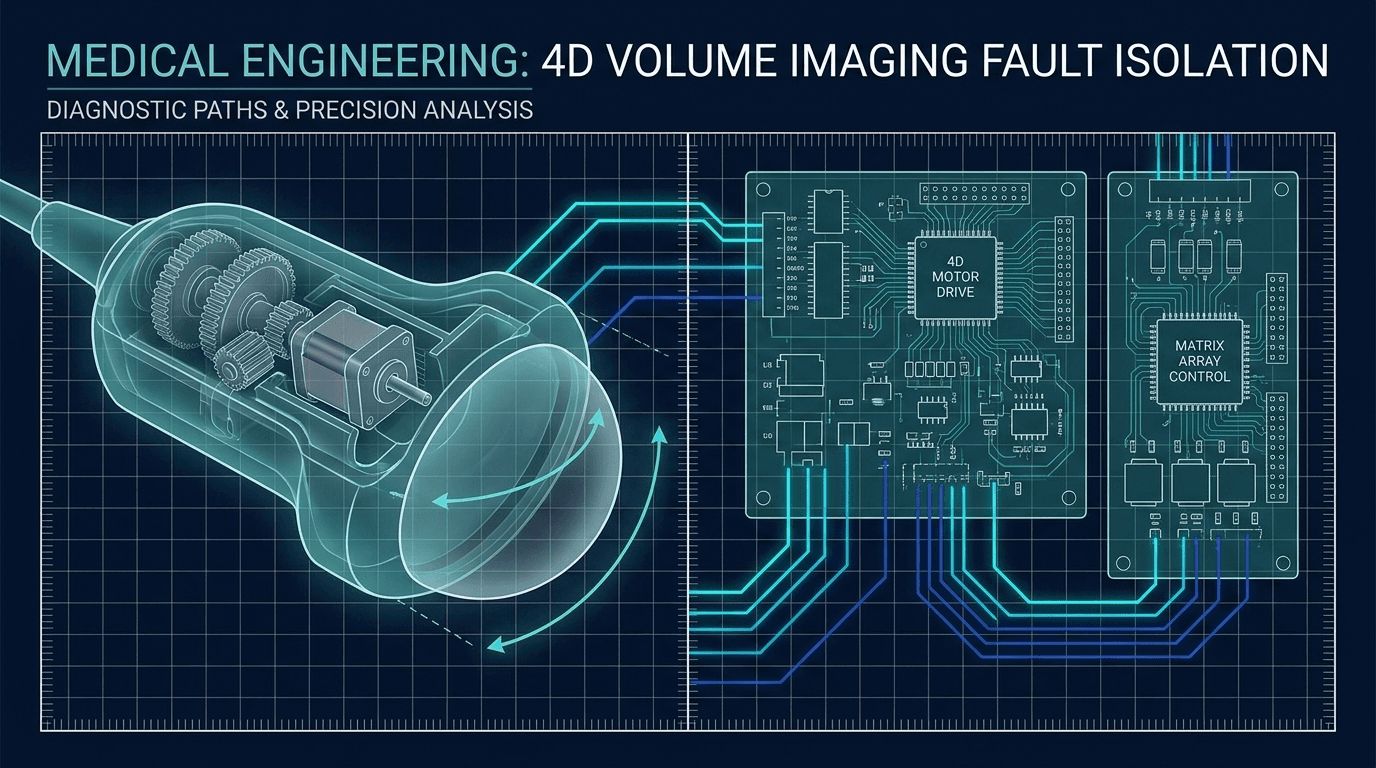
- Why 2D-Good / 4D-Dead Is Three Products, Not One '4D Probe' Repair
- Mechanical Volume Probes (RAB, RIC, C7F2, 7CF2, 3D9-3v): Internals and Why They Fail
- Console 4D Motor/Drive Boards: Siemens, GE, Mindray, and Philips Part Number Registry
- Electronic Matrix / e4D (eM6C, xMATRIX, RTF441 KTZ304082) Has No Sweep Motor
- The Clinical Isolation Order: 2D Baseline, Second Volume Probe, Console Label Verification
- FDA Rule-Outs: 3D9-3v Bonding, Useful-Life Recalls, and RIC5-9-D Misalignment Actions
- What Bounded MAUDE Narratives Actually Show (Oil, Vibration, Housing Splits)
- Repair the Identified Probe, Repair the Identified Board, or Hard-Stop
- Where Rongtao Fits — and Where It Does Not
- Quote-Ready Handoff: Information and Photos Required for Immediate Diagnosis
- Frequently Asked Questions
Why 2D-Good / 4D-Dead Is Three Products, Not One '4D Probe' Repair
In clinical ultrasound maintenance, few complaints generate more wasted expenditure than the generic service ticket: '4D volume mode not working — need 4D probe repair.' Clinical engineering teams and independent service organizations (ISOs) frequently rush to send expensive volumetric transducers out for rebuild or purchase replacement probes, only to discover that the replacement probe exhibits the exact same motionless failure upon delivery. Alternatively, purchasing departments order a console 4D motor drive board based solely on a marketplace product title, only to realize the scanner utilizes an electronic matrix transducer without any motorized drive circuitry whatsoever.
To resolve volume acquisition failures systematically and cost-effectively, service engineers must recognize that a failure where 2D B-mode is fully functional but 4D volume acquisition stalls, halts, or errors involves three completely distinct technical domains across modern ultrasound platforms:
- Mechanical Volume Transducers (Wobbler / Motorized Probes): Transducers such as the GE RAB2-5-D, RAB6-D, RIC5-9-D, Siemens C7F2, 7CF2, and Philips 3D9-3v incorporate a conventional 1D curved or linear array mounted on a mechanical pivot assembly. This array is physically swept back and forth through an internal acoustic coupling oil bath by an integrated micro-stepper or DC motor, monitored by optical or magnetic position encoders 7.
- Console 4D Motor Drive Printed Circuit Boards (PCBs): Dedicated hardware modules housed inside the scanner card cage—such as the Siemens Acuson X300 4D board 10348307 / 10348440, GE LOGIQ S7 DC4D board (
5372959), GE LOGIQ P5/P6 4D driving module SP00773, Mindray DC-70 4D motor board 051-001467-01, or legacy Philips EPIQ 5 4D motor control (453561471812). These are the console-side motor-control path for mechanical volume probes; they are not interchangeable across OEM families 4, 5. - Electronic Matrix / Electronic 4D (e4D) Arrays: Solid-state transducers such as the GE eM6C or Philips xMATRIX models (for example X5-1, X6-1) steer beams electronically and have no 4D sweep motor, drive belt, or oil bladder. TEE xMATRIX probes such as X7-2t still have a separate articulation mechanism, which is not this article's motor class. On Voluson E10, electronic 4D / matrix control is documented as
RTF441-EC320(KTZ304082), not a mechanical 4D motor board 5.
When search engines or commercial repair funnels aggregate all volume imaging issues under 'ultrasound 4D probe motor repair', they mislead service engineers into treating the transducer as the sole point of failure 6. Navigating this decision path requires isolating the signal chain: starting with the 2D acoustic baseline, executing a structured second-probe swap test, verifying exact console board part numbers, and ruling out critical FDA recalls before authorizing component-level repair or replacement.
Mechanical Volume Probes (RAB, RIC, C7F2, 7CF2, 3D9-3v): Internals and Why They Fail
Mechanical 3D/4D transducers are among the most complex electro-mechanical devices in diagnostic imaging. Underneath the external plastic housing and acoustic dome (the thin, curved acoustic window at the probe tip), the transducer contains a sealed fluid chamber filled with acoustic coupling fluid. A public mechanical-3D service description matches what Rongtao family reports already document for RAB/RIC and C7F2-class probes: the array is mounted on a pivoting assembly, a motor oscillates it, sensors report speed and position, and the moving half of the mechanism sits in an oil-filled bladder under a rubber dome 7, 5. Exact sweep angle and frame rate are probe- and preset-specific; do not treat one vendor's numbers as a universal specification.
The mechanical subsystem relies on five critical internal components:
- Micro-Actuator (Stepper or Coreless DC Motor): Drives the rocking or sweeping carriage via precision miniature gearboxes or direct-drive linkages.
- Position & Home Encoders: Optical interrupters, reflective discs, or magnetic Hall-effect sensors that detect the mechanical home position and provide sub-millimeter angular feedback during high-speed sweeping.
- Dynamic Flexible Printed Circuit (FPC) Ribbon: A multi-layer flexible cable that continuously flexes millions of cycles, transferring hundreds of high-voltage coaxial signals from the moving acoustic array to the stationary probe handle PCB.
- Acoustic Fluid Expansion Bladder: A compliant elastomeric membrane that accommodates thermal expansion and contraction of the acoustic coupling oil as the internal motor and transducer elements warm during clinical operation.
- Acoustic Dome Seal: A high-tolerance chemical and mechanical seal bonding the acoustically matched dome to the probe housing, preventing fluid escape and blocking atmospheric air ingress.
Because these transducers combine continuous mechanical motion with fluid submersion, they exhibit failure modes entirely absent in conventional 2D probes. Peer-reviewed quality control surveys establish that ultrasound transducers account for the vast majority of physical hardware failures in active hospital service. In a landmark 4-year Mayo Clinic clinical QC program evaluating multi-brand fleets, Hangiandreou et al. (2011) documented that 88.2% of all clinical ultrasound QC failures were transducer-related. Similarly, a UK multicentre survey by Dudley and Woolley (2016, PMC5098704) revealed that a substantial proportion of clinical probes in daily hospital use suffer from undetected acoustic array, cable, or lens damage 8.
| Clinical & Diagnostic Symptom | Probable Internal Transducer Defect | Diagnostic Error Code / Observation | Clinical Safety & Action Gate |
|---|---|---|---|
| Audible grinding, buzzing, or high-pitch whine during 4D sweep | Worn gearbox, dry motor bearings, or mechanical binding of array pivot carriage | Cart reports sweep stall or high motor current draw; 2D image remains normal | Hard-stop acquisition immediately to prevent motor burnout or gear stripping; route to probe lab |
| Cart halts immediately upon 4D start with initialization error | Failed home sensor, dirty optical encoder disc, or severed motor power wire in cable | GE: 'MotCntl: No Reference Position Signal'; Philips: 'Error 30' or 'Motor Init Failed' | Perform 2-probe swap test; if specific to one probe, route for encoder/motor rebuild |
| Black, moving circular voids/shadows sweeping across 3D rendering | Air bubbles inside acoustic dome due to fluid loss or expansion bladder micro-tear | Bubble visible through translucent dome when probe is tilted; shadows move with gravity | Immediate clinical stop; fluid cavitation and acoustic defocusing degrade diagnostic validity |
| Oily residue on probe handle or leaking from dome seam after reprocessing | Ruptured acoustic dome seal, failed expansion bladder, or chemical degradation from HLD | Acoustic coupling fluid leakage; fluid presence inside endocavity sheath or storage cup | CRITICAL SAFETY STOP: Take out of service. Fluid loss causes array overheating and electrical breakdown |
| Vertical black dropouts across both 2D and 4D imaging modes | Cracked piezoelectric crystals, delaminated lens, or broken coaxial wires in main cable | Stationary vertical dead element bands present regardless of whether sweep motor runs | Front-end / acoustic array defect; evaluate probe repair vs replacement via probe acceptance testing |
Field Precaution on Transducer Dome Pressure: Certain commercial troubleshooting guides suggest pressing firmly on the acoustic dome with the palm of the hand to verify fluid bladder integrity or array movement. Never perform manual pressure tests on acoustic domes. Applying external pressure risks rupturing delicate dome bonding seals, dislodging internal alignment stops, or forcing micro-bubbles across the acoustic aperture. Verify transducer function strictly through non-contact acoustic scanning in water/gel phantoms and non-energized mechanical inspection.— Rongtao Medical editorial safety note; do not republish competitor dome-pressure field tests as procedures
Console 4D Motor/Drive Boards: Siemens, GE, Mindray, and Philips Part Number Registry
When a mechanical volume transducer is connected to an ultrasound console, the internal motor does not run on its own. A dedicated console 4D motor-control PCB supplies drive current, reads position sensors, and keeps the sweep in step with imaging. A published mechanical-3D service page states that scanners usually include that dedicated motor-control board, but it lists no part numbers 7. The registry below is the missing PN layer, drawn from catalog, inventory, and published family archives 4, 5.
When that console board, its power rails, or the probe connector path fails, the cart can look exactly like a dead probe motor: 2D imaging still works on standard probes, but every connected mechanical volume transducer stays motionless and throws a motor-initialization or communication error in 3D/4D 5. That is why the second-probe test comes before any board order. The registry below is limited to part numbers verified in catalog, inventory, or published family archives; it is not a cross-brand interchange table.
| OEM & Model Family | Assembly / Board Designation | Verified Part Number(s) | Source Lineage & Ground Truth | Technical Scope & Architecture Notes |
|---|---|---|---|---|
| Siemens Acuson X300 / X150 | X300 4D Motor Control Board | 10348307 / 10348440 | Catalog SKU x300-4d-board-10348307-10348440; X300/X150 family report | Documented 4D-drive path for C7F2 / 7CF2-class mechanical volume probes on this family. 10348307 and 10348440 are variants in circulation, not a proven silent interchange; match the board label before ordering. |
| GE LOGIQ S7 | DC4D (4D Driving Board) | 5372959 | Inventory row 5372959 (90-day warranty field); LOGIQ S7/S8 family report | Inventory label is LOGIQ S7. The family report documents this as the 4D motor-drive path on the S7/S8 platform. Match the etched label. Exclude beamformer BF64D (5728958/5728961). |
| GE LOGIQ P5 / P6 | 4D Driving Module | SP00773 | Catalog SKU p5-p6-4d-driving-module-sp00773 (photo-backed label) | Photo-backed catalog row for LOGIQ P5/P6 4D driving module SP00773. Match the physical label; do not assume interchange with DC4D 5372959 or with Voluson matrix-control boards. |
| Mindray DC-70 | DC-70 4D Motor Drive Board | 051-001467-01 | Catalog SKU dc-70-4d-motor-board-051-001467-01; Mindray DC/Resona family report | Catalog and family report document this PN on DC-70. Do not treat it as a DC-8, DC-80, or Resona interchange part without a matching board label. |
| Philips EPIQ 5 | 4D Motor Control Board (legacy archive) | 453561471812 | Legacy technical archive; EPIQ/iU22/iE33 family report | Documented EPIQ 5 12NC for mechanical volume transducers (for example 3D9-3v). Not a 2026-08-27 catalog photo SKU, and not an interchange license for iU22, iE33, or xMATRIX controllers. |
| GE Voluson E10 (electronic 4D / probe control) | RTF441-EC320 Probe Control Board | KTZ304082 | Voluson E10 family report; legacy archive spec body | Documented e4D / matrix probe-control path for eM6C-class probes. This is not a Siemens- or LOGIQ-style mechanical 4D motor board. Do not order 10348307, DC4D, or SP00773 to replace it. |
View chart data
| Category | Documented mechanical 4D drive PNs |
|---|---|
| X300 10348307/440 | 2 |
| S7 DC4D 5372959 | 1 |
| P5/P6 SP00773 | 1 |
| DC-70 051-001467-01 | 1 |
| EPIQ 5 453561471812 | 1 |
Count of mechanical 4D motor/drive part numbers verified in the August 2026 Rongtao catalog, inventory, or EPIQ 5 legacy archive. Electronic matrix controllers such as Voluson E10 RTF441 KTZ304082 are excluded because they are not sweep-motor boards.
Source: Rongtao Medical catalog and inventory snapshot plus published EPIQ 5 archive (August 2026)
Critical Part-Number Exclusion Rule: On GE Voluson S6, S8, and related LOGIQ labels, part numbers 5728958 and 5728961 are designated BF64D. Despite the '4D' characters in the suffix, these boards are 64-channel front-end beamformer cards responsible for acoustic transmit/receive processing, not 4D sweep motor controllers 4. Ordering a BF64D board to resolve a motionless probe motor or motor-control error code will not restore volume sweep. Live catalog rows for photo-backed 4D motor/drive SKUs also sit in the probe, 4D motor, transducer and accessory hub; stock turns, so confirm availability on the live catalog or a quote.
Electronic Matrix / e4D (eM6C, xMATRIX, RTF441 KTZ304082) Has No Sweep Motor
A major source of confusion in modern multi-brand ultrasound fleets is the distinction between mechanical 4D volume probes and solid-state electronic matrix array transducers (frequently designated as e4D, Matrix 4D, or xMATRIX) 5, 7. Premium ultrasound platforms have increasingly adopted 2D planar matrix arrays that steer sound beams electronically in three dimensions without any physical transducer movement.
- GE Healthcare eM6C: An electronic curved matrix array transducer used on high-end Voluson systems such as the Voluson E10. Volume rendering is steered electronically. Console-side control on that platform is documented as
RTF441-EC320(KTZ304082), not a mechanical 4D motor board. The probe has no sweep motor, gearbox, or oil bladder. - Philips xMATRIX series (for example X5-1, X6-1): Solid-state matrix transducers with handle electronics and a static imaging aperture during multi-plane or 4D rendering. TEE xMATRIX models such as X7-2t still have a separate articulation motor; that motor is not a 4D sweep mechanism and is out of scope here.
When an electronic matrix transducer fails, its symptoms differ fundamentally from a mechanical probe. It will never grind, click, buzz, or develop air bubble voids. Instead, matrix transducer failures manifest as:
- Dense patchy or wedge-shaped image dropouts: Failed handle electronics or fractured cable conductors can drop out regions of the matrix without any grinding or oil-bubble signature.
- Handle overheating warnings: Some matrix probes thermally protect handle electronics; treat this as a probe/cable/controller path, not a mechanical motor rebuild.
- Console communication lockups: High-speed digital errors between the probe and the console matrix/probe-control board (for example Voluson E10
RTF441) can present as volume-mode dropout with working 2D on standard probes.
Routing an eM6C or xMATRIX probe to a mechanical 4D repair shop for 'motor rebuild' or ordering a Siemens X300 10348307 or GE DC4D 5372959 board to fix a matrix initialization failure represents a costly logistical misroute. Always confirm the transducer architecture before initiating service.
The Clinical Isolation Order: 2D Baseline, Second Volume Probe, Console Label Verification
To prevent unnecessary probe replacements or improper board purchases, clinical engineering teams should execute a rigorous five-step isolation workflow whenever 4D volume imaging becomes unavailable:
The 5-Step Diagnostic Protocol for 4D Volume Failures
- Step 1: Establish 2D B-Mode Acoustic Baseline on the Suspect Probe. Connect the suspect volume probe, select a standard 2D clinical preset (e.g., Routine OB or Abdomen), and scan an acoustic tissue phantom or air-reverberation field. If 2D B-mode produces clean, uniform echo texture across all acoustic channels without vertical dropouts, the probe acoustic elements, coaxial wiring, and the console main front-end beamformer cards are functional. If 2D B-mode is also completely dead or distorted, troubleshoot the acoustic front-end before suspecting 4D motor circuits.
- Step 2: Initialize Volume Mode and Record Exact Error Strings. Switch to 3D/4D acquisition mode. Listen closely to the probe handle. Does the internal motor attempt an initial home-position calibration sweep? Note the exact on-screen prompt. Errors such as GE
'MotCntl: No Reference Position Signal'or Philips'Error 30'confirm that the scanner cannot read the optical home sensor or position encoder 7. - Step 3: Execute the Known-Good Second Volume Probe Swap Test. Connect a second, known-functional mechanical volume probe of the same model family to the same console port (or an adjacent active port).
• Outcome A (Second probe sweeps normally): The console 4D motor drive path is working for that probe class. The failure is isolated to the first transducer (motor, encoder, flex, dome, or oil system).
• Outcome B (Second probe also remains completely motionless): Identical simultaneous motor failure in two probes is unlikely. Isolate the console 4D motor drive board (for example X30010348307, LOGIQ S75372959, DC-70051-001467-01), its power rails, or the transducer connector — then photograph labels before ordering.
• Outcome C (Electronic matrix / e4D): If an eM6C or xMATRIX probe fails, do not send it for mechanical motor rebuild and do not order an X300 or DC4D board. Use a second matrix probe of the same class, then inspect cable/connector and the documented matrix/probe-control path (for exampleRTF441-EC320 KTZ304082on Voluson E10). - Step 4: Physical and Fluid Integrity Inspection. Visually inspect the mechanical probe under bright magnification. Check the acoustic dome seam for fluid weeping, oil smell, cracks, or air bubble shadows under the lens. Check the strain relief for twisting or pinched internal motor control lines.
- Step 5: Photograph Console Board Labels and Transducer Serial Plates. Before placing an order for replacement parts or scheduling board repair, take high-resolution photographs of both sides of the suspect console board, capturing the exact etched OEM part number, hardware revision barcode, and FPGA firmware labels. For probes, capture the connector serial plate and dome condition.
FDA Rule-Outs: 3D9-3v Bonding, Useful-Life Recalls, and RIC5-9-D Misalignment Actions
Before condemning physical hardware or assuming unrepairable internal failure, clinical engineers must cross-reference active regulatory enforcement databases. Diagnostic ultrasound transducers are regulated by the U.S. FDA as Class II medical devices under product code ITX (21 CFR 892.1570) 1. Volumetric transducers and motor drive boards are cleared as specialized accessories under host system 510(k) clearances 1.
Analysis of FDA recall and enforcement records (recomputed August 2026 across 58,785 recall rows and 39,539 enforcement rows) reveals several high-profile regulatory actions involving mechanical volume transducers that clinical engineers must distinguish from routine board or motor wear 2:
| FDA Action / Recall Number | Classification & Status | Target Transducer & Host Systems | Root Cause & Official Description | Clinical Engineering & Service Rule-Out |
|---|---|---|---|---|
| FDA Recall Z-2517-2023 (Event 92761) | Class II / Completed (Initiated 2023-06-30) | Philips 3D9-3v Compact / 3D9-3v transducer (hosts listed on the recall page include EPIQ Elite, Affiniti 30/50/70, ClearVue 850, HD15, iU22, Compact 5000) | Two bonded parts of the transducer may come apart due to a chassis-bonding issue, with risk to users and patients | Probe-housing rule-out. This is not a console 4D-motor-board recall. Loose or separating 3D9-3v housings leave clinical use until qualified probe evaluation. |
| FDA Recall Z-2048-2025 (Event 96994) | Class II / Ongoing (Initiated 2025-05-28) | Philips 3D9-3v Transvaginal Transducer | Commercial distribution of refurbished transducers that exceeded OEM-defined expected service life specifications | Supplier qualification gate. Confirm refurbishment history and compliance documentation from probe repair vendors. |
| FDA Recall Z-2347-2025 (Event 97217) | Class III / Ongoing (Initiated 2025-07-03) | Philips 3D9-3v Transvaginal Transducer | Clarification and updating of customer-facing product labelling regarding expected operational service life | Labelling correction. Does not mandate immediate fleet decommissioning of functional, passing 3D9-3v transducers. |
| FDA Recalls Z-1964-2019 & Z-1965-2019 | Class II / Terminated (Initiated 2019-07-02) | GE Healthcare RIC5-9-D (Refurbished) and RIC5-9A-RS (Repaired) | Potential for mechanical transducer array mis-alignment in certain refurbished transvaginal real-time 4D probes | Acoustic calibration and supplier-qualification gate for refurbished/repaired endocavity 4D probes. Demand alignment evidence from any probe shop; this is not proof that all independent 4D repair is unsafe. See qualifying a probe-repair provider. |
Regulatory Context on Transducer Useful Life: In FDA Warning Letter 709948 issued to Royal Philips (Reedsville transducer facility, 9 September 2025), the agency cited internal manufacturer documentation titled 'Expected Service Life of Ultrasound Transducers' concluding a 3-year useful life for transducers including endocavity model 3D9-3v and TEE model S7-3t 9. That finding is context for Z-2048-2025 and Z-2347-2025. It is a manufacturer compliance finding about refurbishment and labelling—not an FDA mandate that healthcare facilities or independent servicers scrap every functioning 3D9-3v at year three. Serial-specific recall checks still apply; return to clinical use only after qualified integrity and electrical-safety testing 9.
What Bounded MAUDE Narratives Actually Show (Oil, Vibration, Housing Splits)
To understand how volumetric transducers fail in live hospital environments, clinical engineers often review the FDA Manufacturer and User Facility Device Experience (MAUDE) database 3. However, analyzing MAUDE data requires strict methodological discipline:
FDA Passive Surveillance Disclaimer: MAUDE records are voluntary and mandatory reports of suspected device-associated malfunctions, serious injuries, or deaths. MAUDE data cannot be used to evaluate device failure rates, clinical incidence, or comparative safety between manufacturers, because reports lack clinical denominators (total scans performed), undergo unverified reporting, and reflect voluntary reporting biases.— U.S. Food and Drug Administration CDRH (2026)
Furthermore, searching openFDA records without strict query boundaries generates massive false-positive noise. For example, an unquoted substring query for RAB6-D returns 17,783 irrelevant rows across unrelated medical devices. A rigorous, bounded query executed against exact model numbers and brand names (reviewed August 2026, openFDA dataset updated through August 18, 2026) reveals calibrated, highly informative narratives 3:
- GE RAB6-D (Quoted Model Query:
meta.total = 1, Report 14914524): Report documents severe buzzing and physical vibration during 4D OB acquisition. The technician swapped the probe to another console port with no change, but connecting a replacement RAB6-D restored smooth, silent scanning. The console 4D drive board was fully functional; the internal probe motor drive gears had worn out 3. - GE RAB4-8-D (Quoted Model Query:
meta.total = 1, Report 8020021-2016-00001): Report coded under 'Injury' describes a sonographer sustaining ergonomic wrist/shoulder strain from the physical weight of the heavy volumetric probe. This is an ergonomic incident, not an electro-mechanical motor or board failure 3. - GE RIC5-9-D (Quoted Model Query:
meta.total = 3):
• Report 5187497 (Oil Leak After Automated HLD): Transvaginal 4D probe leaked acoustic coupling oil from the dome seal immediately following an automated hydrogen peroxide mist high-level disinfection (HLD) cycle in a Trophon unit. Repeated chemical exposure compromised the elastomeric dome adhesive 3.
• Report 6205091 (Housing Separation): The external plastic shell of the transvaginal 4D probe separated inside the protective probe sheath during an endocavity procedure. Housing adhesive bond failure 3.
• Report 7240498 (Uncontrolled Motor Vibration): Motor exhibited uncontrolled shuddering and high heat during clinical pelvic scanning, requiring immediate shutdown 3. - Philips 3D9-3v (Quoted Brand Name Query:
meta.total = 1, Report 18064221): Report documents a 3D9-3v endocavity probe whose structural handle broke in half during clinical use. The facility reporter explicitly noted that the probe serial number was not included in previous recall notification batches 3. - Electronic matrix eM6C and quoted RAB2-5-D: Quoted model queries returned
NOT_FOUNDunder those exact parameters. That is a search-boundary result, not evidence that matrix arrays or convex volume probes are more stable, safer, or less failure-prone. Do not treat a zero hit as an incidence rate 3.
These authentic narratives underscore that fluid leaks occurring after automated disinfection (e.g., Trophon HLD cycles) represent chemical degradation of dome adhesives (see probe HLD guidelines). They are structural probe integrity failures that must never be misdiagnosed as console 4D motor board faults.
Repair the Identified Probe, Repair the Identified Board, or Hard-Stop
Once the structured isolation workflow determines whether the fault resides in the transducer, the console board, or the electronic matrix controller, clinical engineering managers must select the appropriate remediation pathway 4, 5:
| Isolated Fault Domain | Recommended Technical Action | Turnaround & Service Standards | Mandatory Verification & Safety Gate |
|---|---|---|---|
| Mechanical Volume Probe (Motor / Encoder / Dome / Oil) | Qualified probe lab rebuild when the swap-test isolates the transducer: motor/encoder, flex, dome, and sealed fluid system as required. Do not attempt hospital-bench oil refill. | Quoted per probe model; specialized tooling required | Post-repair physical inspection, acoustic checks, and electrical-safety testing before return to clinical use (acceptance protocol). Economics after isolation: repair versus replace. |
| Console 4D motor drive PCB (labelled 4D drive / DC4D / 4D motor board) | Component-level circuit board repair of the labelled 4D drive assembly, or a tested replacement that matches the exact part number | Standard 5-8 business-day board-repair turnaround; typically 90-day warranty; final terms confirmed at quote | 48-hour real-machine testing inside an actual ultrasound system (evidence pack) |
| Electronic Matrix e4D Array (eM6C / xMATRIX / RTF441) | Second-probe test, then inspect cable/connector and the documented matrix/probe-control board (for example KTZ304082 on Voluson E10). Do not route to a mechanical 4D motor shop. | Board repair or replacement quoted after label match; probe work quoted per probe | Confirm architecture (mechanical vs matrix) before any order; uniformity and thermal warnings stay on the identified assembly |
| Acoustic Fluid Leakage / Dome Seam Rupture | IMMEDIATE CLINICAL HARD-STOP. Remove probe from service immediately; do not energize | Decontaminate according to OEM IFU; quarantine for laboratory evaluation | Fluid loss causes electrical insulation breakdown and array overheating. Never attempt DIY syringe fluid injection |
| Separated Endocavity Housing / Structural Shell Crack | IMMEDIATE CLINICAL HARD-STOP. Decommission probe immediately | Quarantine; do not use protective sheaths as a workaround | Severe cross-contamination and mucosal trauma risks. Probe must be rebuilt or replaced by qualified facility |
Where Rongtao Fits — and Where It Does Not
Selecting an independent service and parts partner requires complete transparency regarding technical capabilities, testing infrastructure, and operational boundaries 4, 5:
Where Rongtao Fits
- Component-Level Ultrasound Board Repair: Rongtao repairs multi-brand ultrasound circuit boards—including 4D motor drive boards, power supplies, beamformers, and back-end processors—at the discrete component level (replacing driver ICs, MOSFETs, and surface-mount components rather than scrapping whole assemblies).
- 48-hour real-machine testing: Every repaired board runs for 48 hours inside an actual ultrasound system before release 4.
- Rigorous Service Terms: Standard 5 to 8 business-day board repair turnaround with typically a 90-day warranty. Final terms depend on item condition and are confirmed upon quote review.
- Verified 4D drive rows: Photo-backed catalog SKUs for Siemens X300 10348307/10348440, GE LOGIQ P5/P6 SP00773, and Mindray DC-70 051-001467-01, plus a LOGIQ S7 DC4D 5372959 inventory row. Philips EPIQ 5 453561471812 is a legacy archive PN, not a current catalog photo SKU. Stock turns; confirm live availability via catalog or quote.
- Qualified volumetric probe repair: Evaluation and repair of mechanical 3D/4D probes, quoted per probe, after the swap-test isolates the transducer. Leaking or split endocavity housings are hard-stops until qualified sealing and electrical-safety checks.
Where Rongtao Does Not Fit
- No DIY Repair Supplies: Rongtao does not sell loose acoustic mineral oil, syringe refill kits, or unverified dome adhesives for hospital-bench repairs.
- No OEM Affiliation Claims: Rongtao Medical is an independent service organization and ISO 13485:2016 certified facility. Rongtao is not an authorized distributor or affiliate of GE HealthCare, Siemens Healthineers, Philips, or Mindray. All OEM trademarks are used strictly for part identification and compatibility.
- No Field Workarounds for Broken Housings: Rongtao does not recommend patching split transvaginal probe housings with silicone or tape; compromised endocavity devices must undergo complete structural shell replacement.
Quote-Ready Handoff: Information and Photos Required for Immediate Diagnosis
To receive an immediate, accurate diagnostic evaluation and quotation for a 4D volume imaging failure, provide the following data packet to the engineering team via our technical contact desk:
- Console Identification: System make, model, and software/system revision (e.g., Siemens Acuson X300 Release 7.0, GE LOGIQ S7 Expert R2, or Philips EPIQ 7 Release 4.0).
- Transducer Model & Serial Number: Exact probe label text and connector plate photo (e.g., GE RAB6-D, Siemens C7F2, Philips 3D9-3v, or GE eM6C).
- Transducer Architecture: Specify whether the connected probe is a mechanical sweep probe or an electronic matrix array.
- 2D B-Mode Baseline Status: Confirm whether 2D B-mode produces a clean acoustic image on the suspect probe (Yes / No / Describe dropouts).
- Second Volume Probe Swap Result: Did a second volume probe operate normally on the same console port? (Yes / No / Second probe not available).
- On-Screen Error Codes: Exact text or screenshot of any diagnostic prompts (e.g.,
'MotCntl: No Reference Position Signal'or'Philips Error 30'). - High-Resolution Photographs:
• Clear photo of both sides of the suspect console 4D board showing etched part numbers, barcodes, and board revisions.
• Close-up photo of the probe acoustic dome, lens seam, and cable strain relief. - Logistics & Destination: Required quantity, facility location/postal code, and urgency level.
Frequently Asked Questions
My 2D image is fine but 4D will not start — should I replace the 4D motor board first?
No. In many 2D-good / 4D-dead tickets the fault is inside the mechanical volume transducer (motor, home sensor, flex, dome, or oil system). Always perform a swap test with a second known-good volume probe of the same class first. Only if the second mechanical volume probe also fails to sweep or initialize should you condemn the console 4D motor drive board — and then only after matching the exact labelled part number.
Will a Siemens X300 4D board 10348307 work in a LOGIQ S7 DC4D slot or an EPIQ 4D motor slot?
No. A Siemens X300 board (10348307 / 10348440) is not a LOGIQ S7 DC4D (5372959) and is not a Philips EPIQ 5 12NC (453561471812). Match the exact etched part number from the board in the cart. Marketplace titles that say only '4D motor' are not a compatibility license.
Is an eM6C or Philips X5-1 matrix probe the same repair as a GE RAB mechanical 4D probe?
No. The GE eM6C and Philips xMATRIX series (for example X5-1) are electronic matrix arrays. They have no 4D sweep motor, gearbox, or oil bladder. Do not send them to a mechanical 4D motor shop. TEE xMATRIX models still have a separate articulation mechanism covered in the TEE probe damage route. Console-side matrix/probe control on Voluson E10 is documented as RTF441-EC320 KTZ304082, which is not an X300 or DC4D substitute.
Does the Philips 3-year transducer useful-life warning letter mean I must scrap my 3D9-3v?
No. FDA Warning Letter 709948 cites an internal Philips document on expected transducer service life in a refurbishment-and-labelling context. It is not a regulation that independent servicers or hospitals must scrap every functional 3D9-3v at year three. Keep serial-specific recall checks (Z-2048-2025, Z-2347-2025, Z-2517-2023) separate from a blanket scrap rule, and return a probe to clinical use only after qualified integrity and electrical-safety testing.
The volume probe leaked oil after automated HLD — is that a console board issue?
No. An acoustic fluid leak is a transducer integrity failure, not a console 4D-drive symptom. Repeated disinfection can degrade dome seals; a leaking volume or endocavity probe must leave clinical use until a qualified laboratory evaluates sealing and electrical safety. Do not inject fluid on the hospital bench. See probe high-level disinfection and integrity stops.
What photos and information should I send to get a 4D probe or 4D motor-board quote?
Please provide the ultrasound system model and software version, probe model number, on-screen error text, results of the 2D baseline and second-probe swap tests, and clear high-resolution photos of both sides of the console board (showing OEM part number labels) or probe connector plate. Submit these details directly through our technical quote desk.